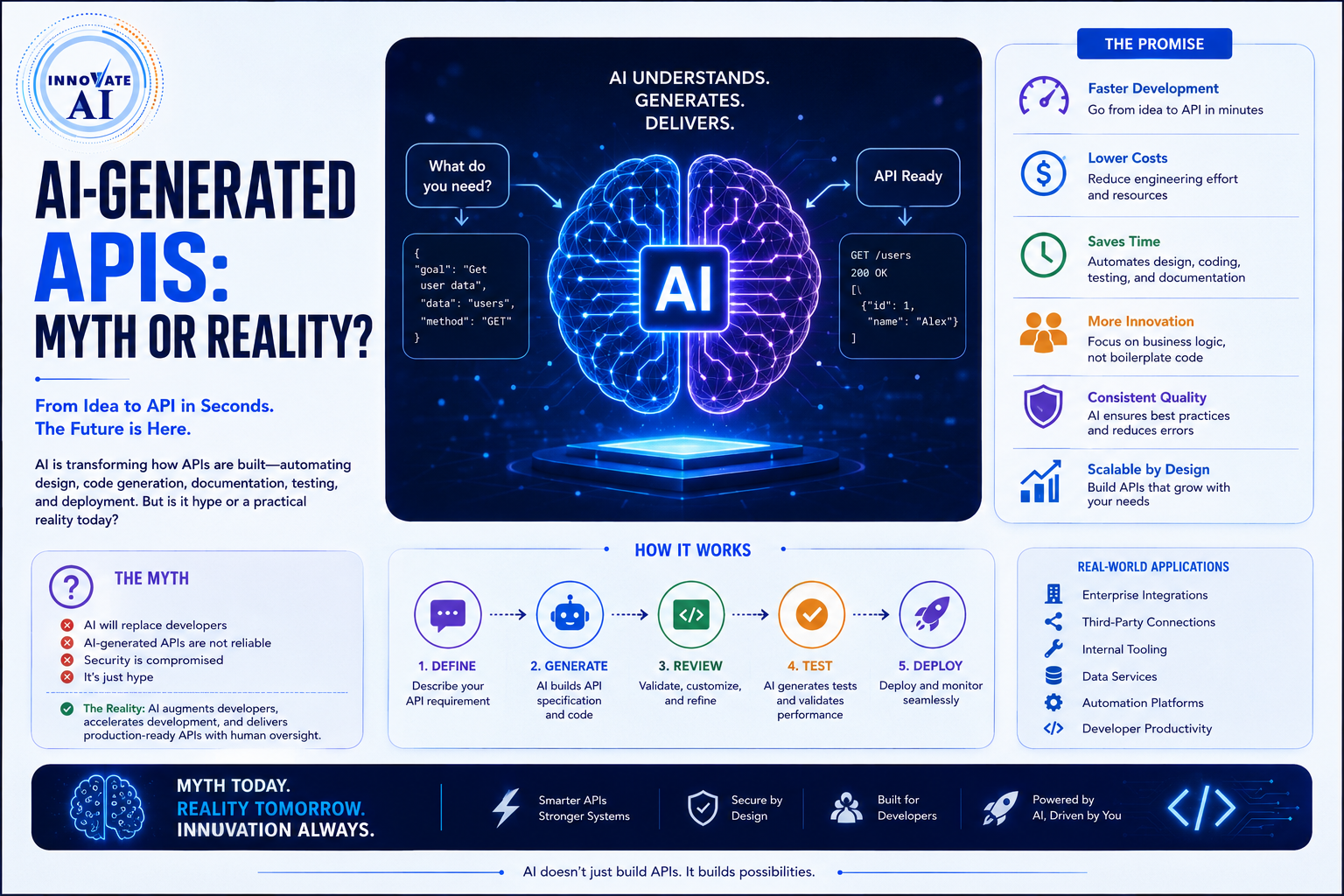
The Big Question
What if you could describe an API in plain English—"Create a REST API for managing customer orders with authentication, pagination, and webhook notifications"—and watch as AI generates the complete specification, code, and deployment configuration in seconds?
And what if the same AI could integrate that API with your existing systems, generate tests, and even discover and consume third-party APIs autonomously?
This is the promise of AI-generated APIs. And it's already here.
The Reality: AI API Generation Is Here
Enterprise-Grade Solutions from IBM
IBM's API Agent, available in IBM API Connect Enterprise as a Service, enables developers and technical users to "create APIs through a chat-based interface, allowing them to define, design, and deploy APIs using natural, conversational interactions" .
The agentic framework powers several critical tools:
-
OpenAPI Generator: Creates OpenAPI specifications from a natural language description. "The user provides a prompt to the API Agent, describing the intended functionality of the application. Based on this prompt, the API Agent generates an OpenAPI specification that represents the described API" .
-
OpenAPI Enhancer: Upgrades or modifies existing OpenAPI files with enhanced descriptions and examples, automatically rectifying validation problems or errors.
-
OpenAPI Python Generator: Generates boilerplate or custom code from OpenAPI specifications using the FastAPI framework.
-
API Governance: Provides access to key API governance capabilities—listing rulesets, validating OpenAPI documents, and fixing them with supported rulesets.
Open-Source Tools Accelerating Adoption
MockGen is an open-source tool that "uses Large Language Models (LLMs) to generate fully functional mock APIs from a simple text description. It instantly creates schemas and deploys live endpoints for both REST (OpenAPI) and GraphQL" .
The vision is ambitious: "truly intelligent, stateful mock servers for developers who need to simulate a backend that doesn't exist yet." Powered by OpenAI's GPT or Google's Gemini, MockGen is Docker-ready and designed for CI/CD integration.
AI-AUTO-API-GENERATOR is another open-source implementation that lets users "generate, manage, and export backend APIs using OpenAI + Node.js + MongoDB." It provides a UI to generate APIs from prompts, manage them in a workspace, track generation history, and export code .
The tool supports REST, GraphQL, and Auth APIs with custom options—and already features update, delete, search, and export capabilities.
The Research Frontier: Synthetic Tool Ecosystems
SynthTools: Beyond Individual APIs
A research paper introducing SynthTools demonstrates a "flexible and scalable framework for generating synthetic tool ecosystems" . The framework addresses a critical problem: real-world APIs are limited in availability, domain coverage, and stability, often requiring access keys and rate limits that make them impractical for stable evaluation or scalable training .
SynthTools consists of three core components:
-
Tool Generation: Automatic and scalable creation of diverse tools with rich interfaces and functionalities
-
Tool Simulation: Emulation of realistic tool behaviors—e.g., a flight booking tool should return "no seat available" when fully booked
-
Tool Audit: Ensures correctness and consistency of tool simulation, achieving 94% accuracy in faithfully emulating tool responses and 99% accuracy in identifying incorrect behaviors
The framework can "readily produce toolsets that exceed all prior works by more than 2× in both the number of fields and the number of tools per field" while covering richer domains like Financial Trading and Transportation Logistics .
The Low-Code API Generation Revolution
Academic research confirms a significant shift: "API development is undergoing transformation with the incorporation of large language models (LLMs) such as GPT which makes development faster, simpler, and more cost-effective" .
Researchers have developed AutoAPIEval, a framework for automatically generating Java REST APIs. Their key finding: "Instead of the single LLM prompt used for the models ChatGPT, stepwise prompting and structured planning are more effective at achieving the desired objective" .
Performance metrics—lines of code written and ability to create files—are being used to assess the effectiveness of various LLMs in API generation tasks .
The Shadow Side: When AI-Generated APIs Go Wrong
The Deceptive Shadow API Market
A systematic audit of shadow APIs—third-party services claiming to provide access to official LLM APIs—reveals alarming deception . Researchers identified 17 shadow APIs utilized in 187 academic papers, with the most popular one reaching 5,966 citations and 58,639 GitHub stars .
The findings are concerning:
-
47.21% performance divergence from official APIs on utility benchmarks
-
45.83% of endpoints failed fingerprint verification, confirming model substitution
-
Accuracy on high-risk medical benchmarks dropped from 83.82% with official APIs to approximately 37.00% across shadow APIs
The "Ghost API" Security Crisis
A more alarming security risk is emerging: AI-generated phantom endpoints . In one documented case, a fintech company discovered attackers had exfiltrated customer data through an API endpoint documented absolutely nowhere. Nobody on the team remembered creating it. After three weeks of investigation, the verdict came in: Copilot had generated it during a late-night coding session .
The numbers are staggering:
-
45% of AI-generated code contains vulnerabilities listed in the OWASP Top 10
-
Java takes the crown with a 72% failure rate
-
AI assistants multiplied vulnerabilities introduced into studied repositories by a factor of 10 in just 6 months
-
Developers who use AI expose their cloud credentials twice as often as those who don't
Traditional security tools see nothing. Static analysis compares your code against documented specs—except phantom APIs don't appear in any spec. API gateways protect registered endpoints but let undeclared routes through without authentication .
The Wrapper Economy Deception
A developer who reverse-engineered 200 funded AI startups found that 73% are running on third-party APIs—primarily OpenAI and Claude wrappers with "extra steps" .
The findings reveal a troubling pattern: companies with $33M valuations operating on $1,200/month in API costs, startups claiming "proprietary deep learning infrastructure" while making constant calls to OpenAI's API, and a $4.3M raise based on promises of building "something fundamentally different"—that was just API orchestration .
API Integration: The Missing Challenge
The 40% Ceiling
While API generation is advancing rapidly, API integration remains a significant challenge. A study benchmarking LLMs in web API integration tasks found that "generating API invocations poses a significant challenge, resulting in hallucinated endpoints, incorrect argument usage, and other errors. None of the evaluated open-source models were able to solve more than 40% of the tasks" .
The unique challenges of web API invocations include:
-
Operations are identified by the combination of a method and a long URL string, not a simple function name
-
Multiple argument lists with complex, nested data types
-
Endpoints are documented externally, limiting accessibility for LLMs
The API Integration Market
Despite these challenges, the market surrounding API integrations is "experiencing explosive growth," with developers leveraging APIs to "rapidly create applications that seamlessly integrate with a wide range of online services" .
The Path Forward: Responsible AI API Generation
What's Working
| Approach | What It Does | Key Result |
|---|---|---|
| IBM API Agent | Creates APIs through chat interface | Production-grade OpenAPI generation |
| MockGen | Generates mock REST/GraphQL APIs | Live, stateful servers from text descriptions |
| SynthTools | Generates synthetic tool ecosystems | 94% simulation accuracy, 99% audit accuracy |
| AutoAPIEval | Generates Java REST APIs | Stepwise prompting outperforms single prompts |
What's Not Working
| Challenge | Impact | Evidence |
|---|---|---|
| Shadow API Deception | Model substitution, 47% performance drops | 45.83% fail fingerprint verification |
| Ghost APIs | Undocumented backdoors, data exfiltration | 45% of AI code has OWASP vulnerabilities |
| Integration Accuracy | Hallucinated endpoints, incorrect arguments | <40% solve rate on API integration tasks |
| Wrapper Deception | Misleading claims, capital misallocation | 73% of AI startups are API wrappers |
Key Principles for Safe Implementation
1. Human-in-the-Loop Review: Never deploy AI-generated APIs without security and documentation review. A 45% vulnerability rate is not acceptable for production .
2. Continuous Verification: Implement model fingerprinting, traffic analysis, and spec-production comparison to detect phantom endpoints .
3. Stepwise Prompting: Research shows structured, stepwise prompting outperforms single prompts for API generation tasks .
4. Transparent Stack: Be honest about your API stack—value lies in integration, UX, and domain expertise, not claiming proprietary AI where none exists .
Implementation Roadmap: The First 90 Days
Phase 1: Foundation (Weeks 1-4)
-
Audit current API development: How many APIs are manually created? What's the development-to-deployment cycle time?
-
Evaluate AI tools: Test IBM API Agent, MockGen, or open-source alternatives on a pilot use case
-
Establish governance: Define security reviews, documentation requirements, and verification processes for AI-generated APIs
-
Set up continuous spec-production comparison to detect phantom endpoints
Phase 2: Pilot (Weeks 5-8)
-
Generate mock APIs for new feature development using tools like MockGen
-
Test API generation for internal APIs with IBM API Agent or similar enterprise tools
-
Implement human review gates for all AI-generated code and specifications
-
Measure impact: Track time saved, quality metrics, and security findings
Phase 3: Scale (Weeks 9-12+)
-
Move to production with AI-generated APIs under controlled conditions
-
Deploy continuous verification to detect model substitution and ghost endpoints
-
Scale to additional API types (REST, GraphQL, Auth)
-
Continuous improvement: Refine prompts, governance, and verification based on learnings
Frequently Asked Questions
Q1: Can AI really generate production-ready APIs?
Yes, but with significant human oversight. IBM's API Agent and tools like MockGen demonstrate production-grade API generation from natural language . However, research shows 45% of AI-generated code contains vulnerabilities—human review is essential .
Q2: What are ghost APIs?
Ghost APIs are undocumented endpoints generated by AI that exist in production but aren't documented, tested, or security-validated. In one case, attackers exfiltrated customer data through an AI-generated phantom endpoint .
Q3: What are shadow APIs?
Shadow APIs are third-party services that claim to provide official LLM access. Research shows 45.83% fail model verification, with performance drops up to 47.21% compared to official APIs .
Q4: What's the difference between AI-generated APIs and API wrappers?
AI-generated APIs are created from scratch using AI. API wrappers are thin layers on top of existing APIs—73% of funded AI startups are wrappers, often misrepresenting their technology stack .
Q5: What's the 40% ceiling?
The 40% ceiling refers to research showing no open-source model can solve more than 40% of API integration tasks—hallucinated endpoints and incorrect arguments remain significant challenges .
Q6: How can Innovative AI Solutions help?
We help organizations design, build, and operationalize AI-generated API strategies—from tool selection and governance frameworks to security verification and implementation roadmaps. Based in Delhi, serving clients across India.
Why Delhi is a Great Hub for AI Development
Delhi is emerging as a significant hub for AI development, backed by concrete government support and infrastructure. The recent Delhi Budget 2026-27 allocated ₹8.20 crore for two Artificial Intelligence centres of excellence (AI-CoEs), functioning as hubs for research, innovation, and startup incubation.
The city's AI infrastructure is expanding rapidly. Under the IndiaAI Mission, more than 38,000 high-end GPUs have been onboarded and are available at approximately ₹65 per hour—roughly one-third of the global average cost.
The government has also announced a ₹350 crore startup policy over five years, aiming to support the emergence of at least 5,000 startups by 2035, with key focus areas including artificial intelligence, machine learning, and automation.
The AI ecosystem in Delhi combines: cost-effective infrastructure, government support, a growing talent pool, and proximity to the country's business decision-makers.
What We Offer at Innovative AI Solutions
After five years of building AI solutions for businesses, we've developed a practical approach that focuses on what actually works:
-
AI-Generated API Strategy: We help you assess your API development and design an AI-powered roadmap
-
Tool Selection: We help you choose between IBM API Agent, MockGen, or custom open-source solutions
-
Security and Governance: We help you implement verification, documentation, and human review processes
-
Ghost API Detection: We help you establish continuous spec-production comparison
-
Integration Pipelines: We help you build robust AI agent-API interaction frameworks
-
Change Management: We help your organization shift from manual to AI-assisted API development
Our approach is built on the reality that AI-generated APIs aren't a myth—but they require careful governance to be production-ready and secure.
Final Thought
AI-generated APIs are very much a reality—from IBM's enterprise-grade API Agent generating OpenAPI specifications through chat , to open-source tools creating live mock servers from text descriptions , to research frameworks generating entire synthetic tool ecosystems . The technology is real, it's working, and it's transforming software development.
But the risks are equally real. Shadow APIs deceive users with model substitution . Phantom endpoints create security backdoors . AI-generated code carries a 45% vulnerability rate . And 73% of AI startups are hiding behind API wrappers while claiming proprietary AI .
The question isn't whether AI-generated APIs are a myth. The question is whether your organization will adopt them responsibly—with security verification, human oversight, and transparent governance.
The technology is here. The path forward is clear. And the organizations that navigate this transition successfully will have a significant competitive advantage.
Contact Us:
Phone: +91 7464 099 059 / +91 9689967356
Email: info@innovativeais.com
Address: Netaji Subhash Place, Pitampura, Delhi – 110034
Website: https://innovativeais.com
About the Author
Abhishek Kumar
Founder & CEO, Innovative AI Solutions
5+ years building AI systems for enterprises. Based in Delhi, serving clients across India.
Hashtags: #AIGeneratedAPIs #APIDevelopment #AIAPIs #GenerativeAI #APIStrategy #SoftwareDevelopment #InnovativeAISolutions
Related services: to apply this in your business, explore our API development and integration and LLM integration.