The Big Question
What's actually holding AI back in 2026?
It's not the models. GPT-5, Claude, Gemini they're all capable of remarkable things. It's not the algorithms. Research breakthroughs happen weekly.
The bottleneck is infrastructure.
Not just "do we have enough GPUs." The question is deeper: Can those GPUs communicate efficiently? Can the data center handle the power density? Can the cooling system keep up? Can the network move data fast enough that chips aren't sitting idle waiting for information?
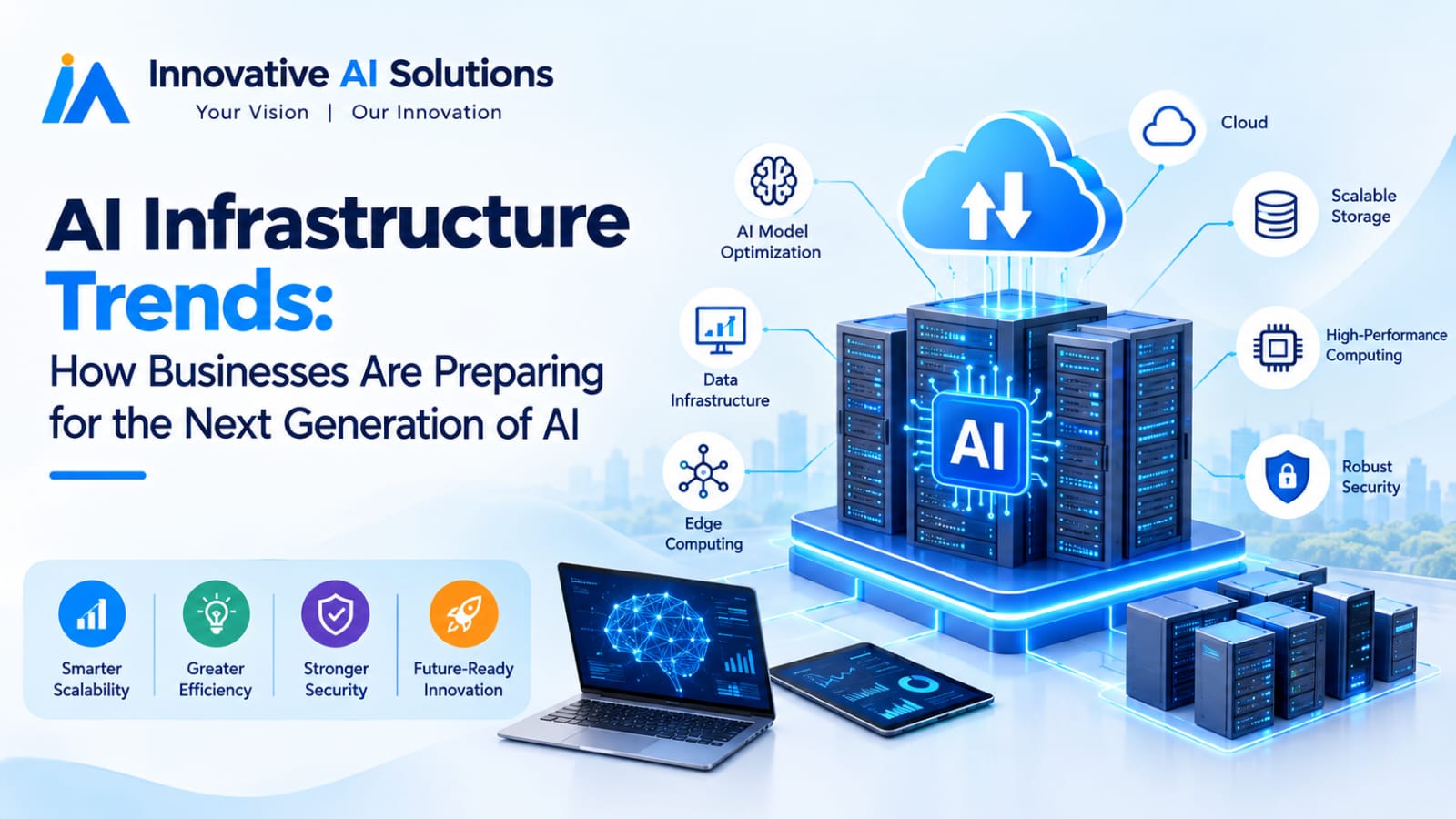
This is the new reality of AI infrastructure. The competitive focus has shifted from single-chip performance to how compute is connected, scheduled, and organized . When you're connecting 72 GPUs into a single compute unit or 384, as Huawei's CloudMatrix does the "road" between chips becomes as important as the chips themselves.
The numbers are staggering. Global AI spending is projected to reach $2.67 trillion in 2026**, with AI infrastructure alone accounting for **$1.48 trillion the largest single category . The five largest hyperscalers Amazon, Google, Meta, Microsoft, and Oracle are spending $750 billion combined in 2026, equal to 38% of their revenue .
But spending alone doesn't guarantee results. The businesses that thrive will be those that understand where the bottlenecks are and how to address them.
The "Missing Road" Problem: High-Speed Interconnect
For years, the AI infrastructure conversation focused on GPUs. "We need more H100s." "We're short on A100s." The "chip shortage" was the story.
That story has changed.
As clusters scale to tens of thousands of chips, the limiting factor is no longer just how many chips you have it's how well they connect. A single GPU might deliver impressive peak performance. But in a cluster, that GPU is only as fast as the network that feeds it data.
When bandwidth is insufficient, latency too high, or signal quality degraded, accelerators sit idle waiting for data that never arrives. Peak compute becomes actual compute only when the "road" between chips is wide and stable enough .
This is why high-speed interconnect has moved from a backstage component to a strategic priority. The technology stack spans SerDes (serializer/deserializer), retimers, optical DSPs, and switching silicon. The industry is transitioning from 400G to 800G deployment, with 1.6T on the horizon.
Broadcom's AI semiconductor revenue hit $20 billion in fiscal 2025, up 65% year-over-year driven largely by Ethernet switching chips for AI networks . The message is clear: the companies building the "roads" are as important as those building the "cars."
For businesses planning AI infrastructure, this means network design is no longer an afterthought. It's a primary constraint.
Data Centers Split in Two: Training vs. Inference
AI workloads are not monolithic. They have fundamentally different infrastructure requirements and that's forcing a split in how data centers are designed.
Training workloads connect tens of thousands of GPUs in tightly coupled clusters. Latency and proximity matter intensely. These clusters run hot rack densities of 30–80 kW, sometimes exceeding 100 kW—and require advanced cooling like direct-to-chip liquid or immersion systems .
Inference workloads prioritize availability and responsiveness at scale. They're less power-dense typically 15–30 kW per rack but must deliver ultra-low latency for billions of real-time queries. These workloads are increasingly distributed across edge and interconnection hubs .
The implication is significant: a single facility must now support both tightly synchronized training systems and distributed, user-facing inference. As Oracle's VP of AI infrastructure put it: "You have to take both into account when you build the data center" .
The rack is no longer just a rack. As Google's distinguished engineer said: "We're not designing a rack anymore—we're designing a system."
Power Becomes the Primary Constraint
For years, the constraint on AI infrastructure was compute. Now it's electricity.
The largest data centers being built can consume more than a gigawatt enough to power entire cities . Over half of that electricity currently comes from fossil fuels, with renewables meeting just over a quarter of demand .
Nvidia's distinguished engineer for energy systems described the challenge: training clusters introduce sharp, dynamic load patterns that ripple beyond the data center. "You can see that impact all the way back at the power plant," he said, describing how generation must ramp to match workload behavior .
The response is multi-pronged. Operators are increasingly relying on on-site generation to accelerate deployment, though this is described as a "stopgap" rather than a long-term solution. Energy storage is becoming essential to smooth fluctuations and maintain power quality .
For businesses planning AI infrastructure, power availability is no longer a secondary concern. It's the limiting factor that determines where and when AI capacity can be deployed.
Cooling Moves Beyond Air—and Beyond Debate
Liquid cooling was once considered optional or niche. In 2026, it's a baseline requirement for high-density AI systems.
"Liquid cooling is here," Google's engineer said. "At this point, the conversation is about standardization."
But the transition isn't simple. Operators must manage hybrid environments where liquid-cooled AI systems coexist with air-cooled infrastructure. Water use is emerging as both a sustainability and operational risk. As Nvidia's engineer noted: "Data centers need to engineer out water where they can" .
The cooling challenge isn't just technical it's economic. Cooling typically accounts for 30–40% of total data center energy consumption . As densities rise, that percentage grows. Efficiency in cooling is no longer a "nice to have." It's a competitive advantage.
India's AI Infrastructure Surge: From GPU Tenders to Sovereign AI
India is building AI infrastructure at an unprecedented pace and the model is distinctive.
The IndiaAI Mission GPU buildout is the most visible initiative. The government has committed ₹10,372 crore to the mission. Through multiple tender rounds, it has procured tens of thousands of GPUs at subsidized rates. The fourth tender alone is expected to add 25,000 more GPUs to the existing commitments for 40,535 .
The pricing is remarkable. Average GPU rates in IndiaAI tenders hit ₹115.85 per GPU hour far below the global average of $2.50–$3.00 . This aggressive bidding has made advanced compute more affordable domestically, though some executives express concerns about long term viability given rising global costs and a weakening rupee .
But the mission isn't just about buying chips. It's about building a sovereign AI ecosystem.
HCLTech's $1.48 billion investment in an AI data center in Odisha, in partnership with Sarvam AI, exemplifies the new model. The facility will combine HCLTech's full-stack AI capabilities with Sarvam's foundation models to offer sector-specific AI applications for government and private companies . HCLTech CEO C Vijayakumar described the strategy: "It's the data centre, it's the GPUs, it's the models, it's the applications that we will deliver on top of it. The overall value creation is significantly of a very different magnitude when you really look at this as a full stack" .
Tata Consultancy Services announced plans to invest $2 billion in AI data centers. The pattern is clear: Indian IT services firms are moving beyond outsourcing into infrastructure ownership .
For Indian businesses, this buildout means access to affordable, sovereign AI compute is improving rapidly. The infrastructure that was once out of reach is becoming available.
The Agentic AI Infrastructure Gap
The next generation of AI agentic systems is exposing weaknesses in current infrastructure.
Google Cloud surveyed 1,402 global IT leaders and found that 83% say their systems need upgrades to support production-grade agentic AI .
Why? Agentic applications are fundamentally different from simple AI assistants. They make repeated model calls, query databases, use external tools, and coordinate with other agents. They require systems to retain context and manage activity across multiple steps sometimes over long-running workflows .
This exposes what Google calls the "inference tax" : data-egress fees, excess storage, and idle specialized hardware. 62% of leaders reported significant inference tax costs, while 81% cited operational complexity as a hidden scaling cost .
Security and governance emerged as the leading challenge, cited by 79% of respondents. The risk of "agent sprawl" large numbers of autonomous systems operating without central oversight is driving demand for centralized control planes for permissions, identity, and workflows .
For businesses preparing for agentic AI, the implication is clear: infrastructure designed for simple inference won't support agents. The requirements are higher, the governance demands are greater, and the cost structure is different.
FinOps for AI: The New Discipline
AI infrastructure is expensive. And the costs are becoming harder to ignore.
Gartner predicts that by 2029, 60% of organizations deploying AI will establish a dedicated function responsible for mapping AI total cost to value .
The emerging discipline is FinOps for AI applying financial operations principles to AI spending. The challenge is that AI costs are non-linear and unpredictable. Training costs, fine-tuning costs, and inference costs have different pricing models. Agentic AI adds another layer of complexity, with multi-step workflows consuming tokens in ways that are difficult to forecast .
The market is responding. FinOps tools are evolving from rate optimization (which resources to use) to usage optimization (how resources are used). "Easy button" approaches are emerging to help customers calculate cost-to-serve the unit economics of a specific AI workload or agent .
For businesses, the message is: don't let AI spending become a black box. The organizations that can tie infrastructure costs to business outcomes will have a sustainable advantage.
What This Means for Your Business
Let me distill this into actionable priorities.
If you're planning AI infrastructure:
Don't focus solely on GPU count. The network, cooling, and power infrastructure are equally critical. A cluster that can't move data efficiently is a cluster that can't deliver value.
If you're in India:
The IndiaAI Mission is making compute more accessible. But access alone isn't enough. The businesses that thrive will be those that can integrate compute into workflows not just rent it.
If you're preparing for agentic AI:
Current infrastructure may not be enough. Agentic systems require persistent memory, multi-step orchestration, and governance controls that simple inference doesn't. Plan for upgrades before you need them.
If you're managing AI costs:
FinOps for AI is becoming a necessity, not a luxury. Track unit economics. Understand where tokens are going. Tie spending to outcomes.
Frequently Asked Questions
Q1: What is the biggest AI infrastructure bottleneck in 2026?
High-speed interconnect the "road" between chips. As clusters scale to tens of thousands of GPUs, the ability to move data efficiently between chips, servers, and racks has become as important as raw compute power .
Q2: How much is being spent on AI infrastructure globally?
Global AI spending is projected at $2.67 trillion in 2026**, with AI infrastructure alone at **$1.48 trillion the largest single category .
Q3: What is the difference between AI training and inference infrastructure?
Training clusters connect tens of thousands of GPUs in tightly coupled systems with rack densities of 30–80 kW. Inference workloads prioritize low latency and availability, with lower density (15–30 kW) and distributed deployment .
Q4: What is the IndiaAI Mission GPU tender?
India's government initiative to procure GPUs at subsidized rates for researchers, startups, and enterprises. The fourth tender is expected to add 25,000 GPUs, bringing total commitments to over 65,000. Average pricing hit ₹115.85 per GPU hour .
Q5: What is the "inference tax" in AI infrastructure?
Google Cloud's term for hidden costs data-egress fees, excess storage, and idle specialized hardware. 62% of IT leaders reported significant inference tax costs .
Q6: Why do 83% of organizations need infrastructure upgrades for agentic AI?
Agentic systems make repeated model calls, query databases, and coordinate with other agents. They require persistent context, multi-step orchestration, and governance controls that simple inference infrastructure doesn't provide .
Q7: What is FinOps for AI?
A discipline for managing AI costs. It involves tracking unit economics, understanding where tokens are consumed, and tying spending to business outcomes. Gartner predicts 60% of AI-deploying organizations will have a dedicated function for this by 2029 .
Q8: How is India building sovereign AI infrastructure?
Through the IndiaAI Mission GPU tenders and private investments. HCLTech is investing $1.48 billion in an Odisha AI data center with Sarvam AI. TCS announced $2 billion in AI data centers. The goal is full-stack sovereign AI capability .
Q9: What is liquid cooling, and why does it matter?
A cooling method where servers are directly cooled by liquid rather than air. It's required for high-density AI systems (30–100+ kW per rack) that air cooling cannot handle efficiently. It's now a "baseline requirement" for AI infrastructure .
Q10: What is the "agent sprawl" risk?
When large numbers of autonomous AI agents operate across different tools and platforms without central oversight. 79% of IT leaders identified security, governance, and MLOps as their main challenge in scaling inference .
Frequently Asked Questions (Continued)
Q11: How does power consumption affect AI infrastructure decisions?
91% of IT leaders consider power consumption when selecting hardware, with 61% calling it a primary or significant factor. Power availability is now the limiting factor for where AI capacity can be deployed .
Q12: What is hybrid multicloud for AI?
A strategy where AI workloads are distributed across public cloud, private cloud, on-premises, and edge environments based on cost, latency, and data residency requirements. 52% of organizations use this model .
Q13: What is edge deployment for AI?
Running AI workloads closer to users and devices to reduce latency and bandwidth costs. 90% of IT leaders rank edge deployment as important for AI initiatives .
Q14: What is the "cloud-anywhere" operating model?
A framework for managing workloads across on-premises, private cloud, public cloud, and edge environments with a consistent "cloud experience." It's seen as the foundation for agentic cloud operations .
Q15: Why should I choose Innovative AI Solutions?
Because we focus on practical AI infrastructure that delivers results. Because we've delivered 100+ projects. Because your code is always yours. Your success is always our goal.
Contact Us
Phone:
+91 7464 099 059
+91 9689967356
Email:
info@innovativeais.com
Address:
9th Floor, Pearls Best Heights-I,
Head Office: 904, Netaji Subhash Place,
Delhi – 110034