The Big Question
What happens when your application uses a powerful, expensive model for every single query even when half of them are simple greetings, FAQs, or straightforward lookups? What if your AI inference costs spiral out of control as usage grows, and you're paying for capability you're not even using?
The gap between what you need and what you pay for is the exact problem model routing solves. Model routing automatically analyzes each incoming request and directs it to the most suitable model the cheapest one that can still do the job well.
The Problem: Why Using One Model for Everything Fails
The most common approach to building AI applications is straightforward: pick one powerful model and route all requests through it. While this simplifies development, it creates significant inefficiencies. Not all requests require the same level of capability. A simple "What are your business hours?" query doesn't need the same reasoning power as a complex legal analysis.
The economics make this clear. Consider the cost difference: Gemini 1.5 Flash at $0.075 is 33 times cheaper than GPT-4o. Yet on simple, structured tasks, the output quality gap is near zero. When you use a frontier model for every request, you are not paying for better answers you are paying for capability you are not using.
What Is AI Model Routing?
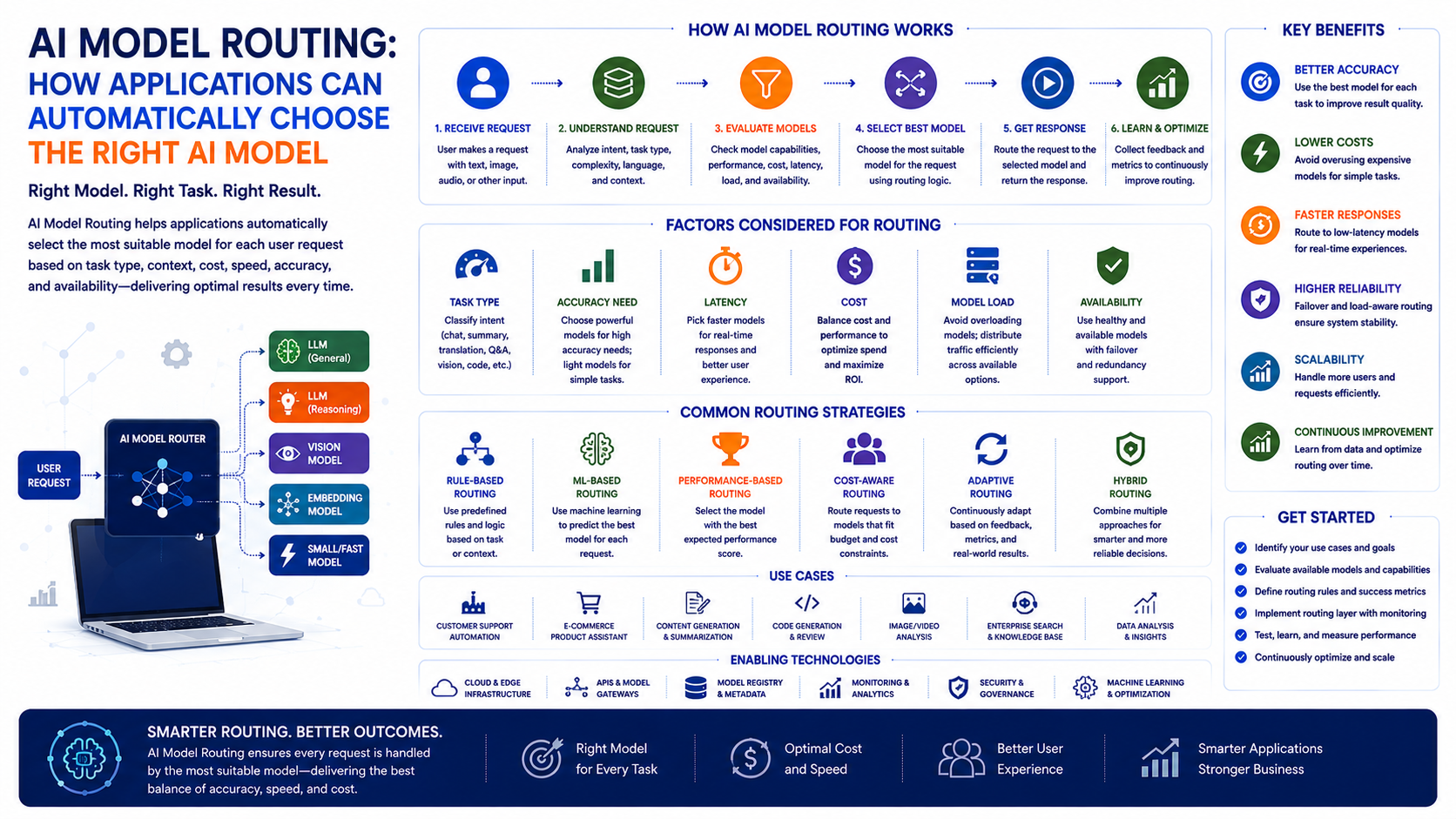
AI model routing is the process of automatically selecting the most appropriate AI model based on the characteristics of an incoming request. Instead of treating every prompt equally, the application evaluates factors such as query complexity, required reasoning, domain specificity, and latency requirements before choosing a model.
Think of it as an intelligent switchboard: it receives a user request, analyzes what the user is asking, determines which model in your pool is best suited to handle it, and routes the request accordingly. The entire routing decision adds minimal overhead—a negligible fraction of the LLM inference time.
How a Routing System Works
A typical production routing system follows a structured workflow:
-
Receive the user request. The application captures the prompt and any associated metadata.
-
Analyze the request. The system evaluates the prompt its complexity, domain, required reasoning depth, and whether it involves tool calls or agentic workflows.
-
Select the best model. Based on the analysis, the router estimates which model in the pool delivers the best result for this specific prompt, factoring in cost, quality, and latency trade-offs.
-
Route and generate response. The prompt is forwarded to the selected model, and the response is returned to the user.
-
Monitor and refine. Metrics such as latency, token usage, routing decisions, and response quality are captured to continuously improve routing policies.
Three Routing Strategies
Strategy 1: Classifier-Based Routing
Classifier-based routing uses a lightweight model to predict query complexity before the query reaches your main model. The classifier outputs a score or category queries below a threshold go to the cheap model, queries above go to the frontier model.
This approach was validated by Berkeley researchers in RouteLLM, where routers trained on preference data from the LMSYS Chatbot Arena achieved significant cost reductions:
-
Matrix factorization router: 85% cost reduction on MT Bench, 95% of GPT-4 performance, with only 14% of queries sent to the strong model
-
BERT-based classifier: 45% cost savings on MMLU at comparable quality
Best for: Teams with high query volume and identifiable simple/complex split. Low latency overhead once the classifier is trained.
Strategy 2: Cascade Routing
Cascade routing sends every query to the cheap model first, checks whether the response meets a confidence threshold, and only escalates to the expensive model when it does not.
This is the core idea behind FrugalGPT from Stanford researchers, which achieved up to 98% cost reduction compared to always using the best LLM API, with the same output quality.
The mechanism that makes cascades work is the confidence check. For structured tasks where the model can assess whether it knows the answer, this is reliable. For open-ended generation, you need a quality judge (another model or a scoring function) rather than raw confidence scores.
Best for: Mixed query types where you want to minimize strong model calls without pre-classifying anything.
Strategy 3: Semantic Routing
Semantic routing embeds the incoming query using a lightweight embedding model and matches it to the closest topic cluster. Each cluster maps to a model optimized for that domain code queries go to a code-specialist model, medical queries go to a clinical model, general conversation goes to the cheapest capable option.
This is different from complexity routing. You are not asking "how hard is this?" You are asking "what kind of task is this?" A simple medical question and a complex medical question both route to the medical model.
Implementation examples include the LLM Semantic Router from Red Hat, which uses BERT embeddings for semantic understanding and operates as an Envoy external processor for integration without modifying client code.
Best for: Teams running multiple specialized models or applications spanning distinct task domains (support, code, analysis, creative).
| Strategy | Routing Signal | Cost Reduction | Best For |
|---|---|---|---|
| Classifier-Based | Predicted complexity score | 45-85% | High-volume structured tasks |
| Cascade | Response confidence | 50-98% | Mixed queries, no pre-classification |
| Semantic | Query topic embedding | Varies | Multi-domain applications |
Advanced Research: The Cutting Edge
Research continues to push routing capabilities further.
MESS+ from IBM Research
IBM's MESS+ introduces a stochastic optimization algorithm for cost-optimal LLM request routing while providing rigorous service level agreement (SLA) compliance guarantees. It learns request satisfaction probabilities of LLMs in real-time and makes model selection decisions by solving a per-request optimization problem. Across a wide range of benchmarks, MESS+ achieves an average of 2x cost savings compared to existing routing techniques.
Lookahead Routing
The Lookahead framework takes a fundamentally different approach. Instead of routing based solely on the input query, it "foresees" potential model outputs by predicting their latent representations and uses these predictions to guide model selection. This enables more informed routing, particularly for complex or ambiguous queries. Empirical evaluations show Lookahead achieves an average performance gain of 7.7% over state-of-the-art routing baselines.
PEARL: Energy-Aware Routing
PEARL introduces energy as a first-class optimization objective in model routing. It uses a proxy model to assess query complexity and an Energy Consumption Meta-Model to predict the energy cost of processing queries on specific models. This enables decision-makers to configure upper bounds for inference energy consumption, achieving significant energy reductions (more than 18% in certain cases) while maintaining high accuracy.
Explainable and Auditable Routing
For regulated industries, routing decisions must be explainable and auditable. Recent patent work describes systems that generate natural language explanations for each routing decision, with immutable audit trails for compliance and governance purposes. These explanations can be tailored to different audiences technical for engineers, executive for leadership, compliance-focused for regulators.
Implementation Roadmap
Phase 1: Assessment and Strategy
-
Analyze your request distribution. Understand the mix of simple vs. complex queries, domain categories, and latency requirements.
-
Define routing categories. Establish clear complexity levels or domain categories for routing decisions.
-
Select a routing strategy. Start with classifier-based or semantic routing depending on your use case.
Phase 2: Build and Integrate
-
Select your model pool. Choose the models you will route between generally a small, fast model and a large, capable model.
-
Train or configure your router. For classifier-based routing, train a lightweight classifier; for semantic routing, define domain clusters.
-
Integrate with your application. Route traffic through the router before reaching the model endpoint.
Phase 3: Monitor and Refine
-
Capture routing metrics. Track latency, token usage, routing decisions, and response quality.
-
Review and adjust thresholds. Periodically review incorrectly classified requests to improve the classifier.
-
Maintain fallback mechanisms. Escalate difficult requests to a more capable model if the selected model fails or produces unsatisfactory responses.
Frequently Asked Questions
Q1: What is AI model routing?
AI model routing automatically selects the most appropriate model for each request based on its complexity, domain, and requirements balancing cost, performance, and latency.
Q2: How much can model routing save?
Cost savings range from 45% to 98%, depending on the routing strategy and query distribution. RouteLLM achieved 85% cost reduction with 95% of GPT-4 performance; FrugalGPT achieved up to 98% cost reduction.
Q3: What's the difference between classifier-based and cascade routing?
Classifier-based routing predicts query complexity before processing. Cascade routing tries the cheap model first and only escalates if confidence is low.
Q4: What are the different routing modes in production?
Common modes include Balanced (best combination of quality and cost), Cost (aggressively favors cheaper models), and Quality (always selects the highest-quality model).
Q5: How can Innovative AI Solutions help?
We help organizations design, build, and operationalize AI model routing systems from strategy and model selection to implementation and monitoring. Based in Delhi, serving clients across India.
Why Delhi is a Great Hub for AI Innovation
Delhi is emerging as a hub for AI and cloud innovation, backed by a thriving IT services ecosystem and growing demand for cost-efficient AI deployments. As Indian enterprises scale their AI applications, model routing becomes essential for controlling inference costs while maintaining quality. The region's deep talent pool positions it to lead in building and scaling intelligent routing systems.
What We Offer at Innovative AI Solutions
-
AI Model Routing Strategy: We help you design routing architectures aligned with your cost and quality goals.
-
Platform Selection: We help you choose between Azure Foundry, OpenRouter, LiteLLM, or custom solutions.
-
Implementation Support: We help you build and integrate routing layers into production applications.
-
Cost Optimization: We help you achieve 50%+ inference cost reduction with quality preservation.
Final Thought
The shift is clear: from using the most powerful model for every request to using the right model for each request. Organizations that master AI model routing will achieve efficient, scalable AI operations without sacrificing quality. The technology is proven, the savings are real, and the patterns are ready for production.
Contact Us:
Phone: +91 7464 099 059 / +91 9689967356
Email: info@innovativeais.com
Address: Netaji Subhash Place, Pitampura, Delhi – 110034
Website: https://innovativeais.com
About the Author
Abhishek Kumar
Founder & CEO, Innovative AI Solutions
5+ years building AI, cloud, and enterprise systems. Based in Delhi, serving clients across India.
Related services: to apply this in your business, explore our LLM integration and AI development services.