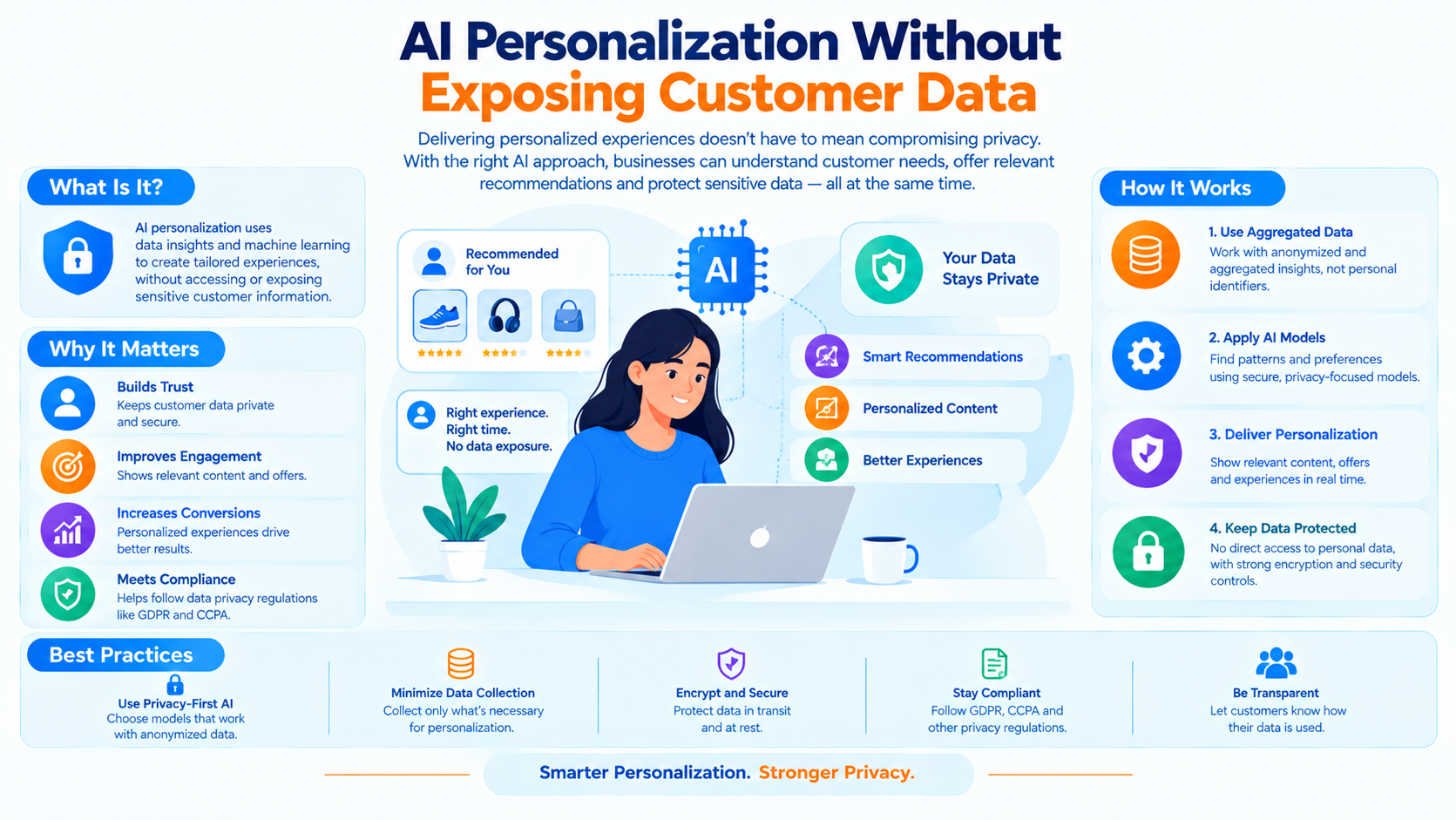
The Big Question
What happens when your personalization system requires sending every user's behaviour to a server, storing it indefinitely, and training models on it? When a breach exposes the behavioural history of millions of users? When a regulator asks what personal data you hold and why?
Personalization creates value. Centralizing personal data to achieve it creates risk. The question is whether you can get the first without accepting the second.
Why Centralized Personalization Is Risky
The default personalization architecture concentrates risk.
Data Centralization
Behavioural data is collected from every user, transmitted to a central store, and retained for training and analysis.
The risk: A single breach exposes the entire dataset. There is no segmentation, no minimization, and no way to limit the blast radius after the fact.
Continuous Transmission
Every interaction sends personal data to a server.
The risk: Data is exposed in transit, in logs, in caches, and at every point along the path.
Indefinite Retention
Training data is retained because it may be useful later.
The risk: The longer data is held, the greater the chance it is exposed, misused, or subpoenaed.
Broad Access
Engineers, analysts, and data scientists need access to build and improve models.
The risk: Access multiplies the number of people who could leak or misuse data.
Regulatory Exposure
Regulations like the DPDP Act, GDPR, and CCPA impose obligations on personal data: purpose limitation, minimization, retention limits, and consent.
The risk: Centralized personalization makes compliance harder because personal data is everywhere.
The Principles of Privacy-Preserving Personalization
Personalization without exposure rests on a set of principles.
Minimize collection. Collect only what is needed for the specific purpose.
Process locally. Where possible, do the computation on the device rather than the server.
Transmit derived signals, not raw data. Send insights, not behaviour.
Aggregate with privacy guarantees. When data must be combined, use techniques that prevent individual identification.
Retain briefly. Delete data when its purpose is served.
Control access. Limit who can see what, and audit every access.
Be transparent. Tell users what is happening and why.
The Techniques
On-Device Inference
The model runs on the user's device. Personal data never leaves.
How it works: A model is downloaded to the device, runs locally on local data, and produces a personalized result without transmitting anything.
What it enables: Recommendations, ranking, classification, and prediction that adapt to the user without exposing their behaviour.
The limits: Device compute and memory are constrained. Model size must fit within those constraints. This is the same trade-off described in on-device personalization.
Federated Learning
The model is trained across many devices without centralizing the training data.
How it works: Each device trains a local model on local data. Only model updates — not data — are sent to the server. The server aggregates the updates into a global model.
What it enables: A shared model that improves from collective data without anyone seeing individual behaviour.
The limits: Aggregation must preserve privacy (see secure aggregation below). Communication overhead is significant. Devices must be available for training.
Differential Privacy
Noise is added to data or results so that individual contributions cannot be identified.
How it works: Statistical noise is injected such that the presence or absence of any individual's data cannot be inferred from the output.
What it enables: Aggregate analytics and model training with formal privacy guarantees.
The limits: There is a trade-off between privacy and accuracy. More noise means more privacy but less precise results.
Secure Aggregation
Model updates from many devices are combined without any party seeing individual updates.
How it works: Cryptographic protocols allow the server to compute the sum of updates without decrypting any individual update.
What it enables: Federated learning where the server never sees individual contributions.
The limits: Requires protocol support and adds computational overhead.
On-Device Learning
The model adapts to the individual user entirely on the device.
How it works: The model updates locally based on the user's behaviour, without any server involvement.
What it enables: Personalization that is specific to the user and never shared.
The limits: The model cannot benefit from collective data. Each device learns in isolation.
Privacy-Preserving Analytics
Aggregate insights are computed without exposing individual records.
How it works: Techniques such as k-anonymity, aggregation with minimum thresholds, and query budgets prevent individual identification.
What it enables: Product analytics without centralizing personal data.
Local Data Storage
Data is stored on the device rather than on the server.
How it works: The application stores user data locally in IndexedDB, OPFS, or a local database and syncs only derived state.
What it enables: Personalization based on local data that never leaves the device.
The limits: The data is lost if the device is lost. The trade-off must be acceptable to the user.
The Architecture
A privacy-preserving personalization architecture separates the device from the server by design.
What Stays on the Device
-
Raw behavioural data
-
Personal preferences
-
Individual predictions
-
Sensitive attributes
What Crosses to the Server
-
Model updates (with privacy guarantees)
-
Aggregate statistics (with privacy guarantees)
-
Explicit, user-initiated actions
-
Anonymized or derived signals
What the Server Provides
-
Model distribution
-
Aggregation
-
Global improvements
-
Non-personal content
The principle: The server improves the system without knowing the individual.
The Trade-offs
Privacy-preserving personalization is not free.
| Trade-off | What It Means |
|---|---|
| Accuracy | Privacy techniques reduce precision |
| Latency | On-device inference may be slower for large models |
| Coverage | Federated learning requires device availability |
| Complexity | Privacy-preserving systems are harder to build and debug |
| Capability | Some personalization requires centralized data |
| Cost | On-device computation shifts cost to users |
The practical guidance: not every use case requires maximum privacy. Match the technique to the sensitivity of the data and the requirements of the application.
Regulatory Alignment
Privacy-preserving personalization aligns with regulatory requirements.
Data minimization. Collecting less and processing locally satisfies minimization requirements.
Purpose limitation. Local processing makes it easier to limit data to its stated purpose.
Retention limits. Data that never leaves the device does not need to be retained by the organization.
Consent. Users can be given meaningful control over what stays local and what is shared.
Cross-border transfer. Data that never crosses borders does not trigger transfer restrictions.
This alignment is not incidental. Privacy-preserving techniques make compliance structural rather than procedural.
Implementation Roadmap
Phase 1: Assess (Weeks 1-4)
-
Inventory personal data flows. What data is collected, where it goes, and why?
-
Identify high-sensitivity data. Where would exposure cause the most harm?
-
Assess use cases for on-device processing. What can run locally?
-
Review regulatory requirements.
Phase 2: Build (Weeks 5-12)
-
Implement on-device inference for appropriate use cases.
-
Implement local data storage with clear retention policies.
-
Implement privacy-preserving analytics for aggregate insights.
-
Implement federated learning where collective improvement is needed.
-
Implement secure aggregation and differential privacy where applicable.
Phase 3: Operate (Weeks 13-16+)
-
Measure privacy guarantees. What is the formal privacy budget?
-
Monitor accuracy trade-offs.
-
Audit data flows to confirm minimization.
-
Be transparent with users about what is local and what is shared.
Frequently Asked Questions
Q1: Can personalization work without exposing customer data?
Yes, within limits. On-device inference, local storage, and federated learning enable personalization without centralizing personal data.
Q2: What is federated learning?
Training a model across many devices without centralizing the training data. Only model updates are shared, not data.
Q3: What is differential privacy?
Adding statistical noise so that individual contributions cannot be identified from the output. It provides formal privacy guarantees at the cost of accuracy.
Q4: What is secure aggregation?
Cryptographic protocols that combine model updates without any party seeing individual updates.
Q5: Does this reduce personalization quality?
It can. Privacy techniques reduce precision. The trade-off must be matched to the sensitivity of the data and the requirements of the application.
Q6: How can Innovative AI Solutions help?
We help organizations design privacy-preserving personalization from on-device inference and local storage to federated learning and differential privacy. Explore our services to see how we approach privacy-aware AI engineering. Based in Delhi, serving clients across India.
Why Delhi is a Great Hub for Privacy-Aware AI
Delhi is emerging as a hub for enterprise AI adoption, backed by a thriving IT services ecosystem and India's evolving data protection framework under the DPDP Act. As Indian enterprises build personalization systems, doing so without centralizing personal data becomes both a regulatory requirement and a competitive differentiator.
What We Offer at Innovative AI Solutions
-
Privacy Assessment: We inventory personal data flows and identify high-sensitivity data.
-
On-Device Inference: We implement models that run locally without transmitting data.
-
Local Storage Design: We implement device-side storage with retention controls.
-
Federated Learning: We implement collective model improvement without centralized data.
-
Privacy-Preserving Analytics: We implement aggregate insights with privacy guarantees.
-
Regulatory Alignment: We align architecture with DPDP Act and GDPR requirements.
Final Thought
The shift is clear: from centralizing personal data to processing it where it lives. Personalization has always required data, but it does not require centralization. Organizations that build privacy-preserving personalization will deliver adaptive experiences without carrying the risk of a breach exposing everything. Those that centralize by default will keep discovering that the data they collected is the liability they cannot remove.
Contact Us:
Phone: +91 7464 099 059 / +91 9689967356
Email: info@innovativeais.com
Address: 904, 9th floor Pearls Best Heights-I, Netaji Subhash Place, Delhi-110034
Website: https://innovativeais.com
About the Author
Abhishek Kumar
Founder & CEO, Innovative AI Solutions