The Big Question
What happens when your business intelligence no longer waits for you to ask questions? What if insights proactively surface anomalies before they become crises, explain the root cause without a manual deep-dive, and even recommend next actions—all in real-time?
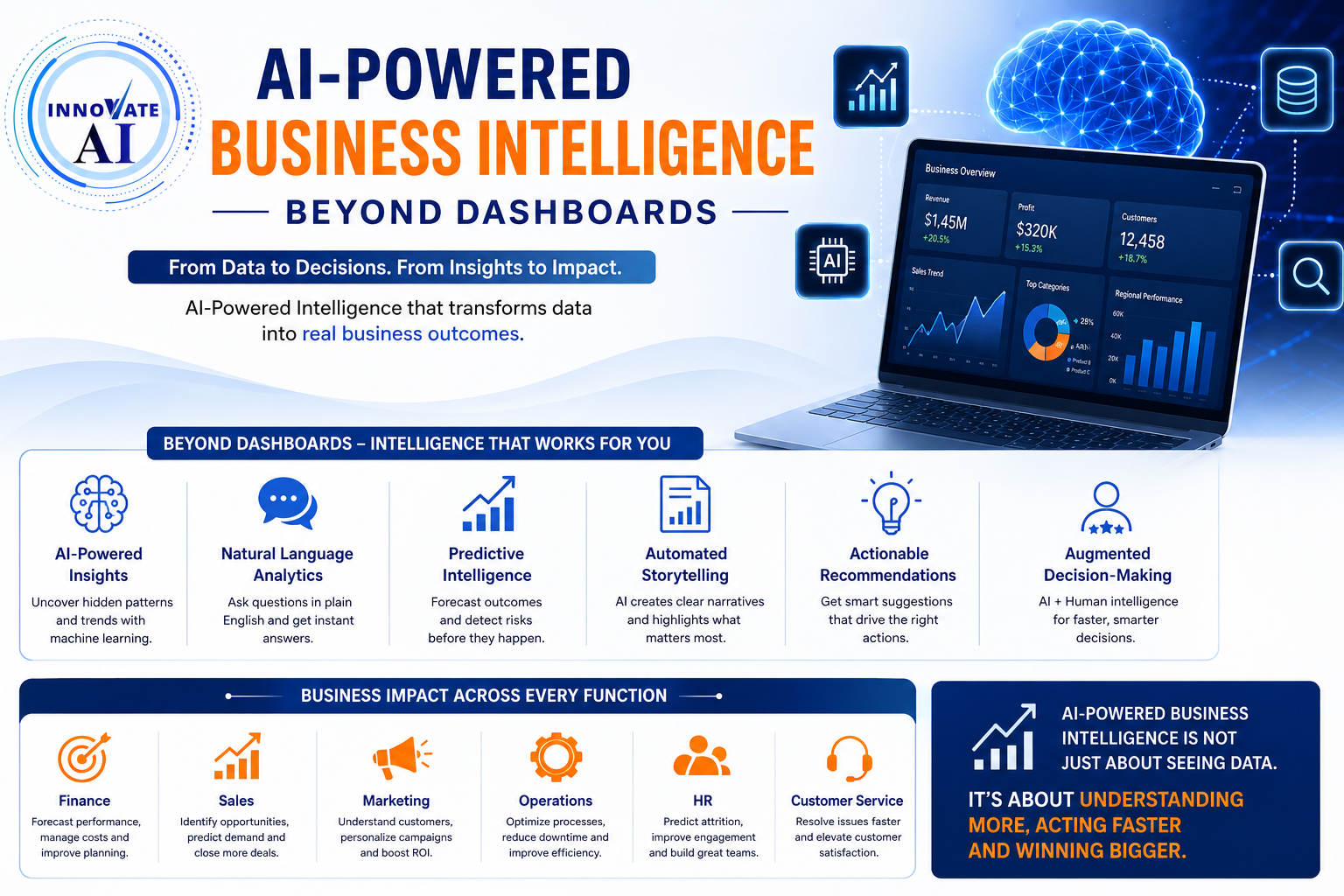
This is the promise of AI-powered business intelligence beyond dashboards. And it's transforming how organizations move from insight to action.
The "Dashboard-Driven" Trap
For years, the "Data-Driven" dream has looked a lot like a crowded screen. We built dashboards for every department, every KPI, and every niche project. But as we reached "peak dashboard," a frustrating reality set in: organizations were drowning in visualizations but starving for immediate insights .
The problem is structural. Verivox, a leading European comparison platform, recognized this pattern early. While dashboards are great for monitoring, they often fail at the explanation phase. When a KPI turns red, the dashboard rarely tells you why. This triggers a manual cycle :
-
Management sees a dip in the dashboard
-
A request is sent to the data team
-
Days later, an answer arrives
-
By then, the decision has often already been made based on intuition
The willingness to be data-driven exists, but the information isn't available fast enough . As Joachim Höffner, Lead Data & BI Engineer at Verivox, explained: "Most companies are not data-driven; they are dashboard-driven" .
What Is Agentic Analytics?
Agentic analytics represents a new paradigm where AI agents don't just find data—they analyze relationships and explain variances . Rather than asking data teams to chase answers, agentic AI anticipates business needs, explores data autonomously, and delivers insights without being explicitly requested .
What Makes Analytics Truly Agentic?
| Capability | What It Means |
|---|---|
| Proactive Delivery | The system surfaces findings without being prompted—not just answering on demand |
| Multi-Step Reasoning | The AI executes sequences: querying a source, detecting an anomaly, cross-referencing, and formatting results |
| Persistent Context | The agent retains context across interactions, building on previous understanding |
A 2025 study of 500 companies found that agentic AI systems reduced task completion times by 34%, increased accuracy by 8%, and improved resource utilization by 14% .
Agentic BI in Action: The Verivox Story
Verivox has spent 18 months moving beyond static reporting toward a more conversational, agentic approach. They've been testing AI-driven chat systems that allow business users to skip the ticket queue and ask questions directly .
The shift is profound. "It is about fundamentally changing how questions are asked and answered," Höffner explains. "Business users can increasingly obtain answers independently without always relying on specialists" .
The Reality Check: Trust and Human Responsibility
Verivox's journey has been grounded in pragmatism. AI isn't a magic wand, and hallucinations are a real technical hurdle :
-
The 1+1 Test: Some companies lose trust in AI when it fails simple logic tests
-
Consistency is King: "Creative" answers are a liability—enterprises require deterministic, accurate results
-
The Human Guardrail: The responsibility still lies with humans; employees are trained not just to use AI, but to critically evaluate its output
How Agentic BI Compares to Traditional Dashboards
A recent Gartner report describes how the market is moving toward agentic AI, governed semantics, and AI-augmented decision support . Modern ABI platforms increasingly embed agentic capabilities that orchestrate tasks across the data-to-insight workflow, complementing and, in part, displacing time spent in curated dashboards .
Architecture Matters: The Semantic Layer Distinction
The differentiator between AI BI tools in 2026 isn't which model they use—it's whether a governed semantic layer feeds the model the context it would otherwise invent . A semantic layer provides the business definitions, join paths, and access rules that make AI answers trustworthy.
| Traditional Dashboards | Agentic Analytics |
|---|---|
| Static, curated views | Dynamic, conversational insights |
| Surface "what happened" | Explain "why" and "what to do" |
| Require manual requests for new questions | Answer ad-hoc questions instantly |
| Data team dependency for every query | Self-service for business users |
| Reactive monitoring | Proactive anomaly detection |
The Technology Behind Agentic BI
The RIDE Framework
Recent academic research has introduced the Retail Intelligence and Decision Engine (RIDE), an LLM-driven BI framework that transforms natural language business inquiries into analytical operations, predictive insights, and actionable recommendations .
The framework integrates four key components :
-
Knowledge Grounding: Constructs analytical contexts from enterprise repositories to ensure factual consistency
-
Reasoning-Action Planning: Decomposes complex business inquiries into structured analytical steps
-
Grammar-Constrained SQL Generation: Guarantees syntactic correctness and schema-aware query execution
-
Predictive Forecasting: Embeds forecasting into the analytical loop to support future-oriented decisions
The Agentic Architecture Stack
Agentic BI systems draw data from internal and external sources, organize it, and look for patterns and trends. The key components include :
-
Data Integration Platforms: Aggregate and clean data from diverse sources
-
ML Frameworks: Support autonomous model training and adaptive learning
-
NLP Components: Process unstructured data and facilitate conversational interfaces
-
Automation Tools: Manage workflows, trigger actions, and execute decisions autonomously
-
BI Visualization: Deliver insights in user-friendly formats
Real-World Applications Across Industries
Agentic AI dashboards are being applied across business sectors :
Healthcare: The Mayo Clinic uses an agentic AI platform to analyze patient records and flag high-risk patients. Telemedicine companies use real-time data from wearable devices to automatically identify health risks .
Retail: Walmart applies agentic AI to forecast demand for 500 million items weekly—the system learns with more data, resulting in significant cost savings .
Customer Service: Delta Air Lines applies sentiment analysis through agentic AI dashboards to proactively monitor feedback and address concerns, reporting a 30% increase in customer satisfaction ratings .
Cybersecurity: Some companies process trillions of threats weekly using unsupervised learning to detect and respond autonomously .
Will Dashboards Disappear?
The consensus is clear: dashboards aren't dying—they're returning to their original purpose .
KPMG analysts Dario Verschueren and Olivier Mees argue that data agents are not a replacement for dashboards but a complementary layer addressing distinct business needs :
"Dashboards remain the gold standard for supporting recurring key business processes and driving a narrative through a centralized vision... Data agents excel at managing the remaining chunk of analytical ad-hoc needs" .
At Verivox, dashboards will return to providing a high-level view of core company health. When an anomaly appears, that's when the agent steps in. Instead of building a new dashboard to investigate a trend, users engage an AI agent to perform the deep dive, potentially saving days of manual labor .
The Data Office Transformation
Within a typical data office, a significant portion of the workload is consumed by the "endless ad-hoc queue." Highly skilled data analysts and engineers find their time increasingly spent on minor, repetitive reporting requests .
Data agents offer a potential solution. By automating basic ad-hoc data requests, data agents enable business users to serve themselves using natural language . The shift transforms the time to insight from weeks to just minutes .
KPMG illustrates this with a compelling scenario: A CFO preparing for a quarterly board meeting sees a spike in loss rates on the dashboard. Instead of waiting days or weeks for a data team to investigate, the CFO uses a data agent to interrogate the data in plain language. In minutes, the agent uncovers a suspicious pattern—a single dealer initiating 204 claims versus the next highest's 44—revealing potential fraud .
The Governance Imperative
As agentic BI becomes more powerful, governance becomes critical. Gartner identifies analytics governance as a mandatory feature for modern ABI platforms, including :
-
Controlling access and certifying content
-
Managing life cycle policies
-
Monitoring usage and optimizing performance
-
Enforcing auditability and policy-as-code
-
Maintaining trust and transparency across all analytics workflows
Challenges to Adoption
Organizations face several challenges implementing agentic BI :
-
Change Management: Employees may need to learn new skills and modify daily tasks
-
Model Drift: AI agents must continually update their models with uninterrupted data streams
-
Data Privacy: A 2025 study found 78% of organizations had concerns about data privacy with agentic AI systems
Platform Landscape: Leading Agentic BI Solutions
ThoughtSpot: Agent Ecosystem
ThoughtSpot has introduced a team of AI agents that augment every role in the analytics workflow :
-
SpotterModel: Builds governed semantic models in minutes, not days
-
SpotterViz: Assembles complete, on-brand Liveboards from a single prompt
-
SpotterCode: Generates embedded analytics implementations in seconds
-
Spotter 3: Acts as a true analytical partner that thinks, reasons, and validates its work automatically
Cube: AI-Native BI with a Semantic Layer
Cube is an AI-native agentic analytics platform built on a semantic layer. The platform "cures the confidence gap" in AI business intelligence by grounding AI in certified business context . Its open-source foundation, Cube Core, provides the semantic layer—a governed model of metrics, dimensions, joins, and access policies that the AI must go through .
Incorta Intelligence: Unified Decision Intelligence
Incorta has launched Incorta Intelligence, a unified decision intelligence platform that enables organizations to move beyond dashboards and AI chat experiences to governed, AI-powered decision-making and action . The platform combines :
-
Incorta Builder (AI Apps): Low-code environment for creating purpose-built AI applications
-
Incorta Smart Agent: Conversational AI that grounds answers in the semantic layer
-
Incorta Workflows: Workflow automation that connects insights to governed business processes
Implementation Roadmap: The First 90 Days
Phase 1: Foundation (Weeks 1-4)
-
Audit your dashboard ecosystem: Count dashboards, measure request backlog, identify high-value but time-consuming ad-hoc requests
-
Define governance: Establish data boundaries, permissions, and compliance requirements
-
Assess semantic layer readiness: Do you have governed metrics definitions? If not, start there
-
Select pilot use case: Choose one high-value, high-friction analytical question
Phase 2: Pilot (Weeks 5-8)
-
Build the semantic foundation: Establish governed metric definitions
-
Deploy a data agent: Enable one team to ask questions conversationally
-
Train on human-AI teaming: Introduce teams to the agent, give it multiple roles, and maintain collective ownership
-
Measure impact: Track time saved, questions answered, and decisions accelerated
Phase 3: Scale (Weeks 9-12+)
-
Expand to additional functions: Move beyond the pilot to operations, finance, and product teams
-
Enable agentic execution: Let AI trigger workflows like Jira tickets or Slack alerts
-
Embed insights into workflows: Move from dashboards to in-context insights
-
Continuous improvement: Refine semantic models based on user feedback
Frequently Asked Questions
Q1: What is AI-powered business intelligence beyond dashboards?
It's an operating model where AI agents proactively surface anomalies, investigate root causes, and deliver actionable insights without waiting for manual data requests .
Q2: Will AI replace dashboards?
No. Dashboards remain the gold standard for recurring core metrics. Agentic analytics is a complementary layer that handles ad-hoc, exploratory, and anomaly investigation needs .
Q3: What makes a BI tool truly agentic?
Three capabilities: proactive delivery (surfacing insights without prompts), multi-step reasoning (executing sequences of actions), and persistent context (retaining context across interactions) .
Q4: What are the measurable benefits of agentic BI?
A 2025 study found 34% reduction in task completion times, 8% increase in accuracy, and 14% improvement in resource utilization .
Q5: What's the governance challenge with agentic BI?
Governance must cover access control, version history, audit trails, and policy-as-code. AI agents can't be trusted automatically—human oversight and model validation remain essential .
Q6: How can Innovative AI Solutions help?
We help organizations design, build, and operationalize agentic analytics—from semantic layer design and platform selection to governance frameworks and change management. Based in Delhi, serving clients across India.
Why Delhi is a Great Hub for AI Development
Delhi is emerging as a significant hub for AI development, backed by concrete government support and infrastructure. The recent Delhi Budget 2026-27 allocated ₹8.20 crore for two Artificial Intelligence centres of excellence (AI-CoEs), functioning as hubs for research, innovation, and startup incubation.
The city's AI infrastructure is expanding rapidly. Under the IndiaAI Mission, more than 38,000 high-end GPUs have been onboarded and are available at approximately ₹65 per hour—roughly one-third of the global average cost. This makes AI development remarkably cost-effective compared to other tech hubs.
The government has also announced a ₹350 crore startup policy over five years, aiming to support the emergence of at least 5,000 startups by 2035, with key focus areas including artificial intelligence, machine learning, and automation.
The AI ecosystem in Delhi combines: cost-effective infrastructure, government support, a growing talent pool, and proximity to the country's business decision-makers.
What We Offer at Innovative AI Solutions
After five years of building AI solutions for businesses, we've developed a practical approach that focuses on what actually works:
-
Agentic Analytics Strategy: We help you assess your data maturity and design an agentic analytics roadmap
-
Semantic Layer Design: We help you build the governed metric definitions that make AI trustworthy
-
Platform Selection: We help you choose between ThoughtSpot, Cube, Incorta, and open-source solutions
-
Data Agent Deployment: We help you pilot and scale conversational analytics
-
Governance and Compliance: We help you establish permissions, audit trails, and policy-as-code
-
Change Management: We help your organization shift from dashboard-driven to insight-driven
Our approach is built on the reality that AI-powered BI isn't just a technology upgrade—it's a fundamentally new operating model for decision-making.
Final Thought
The verdict from organizations like Verivox is clear: Traditional BI isn't dead—it's the baseline. But if you want to move at the speed of the modern market, you need to start building your agentic future today .
AI in BI is a strong assistant and accelerator today, and a trustworthy autonomous analyst only when grounded in a semantic layer . The organizations that navigate this transition successfully won't just make faster decisions. They'll make better decisions.
Contact Us:
Phone: +91 7464 099 059 / +91 9689967356
Email: info@innovativeais.com
Address: Netaji Subhash Place, Pitampura, Delhi – 110034
Website: https://innovativeais.com
About the Author
Abhishek Kumar
Founder & CEO, Innovative AI Solutions
5+ years building AI systems for enterprises. Based in Delhi, serving clients across India.
Hashtags: #AgenticAI #BusinessIntelligence #AIDrivenAnalytics #DecisionIntelligence #EnterpriseAI #AIStrategy #InnovativeAISolutions
Related services: to apply this in your business, explore our AI agent development and AI development services.