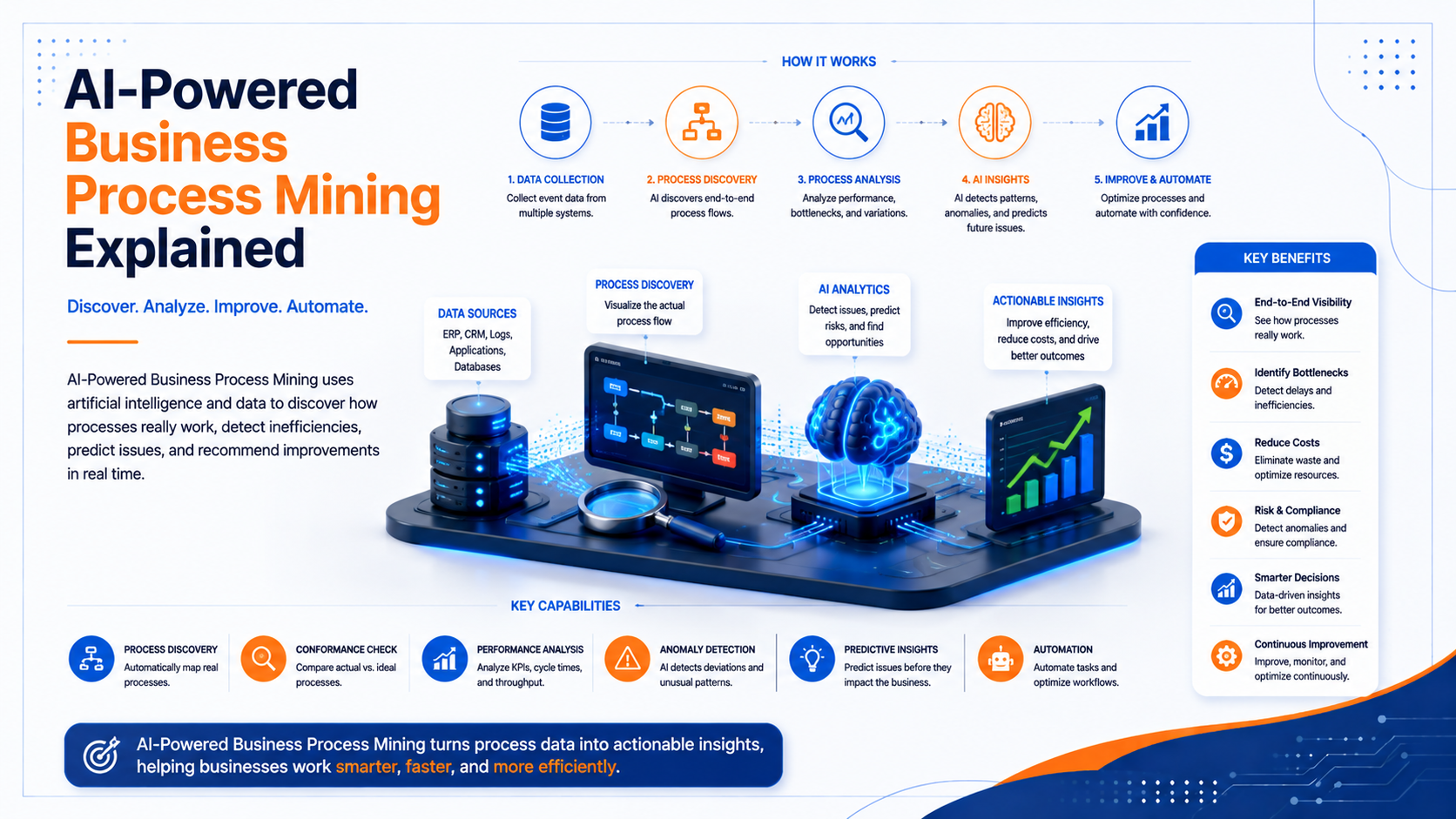
The Big Question
What happens when your process mining tool stops just showing you what happened and starts telling you why it happened and what to do about it? When a system can analyze terabytes of event log data, identify bottlenecks, and recommend specific actions to fix them all without manual analysis? And when it can predict future delays before they occur?
This is the promise of AI-powered process mining. It represents a fundamental evolution from retrospective analysis to predictive and prescriptive intelligence .
What Is AI-Powered Process Mining?
Traditional process mining reconstructs workflows from event logs to visualize how processes actually run. AI-powered process mining adds a layer of intelligence that goes beyond visualization. It combines machine learning, predictive analytics, and generative AI to detect patterns, forecast outcomes, and recommend improvements .
Traditional vs. AI-Powered Process Mining
| Capability | Traditional Process Mining | AI-Powered Process Mining |
|---|---|---|
| Primary Purpose | Reconstruct and visualize workflows | Detect patterns, predict outcomes, and guide improvement |
| Time Orientation | Retrospective analysis | Retrospective and predictive intelligence |
| Insight Depth | Identifies bottlenecks and deviations | Identifies statistical drivers and risk signals at scale |
| Investigation Effort | Requires analyst interpretation | Accelerates root cause identification through automated modeling |
| Forecasting | Limited to historical pattern observation | Estimates probability of delays, cost overruns, or compliance risk |
| Recommendations | Surfaces areas for improvement | Suggests prioritized corrective actions |
| Learning Capability | Static analysis based on available data | Continuously refines models as new outcomes emerge |
The Technologies Powering AI Process Mining
Machine Learning Models
Machine learning is the engine behind AI process mining. Models identify correlations between activities, resources, timing, and outcomes, allowing the system to continually improve and grow more accurate with time .
Key applications include:
-
Predictive process monitoring: Using LSTM algorithms to predict process outcomes and identify factors that most influence results
-
Anomaly detection: Identifying subtle, emerging risks that may not yet be obvious through traditional analysis
-
Pattern recognition: Automatically detecting process variants and deviations at scale
Generative AI and Large Language Models
LLMs are revolutionizing how organizations interact with process mining data. A systematic review of GenAI in process mining identified five key application themes :
| Theme | What It Does |
|---|---|
| Business-oriented assistance and decision support | Translates complex process data into intuitive narratives |
| Predictive process monitoring | Enhances forecasting with weak supervision and rare-event constraints |
| Explainability and human-facing interaction | Makes process mining outputs understandable to non-experts |
| Anomaly detection | Identifies irregularities in noisy, incomplete logs |
| Process model generation | Automates discovery and refinement of process models |
ChatGPT and similar LLMs have demonstrated proficiency in transforming complex process mining data into intuitive formats, significantly improving the efficiency and precision of process analysis .
Agentic AI Frameworks
Agentic frameworks like PMAx implement closed-loop orchestration specifically tailored to bridge the gap between process semantics and technical implementation . These frameworks typically include:
-
Engineer Node: Synthesizes executable Python code from natural language queries
-
Analyst Node: Translates technical artifacts into business insights while remaining isolated from code
-
Self-correction loops: Validate outputs and force reconciliation with empirical evidence
Explainable AI (XAI)
XAI techniques are reducing reliance on human intuition and domain knowledge in root cause analysis. By applying explainable AI to process prediction models, organizations can identify the factors that most significantly impact process outcomes quantitatively and rapidly .
Agentic Process Mining in Action
PMAx: From Natural Language to Data-Grounded Insights
PMAx is an agentic framework that shifts the focus of process mining from algorithmic development to agentic system design. It autonomously generates data-grounded insights from natural language cues .
How it works:
-
A user asks a business question in natural language (e.g., "What are the bottlenecks in our loan application process?")
-
The Engineer Node synthesizes executable Python code
-
The Analyst Node translates technical artifacts into domain-specific reports
-
A self-correction loop validates outputs and ensures they are strictly grounded in empirical evidence
Results: In testing with the BPI Challenge 2017 loan application dataset, PMAx successfully transformed complex queries into precise code and generated accurate, data-grounded insights .
LLM-Based Agents for Procurement Analysis
A research framework integrating process mining with an LLM-based agent for tendering performance interpretation demonstrated the power of this approach. The agent :
-
Extracted 16 activity labels and their average durations with 100% accuracy
-
Produced descriptive narratives summarizing activity performance
-
Identified bottlenecks and dominant delay paths
-
Prioritized improvement recommendations
Expert review confirmed that the interpretations and suggestions "make sense, fit the situation, and can be used for tendering" .
Domain Knowledge Generation
LLMs can generate domain-specific knowledge for process mining tools by grounding outputs in process discovery artifacts. Research using a ReWOO-based agent architecture found that over 65% of generated report content contained information specific to the process components being analyzed .
Predictive and Prescriptive Capabilities
Predictive Analytics
AI-powered process mining enables organizations to go beyond historical analysis to estimate the probability of future events :
-
Delay prediction: Estimate the likelihood of process delays based on current state and historical patterns
-
Cost overrun forecasting: Predict when projects are at risk of exceeding budget
-
Compliance risk detection: Identify emerging compliance risks before they materialize
Simulation and Optimization
Many AI process mining tools use optimization algorithms to test different workflow scenarios :
-
Simulate reallocating resources or adjusting approval paths
-
Estimate impact of changes before deploying in production
-
Compare expected outcomes with actual results in real-time
Prioritizing Automation
AI helps organizations move from identifying automation candidates to prioritizing them based on business impact :
-
Evaluate which process variations generate the highest cost, risk, or delay
-
Rank automation initiatives by projected ROI
-
Monitor RPA bot performance and recommend fixes for failure patterns
Real-World Results
BoB-Cardif Life Insurance: 176% ROI
BoB-Cardif Life Insurance partnered with IBM to implement process mining, achieving :
-
70% reduction in processing time
-
176% ROI
-
Enhanced transparency in claims processes
-
Identification of business anomalies, excessive duplicate work, and uneven employee workload distribution
-
Targeted digital technology and process management measures based on data-driven insights
Object-Centric Process Mining Goes Mainstream
Object-centric process mining (OCPM) has become the de facto approach to discover, monitor, and improve business processes . Organizations are applying OCPM with AI across industries:
-
Mercedes-Benz: Using process mining in supply chains for reliability and predictive intelligence
-
Lufthansa: Minimizing flight delays through process intelligence
-
Aachen, Germany: Leveraging process intelligence to reshape public services
Implementation Roadmap
Phase 1: Foundation (Weeks 1-4)
-
Audit your process mining maturity: Identify where AI could add value beyond traditional analysis
-
Select a pilot use case: Start with a high-impact, well-documented process (e.g., order-to-cash, procure-to-pay)
-
Assess data readiness: Ensure event logs are complete, structured, and accessible
-
Choose a platform: Evaluate vendors like Celonis, IBM Process Mining, or Infor that offer AI-powered capabilities
Phase 2: Deploy AI Capabilities (Weeks 5-8)
-
Enable predictive analytics: Deploy machine learning models for outcome prediction
-
Implement natural language interfaces: Allow business users to query process data in plain language
-
Configure anomaly detection: Set up automated monitoring for emerging risks
-
Establish feedback loops: Ensure the system learns from corrections and outcomes
Phase 3: Operationalize (Weeks 9-12+)
-
Integrate with automation: Connect AI insights to RPA and workflow automation
-
Scale across processes: Expand to additional business functions
-
Measure impact: Track processing time reduction, cost savings, and ROI
-
Continuous improvement: Refine models as new data and outcomes emerge
Frequently Asked Questions
Q1: What is AI-powered process mining?
AI-powered process mining combines traditional process discovery with machine learning, predictive analytics, and generative AI to detect patterns, forecast outcomes, and recommend improvements .
Q2: How is it different from traditional process mining?
Traditional process mining reconstructs workflows from event logs. AI-powered process mining adds predictive capabilities, automated root cause analysis, natural language interfaces, and prescriptive recommendations .
Q3: What technologies power AI process mining?
Key technologies include machine learning models, predictive analytics, anomaly detection, generative AI (LLMs), agentic AI frameworks, and explainable AI .
Q4: What results can organizations achieve?
IBM case studies report 70% reduction in processing time and 176% ROI. Organizations also achieve enhanced process transparency, identification of business anomalies, and prioritized automation improvements .
Q5: How can Innovative AI Solutions help?
We help organizations design, build, and operationalize AI-powered process mining capabilities from platform selection and data readiness assessment to AI model deployment and integration with automation. Based in Delhi, serving clients across India.
Why Delhi is a Great Hub for Process Innovation
Delhi is emerging as a hub for process automation and AI innovation, backed by a thriving IT services ecosystem. Indian enterprises in BFSI, manufacturing, and logistics are increasingly adopting AI-powered process mining to improve operational efficiency, reduce costs, and drive digital transformation.
What We Offer at Innovative AI Solutions
-
AI Process Mining Strategy: We help you identify high-value processes and design an AI-powered roadmap.
-
Platform Selection: We help you evaluate and choose between Celonis, IBM Process Mining, Infor, or open-source solutions.
-
Implementation: We help you deploy AI capabilities predictive analytics, LLM integration, and anomaly detection.
-
Automation Integration: We help you connect AI insights to RPA and workflow automation.
Final Thought
The shift is clear: from visualizing what happened to predicting what will happen and prescribing what to do about it. Organizations that adopt AI-powered process mining will achieve faster root cause analysis, better decision-making, and sustained operational improvement.
Contact Us:
Phone: +91 7464 099 059 / +91 9689967356
Email: info@innovativeais.com
Address: Netaji Subhash Place, Pitampura, Delhi – 110034
Website: https://innovativeais.com
About the Author
Abhishek Kumar
Founder & CEO, Innovative AI Solutions
5+ years building AI, process automation, and enterprise systems. Based in Delhi, serving clients across India.
Related services: to apply this in your business, explore our machine learning and predictive analytics and AI development services.