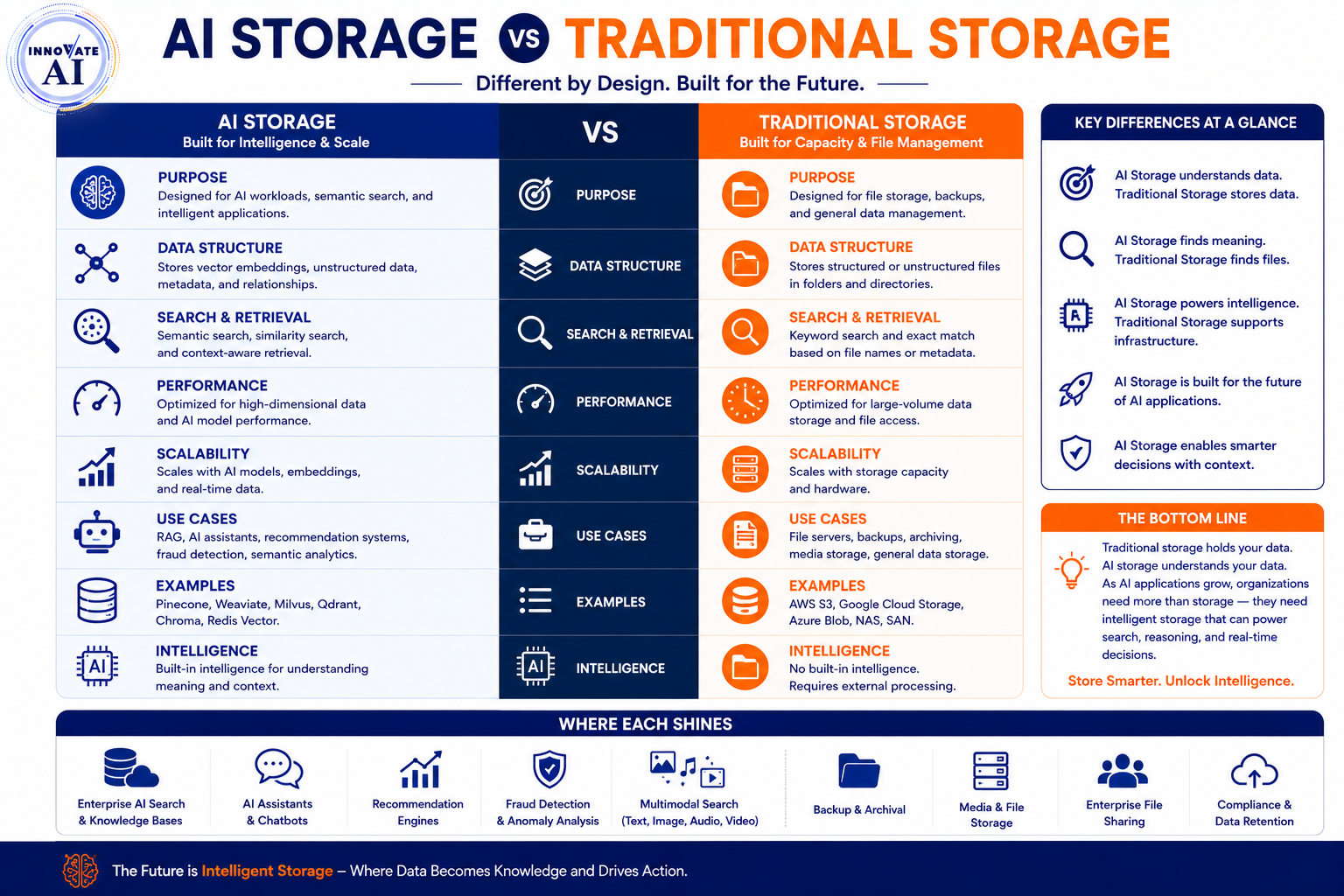
The Big Question
What happens when your AI training cluster is bottlenecked by storage that can't deliver data fast enough to keep GPUs busy? When the metadata server crashes under the load of billions of small files, and dataset expansion has consumed all available capacity? And when the storage system designed for transactional workloads is completely wrong for streaming vast amounts of unstructured data?
These aren't hypothetical problems. They're the reality for organizations trying to run AI on infrastructure designed for a different era.
The Core Difference: Purpose-Built Architecture
Traditional storage and AI storage were built for fundamentally different worlds. Traditional storage was designed for predictable workloads—databases, file sharing, backups. AI storage was built from the ground up for the unique demands of AI: massive scale, enormous throughput, and the ability to handle both tiny files and massive datasets seamlessly.
The fundamental architectural gap: Traditional storage hierarchies with metadata stored on single controller nodes were designed for millions of files. AI workloads can involve hundreds of billions of objects, and that distinction is structural, not incremental.
AI Storage vs Traditional Storage: The Five Core Differences
1. Data Storage Model
| Traditional Storage | AI Storage |
|---|---|
| Hierarchical tree structure | Flat namespace with unique identifiers |
| Files nested in folders | Objects stored independently |
| Metadata stored centrally | Distributed metadata across nodes |
| Degrades at millions of files | Handles billions of objects |
Traditional storage uses a strict directory hierarchy where files exist in parent-child relationships, with all metadata stored centrally on controller nodes. When file counts reach tens of millions, directory queries experience severe delays.
AI storage treats every file as an independent object with its own unique identifier, eliminating the directory bottleneck entirely. Systems like RustFS, MinIO, and Ceph distribute metadata across multiple nodes, supporting billions of files seamlessly.
2. I/O Performance Model
Traditional storage optimizes for random I/O—ideal for databases and enterprise applications. But AI workloads demand sequential high-bandwidth reads and high-concurrency random small-file I/O simultaneously. Traditional controllers become a single point of performance failure, often failing to saturate network links.
AI storage optimizes for both modes simultaneously. Distributed sharding across multiple nodes enables parallel reads—multiple storage nodes deliver data concurrently to GPU clusters, providing aggregate bandwidth at TB/s scale.
3. Scaling Architecture
Traditional storage scales vertically—upgrading a single controller with more CPU, memory, and drives. This approach has a fixed performance ceiling and is expensive. Horizontal expansion is often prohibitively costly and prone to migration failures.
AI storage scales horizontally. Simply adding more storage nodes increases both capacity and bandwidth linearly. There is no hardware bottleneck, and in private cloud environments, nodes can be added incrementally.
4. Metadata Capacity
In traditional NAS, metadata services are deployed as a single point. When file counts reach tens of millions, directory queries time out—making them unsuitable for AI datasets involving billions of files.
AI storage distributes metadata across all nodes. SeaweedFS stores metadata separate from data; RustFS uses a Rust-based metadata engine to reduce lock contention; Ceph MDS clusters support active-active metadata services.
5. Primary Use Cases
Traditional storage remains appropriate for ERP systems, database block storage, office file sharing, and virtual machine hosting. These workloads are predominantly structured data with limited unstructured files.
AI storage is purpose-built for large model training datasets, multimodal media, model weights, autonomous vehicle data, and GPU cluster shared storage. These are all unstructured data at enormous scale.
The Hidden Costs of Using Traditional Storage for AI
The most expensive mistake in AI infrastructure is using traditional storage for AI workloads. Here's what goes wrong:
Metadata node crashes. During AI training with millions of small image files, the metadata node can crash under the load.
Wasted GPU cycles. When storage can't feed data fast enough, expensive GPUs sit idle. GPUs are the most expensive component in AI clusters—idle time represents money burning.
Dataset expansion shock. Converting raw data to vectorized data for AI training can expand dataset size by up to 10x. Traditional storage wasn't built for this kind of expansion.
Checkpoint storage bloat. During AI training, checkpoints are created regularly to allow rollback after failures. These can add massive data volumes to storage requirements.
What AI-Ready Storage Looks Like
The Key Technical Requirements
Flash Storage is the Baseline. AI's I/O demands make flash storage non-negotiable. HDDs simply can't keep up with the throughput demands of feeding GPU clusters.
High-density QLC Flash. QLC flash offers flash performance at much lower cost—not quite as low as spinning disk, but with much faster access for AI workloads.
Hybrid Search Capabilities. Modern AI storage platforms are integrating intelligent data services directly into storage, including automated indexing, vectorization, and data protection. NetApp's AI Data Engine uses NVIDIA acceleration for semantic search, data vectorization, and data guardrails.
Exabyte-Scale Capability. Traditional storage scales vertically with a fixed ceiling. AI storage must deliver linear performance scaling to 128+ nodes with TB/s bandwidth.
Multi-Protocol Support. AI workloads require support for both file (NFS/SMB) and object (S3) protocols.
Why Object Storage Is Winning for AI
Gartner predicts that by 2029, key-value-based object storage will store 50% of on-premises unstructured data, up from less than 10% in 2025.
The reasons are compelling. AI applications don't need file locking—they read large blobs of data, process in memory, and write back vector data. The overhead of a hierarchical file system adds no value and creates bottlenecks. Modern object storage with integrated intelligence and multi-protocol access offers the optimal combination of cost, performance, and simplicity.
When to Use Which Storage Architecture
Use Traditional Storage For
-
Enterprise ERP systems
-
Database block storage
-
Office file sharing
-
Virtual machine hosting
-
Structured data with limited unstructured files
Use AI Storage For
-
Large model training datasets
-
Multimodal media files
-
Model weight file archiving
-
Autonomous vehicle image datasets
-
GPU cluster shared storage
-
Any AI initiative with large unstructured data volumes
The Practical Recommendation
For most enterprises, the optimal strategy isn't choosing one over the other—it's intelligent separation:
-
Keep traditional storage for structured business data (databases, ERP)
-
Deploy AI object storage (RustFS, MinIO, Ceph, or commercial solutions) for training datasets and unstructured data
-
Add RustFS parallel file systems when maximum small-file performance is needed
This approach allows you to leverage existing storage hardware while solving the IO bottlenecks that destroy AI performance.
Implementation Roadmap: First 90 Days
Phase 1: Foundation (Weeks 1-4)
-
Audit your existing storage estate and identify which workloads are structured vs. unstructured
-
Measure current AI workload performance—where are the bottlenecks?
-
Define your data growth trajectory: how much capacity will you need in 12 months?
Phase 2: Design (Weeks 5-8)
-
Design a tiered storage architecture separating structured and unstructured data
-
Select AI storage platform (consider RustFS, MinIO, Ceph for open source; commercial options from NetApp, VAST, Pure Storage)
-
Plan migration strategy—start with non-critical AI workloads
Phase 3: Deploy (Weeks 9-12+)
-
Deploy AI storage for a specific use case—one department or one workload
-
Measure performance and cost improvements
-
Plan organization-wide rollout
Frequently Asked Questions
Q1: What makes AI storage different from traditional storage?
AI storage uses a flat namespace (not a hierarchy), distributed metadata (not a single point), horizontal scaling (not vertical), and optimizes for streaming throughput (not random I/O).
Q2: Can I use my existing NAS for AI workloads?
You can, but with severe limitations. At file counts in the millions, metadata nodes become a performance bottleneck. At scale, they can crash entirely.
Q3: How much can AI expand dataset volumes?
Vectorizing raw data for AI training can expand dataset size by up to 10x. Combined with checkpoint storage, this represents massive additional capacity.
Q4: What is the most important storage requirement for AI?
Feeding GPUs fast enough to keep them from idling. GPUs are the most expensive component—idle time is direct financial loss.
Q5: When should I use file storage vs. object storage for AI?
Use file storage when you need locking or the framework demands it (e.g., TensorFlow). Use object storage for most AI workloads due to its scalability, flat namespace, and lower complexity.
Q6: How can Innovative AI Solutions help?
We help organizations design, build, and operationalize AI-ready storage infrastructure—from assessment and architecture design to implementation and optimization. Based in Delhi, serving clients across India.
Why Delhi is a Great Hub for AI Development
Delhi is emerging as a significant hub for AI development, backed by concrete government support and infrastructure. The recent Delhi Budget 2026-27 allocated ₹8.20 crore for two Artificial Intelligence centres of excellence (AI-CoEs), functioning as hubs for research, innovation, and startup incubation.
Under the IndiaAI Mission, more than 10,000 GPUs have been onboarded at subsidized rates. The government has also announced a ₹350 crore startup policy over five years, aiming to support at least 5,000 startups by 2035.
What We Offer at Innovative AI Solutions
-
Storage Assessment: We help you audit your storage estate and identify AI readiness gaps
-
Architecture Design: We help you design tiered storage architectures for AI workloads
-
Platform Selection: We help you choose between open-source (RustFS, MinIO, Ceph) and commercial solutions (NetApp, VAST, Pure)
-
Migration Support: We help you move existing data to AI-ready storage without disrupting operations
-
Performance Optimization: We help you tune storage for specific AI workloads
Final Thought
The verdict is clear: using traditional storage for AI workloads is a recipe for failure. AI requires purpose-built infrastructure that can handle billions of objects, deliver TB/s of throughput, and scale horizontally without performance degradation.
The organizations that succeed with AI will be those that invest in modern AI storage before they need it. The failures we're seeing—metadata crashes, GPU idle time, dataset capacity exhaustion—are avoidable with the right infrastructure.
The shift is clear: from legacy storage designed for structured data to AI-native storage built for massive, unstructured, high-velocity data.
Contact Us:
Phone: +91 7464 099 059 / +91 9689967356
Email: info@innovativeais.com
Address: Netaji Subhash Place, Pitampura, Delhi – 110034
Website: https://innovativeais.com
About the Author
Abhishek Kumar
Founder & CEO, Innovative AI Solutions
5+ years building AI systems for enterprises. Based in Delhi, serving clients across India.
Related services: to apply this in your business, explore our RAG development and AI development services.