The Big Question
What if a patient's medical record could be shared seamlessly across hospitals without compromising privacy? What if a single, tamper-proof system could ensure every drug in the supply chain is authentic and every vaccine shipment has been stored at the correct temperature?
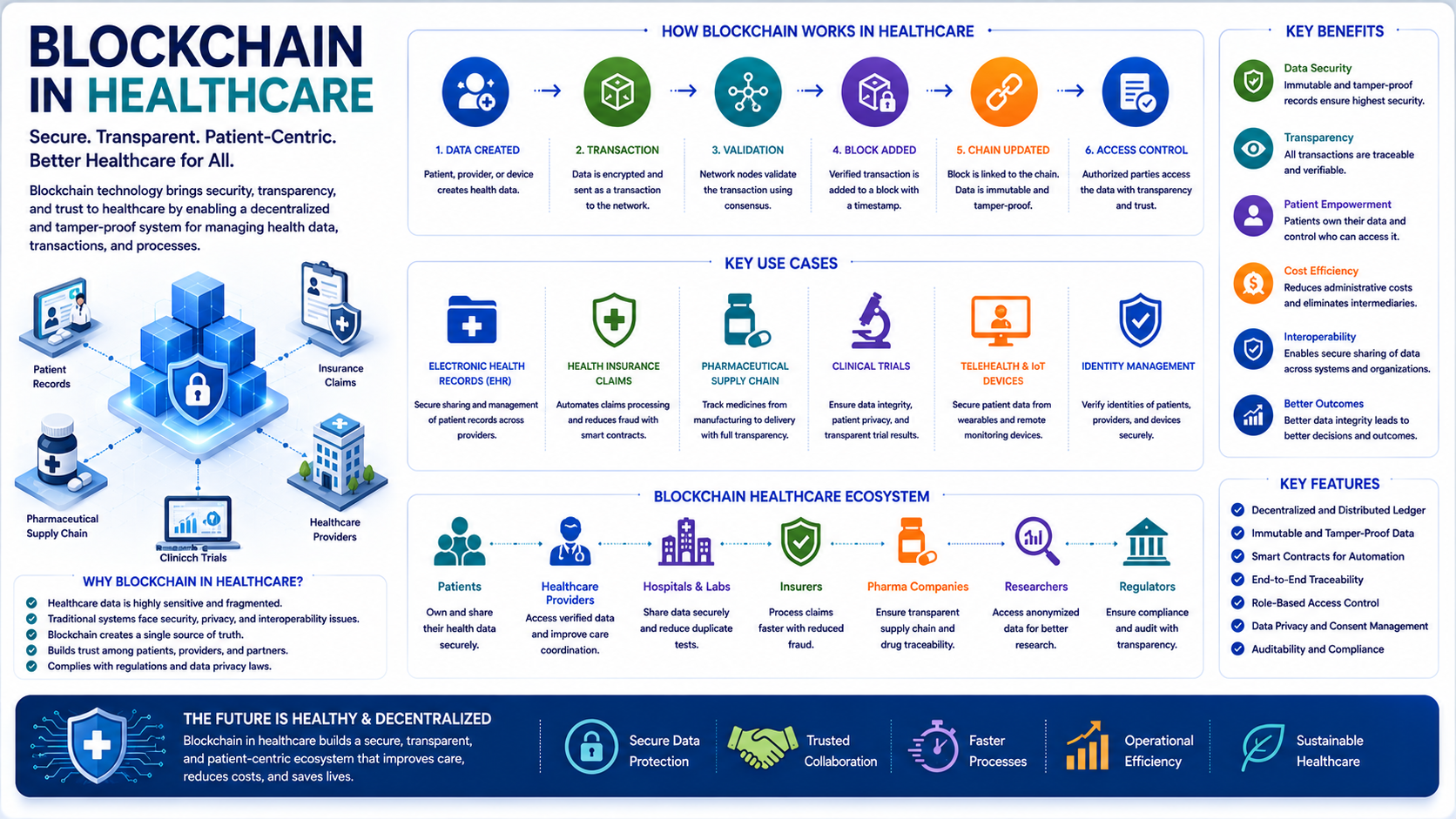
Blockchain technology is being explored as the answer to these questions. By providing a secure, transparent, and decentralized framework for managing sensitive health data and tracking critical medical products, blockchain could fundamentally reshape how trust is established in healthcare .
The Promise: Key Applications of Blockchain in Healthcare
1. Electronic Health Records (EHRs) and Patient Data Management
The Problem: Current EHR systems are often fragmented and centralized, creating data silos that hinder interoperability and place patient data at risk of breaches . Data remains controlled by individual providers, making it difficult for patients to own and share their health information securely .
The Blockchain Solution: Blockchain can facilitate secure, interoperable EHR exchange. Recent research highlights several breakthrough approaches:
-
Tokenized Access Control: The SST-MedChain framework uses one-time access tokens and a permissioned blockchain to manage EHR sharing. This patient-centric system reduces the computational overhead of on-chain authorization, allowing faster and more scalable record sharing while maintaining a traceable audit log. Testing showed this system improved throughput by 38% and reduced confirmation latency by 86% compared to traditional access control models .
-
Context-Aware Security: Another advanced framework integrates context-aware and attribute-based access control with real-time AI monitoring on a blockchain. This provides a more comprehensive data governance solution, ensuring access decisions depend not only on user attributes but also on contextual parameters like time, location, and device properties, making access control more dynamic and secure .
-
Privacy-Preserving Techniques: Research on blockchain-based decentralized applications for healthcare integrates Non-Interactive Zero-Knowledge Proofs (NIZKPs) to maintain data integrity and patient privacy while enabling secure communication between hospitals, patients, and IoT devices . This allows verification of data correctness without revealing the underlying information.
2. Pharmaceutical Supply Chain Integrity
The Problem: The healthcare supply chain is a sensitive, fragmented system where lack of transparency creates a breeding ground for counterfeit drugs, threatening patient safety worldwide . The World Health Organization reports that low-quality and counterfeit medical products are a common problem, especially in low- and middle-income countries .
The Blockchain Solution: Blockchain offers end-to-end visibility by recording every transaction from manufacturing to delivery—on an immutable ledger . Smart contracts can automate compliance and logistics updates, reducing administrative burden and the need for intermediaries .
-
Quotation Selection and Tracking: A blockchain framework integrated with oracles was proposed to ensure unbiased quotation selection for medical equipment and secure tracking of the equipment's entire supply chain journey .
-
Vaccine Supply Chain Security: A federated blockchain framework using smart contracts achieved significant improvements in vaccine supply chain management. The system detected temperature anomalies 76% faster, increased transaction throughput by 36.1%, and achieved a 99.7% breach detection rate .
3. Telemedicine, Clinical Trials, and Insurance
Telemedicine: Blockchain can provide a decentralized infrastructure for telemedicine platforms. Smart contracts enable consent-driven data sharing, authenticate prescriptions, and automate payments, while blockchain-verified P2P protocols ensure video consultation confidentiality .
Clinical Trials: Blockchain technology can enhance the integrity and transparency of clinical trial data, ensuring tamper-proof records, improving patient recruitment processes, and streamlining regulatory compliance .
Insurance: Blockchain has the potential to automate claims processing, reducing fraud and improving efficiency by providing an immutable record of patient care and transactions .
The Challenges: What's Holding Blockchain Back?
Despite its promise, the widespread adoption of blockchain in healthcare is hindered by several significant obstacles:
-
Scalability and Performance: Many blockchain architectures struggle with the high transaction throughput required for large healthcare systems . Research efforts are focused on addressing this, with frameworks like SST-MedChain showing that performance improvements are possible .
-
Integration with Legacy Systems: Interoperability between blockchain platforms and existing, siloed healthcare IT systems remains a significant technical and financial hurdle . The healthcare industry has a high degree of heterogeneity, making seamless data exchange difficult .
-
Regulatory Compliance and Governance: Navigating complex and differing regulations like HIPAA and GDPR requires careful design. Data governance is not an afterthought; it must be a core component of any solution, including secure key management and metadata protection . Clinical and data governance remain key challenges .
The Verdict: Evolutionary or Revolutionary?
Current evidence suggests blockchain's integration into healthcare is less of a sudden revolution and more of a significant evolutionary shift . The technology's proven potential to solve critical problems like secure data sharing and supply chain integrity is driving substantial research and pilot projects .
However, the path to wholesale change is gradual. The real-world impact will depend on overcoming the challenges of scalability, interoperability, regulation, and cost through continued innovation, strategic deployment, and industry-wide collaboration .
Implementation Roadmap
Phase 1: Assessment (Weeks 1-4)
-
Identify a Bounded Use Case: Start with a specific, high-impact problem like securing a pharmaceutical supply chain or creating a consent-managed health data sharing system .
-
Evaluate Existing Infrastructure: Understand your current systems and data silos.
-
Engage Stakeholders: Gain buy-in from IT, clinical, legal, and compliance teams.
-
Select the Right Platform: Choose between a permissioned blockchain (e.g., Hyperledger Fabric, FISCO BCOS) for consortium use or a public blockchain for greater transparency.
Phase 2: Build and Pilot (Weeks 5-8)
-
Focus on a Permissioned Network: For most enterprise healthcare applications, a permissioned blockchain is preferable due to its enhanced privacy and governance controls .
-
Implement Smart Contracts and Oracles: Develop smart contracts to automate workflows (e.g., supply chain tracking) and use oracles to connect the blockchain to external data sources when needed .
-
Prioritize Privacy and Security by Design: Integrate robust access control (ABAC/CAAC) , encryption for off-chain data , and consider zero-knowledge proofs for privacy-preserving verification .
Phase 3: Deploy and Scale (Weeks 9-12+)
-
Monitor Performance: Keep a close eye on critical metrics like transaction latency and throughput .
-
Establish Governance Protocols: Define clear rules for data provenance, permission management, and compliance (e.g., HIPAA, GDPR) from the outset .
-
Scale Gradually: Expand the solution to include additional partners and use cases.
Frequently Asked Questions
Q1: What are the primary benefits of blockchain in healthcare?
The primary benefits include enhanced data security and integrity, improved interoperability for seamless EHR sharing, transparent and immutable audit trails for compliance, and increased patient control over their own health data .
Q2: What are the biggest barriers to adoption?
The main barriers are scalability, the complexity of integrating with legacy healthcare IT systems, a lack of standardization, and navigating a complex regulatory landscape .
Q3: Is blockchain suitable for large-scale healthcare systems?
Yes, but with careful design. Recent research has focused on overcoming scalability and latency issues, with tokenized permissioned blockchains showing promising results in handling higher throughput loads compared to traditional baselines .
Q4: What is the difference between a public and a permissioned blockchain in this context?
A public blockchain is open to anyone, while a permissioned blockchain restricts participation to known, authorized entities. For most enterprise healthcare applications, a permissioned blockchain is preferred due to its enhanced privacy and governance capabilities .
Q5: How can Innovative AI Solutions help?
We help healthcare organizations assess their needs, design and build secure, scalable blockchain solutions, and integrate them with existing systems. Our expertise covers platform selection, smart contract development, and ensuring compliance with healthcare regulations like HIPAA and GDPR. Based in Delhi, serving clients across India.
Why Delhi is a Great Hub for Healthcare Tech Innovation
Delhi is a central hub for medical and technological expertise. With research and conferences on blockchain in healthcare being hosted in cities like Mathura, Rajpura, Sangli, and Greater Noida , the region is a critical center for developing and implementing these next-generation technologies.
What We Offer at Innovative AI Solutions
-
Blockchain Strategy & Consulting: We help you define a clear roadmap aligned with your healthcare goals.
-
Platform Selection & Implementation: We guide you in choosing the right blockchain platform and oversee the technical build.
-
Integration & Data Governance: We specialize in bridging blockchain solutions with legacy systems while implementing robust data governance frameworks.
Final Thought
Blockchain is not a magic bullet for all of healthcare's ills, but it offers a powerful new tool to tackle some of its most persistent problems: data breaches, drug counterfeiting, and a lack of transparency. By starting with targeted pilots and focusing on governance and integration, healthcare organizations can begin to unlock this technology's potential to build a more secure, efficient, and patient-centric future.
Contact Us:
Phone: +91 7464 099 059 / +91 9689967356
Email: info@innovativeais.com
Address: Netaji Subhash Place, Pitampura, Delhi – 110034
Website: https://innovativeais.com
About the Author
Abhishek Kumar
Founder & CEO, Innovative AI Solutions
5+ years building AI, blockchain, and enterprise systems. Based in Delhi, serving clients across India.
Related services: to apply this in your business, explore our AI development services and RAG development.