The Big Question
What happens when your business intelligence arrives too late to act on? When AI agents are making decisions based on data that's hours—or days—old? When a customer interaction that could have been saved passes because you didn't have real-time context?
This is the challenge of the modern enterprise. AI can't run on stale data. It needs live operational data to understand what is happening now, and it needs analytics to interpret that data and guide the right action in real time .
The Shift: From Batch to Real Time
Real-time data processing has evolved from a niche capability to a core component of enterprise operations as companies adopt AI agents for immediate, automated decision-making . The gap between when data is generated, analyzed, and acted on is becoming a critical challenge .
The Numbers Tell the Story
-
53% of enterprises already have AI agents in production
-
28% more plan to deploy them within six months
-
96% already use or plan to use streaming data for AI and analytics
-
60% of enterprise data platforms will unify transactional and analytical workloads by 2029
The shift is driven by speed. Organizations want to reduce the delay between an event, the analysis of that event, and the action that follows .
The Architecture of Real-Time Enterprise Intelligence
The Four Operating Stages
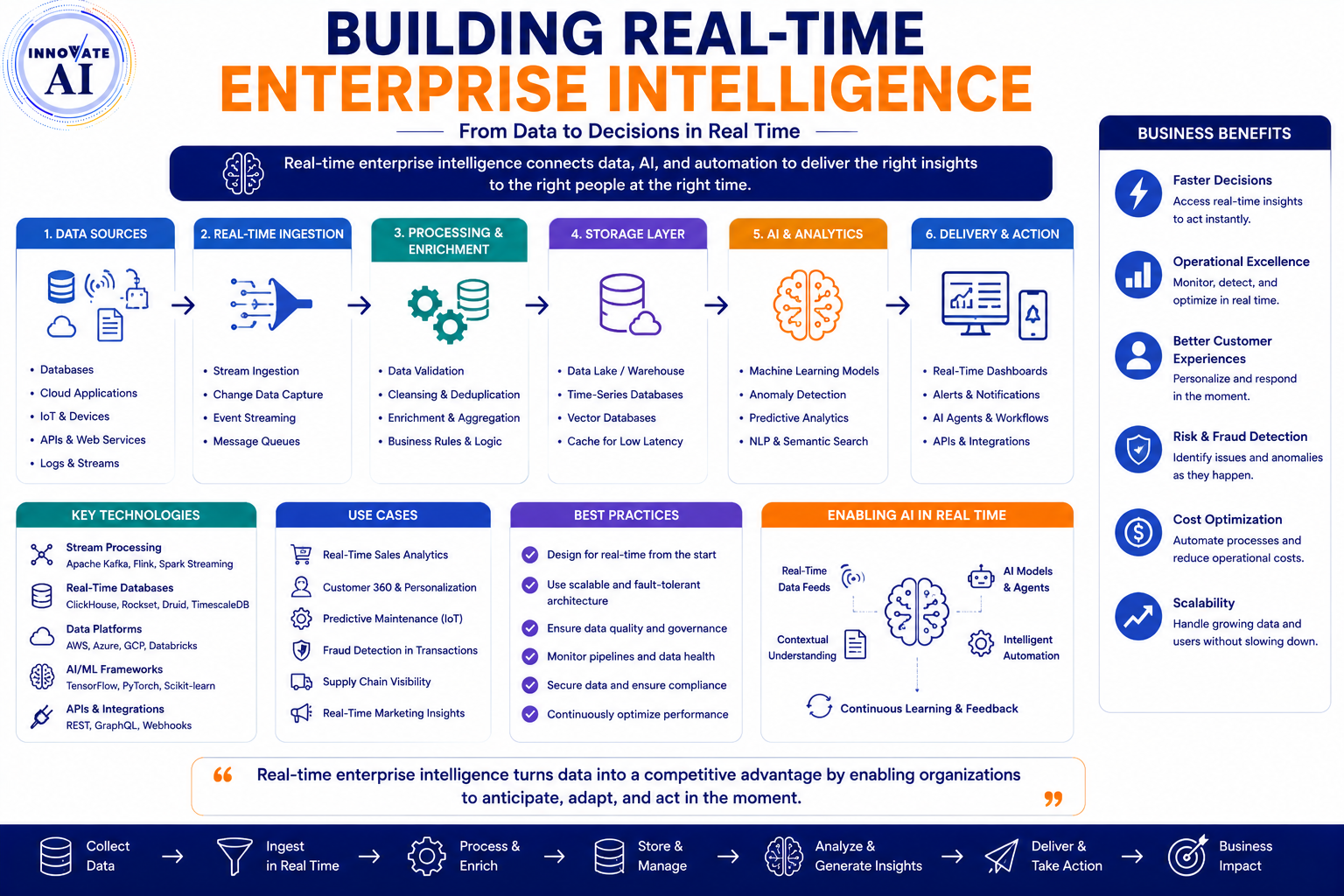
Modern real-time intelligence solutions operate through four key stages :
1. Ingestion and Processing
Data is captured from multiple sources: IoT devices, customer interactions, application signals, and transaction systems. Event streams process millions of events with subsecond latency .
2. Analysis, Transformation, and Enrichment
Raw events are enriched with business context—customer profiles, inventory data, service plans—and aggregated into usable datasets .
3. Training and Scoring
Machine learning models are trained and deployed to score events in real-time, detecting anomalies, predicting network issues, and optimizing performance .
4. Visualization and Activation
Real-time dashboards, automated alerts, and AI agents deliver insights and trigger actions when conditions are met .
Key Components of Real-Time Architecture
Real-Time Data Ingestion
High-velocity data enters the system through event streams. For example, NTT processes over 100,000 events per second with subsecond query latency across their global IP backbone .
Microsoft Fabric Real-Time Intelligence can handle over 1 TB/hour of router logs while maintaining subsecond response times .
Data Enrichment in Motion
Real-time intelligence isn't just about collecting data—it's about making it meaningful. Systems enrich streaming events with:
-
Customer and device information to link events to specific accounts
-
Operational metadata from ERP systems (inventory, service plans, maintenance schedules)
-
Geographic and service quality data to provide complete context
Real-Time Analytics and Querying
Modern platforms use technologies like Eventhouse with Kusto Query Language (KQL) to enable subsecond querying across high-cardinality datasets . This supports:
-
Time-series analysis
-
Pattern discovery
-
Anomaly detection
-
Geospatial queries
-
Vector similarity search
Automated Actions and Alerts
The final piece is automated response. Activators monitor data streams and trigger actions when conditions are met—from Teams notifications to automated workflows . For example, when inventory falls below a threshold, a restock workflow can be triggered automatically .
Why This Matters for AI
AI Can't Run on Stale Data
IDC's research makes this clear: agentic AI depends on current operational data and analytical context. If you want real ROI from agentic AI, it cannot run on stale data .
By 2027, 40% of the Global 2000 will adopt modern event streaming and pre-built real-time data views to support AI agents .
Selective Convergence
The goal isn't convergence for its own sake. It's to converge where faster insight, faster action, and AI-driven automation create real business value . Organizations should start with one simple question: where does stale data hurt the business? .
Real-World Impact
Telecommunications: NTT
NTT modernized its network observability with Imply's platform:
-
100,000+ events per second ingested with subsecond query latency
-
Unified visibility across latency, routing, and packet performance
-
Faster anomaly detection and response, improving customer experience
Industrial Manufacturing
With Microsoft Fabric Real-Time Intelligence, an industrial manufacturer can process millions of IoT events daily from customer factories while integrating complete asset metadata . This enables:
-
Real-time device monitoring
-
Predictive maintenance
-
Customer-specific analytics
-
Multi-tenant data isolation
Retail Analytics
An Azure Service Bus and Fabric real-time analytics solution processes inventory updates, purchase transactions, loyalty program updates, and customer feedback submissions . The system can:
-
Detect anomalies in checkout behavior
-
Trigger restock workflows automatically
-
Provide natural language interfaces for store managers
The Real-Time Enterprise Mindset
According to IDC's Devin Pratt, the real-time enterprise is not about better dashboards. It's about sensing what is happening and responding while the moment still matters—stopping fraud in the moment, predicting equipment issues before failure, or changing a customer interaction while it is still underway .
This is a shift from looking back at what happened to acting while it is happening .
Implementation Roadmap
Phase 1: Foundation (Weeks 1-4)
-
Identify critical latency gaps: Where does stale data hurt the business?
-
Assess data estate maturity: What data is streamed vs. batch?
-
Define governance requirements: Who needs access? What compliance rules apply?
-
Select starting point: One high-value use case requiring real-time action
Phase 2: Build Streaming Foundation (Weeks 5-8)
-
Deploy event streaming infrastructure: Apache Kafka, Azure Service Bus, or Fabric Eventstreams
-
Connect source systems: IoT devices, applications, transaction systems
-
Implement real-time enrichment: Add operational context to streaming events
-
Set up observability: Monitor latency, throughput, and quality
Phase 3: Enable Analytics and Action (Weeks 9-12+)
-
Deploy real-time analytics: Eventhouse or similar for subsecond querying
-
Create real-time dashboards: Visualize live data for operations teams
-
Implement automated actions: Activate workflows based on event patterns
-
Enable AI agents: Connect real-time data to agentic systems
-
Scale to additional use cases: Expand beyond the pilot
Frequently Asked Questions
Q1: What is the real-time enterprise?
The real-time enterprise senses what is happening and responds while the moment still matters—stopping fraud in the moment, predicting issues before failure, or changing customer interactions while they're still underway .
Q2: Why is batch processing no longer enough?
AI agents need live operational data to understand what is happening now. They can't run on stale data or delayed pipelines .
Q3: What technology do I need for real-time intelligence?
Event streaming platforms (Apache Kafka, Azure Service Bus), real-time analytics engines (KQL, Imply), and activation systems that trigger automated actions .
Q4: Should I converge all workloads?
No. The goal is selective convergence. Organizations should converge where faster insight and action create business value, and keep separate systems where strict isolation is needed .
Q5: How can Innovative AI Solutions help?
We help organizations design, build, and operationalize real-time enterprise intelligence—from architecture design and platform selection to implementation and scaling. Based in Delhi, serving clients across India.
Why Delhi is a Great Hub for AI Development
Delhi is emerging as a significant hub for AI development, backed by concrete government support and infrastructure. The recent Delhi Budget 2026-27 allocated ₹8.20 crore for two Artificial Intelligence centres of excellence (AI-CoEs), functioning as hubs for research, innovation, and startup incubation.
Under the IndiaAI Mission, more than 10,000 GPUs have been onboarded at subsidized rates. The government has also announced a ₹350 crore startup policy over five years, aiming to support at least 5,000 startups by 2035.
What We Offer at Innovative AI Solutions
-
Real-Time Strategy: We help you identify latency gaps and design a real-time architecture roadmap
-
Platform Selection: We help you choose between Fabric, Azure, AWS, or open-source solutions
-
Streaming Foundation: We help you deploy event streaming and data enrichment pipelines
-
Analytics and Action: We help you implement real-time dashboards, alerts, and automated workflows
-
AI Integration: We help you connect real-time data to agentic AI systems
Final Thought
The shift is clear: from looking back at what happened to acting while it is happening. The real-time enterprise isn't just about faster dashboards it's about enabling AI to reason, decide, and act with the right context and guardrails while the moment still matters .
Organizations that build real-time intelligence into their architecture will be the ones that can respond to market changes, customer needs, and operational challenges instantly. Those that don't will be left behind.
Phone: +91 7464 099 059 / +91 9689967356
Email: info@innovativeais.com
Address: Netaji Subhash Place, Pitampura, Delhi – 110034
Website: https://innovativeais.com
About the Author
Abhishek Kumar
Founder & CEO, Innovative AI Solutions
5+ years building AI systems for enterprises. Based in Delhi, serving clients across India.