The Big Question
Adding real-time functionality to a web application starts simple. A WebSocket connection opens, messages flow between client and server, and the feature works flawlessly in development. Then the application launches, users multiply, and everything falls apart.
The problems emerge predictably. Connections drop and clients reconnect simultaneously, overwhelming the server. State synchronization across multiple servers becomes a nightmare. Slow clients block message queues, causing memory to spiral. A single gateway restart triggers a thundering herd that takes down the entire system.
The core challenge is that real-time web applications are distributed systems pretending to be simple features . A chat message isn't just a string sent from point A to point B. It's a state change that must be synchronized across every connected client, persisted reliably, and delivered with acceptable latency regardless of network conditions.
Research from 2020 through September 2025 shows a clear convergence around WebSockets, hybrid edge–cloud architectures, and JavaScript-based ecosystems built on Node.js and React . The evidence suggests a growing preference for microservice-based architectures over monolithic designs because of their scalability, fault isolation, and support for asynchronous workflows . But the most effective architectural choice still depends on the application context.
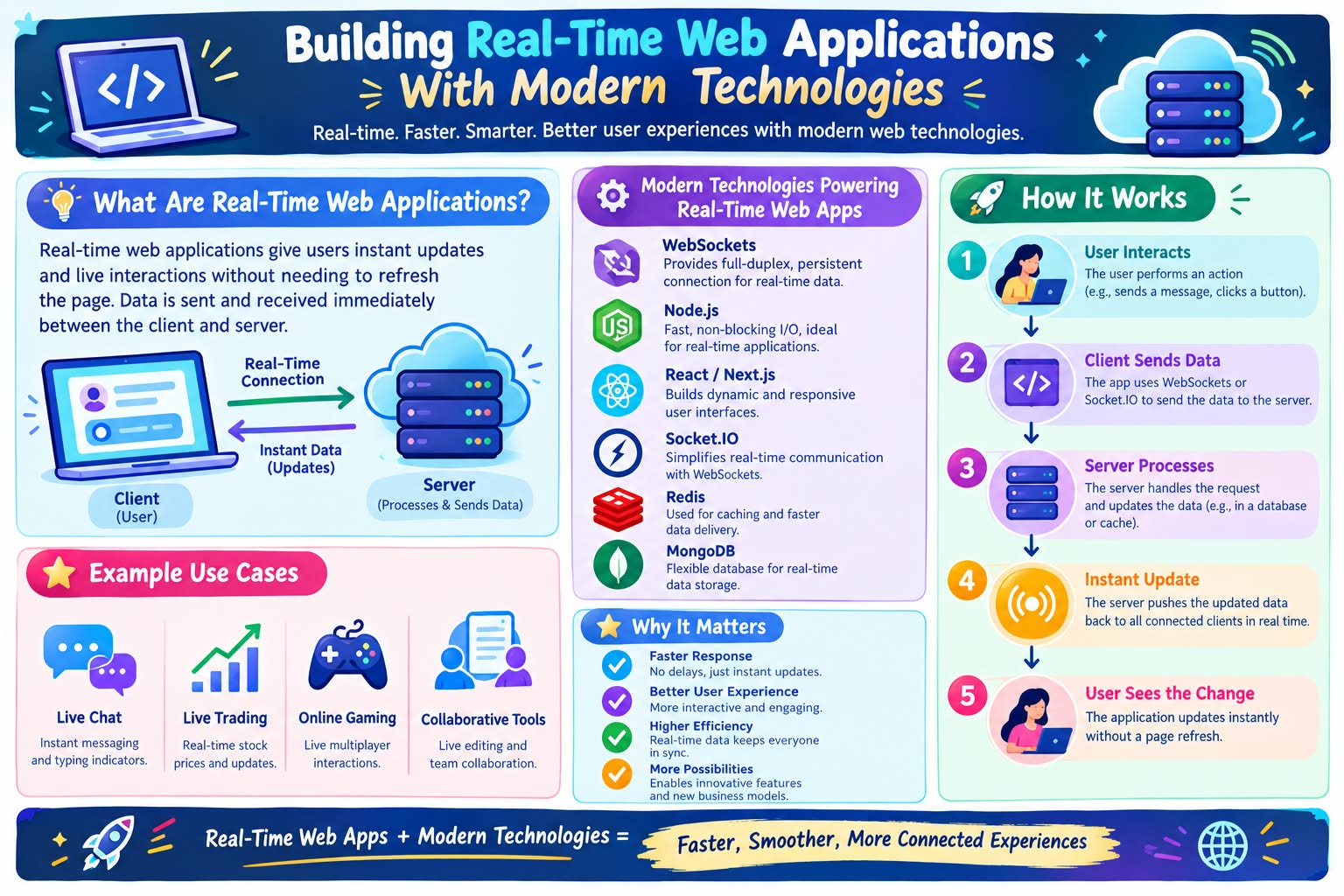
The starting point for any real-time project is understanding which communication technology fits your use case. SSE, WebSocket, WebRTC, and WebTransport each solve different problems .
Cost Based on Application Type
Real-time web application costs depend on the communication technology, the scale of concurrent users, and the complexity of state management. Here's the 2026 market landscape:
| Application Type | Build Cost (India) | Monthly Run Cost | Communication Pattern |
|---|---|---|---|
| Notification / Feed System | ₹3,00,000 – ₹8,00,000 | ₹15,000 – ₹50,000 | SSE (one-way push) |
| Chat / Messaging Platform | ₹8,00,000 – ₹25,00,000 | ₹40,000 – ₹1,50,000 | WebSocket (bidirectional) |
| Collaborative Editor | ₹15,00,000 – ₹40,00,000+ | ₹75,000 – ₹3,00,000 | WebSocket + CRDT / OT |
| Live Streaming / Voice / Video | ₹20,00,000 – ₹60,00,000+ | ₹1,00,000 – ₹5,00,000+ | WebRTC + SFU |
What drives the range:
The single biggest cost factor is state synchronization complexity. A notification system that pushes updates from server to client has minimal state management. A chat application must track message delivery, read receipts, presence, and conversation history across multiple servers. A collaborative editor must handle conflict resolution when two users edit the same document simultaneously .
Concurrent connection scaling adds another dimension. WebSocket connections are stateful, meaning they occupy server resources for their entire lifetime. Scaling to hundreds of thousands of concurrent connections requires kernel tuning, sticky routing, and a pub/sub backplane so any gateway can deliver any channel's messages .
The hidden cost trap: Real-time systems require ongoing operational investment. Connection monitoring, reconnection logic, backpressure handling, and failover testing are not one-time build costs. Teams that build real-time features without budgeting for operational support discover this during their first major outage.
Breakdown by Communication Technology
Choosing the right real-time technology is the foundational architectural decision. Each option serves specific use cases:
| Technology | Direction | Transport | Best For | Complexity |
|---|---|---|---|---|
| Polling | One-way (pull) | HTTP | Occasional updates, simple status checks | Low |
| SSE | One-way (push) | HTTP | Notifications, feeds, live scores | Low |
| WebSocket | Bidirectional | TCP (HTTP upgrade) | Chat, multiplayer games, collaborative editing | Medium |
| WebRTC | Bidirectional (P2P) | UDP | Voice/video calls, screen sharing, direct data transfer | High |
| WebTransport | Bidirectional | HTTP/3 (QUIC) | High-volume, low-latency, unreliable delivery | Medium-High |
The selection framework is straightforward :
If the client never needs to send data back on the same connection, use SSE. It works through virtually every proxy and load balancer, has built-in automatic reconnection via Last-Event-ID, and requires no special server configuration .
If bidirectional communication is required with strict in-order, reliable delivery, use WebSocket. This remains the correct default for chat, collaborative cursors, and most interactive applications in mid-2026 .
If the interaction never touches a server two browsers exchanging media or data directly use WebRTC. Media tracks for audio/video, data channels for arbitrary low-latency peer-to-peer data. Budget for TURN relay fallback, as 15-20% of network paths fail direct peer-to-peer connections .
If the workload benefits from unreliable delivery (dropping stale data rather than blocking) or independent multiplexed streams, WebTransport is production-viable as of March 2026 .
Breakdown by Developer Type (2020-2026)
Real-time development requires specialized skills in networking, state management, and distributed systems. The Indian talent market offers a range of options:
| Developer Type | Hourly Rate (India) | Typical Engagement | What They Deliver |
|---|---|---|---|
| Freelancer | ₹1,000 – ₹3,000 | ₹25,000 – ₹75,000 | Basic WebSocket setup, simple SSE feeds |
| Small Agency | ₹2,500 – ₹6,000 | ₹1,50,000 – ₹5,00,000 | Chat implementations, notification systems |
| Mid-Size Firm | ₹6,000 – ₹12,000 | ₹5,00,000 – ₹25,00,000 | Collaborative editing, presence systems, pub/sub backplanes |
| Enterprise Consultancy | ₹12,000 – ₹20,000+ | ₹25,00,000+ | SFU architecture, multi-region scaling, WebRTC infrastructure |
India's structural advantage: Senior developers in India bill at $20 to $55 per hour, with the median near $32 . Real-time web application development adds 20-40% to the base cost if it involves serious concurrency or multi-tenancy . The loaded cost of offshore work runs 1.4 to 1.8 times the quoted rate once management, ramp-up, and attrition are counted .
The critical question before hiring: "Show me a production real-time system you built that handles 10,000+ concurrent connections not a demo, a running system with monitoring and reconnection logic." Real-time features look simple in tutorials. In production, state synchronization and connection management are where projects fail.
Why Prices Changed in 2026
Three forces have reshaped real-time development economics.
First, the runtime landscape shifted. Research on high-load real-time systems in 2025-2026 compares Bun, Node.js, Deno, and Go runtimes. Bun, written in Zig, demonstrates the lowest startup time and highest throughput, which is critical for real-time performance. The planned architecture for modern real-time platforms uses Bun with Hono on the backend, achieving 3-5 times higher performance compared to traditional Node.js solutions . The ecosystem is moving toward decoupled, event-driven systems that rely on asynchronous communication .
Second, gRPC emerged as the internal communication standard. For microservice communication, gRPC provides 3-10 times less traffic compared to JSON in REST due to efficient Protobuf serialization, supports bidirectional streaming for real-time, and reduces latency by 30-50% . The recommended architecture is hybrid: gRPC for internal service-to-service communication, REST/Hono for client-facing requests .
Third, the managed real-time platform market matured. Building real-time infrastructure from scratch is increasingly hard to justify. Managed platforms handle connection management, scaling, and failover. For rich collaboration with presence and storage, the default recommendation is now a managed real-time platform or CRDT stack rather than custom WebSocket infrastructure .
Pro Tips to Save Money in 2026
1. Start with SSE before WebSocket. If your use case is server-to-client push notifications, feeds, live scores SSE is simpler, works through every proxy, and has built-in reconnection . WebSocket adds complexity you don't need unless bidirectional communication is required.
2. Plan for reconnection from day one. Every WebSocket client disconnects eventually. Networks drop, devices sleep, servers restart. The thundering herd problem occurs when a gateway restarts and all disconnected clients reconnect simultaneously, overwhelming surviving gateways. Mitigate with exponential backoff plus full jitter on the client .
3. Use in-flight request deduplication for data fetching. Atlassian's real-time event app found that multiple React components mounted at nearly the same time and independently requested the same data. A cache of completed responses didn't help because the first response hadn't returned yet. Sharing in-flight promises eliminated duplicate network calls .
4. Design for eventual consistency, not instant consistency. New user provisioning is not instantly consistent. Permissions propagate across systems with delay. Atlassian's approach: render useful content immediately from cached data, persist user intent locally before trusting the remote write path, and overlay recently completed actions while the read model catches up .
5. Budget for TURN relay bandwidth in WebRTC. TURN relay bandwidth is the single most volatile cost line in WebRTC deployments. About 15-20% of network paths fail direct peer-to-peer connections due to symmetric NAT or restrictive firewalls. Do not ship WebRTC without a TURN fallback budgeted in .
6. Use SFU for multi-party WebRTC beyond 4-6 participants. Peer-to-peer mesh is O(N²) each additional peer multiplies every existing peer's upload bandwidth. Beyond small huddles, route media through a Selective Forwarding Unit (SFU) so each client uploads once and the SFU fans out .
Questions to Ask Before Hiring
Before you commit budget to any real-time development engagement, ask these questions.
1. "What communication technology do you recommend, and why?" The right answer maps your use case to the technology. One-way push → SSE. Bidirectional interaction → WebSocket. Peer-to-peer media → WebRTC. If they default to WebSocket for everything, they haven't thought about the trade-offs .
2. "How do you handle reconnection and thundering herd?" Every real-time system faces this. The right answer involves exponential backoff with jitter, sticky routing so reconnects land on the same gateway, and edge caches to absorb reconnect metadata requests .
3. "How do you scale WebSocket horizontally?" Three things are required: sticky routing, a pub/sub backplane so any gateway can deliver any channel's messages, and kernel tuning to handle hundreds of thousands of file descriptors .
4. "What's your backpressure strategy?" When a slow client stops acknowledging messages, the server's kernel send buffer fills and application-level queues grow unboundedly. The right answer involves checking getBufferedAmount() per client and dropping non-critical events or disconnecting with a resume hint .
5. "Who maintains the real-time infrastructure after launch?" Real-time systems require ongoing operational investment. Connection monitoring, failover testing, and scaling adjustments are not one-time costs. Ask for retained operations as part of the engagement.
Why Delhi is a Great Hub for Real-Time Development
Delhi-NCR has become a serious destination for real-time web development work, and the reason isn't just cost.
The region hosts a growing cluster of companies building real-time platforms. Softlume (Delhi, founded 2026) builds high-performance web platforms, SaaS products, and AI-driven automation with React, Next.js, and Python . SecWiz Technologies (Delhi, founded 2024, 31-person team) specializes in high-performance web development, AI-powered solutions, and cybersecurity, serving E-commerce, SaaS, Healthcare, and Finance clients .
India's conference ecosystem is also contributing to real-time research. A 2025 IEEE conference in Greater Noida presented research on real-time collaborative programming environments using WebRTC, Socket.io, Node.js, and React.js . The proposed architecture and synchronization strategy provide a foundation for future empirical studies and performance analysis .
The talent density keeps improving. With a steady pipeline of full-stack engineers, backend specialists, and cloud architects, Delhi offers a combination of cost and capability that's hard to match. And the time zone advantage matters: a Delhi-based team can sync with Middle East morning, European afternoon, and US East Coast evening.
What We Offer
At Innovative AI Solutions, we build real-time web applications that stay connected and scale.
Our approach:
-
Technology Selection First. We map your use case to the right communication technology. SSE for one-way push. WebSocket for bidirectional interaction. WebRTC for peer-to-peer media. No default choices.
-
Reconnection and Resilience. Exponential backoff with jitter, sticky routing, and in-flight request deduplication. Your system survives gateway restarts and network blips.
-
Eventual Consistency by Design. We render useful content immediately, persist user intent locally, and overlay settled actions while read models catch up.
-
Backpressure Handling. We check buffered amounts per client, drop non-critical events, and disconnect with resume hints. Slow clients don't take down the system.
-
Retained Operations. Connection monitoring, failover testing, and scaling adjustments. Your real-time system doesn't rot because someone forgot it existed.
Our principle is simple: small steps, fast iteration, data speaks.
Frequently Asked Questions
Q: What is a real-time web application?
A real-time web application delivers data updates to users immediately as events occur, without requiring page refreshes or manual polling. Examples include chat applications, collaborative editors, live notifications, multiplayer games, and streaming dashboards. The defining characteristic is low-latency bidirectional or server-to-client communication .
Q: Should I use WebSocket or SSE?
Use SSE when you only need server-to-client push notifications, feeds, live scores. It's simpler, works through every proxy, and has built-in reconnection . Use WebSocket when you need bidirectional communication chat, collaborative editing, multiplayer games . When in doubt, start from SSE or WebSocket. If one-way suffices, SSE is easy. If you need two-way, WebSocket is easy .
Q: How do I scale WebSocket connections?
Three things are required: (1) Sticky routing so reconnects land on the same gateway. (2) A pub/sub backplane so any gateway can deliver any channel's messages. (3) Kernel tuning to handle hundreds of thousands of file descriptors and shrunk TCP buffers per process .
Q: What is the thundering herd problem?
When a gateway restarts, all disconnected clients reconnect simultaneously, overwhelming surviving gateways and auth services. Mitigate with exponential backoff plus full jitter on the client, and edge caches that absorb reconnect metadata requests without hitting origin .
Q: How much does a real-time web application cost in India?
Build costs range from ₹3,00,000 for a notification system to ₹60,00,000+ for a live streaming platform. Real-time adds 20-40% to base web app development costs . Monthly run costs scale with concurrent connections and data volume.
Frequently Asked Questions (Extended)
Q: What is backpressure in a WebSocket server?
When a slow client stops acknowledging messages, the server's kernel send buffer fills and application-level queues grow unboundedly. Handle it by checking getBufferedAmount() per client. If it exceeds a threshold, drop non-critical events or disconnect with a resume hint .
Q: What kernel parameters need tuning for millions of WebSocket connections?
Raise fs.file-max (12M+), ulimit -n (20M), and shrink per-socket TCP buffers (tcp_rmem, tcp_wmem to 4-16 KB) so idle sockets fit in memory. The Phoenix team documented hitting every one of these ceilings on the road to 2 million connections on a single 40-core server .
Q: How does Discord handle WebRTC at scale?
Every client connects directly to a C++ SFU whose endpoint is assigned via etcd service discovery. Since all peers connect to the SFU (not to each other), NAT traversal is deterministic and ICE is unnecessary. This also hides client IPs for DDoS defense .
Q: What's the first step I should take tomorrow?
Pick one real-time feature. Just one. A notification feed is the simplest starting point. Choose SSE. Build it. Measure the connection behavior under load. Then expand to bidirectional features if needed. That's how you start. Not with a strategy document about real-time transformation.
Contact Us:
Phone: +91 7464 099 059 / +91 9689967356
Email: info@innovativeais.com
Address: 9th Floor, Pearls Best Heights-I, Head Office: 904, Netaji Subhash Place, Delhi, 110034