The Big Question
What happens when building on top of a platform does not require the platform's approval? When a user can move their identity, data, or reputation between services without asking anyone? When a developer can integrate with a protocol without negotiating a partnership?
Most of the web still runs on permission. But a growing set of capabilities does not, and understanding where permission is necessary and where it is incidental changes what organizations can build.
What Permissionless Actually Means
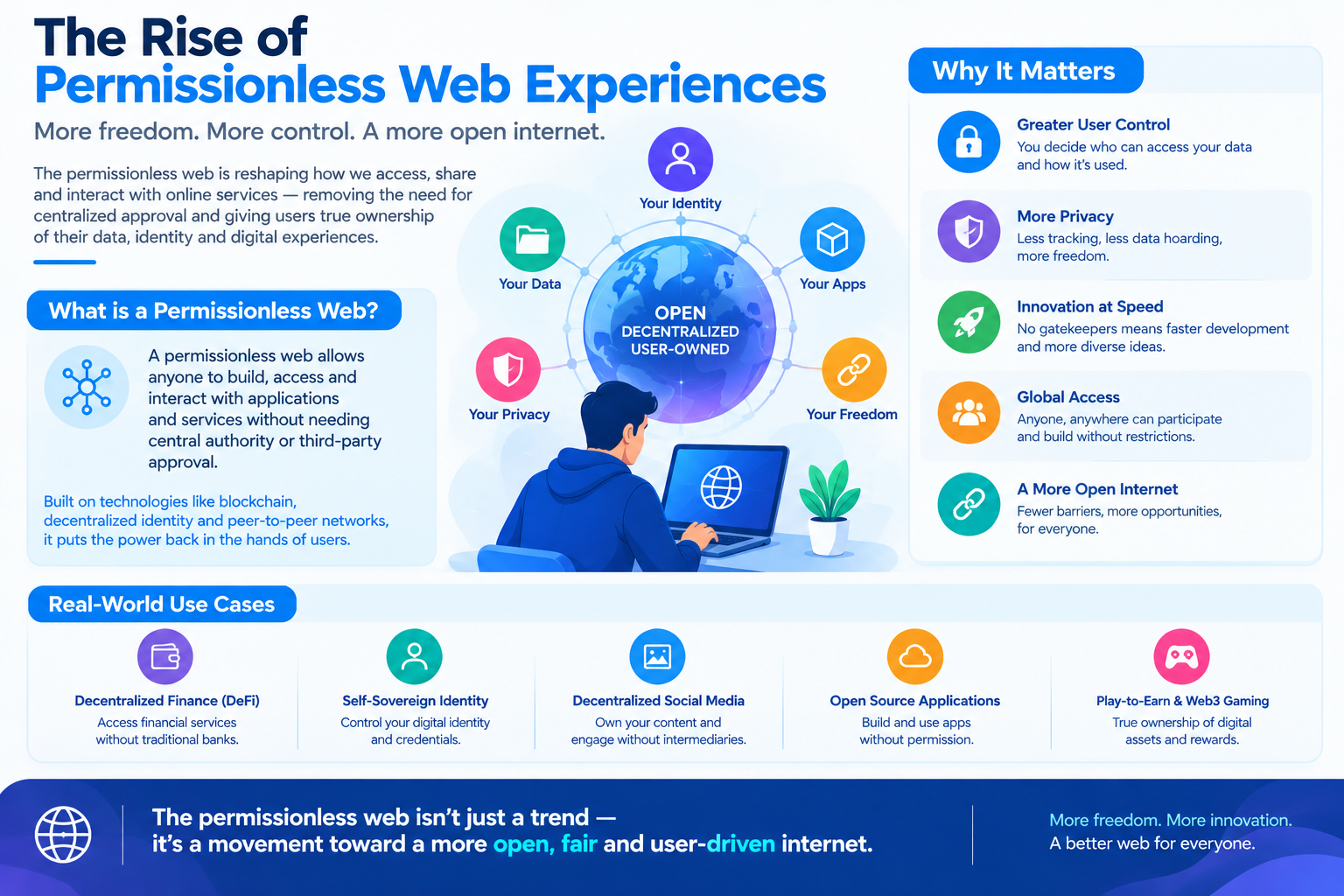
Permissionless means participation does not require approval from a central authority.
The contrast:
| Permissioned | Permissionless |
|---|---|
| A gatekeeper approves access | Anyone can participate |
| Rules are set by the operator | Rules are defined by protocol |
| Access can be revoked arbitrarily | Access cannot be revoked unilaterally |
| Identity is issued by the platform | Identity is self-sovereign |
| Data is held by the platform | Data is portable |
The important qualification: Permissionless does not mean ungoverned. Rules still exist. They are just not enforced by a single party who can exclude anyone at will.
What Makes an Experience Permissionless
Permissionless systems share several properties.
Open Participation
Anyone can join without approval. There is no application, no allowlist, and no gatekeeper deciding who qualifies.
Verifiable Rules
The rules are defined in code or protocol rather than in policy documents that can be changed at will. Participants can verify the rules rather than trusting the operator.
Portable Identity
Identity is not owned by the platform. Users can present credentials across services and take their reputation with them.
Portable Data
Data is not locked in a proprietary format behind a proprietary API. Users can move it.
Composable Interfaces
Any developer can build on top of the system without negotiating access.
The Building Blocks
Permissionless experiences depend on several technical capabilities.
Open Protocols
Protocols that anyone can implement, rather than APIs that require an account and approval. HTTP itself is an example: anyone can build a server or client without permission.
Self-Sovereign Identity
Identity that the user controls rather than the platform. Decentralized identifiers and verifiable credentials allow users to prove claims without a central issuer's involvement at verification time.
Verifiable Credentials
Credentials that can be verified cryptographically without contacting the issuer, enabling trust across organizational boundaries.
Blockchain and Smart Contracts
Systems where rules are enforced by code and state is shared across participants, removing the need for a trusted operator.
Content Addressing
Content identified by its hash rather than its location, enabling verification and distribution without a central host.
Portable Reputation
Reputation that travels with the user rather than being locked to a single platform.
Where Permissionless Works
Open Source and Public Protocols
Open-source software is inherently permissionless. Anyone can use, modify, and distribute it. Public protocols like HTTP, SMTP, and DNS work the same way.
Why it works: The value comes from ubiquity, and ubiquity requires open participation.
Developer Platforms
Platforms that allow any developer to build without approval. The web itself is the original example. App stores are the counter-example they require approval.
Why it works: Open participation increases the number of applications, which increases the value of the platform.
Identity and Credentials
Self-sovereign identity systems allow users to present credentials without a central issuer's involvement at verification time.
Why it works: Verification becomes cheaper and more portable.
Financial Infrastructure
Public blockchains allow anyone to transact without approval, subject to the rules of the protocol.
Why it works: Removing intermediaries reduces friction and cost for cross-border and programmatic transactions.
Content Distribution
Content-addressed networks allow anyone to publish and anyone to retrieve, without a central host.
Why it works: Distribution does not depend on a single provider's continued participation.
Where Permissionless Fails
Permissionless is not universally better. It fails in specific conditions.
When Moderation Is Essential
Systems that must remove harmful content need someone to decide what is harmful. Permissionless systems struggle with this.
The tension: Moderation requires a gatekeeper; permissionlessness rejects gatekeepers.
When Accountability Is Required
Systems where someone must answer for outcomes need identifiable responsible parties.
The tension: Anonymity is compatible with permissionlessness; accountability is not.
When Compliance Is Mandatory
Regulated activities financial services, healthcare, and others require identity verification, reporting, and oversight.
The tension: Compliance requires gatekeeping.
When Quality Must Be Assured
Systems where poor quality has serious consequences need vetting.
The tension: Open participation means no vetting.
When Coordination Is Complex
Systems requiring coordination between many parties often need a coordinator.
The tension: Permissionless systems are hard to coordinate.
The Hybrid Reality
Most successful systems are hybrid. They combine permissionless participation with permissioned controls where necessary.
The pattern:
| Layer | Approach |
|---|---|
| Protocol | Permissionless : anyone can participate |
| Application | Permissioned : quality and compliance controls |
| Identity | Self-sovereign : user controls credentials |
| Verification | Permissionless : cryptographic verification |
| Moderation | Permissioned : content and behaviour policies |
| Settlement | Permissionless : open financial rails |
The principle: Permissionlessness is a property of specific layers, not of entire systems. The question is which layers benefit from open participation.
What Changes for Organizations
Building permissionless experiences changes how organizations think about their product.
From Platform to Protocol
Instead of owning a platform that others must ask to join, organizations can build protocols that anyone can implement.
The trade-off: Protocols are harder to monetize directly but easier to grow.
From Lock-In to Portability
When identity and data are portable, users can leave. This removes lock-in as a strategy and forces competition on quality.
The trade-off: Retention requires value, not friction.
From Permission to Verification
Instead of deciding who can participate, systems verify what participants claim.
The trade-off: Verification requires investment in cryptographic infrastructure.
From Central Control to Distributed Governance
Rules are set by protocol or community rather than by a single operator.
The trade-off: Distributed governance is slower and messier than central control.
Implementation Roadmap
Phase 1: Assess (Weeks 1-4)
-
Identify where permission creates friction. Which participants must be approved today?
-
Determine where permission is necessary. Which participants require vetting for compliance or quality?
-
Assess readiness. Do you have the technical capability for verification, portability, and open protocols?
Phase 2: Build (Weeks 5-12)
-
Open the protocol layer where open participation adds value.
-
Implement self-sovereign identity or portable credentials where relevant.
-
Implement cryptographic verification for claims that participants make.
-
Maintain permissioned controls where compliance and moderation require them.
Phase 3: Operate (Weeks 13-16+)
-
Monitor participation and quality.
-
Adjust the permission boundary as conditions change.
-
Invest in verification infrastructure.
-
Govern the protocol with clear rules and transparent change processes.
Frequently Asked Questions
Q1: What is a permissionless web experience?
An experience where participation does not require approval from a central authority. Anyone can join, build, or verify without asking permission.
Q2: Does permissionless mean ungoverned?
No. Rules still exist. They are defined by protocol or code rather than by a single operator who can exclude participants arbitrarily.
Q3: Is this only about blockchain?
No. Open protocols, self-sovereign identity, and content addressing all reduce permission requirements without blockchain. Blockchain is one enabling technology among several.
Q4: When is permission necessary?
When moderation, accountability, compliance, or quality assurance are required. These are genuine needs, not gatekeeping for its own sake.
Q5: Can systems be partly permissionless?
Yes, and most successful systems are. Protocol layers can be permissionless while application layers retain permissioned controls.
Q6: How can Innovative AI Solutions help?
We help organizations evaluate where permission is necessary and build permissionless capabilities — from open protocols and verifiable credentials to portable identity and cryptographic verification. Explore our services to see how we approach platform and protocol engineering. Based in Delhi, serving clients across India.
Why Delhi is a Great Hub for Open Web Engineering
Delhi is emerging as a hub for web and platform engineering, backed by a thriving developer ecosystem and India's demonstrated capability in building open digital infrastructure. India Stack — Aadhaar, UPI, and the surrounding layers — showed at national scale what open protocols can achieve. Organizations building permissionless capabilities in the region have a strong foundation to build on.
What We Offer at Innovative AI Solutions
-
Permission Assessment: We evaluate where permission creates friction and where it is necessary.
-
Protocol Design: We help build open protocol layers with clear governance.
-
Verifiable Credentials: We implement cryptographic verification of participant claims.
-
Portable Identity: We implement self-sovereign identity where relevant.
-
Hybrid Architecture: We combine permissionless protocol layers with permissioned controls.
-
Governance Design: We help define how protocols evolve and who decides.
Final Thought
The shift is clear: from permission as the default to permission as a deliberate choice. Not every experience should be permissionless. Moderation, accountability, compliance, and quality assurance are real needs. But permission is often applied where it is not required, and removing it where it is not necessary opens participation that a gatekeeper would otherwise limit. Organizations that understand the difference will build systems that grow faster and serve more participants. Those that gatekeep by habit will keep discovering that the gate was the constraint.
Contact Us:
Phone: +91 7464 099 059 / +91 9689967356
Email: info@innovativeais.com
Address: 904, 9th floor Pearls Best Heights-I, Netaji Subhash Place, Delhi-110034
Website: https://innovativeais.com
About the Author
Abhishek Kumar
Founder & CEO, Innovative AI Solutions
5+ years building AI, cloud, and enterprise systems. Based in Delhi, serving clients across India.