The Big Question
What happens when a single lost packet stalls every request on a connection? When a mobile user switches from Wi-Fi to cellular and the connection breaks? When establishing a secure connection requires multiple round trips before the first byte of data moves?
TCP, the transport protocol that has carried the web for decades, has structural limitations that no amount of application-layer optimization can fully overcome. HTTP/3 and QUIC are the industry's answer.
What QUIC and HTTP/3 Actually Are
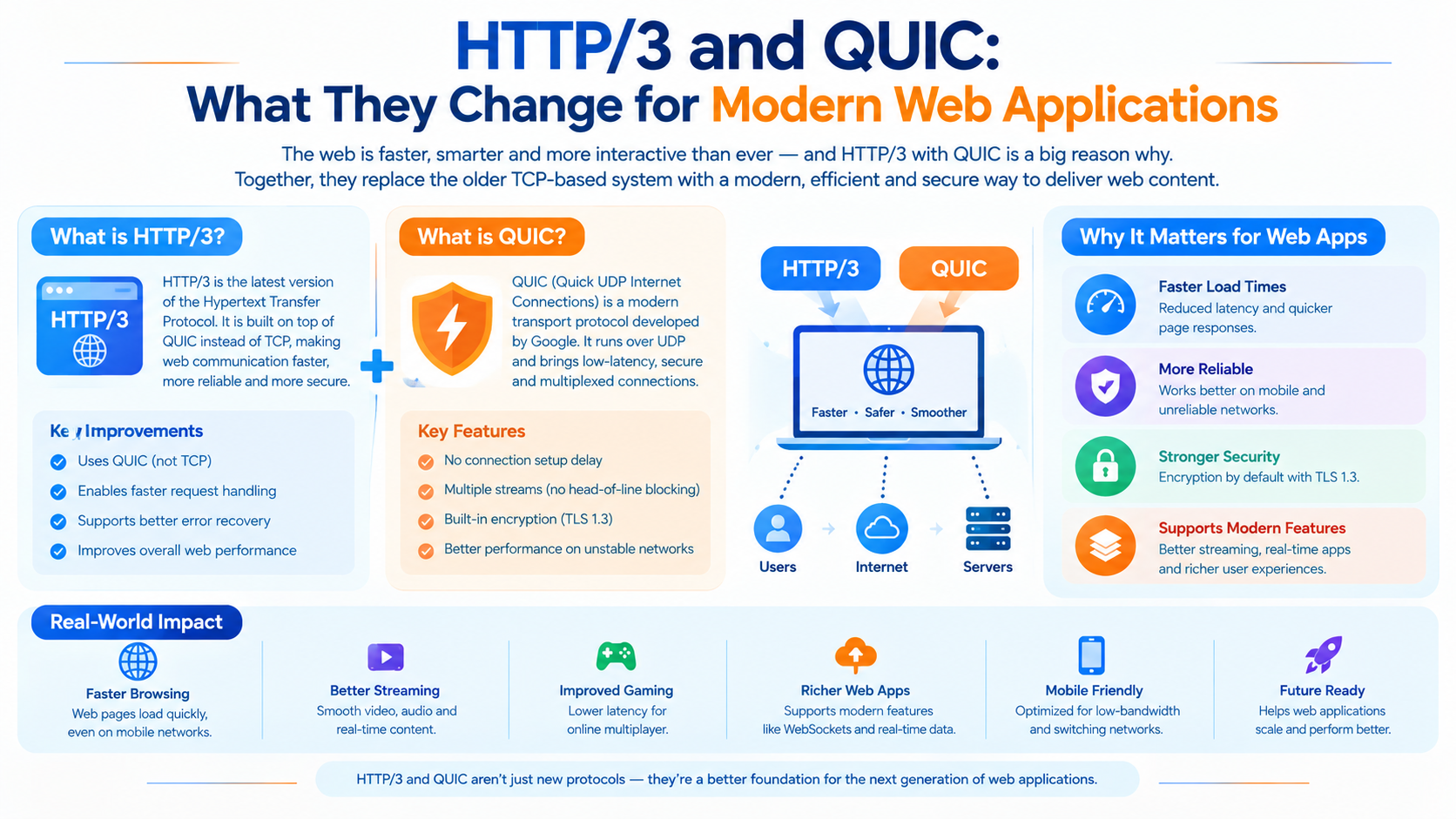
QUIC is a general-purpose transport protocol built on UDP. HTTP/3 is the HTTP semantics — request methods, status codes, headers carried over QUIC.
The relationship: QUIC provides the transport. HTTP/3 provides the application protocol. They are separate specifications.
The key design decision: QUIC runs in user space rather than the kernel. This allows it to evolve without requiring operating system changes, which is the primary reason TCP has been difficult to update .
What Changed Under the Hood
Eliminating Head-of-Line Blocking
TCP treats a connection as a single ordered stream. If one packet is lost, every subsequent packet on that connection waits for retransmission even if those packets belong to different requests. This is head-of-line blocking.
QUIC provides independent streams within a single connection. A lost packet affects only the stream it belongs to. Other streams continue without interruption .
Why this matters: HTTP/2 multiplexes requests over a single TCP connection, but a single packet loss can still stall all of them. HTTP/3 removes this constraint entirely.
Faster Connection Establishment
TCP requires a three-way handshake before TLS can begin, then TLS requires its own handshake. Establishing a secure connection takes multiple round trips.
QUIC combines transport and encryption handshakes. A new connection takes one round trip (1-RTT). A returning connection can achieve zero round trips (0-RTT) by resuming a previous session .
The practical impact: On a commercial 5G network, 0-RTT reduced median time to first byte by 70% compared to TCP . On high-latency links, handshake delay drops by about one round trip .
Connection Migration
TCP connections are identified by a four-tuple: source IP, source port, destination IP, destination port. When a mobile device changes networks Wi-Fi to cellular, for example the four-tuple changes and the connection breaks.
QUIC uses a connection identifier that is independent of the network path. A connection can survive an IP address change without renegotiation .
Why this matters: Mobile users switch networks constantly. Connection migration removes a class of connection failures that TCP cannot address.
Built-in Encryption
QUIC embeds TLS 1.3 in the transport itself. Nearly the entire packet payload, including headers, is encrypted. HTTP/2 leaves encryption to the application layer and encrypts less of the packet .
The consequence: Passive profiling of traffic is harder. But it also means middleboxes that inspect packet headers cannot see QUIC traffic, which is why some networks block it.
What This Changes for Applications
Latency-Sensitive Applications
Applications that depend on low latency benefit most. Real-time applications — gaming, AR/VR, collaborative tools — require end-to-end latencies below 50ms, often below 20ms . QUIC's reduced handshake and independent streams help achieve this.
Mobile Applications
Connection migration directly addresses the mobile use case. A user moving between networks no longer experiences connection failure and retry. The connection persists .
API and Microservices Traffic
Services that make many concurrent requests benefit from independent streams. A single slow or lost response no longer blocks the others .
IoT and Embedded Systems
QUIC's ability to provide both reliable streams and unreliable datagrams makes it suitable for IoT communication. But user-space implementations have higher processor overhead, which matters on constrained devices .
The Performance Reality: Where Gains Are Real and Where They Aren't
HTTP/3 does not improve performance uniformly. The gains depend on network conditions.
Where HTTP/3 Helps
Lossy or high-latency networks. QUIC shows more stable latency behavior and more gradual performance degradation under packet loss compared to TCP . In Chinese long-tail networks, QUIC reduced transfer time by 17% .
Mobile and 5G networks. 0-RTT handshake provides measurable benefit on 5G .
Same-ISP paths. When client and server are on the same ISP, HTTP/3 delivers its expected TTFB advantage .
Where HTTP/3 Does Not Help
Fast, stable networks. On fast internet connections, QUIC's page load time was 3% longer than HTTP/2 across 100 representative websites. The cause is receiver-side processing overhead — user-space packet handling and ACK generation consume more CPU than kernel-space TCP .
Optimized CDN edge scenarios. In low-latency CDN edge scenarios, QUIC slightly regressed performance by 0.79% .
Cross-ISP paths. A case study in China found that on cross-ISP paths under short deadlines, 20MB HTTP/3 success dropped to 24% versus 70% for HTTP/2. The failures were mid-transfer stalls, not handshake failures .
Raw throughput. Under controlled lossless conditions, TCP achieves higher throughput than QUIC due to kernel-space efficiency. QUIC incurs 40% higher processor usage compared to TCP with TLS .
The Nuance
The performance gap is not about the protocol design. It is about implementation maturity. QUIC runs in user space, which introduces overhead that kernel-space TCP does not have. UDP generic receive offload (GRO) is not widely deployed for QUIC, meaning the kernel passes more packets to user space than necessary .
The trajectory: These are engineering problems, not architectural ones. As QUIC implementations mature and kernel offloading improves, the gap narrows.
Adoption: Where Things Stand
HTTP/3 adoption has grown rapidly.
| Metric | Value |
|---|---|
| Websites using HTTP/3 (July 2026) | 40.0% |
| Top 1,000,000 websites using HTTP/3 | 43.9% |
| Non-Chinese websites with HTTP/3 support | 35.0% |
| Chinese websites with HTTP/3 support | 5.7% |
| Meta traffic on QUIC/HTTP3 | ~75% |
Regional variation: India shows 8.6% HTTP/3 usage, Indonesia 7.4%, while Ireland reaches 45.9% . Adoption correlates with CDN presence and network modernization.
The Implementation Landscape
Server-Side Support
Cloud providers: Azure Application Gateway supports HTTP/3 in preview . Cloudflare, Google, and Meta have deployed at scale.
Web servers: Kestrel (ASP.NET Core) supports HTTP/3 in .NET 7+ . NGINX supports it via Cloudflare's quiche library .
Java: Java 26 includes HTTP/3 support in the standard HTTP client . Apache HttpComponents has not yet implemented it, citing ecosystem instability and the complexity of integrating non-Java QUIC implementations .
Client-Side Support
Browsers have supported HTTP/3 for years. But QUIC's user-space implementation on the client side is a performance factor mobile devices have less processing power than servers .
Congestion Control
QUIC's congestion control is pluggable. Implementations support:
-
CUBIC: Well-tested, TCP-friendly, but can overshoot on high-bandwidth links
-
BBRv2: Better throughput in shallow buffers, addresses fairness issues of BBRv1
-
HyStart++: Hybrid slow start that reduces loss during startup
The choice matters for performance under different network conditions.
Implementation Roadmap
Phase 1: Assess (Weeks 1-2)
-
Measure current performance. What are your latency and throughput baselines?
-
Identify target use cases. Where would reduced handshake latency or connection migration help?
-
Check CDN support. Does your CDN or load balancer support HTTP/3?
Phase 2: Enable (Weeks 3-4)
-
Enable HTTP/3 on the server where supported.
-
Verify Alt-Svc discovery. HTTP/3 is negotiated via the Alt-Svc header the first request uses HTTP/2 or HTTP/1.1 before upgrading .
-
Confirm fallback. Ensure HTTP/1.1 and HTTP/2 remain available.
Phase 3: Measure and Optimize (Weeks 5-8+)
-
Compare performance. HTTP/3 vs. HTTP/2 on your actual user base.
-
Segment by network condition. Mobile vs. desktop, high-latency vs. low-latency.
-
Monitor QUIC-specific issues. Blocked UDP, middlebox interference.
-
Tune if needed. Congestion control, buffer sizes.
Frequently Asked Questions
Q1: What is the difference between QUIC and HTTP/3?
QUIC is the transport protocol the mechanism for moving data. HTTP/3 is the application protocol the HTTP semantics carried over QUIC. They are separate specifications that work together.
Q2: Does HTTP/3 always improve performance?
No. On fast, stable networks, QUIC's user-space processing can make it slightly slower than HTTP/2. Gains are most consistent on lossy, high-latency, and mobile networks .
Q3: Why is QUIC built on UDP?
UDP allows QUIC to run in user space, which means it can evolve without kernel changes. TCP is ossified because middleboxes and operating systems assume specific behavior .
Q4: What is head-of-line blocking?
When a lost packet stalls all subsequent data on a connection, even data belonging to independent requests. QUIC eliminates this by giving each stream independent delivery .
Q5: What is connection migration?
QUIC connections are identified by a connection ID, not a network address. When a device changes networks Wi-Fi to cellular the connection survives .
Q6: How can Innovative AI Solutions help?
We help organizations assess HTTP/3 readiness, enable it where it helps, and measure the real-world impact on their user base. Explore our services to see how we approach web performance engineering. Based in Delhi, serving clients across India.
Why Delhi is a Great Hub for Web Performance Engineering
Delhi is emerging as a hub for web and product engineering, backed by a thriving developer ecosystem and a user base that spans diverse network conditions. India shows relatively low HTTP/3 adoption at 8.6% , which means organizations that adopt early may see disproportionate benefit on the mobile and variable networks where Indian users operate.
What We Offer at Innovative AI Solutions
-
HTTP/3 Readiness Assessment: We evaluate whether HTTP/3 would help your applications.
-
Server-Side Enablement: We configure HTTP/3 on supported platforms.
-
Performance Measurement: We compare HTTP/3 and HTTP/2 across real network conditions.
-
Monitoring: We track QUIC-specific issues and fallback behavior.
-
Congestion Control Tuning: We optimize for your traffic patterns.
Final Thought
The shift is clear: from TCP as the universal transport to QUIC as a modern alternative. HTTP/3 and QUIC address real structural limitations head-of-line blocking, slow handshakes, connection fragility. But the gains are not automatic. They depend on network conditions, implementation maturity, and careful measurement. Organizations that understand where HTTP/3 helps and where it does not will deploy it deliberately. Those that assume it is universally faster will discover that the protocol is only part of the performance equation.
Contact Us:
Phone: +91 7464 099 059 / +91 9689967356
Email: info@innovativeais.com
Address: 904, 9th floor Pearls Best Heights-I, Netaji Subhash Place, Delhi-110034
Website: https://innovativeais.com
About the Author
Abhishek Kumar
Founder & CEO, Innovative AI Solutions
5+ years building AI, cloud, and enterprise systems. Based in Delhi, serving clients across India.