The Big Question
What happens when you need real-time data to flow directly between two browsers, without routing every message through a server? When you need sub-100ms latency for a multiplayer game, a collaborative editor, or a remote control application? When you need to transfer a large file peer-to-peer without uploading it to a server first?
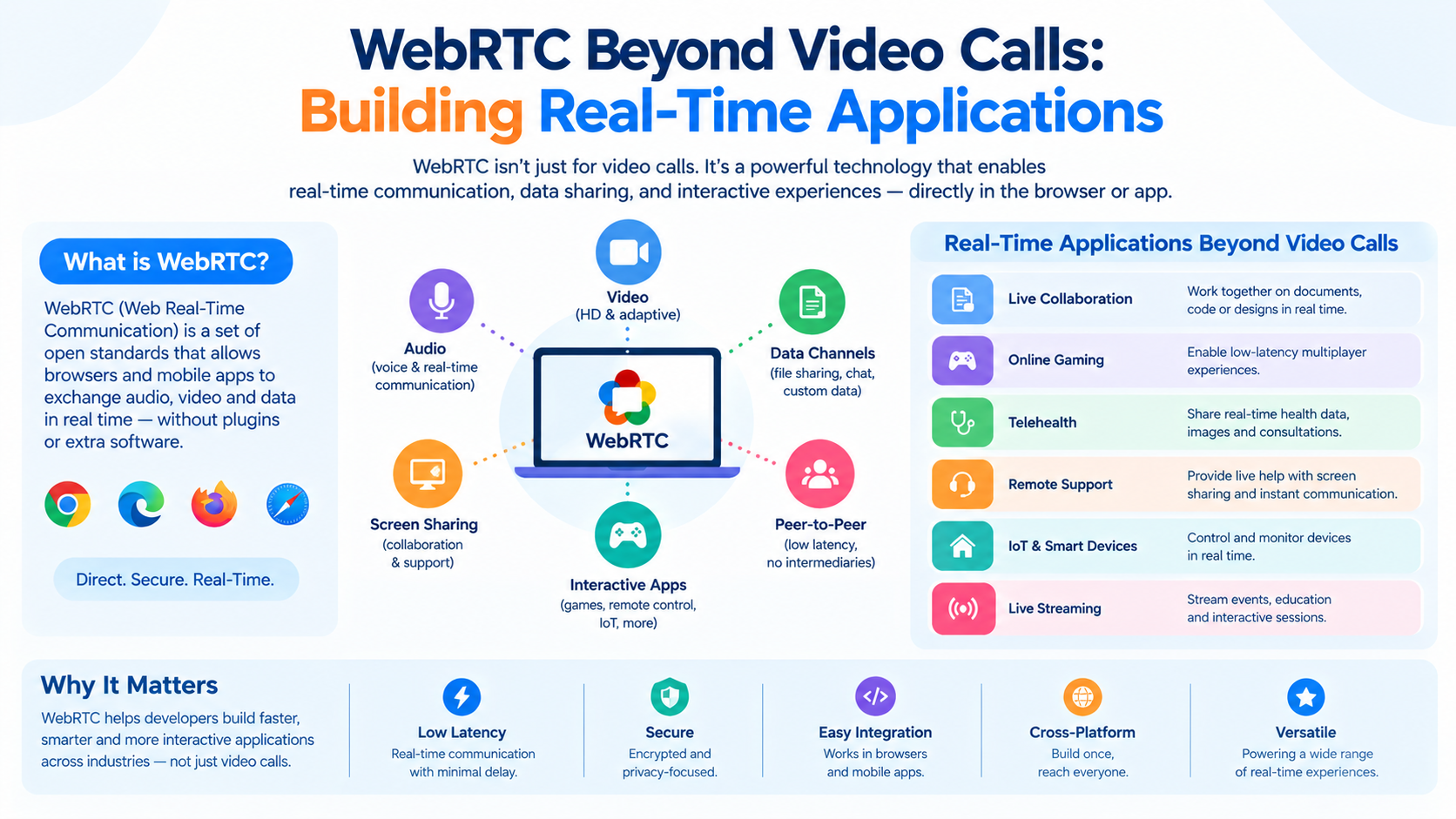
WebRTC was designed for video calls. Its underlying capability direct, low-latency data channels between peers is applicable to a much wider range of problems.
What WebRTC Actually Provides
WebRTC is a set of browser APIs and protocols for real-time communication. It has three primary capabilities.
| Capability | What It Does |
|---|---|
| Media streams | Captures and transmits audio and video |
| Data channels | Transmits arbitrary data between peers |
| Peer connection | Establishes and manages the connection |
The data channel is the capability most often overlooked. It provides a bidirectional channel between two peers with configurable reliability and ordering which is what makes non-video applications possible.
How the Connection Works
Establishing a WebRTC connection is more complex than a typical HTTP request.
The sequence:
-
Signaling. The two peers exchange connection information session descriptions and ICE candidates through a signaling channel that WebRTC does not define. This is usually a WebSocket server.
-
ICE. The peers gather candidates possible network paths and exchange them.
-
STUN. A STUN server helps each peer discover its public address.
-
TURN. When direct connection fails, a TURN server relays traffic between the peers.
-
Connection. Once a path is established, data flows directly between peers.
The practical implication: WebRTC is peer-to-peer, but it is not serverless. Signaling and TURN relay both require server infrastructure.
Data Channels: The Underused Capability
Data channels transmit arbitrary data between peers. Their configuration determines their behavior.
Configurable properties:
| Property | Options | Effect |
|---|---|---|
| Ordered | Ordered or unordered | Whether messages arrive in order |
| Reliability | Reliable or unreliable | Whether lost messages are retransmitted |
| Max retransmits | Number or unlimited | How many times to retry |
| Max packet lifetime | Milliseconds | How long to keep trying |
Why this matters: Different applications need different guarantees. A collaborative editor needs ordered, reliable delivery. A real-time game may prefer unordered, unreliable delivery to avoid head-of-line blocking.
Applications Beyond Video
Collaborative Editing
Real-time collaborative editing requires low-latency synchronization between participants.
Why WebRTC helps: Direct peer-to-peer data channels reduce latency compared to routing every change through a server. Conflict resolution is handled by CRDTs or operational transformation above the transport layer.
The consideration: Peer-to-peer topologies scale poorly beyond a few participants. For larger groups, a server-based topology is usually required.
Real-Time Gaming
Multiplayer games require low latency and often tolerate some packet loss.
Why WebRTC helps: Unordered, unreliable data channels avoid head-of-line blocking, which matters for position updates and input events.
The consideration: Cheating is easier in peer-to-peer topologies because each peer has authority. Competitive games typically use authoritative servers instead.
File Transfer
Transferring files directly between browsers avoids uploading to a server.
Why WebRTC helps: Large files can be transferred peer-to-peer, reducing server bandwidth and cost. The data channel handles the transfer, and the application handles chunking and reassembly.
The consideration: Direct transfer requires both peers to be online simultaneously. For asynchronous transfer, a server is required.
Live Sensor Streaming
Streaming data from a device a phone, a sensor, a drone to a browser or another device.
Why WebRTC helps: Low-latency streaming without buffering delays. Useful for telemetry, monitoring, and remote observation.
The consideration: Bandwidth and reliability depend on the network path between peers.
Remote Control and Collaboration
Controlling a remote device or collaborating on a shared session.
Why WebRTC helps: Bidirectional low-latency communication is essential for control applications.
The consideration: TURN relay may be required when peers cannot connect directly, adding latency.
Peer-to-Peer Content Delivery
Distributing content between peers rather than from a central server.
Why WebRTC helps: Reduces server bandwidth for large audiences.
The consideration: Peer-to-peer delivery is complex to manage and less predictable than CDN delivery.
The Architecture Considerations
WebRTC applications require infrastructure beyond the peer connection.
Signaling
Signaling is not defined by WebRTC. Applications must implement it.
Common approaches:
-
WebSocket server for real-time signaling
-
HTTP endpoints for session establishment
-
Existing messaging infrastructure
The consideration: Signaling must be reliable. If it fails, connections cannot be established.
STUN and TURN
STUN helps peers discover their public addresses. TURN relays traffic when direct connection fails.
The reality: A significant proportion of connections require TURN relay. TURN servers consume bandwidth and cost money.
The consideration: TURN infrastructure must be provisioned and scaled. Underestimating TURN usage is a common mistake.
Topology
WebRTC supports several topologies, each with trade-offs.
| Topology | Description | Best For |
|---|---|---|
| Peer-to-peer | Direct connection between two peers | One-to-one communication |
| Mesh | Every peer connects to every other peer | Small groups (3–5 participants) |
| Star | All peers connect to a central peer | Moderate groups |
| SFU | Selective forwarding unit relays streams | Larger groups |
| MCU | Mixing unit combines streams | Large groups, limited client capability |
The consideration: Mesh topologies scale poorly. SFUs and MCUs introduce server infrastructure but scale better.
Scaling
Scaling WebRTC applications requires attention to several dimensions.
What scales:
-
Signaling servers
-
TURN relay capacity
-
SFU or MCU infrastructure
-
Peer connection limits
The consideration: Each dimension has different scaling characteristics and cost profiles.
Where WebRTC Is Not the Right Choice
WebRTC is powerful but not universal.
Poor fits:
-
Server-to-client streaming. HTTP streaming, SSE, or WebSockets are simpler.
-
Broadcast to large audiences. CDN-based delivery is more efficient.
-
Asynchronous communication. WebRTC requires both peers to be present.
-
Applications that do not need low latency. WebSockets are simpler to operate.
The practical guidance: Use WebRTC when you need peer-to-peer communication with low latency and cannot accept the overhead of routing everything through a server.
Implementation Roadmap
Phase 1: Assess (Weeks 1-2)
-
Confirm the requirement. Is peer-to-peer communication necessary, or would WebSockets suffice?
-
Determine the topology. Peer-to-peer, mesh, star, or SFU?
-
Plan signaling infrastructure.
-
Plan TURN infrastructure.
Phase 2: Build (Weeks 3-8)
-
Implement signaling.
-
Implement peer connection establishment.
-
Configure data channels appropriate to your use case.
-
Implement TURN fallback.
-
Handle connection failures gracefully.
Phase 3: Operate (Weeks 9-12+)
-
Measure connection success rates.
-
Measure TURN usage and cost.
-
Monitor latency and reliability.
-
Scale signaling and TURN infrastructure.
Frequently Asked Questions
Q1: Is WebRTC only for video calls?
No. WebRTC provides data channels that transmit arbitrary data between peers. Video is one application of a broader capability.
Q2: Is WebRTC serverless?
No. Signaling is not defined by WebRTC and must be implemented. TURN relay is required when direct connections fail. Both require server infrastructure.
Q3: What is a TURN server and why does it matter?
TURN relays traffic between peers when direct connection is not possible. A significant proportion of connections require it, and it consumes bandwidth and cost.
Q4: What is an SFU?
A Selective Forwarding Unit is a server that receives streams from participants and forwards them selectively. It scales better than mesh topologies for larger groups.
Q5: When should I use WebSockets instead of WebRTC?
When you do not need peer-to-peer communication. WebSockets are simpler to operate and sufficient for client-server real-time communication.
Q6: How can Innovative AI Solutions help?
We help organizations build real-time applications from WebRTC data channels and signaling to TURN infrastructure and scaling. Explore our services to see how we approach real-time engineering. Based in Delhi, serving clients across India.
Why Delhi is a Great Hub for Real-Time Engineering
Delhi is emerging as a hub for web and product engineering, backed by a thriving developer ecosystem and a mobile-first user base with variable network conditions. As Indian enterprises build collaborative and real-time applications, understanding where WebRTC fits and where it does not becomes a practical engineering decision.
What We Offer at Innovative AI Solutions
-
Real-Time Architecture Design: We help you choose between WebRTC and WebSockets.
-
WebRTC Implementation: We build peer connections, data channels, and signaling.
-
TURN Infrastructure: We provision and scale relay capacity.
-
Topology Design: We select the right topology for your participant count.
-
Scaling: We help you scale signaling, relay, and media infrastructure.
Final Thought
The shift is clear: from treating WebRTC as a video technology to treating it as a peer-to-peer transport. The data channel is the capability that makes WebRTC useful far beyond calls. Organizations that understand this will build real-time applications that are faster and cheaper than server-routed alternatives. Those that assume WebRTC is only for video will overlook a capability that solves problems they already have.
Contact Us:
Phone: +91 7464 099 059 / +91 9689967356
Email: info@innovativeais.com
Address: 904, 9th floor Pearls Best Heights-I, Netaji Subhash Place, Delhi-110034
Website: https://innovativeais.com
About the Author
Abhishek Kumar
Founder & CEO, Innovative AI Solutions
5+ years building AI, cloud, and enterprise systems. Based in Delhi, serving clients across India.