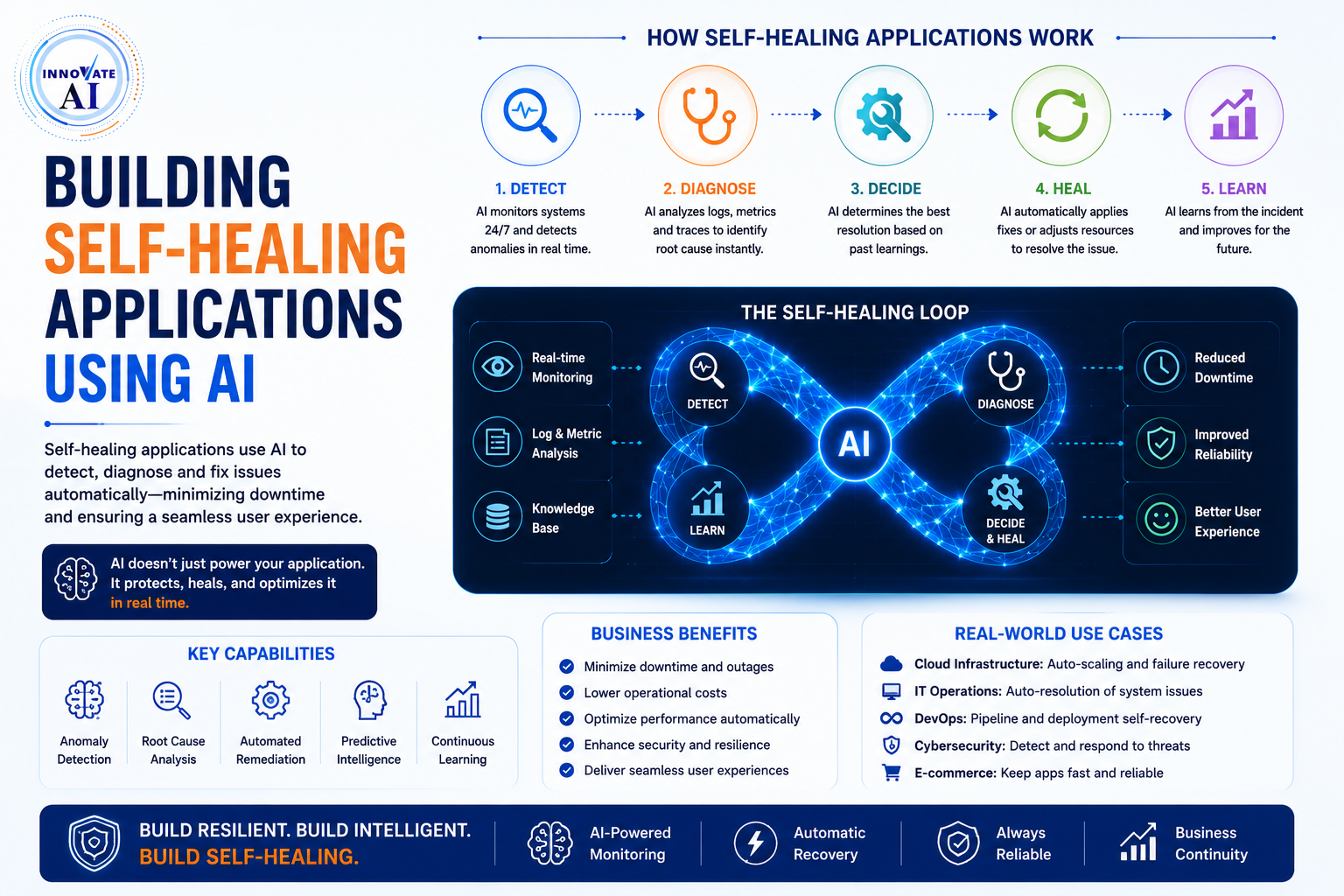
The Big Question
What happens when a software failure triggers an autonomous recovery process that not only fixes the immediate issue but learns from it—so the same mistake never happens again? What if your applications could literally repair their own code, restart services, and adapt to changing conditions without a human writing a single line of code?
This is the promise of self-healing applications. And they're moving from research labs to production reality.
The Challenge: Why Traditional Error Handling Falls Short
Unanticipated runtime errors—errors lacking predefined handlers—can abruptly terminate execution and lead to severe consequences, such as data loss or system crashes . Despite extensive efforts to identify potential errors during development, such unanticipated errors remain a persistent challenge .
Traditional self-healing systems rely on predefined heuristic strategies, such as rolling back to a checkpoint or matching existing error handlers . However, limited by their rule-based nature, these strategies are not adaptive enough to deal with diverse errors, which impedes their adoption .
A large-scale industry study highlights that one of the main challenges encountered with engineering such systems is the complexity of defining adaptation rules .
The AI Solution: LLM-Assisted Self-Healing
Recent research has introduced a paradigm shift: using Large Language Models (LLMs) as runtime error handlers . This approach moves beyond static rules to dynamic, context-aware error recovery.
How It Works: The Healer Framework
Healer, the first LLM-assisted self-healing framework, operates in real-time :
-
Detection: When an unanticipated runtime error occurs, Healer is activated
-
Context Gathering: It collects runtime context—error messages, program states, and the erroneous source code
-
Code Generation: An LLM generates a bespoke error-handling code snippet tailored to the specific error
-
Execution & Recovery: The handling code is executed in an isolated environment to produce a corrected program state
-
Continuation: The program continues execution from the point of error without termination
The key insight: instead of patching the source code against an error, the system revises the runtime state—variable values and environment configurations—to recover execution .
The Results
Without any fine-tuning, GPT-4 successfully helped programs recover from 72.8% of runtime errors in academic evaluations . Healer introduced negligible latency in normal code execution (less than 1 ms per program) and acceptable overhead for error handling (less than 4 seconds for LLM code generation) .
Autonomous Agent-Based Self-Healing
Beyond LLM-assisted recovery, multi-agent systems are pushing the boundaries of what self-healing can achieve.
The "AI Mechanic" Approach
An agentic self-healing system developed for an AI Agents Intensive course demonstrates a fully autonomous repair pipeline :
-
Crash: A "Broken Agent" runs and fails, producing a log file
-
Diagnose: An "AI Mechanic" reads the log, analyzes the error, and writes a simple diagnosis in plain English
-
Heal: An "AI Surgeon" reads the diagnosis, opens the source code of the broken agent, and rewrites the code to fix the bug automatically
This approach turns a 30-minute debugging session into a 10-second autonomous fix .
The Self-Healing GenAI Swarm: A Production-Ready Example
A more comprehensive implementation, Autonomic AI, demonstrates a closed-loop control system for self-healing chatbots :
-
Gateway Agent: Interacts with the user
-
Auditor (The Judge): Asynchronously scores every conversation against strict rules via Google Pub/Sub
-
Refiner (The Fixer): If the Auditor flags a mistake, the Refiner uses Gemini to rewrite the system prompt
-
Evaluator (The Tester): Tests the new prompt against the failed conversation to ensure the fix works
-
Deployment: Automatically updates the agent version and deploys it to production
-
Observability: Datadog visualizes the entire process and alerts humans only if the AI fails to fix itself
The architecture uses Google Cloud Platform with Gemini 2.5 Flash, Firestore for agent "DNA" storage, and Datadog for observability .
Agent configurations are stored as JSON in Firestore—not hardcoded—enabling version control and automated updates .
The Trustworthiness Challenge
While results are promising, significant challenges remain, particularly regarding trustworthiness of LLM-generated code . Key concerns include:
-
Safety Validation: How do we ensure generated fixes don't introduce regressions or security vulnerabilities?
-
Integration: How do we safely integrate LLM-generated code into existing systems?
-
Human Oversight: When should humans be notified or consulted?
Potential solutions include implementing safety checks and developing Healer-aware programming practices to mitigate risks .
Implementation Roadmap: The First 90 Days
Phase 1: Foundation (Weeks 1-4)
-
Audit current incident response: How long does it take to detect, diagnose, and resolve failures?
-
Identify high-value error patterns: Which errors are most frequent and costly?
-
Define governance: What permissions, audit trails, and rollback mechanisms are needed?
Phase 2: Pilot (Weeks 5-8)
-
Deploy a pilot framework: Consider Healer for runtime error handling
-
Test with bounded use cases: Start with low-risk errors where AI recovery is safe
-
Measure success rates: Track recovery percentage and time-to-recovery
Phase 3: Scale (Weeks 9-12+)
-
Expand to additional error types based on learnings
-
Implement observability: Monitor autonomous repairs and alert humans when needed
-
Enable consolidation: Store failure patterns for continuous improvement
Frequently Asked Questions
Q1: How does LLM-assisted self-healing differ from traditional error handling?
Traditional handling relies on predefined rules for anticipated errors. LLM-assisted healing generates bespoke, context-aware solutions for unanticipated runtime errors in real-time .
Q2: What results have been achieved with this approach?
Without fine-tuning, GPT-4 recovered from 72.8% of runtime errors with less than 4 seconds of overhead per error .
Q3: What are the trustworthiness concerns?
LLM-generated code may introduce regressions or security vulnerabilities. Safety checks and human oversight are essential .
Q4: What is the "AI Mechanic" approach?
A multi-agent system where one agent diagnoses failures and another rewrites source code to fix bugs automatically—turning 30-minute debugging into 10-second fixes .
Q5: How can Innovative AI Solutions help?
We help organizations design, build, and operationalize self-healing applications—from framework selection and pilot design to governance and observability. Based in Delhi, serving clients across India.
Why Delhi is a Great Hub for AI Development
Delhi is emerging as a significant hub for AI development, backed by concrete government support and infrastructure. The recent Delhi Budget 2026-27 allocated ₹8.20 crore for two Artificial Intelligence centres of excellence (AI-CoEs), functioning as hubs for research, innovation, and startup incubation.
The city's AI infrastructure is expanding rapidly. Under the IndiaAI Mission, more than 38,000 high-end GPUs have been onboarded and are available at approximately ₹65 per hour—roughly one-third of the global average cost.
The government has also announced a ₹350 crore startup policy over five years, aiming to support the emergence of at least 5,000 startups by 2035, with key focus areas including artificial intelligence, machine learning, and automation.
What We Offer at Innovative AI Solutions
After five years of building AI solutions for businesses, we've developed a practical approach that focuses on what actually works:
-
Self-Healing Strategy: We help you assess incident response and design a self-healing roadmap
-
Framework Implementation: We help you deploy Healer-style runtime recovery or agent-based self-repair systems
-
Observability and Governance: We help you implement monitoring, safety checks, and audit trails
-
Change Management: We help your organization shift from reactive to autonomous resilience
Our approach is built on the reality that self-healing isn't just about reducing downtime—it's about building systems that get smarter with every failure.
Final Thought
The question facing engineering leaders isn't whether self-healing applications are coming. The question is whether you'll be ready when they do. From LLM-assisted runtime recovery at 72.8% success rates to autonomous agents that rewrite their own code, the technology is maturing rapidly.
The systems that can achieve true self-healing—where failures become data, agents get smarter with every incident, and humans are freed from endless debugging—will have an enormous competitive advantage.
The shift is clear: from responding to failures after they happen, to anticipating and repairing them before they impact users.
Contact Us:
Phone: +91 7464 099 059 / +91 9689967356
Email: info@innovativeais.com
Address: Netaji Subhash Place, Pitampura, Delhi – 110034
Website: https://innovativeais.com
About the Author
Abhishek Kumar
Founder & CEO, Innovative AI Solutions
5+ years building AI systems for enterprises. Based in Delhi, serving clients across India.
Hashtags: #SelfHealing #AIOps #AgenticAI #RuntimeRecovery #Resilience #DevOps #InnovativeAISolutions
Related services: to apply this in your business, explore our LLM integration and AI development services.