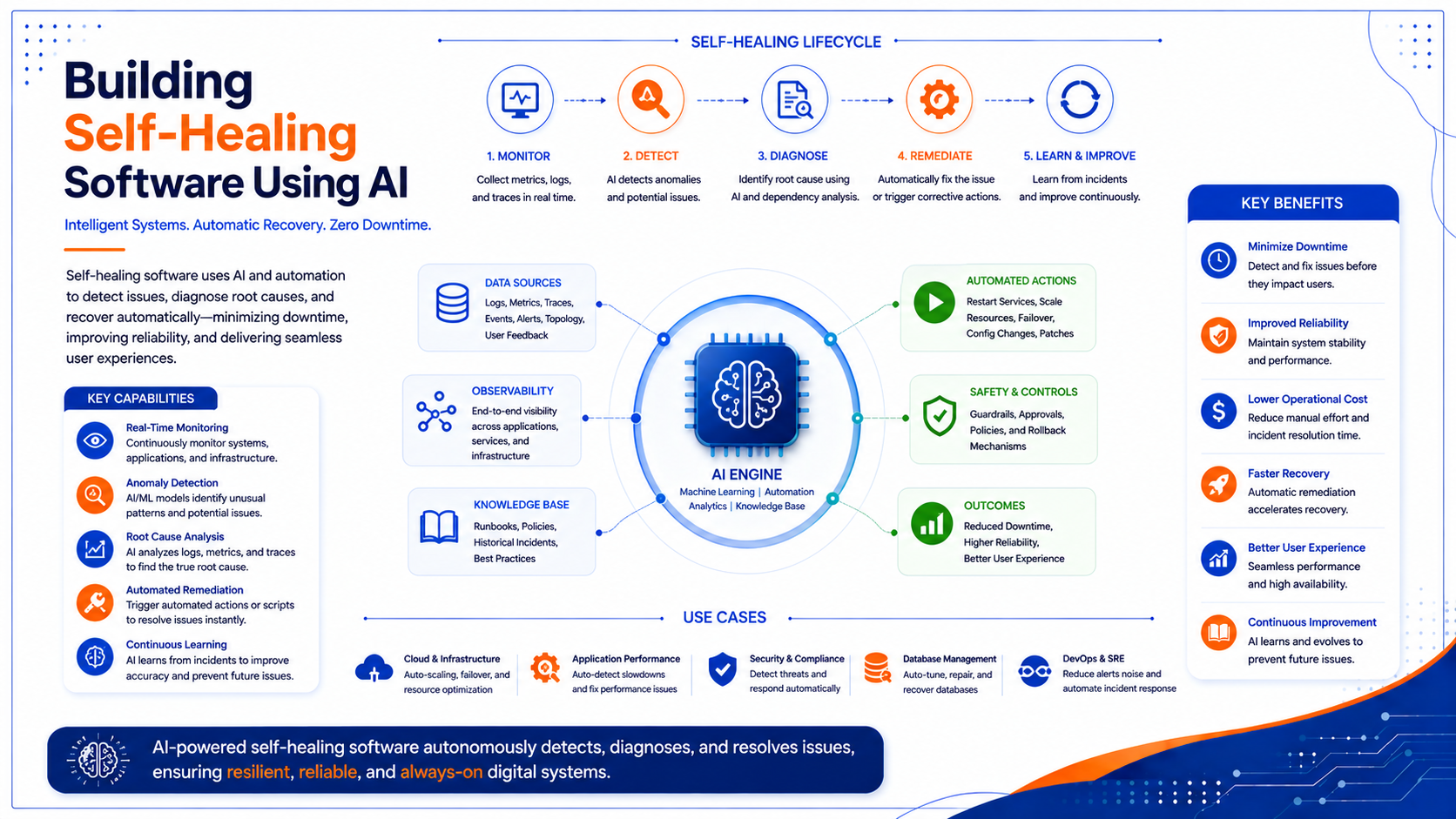
The Big Question
What happens when a software failure triggers an autonomous recovery process that not only fixes the immediate issue but learns from it so the same mistake never happens again? What if your applications could literally repair their own code, restart services, and adapt to changing conditions without a human writing a single line of code?
For decades, the answer to these questions has remained in the realm of science fiction. But recent advances in AI, particularly large language models and agentic frameworks, are making self-healing software a production reality. This guide explores the technology, architecture, and practical implementation of AI-driven self-healing systems.
The Challenge: Why Traditional Error Handling Falls Short
Modern software systems, particularly those deployed in safety-critical and real-time environments, demand continuous operation and resilience to unforeseen faults . Yet traditional fault-handling mechanisms—exception handling, static assertions, checkpointing, and restart mechanisms offer reactive rather than proactive solutions and are often incapable of coping with unforeseen software anomalies during runtime .
A systematic literature review of AI-driven self-healing across the edge-cloud continuum identifies the challenge: traditional software engineering practices fall short for addressing the particularities of complex distributed deployments. There is a critical need for innovative tools and techniques capable of autonomous self-remediation and enhanced resilience with minimal human intervention .
The scale of the problem is significant. In the Linux kernel, for example, software fuzzing discovers 30+ new crashes monthly, yet the average time to fix a kernel bug remains high at 66 days. The escalating volume of crash cases now far surpasses human analysts' ability to repair the bugs . This widening gap between bug discovery and patching underscores the urgent need for highly automated repair solutions.
The AI Solution: Agentic Self-Healing Systems
How It Works: The MAPE-K Loop with AI
Modern self-healing systems extend the traditional MAPE-K loop (Monitor, Analyze, Plan, Execute, Knowledge) by incorporating Agentic AI and low-latency reflexive actions . The core components include:
Monitoring: Continuous observation of system behavior, metrics, and logs. AI enhances this through real-time anomaly detection and drift tracking .
Analysis: AI-powered root cause analysis using transformer-based fault localization engines. Recent research demonstrates fault localization accuracy of 88.6% across 395 real-world bugs .
Planning: Agentic AIOps frameworks leverage LLMs and standardized interfaces to select mitigation policies. Distributed or reflex-augmented loops reduce time-to-action .
Execution: Automated program repair (APR) using fine-tuned LLMs and structured pipelines to generate minimal patches. Patch generation success rates of 74.2% have been achieved with mean latency of 310.4ms .
Knowledge: Continuous learning through "healing memory" that stores historical success data to optimize recovery strategies .
The Agentic Self-Healing Architecture
The most compelling implementations use multi-agent architectures where specialized agents handle different aspects of the repair process. A typical pattern involves three phases :
-
Crash: A broken agent runs and fails, producing a messy technical log
-
Diagnose: An "AI Mechanic" reads the log, analyzes the error, and writes a diagnosis in plain English
-
Heal: An "AI Surgeon" reads the diagnosis, opens the source code, and rewrites the code to fix the bug automatically
This approach turns a 30-minute debugging session into a 10-second autonomous fix .
The Reconciliation Pattern
An emerging pattern for self-healing infrastructure is the reconciliation loop a continuous process that compares a desired state with an actual state . This pattern, familiar from Kubernetes, is now being applied with agentic AI to create self-correcting systems.
The Chainguard Factory 2.0, powered by its DriftlessAF framework, demonstrates this approach. Agentic AI reconciler bots constantly reconcile discovered state changes from code repositories, security feeds, and other sources to a desired state of up-to-date containers and libraries with zero known CVEs . The framework handles unstructured data, orchestrates iterative and verifiable workflows, and reduces the need for human intervention in software maintenance.
Real-World Performance Metrics
The effectiveness of AI-driven self-healing is now documented across multiple research and production implementations:
| Metric | Result | Context |
|---|---|---|
| Fault Localization Accuracy | 88.6% | Evaluated on 395 real-world bugs |
| Patch Generation Success Rate | 74.2% | Across 150,000+ bug-fix pairs |
| Patch Correctness Rate | 68.3% | Verified on Defects4J dataset |
| Mean Patch Generation Latency | 310.4ms | Real-time repair capability |
| Linux Kernel Bug Repair Rate | 27.81% | Evaluated on 543 real-world kernel bugs |
| Testing Benchmark Resolution | 100% | On curated Python repositories (5/5 cases) |
| Avg. Time to Resolution | ~42 seconds | From ingestion to validated patch |
Linux Kernel Repair: The kAPR Breakthrough
One of the most significant advances is kAPR (coverage-guided, context-aware APR), a system designed for the challenging domain of Linux kernel bug repair. kAPR uses a dual-agent framework that mirrors Linux developer-maintainer collaboration and employs a Coverage-Guided Code Context Retrieval algorithm to navigate the massive Linux codebase .
In a comprehensive evaluation on 543 real-world Linux kernel bugs, kAPR successfully repaired 27.81% of cases a significant improvement over state-of-the-art APR tools. Notably, kAPR has generated three plausible patches for currently active Linux kernel bugs, demonstrating practical utility in automating kernel maintenance tasks .
The Autonomous Test-and-Improve Product
Open-source frameworks like Naoru provide a host-agnostic autonomous code-repair engine that implements a "drive → judge → fix → red-first oracle gate" pattern . The system executes a system-under-test, judges the result, has an LLM propose a fix in an isolated worktree, and gates any autonomous commit behind a deterministic validation oracle.
This approach supports multiple mission types: test-and-fix-bugs (red-first oracle, auto-commit), improve-performance (metric gate, auto-commit), and improve-ux (propose-a-patch for review, never auto-commit) .
Safety and Governance: The Human-in-the-Loop Imperative
A systematic literature review of 99 primary studies on AI-driven self-healing reveals a critical validation gap: current research often lacks rigorous testing frameworks to ensure that AI-generated repairs do not introduce regressions or security vulnerabilities . Achieving trustworthy autonomy requires a holistic approach that merges advanced AI paradigms with disciplined software engineering.
Practical Safety Mechanisms
Real-world implementations incorporate graduated safety controls :
Green Actions (Autonomous approved):
-
Restart unhealthy pods/containers
-
Scale up compute resources within limits
-
Clear specific caches
-
Adjust rate limits within bounds
Yellow Actions (Requires rapid approval):
-
Database failover
-
Traffic rerouting
-
Deployment rollback
-
Service isolation
Red Actions (Always requires human judgment):
-
Schema migrations
-
Data deletion
-
External dependency changes
-
Security policy modifications
Learning Loops and Confidence Scoring
Every autonomous action generates training data that improves the decision engine over time. Actions that consistently succeed in specific contexts get higher confidence scores. Actions that fail or require rollback trigger investigation .
The DevSecOps Pipeline Integration
An AI-powered pipeline for enabling self-healing in software systems demonstrates how LLM-generated code fixes can flow through a CI/CD pipeline that reruns security assessment processes to verify vulnerability fixes. Source code is then accepted with human administrator approval. This represents the first set of steps toward enabling self-healing software systems within a DevSecOps culture .
Implementation Roadmap
Phase 1: Foundation (Weeks 1-4)
-
Audit your incident response: Measure current MTTR, MTTD, and on-call burden. Where are the biggest bottlenecks?
-
Identify high-frequency failure patterns: Start with repetitive, predictable issues like pod restarts, memory leaks, or specific error types.
-
Define safety guardrails: Establish action libraries, approval thresholds, and rollback mechanisms.
-
Select starting point: Choose one high-value, bounded failure scenario for the pilot.
Phase 2: Build Autonomous Capabilities (Weeks 5-8)
-
Deploy monitoring and anomaly detection: Implement real-time drift tracking and performance monitoring .
-
Build the agentic repair pipeline: Start with a simple "diagnose → suggest fix" workflow for bounded error types.
-
Implement healing memory: Store historical repair outcomes to optimize future recovery strategies .
-
Establish human review gates: Define which actions require approval and which can run autonomously.
Phase 3: Scale and Learn (Weeks 9-12+)
-
Expand to additional failure types: Gradually increase the scope of autonomous repair.
-
Implement confidence scoring: Use historical outcomes to calculate action confidence .
-
Enable continuous learning: Store every autonomous action as training data.
-
Measure impact: Track MTTR reduction, on-call burden reduction, and system uptime improvements.
Frequently Asked Questions
Q1: What is self-healing software?
Self-healing software is a system that can autonomously detect, diagnose, and repair disruptions with minimal human intervention. It combines real-time monitoring, anomaly detection, root cause analysis, automated repair, and continuous learning .
Q2: How effective are current AI-driven self-healing systems?
Research demonstrates 88.6% fault localization accuracy, 74.2% patch generation success rate, and 68.3% patch correctness rate. The Linux kernel repair system kAPR achieved 27.81% repair rate on 543 real-world bugs .
Q3: What is the reconciliation pattern?
The reconciliation pattern is a continuous process that compares a desired state with an actual state. Agentic AI reconciler bots constantly reconcile discovered state changes to the desired state, creating a self-correcting system .
Q4: Is autonomous code repair safe?
When implemented with proper guardrails, yes. Safety mechanisms include graduated action libraries (green/yellow/red), human review gates for high-risk actions, and rollback strategies. The systematic literature review emphasizes that Human-in-the-Loop techniques are essential for safety .
Q5: How can Innovative AI Solutions help?
We help organizations design, build, and operationalize self-healing software from incident audit and safety guardrail design to agentic repair pipeline implementation and continuous learning frameworks. Based in Delhi, serving clients across India.
Final Thought
The evidence is clear: AI-driven self-healing is moving from research labs to production environments. The technology is mature enough for bounded, well-governed deployment. Organizations that invest in self-healing capabilities now will achieve faster recovery times, lower operational costs, and systems that get smarter with every failure.
The shift is clear: from responding to failures after they happen, to anticipating and repairing them before they impact users.
Contact Us:
Phone: +91 7464 099 059 / +91 9689967356
Email: info@innovativeais.com
Address: Netaji Subhash Place, Pitampura, Delhi – 110034
Website: https://innovativeais.com
About the Author
Abhishek Kumar
Founder & CEO, Innovative AI Solutions
5+ years building AI, cloud, and enterprise systems. Based in Delhi, serving clients across India.
Related services: to apply this in your business, explore our AI agent development and AI development services.