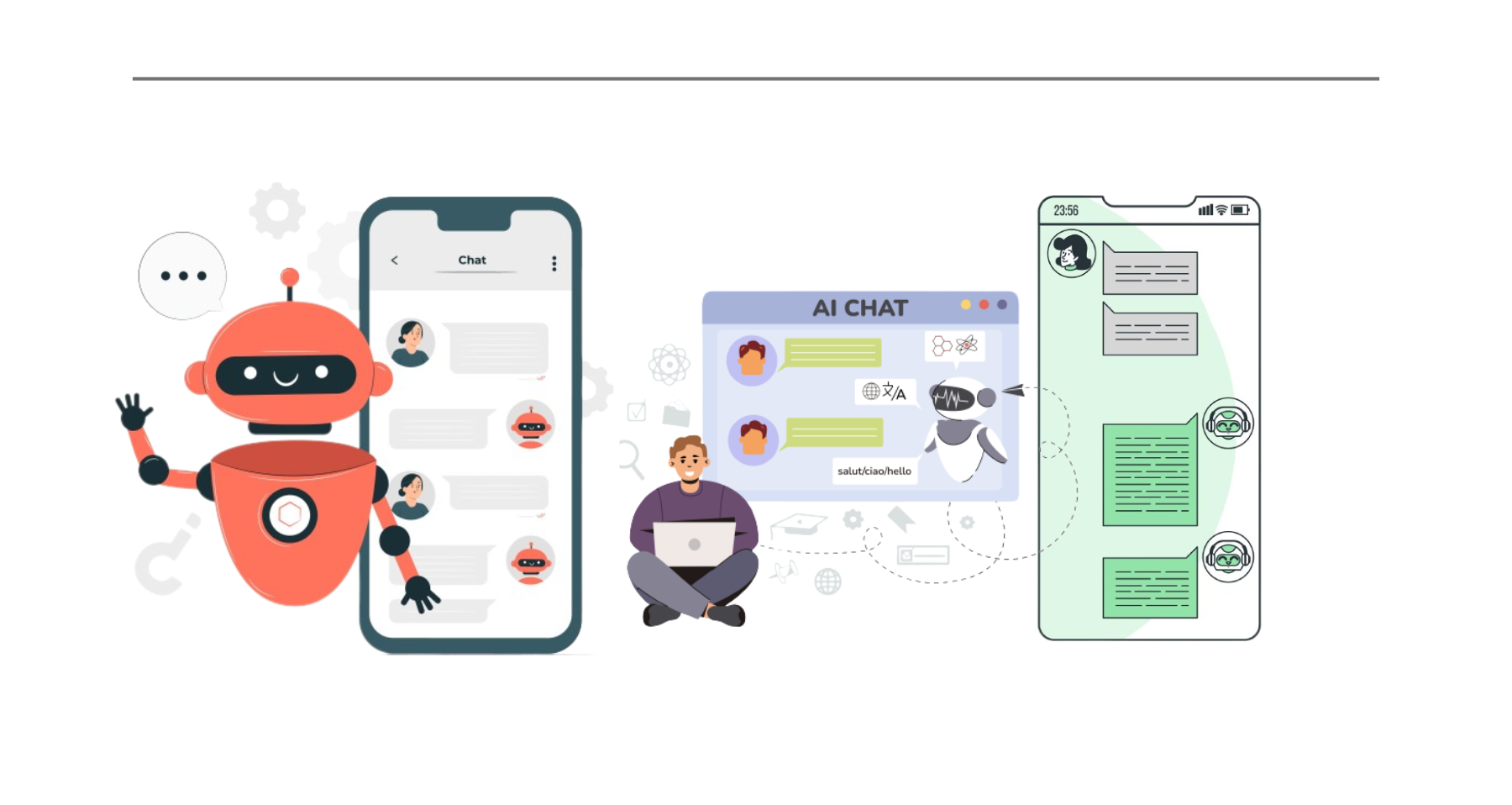
What Is a Traditional Chatbot?
A traditional chatbot, also known as a rule-based or decision-tree chatbot, follows a pre-defined path. It presents fixed options such as "Press 1 for sales, Press 2 for support" or displays buttons like "Order Status," "Returns," and "Store Hours." The user chooses an option, and the bot follows a scripted path based on that choice.
How It Works
Traditional chatbots work on an if-this-then-that logic. The bot recognizes specific keywords, matches them to a pre-written response, or follows a flowchart of options. If the user says something unexpected, the bot defaults to a fallback phrase such as "I'm sorry, I didn't understand that. Please type 1 for sales or 2 for support."
Strengths
| Strength | Why It Matters |
|---|---|
| Predictable and controllable | You know exactly what the bot will say in every scenario |
| Easy to build | No coding required for most platforms; drag-and-drop interface |
| Low cost | Free to a few thousand rupees per month, often with generous free tiers |
| Fast to deploy | A simple bot can be built and launched in a day |
| No data privacy concerns | The bot does not learn from conversations; no training data required |
Weaknesses
| Weakness | The Real Cost |
|---|---|
| Cannot understand natural language | Users must choose from buttons or type exact keywords |
| Breaks when users go off-script | One unexpected phrase, and the bot is useless |
| Frustrates users | Being forced to navigate menus when you just want a simple answer creates bad experiences |
| No learning | The bot never improves; every interaction starts from zero |
| High maintenance | Adding a new feature means rebuilding decision trees |
| No personalization | Every user gets the same experience; the bot does not remember past interactions |
Typical Use Cases
-
FAQ automation where questions are predictable
-
Appointment booking with fixed slots and services
-
Order status lookup with order number entry
-
Basic lead capture with fixed qualification questions
-
Internal IT help desk for password resets and common requests
Step 3: What Is a Custom AI Chatbot?
A custom AI chatbot uses large language models to understand natural language, learn from conversations, and adapt responses based on context. It is not a decision tree. It is an AI that reads the user's message, understands the intent, and generates an appropriate response.
How It Works
The AI chatbot is built on a foundation model such as GPT, Claude, or Gemini. The model is trained on your specific business data: product catalogues, customer support tickets, policy documents, and conversation histories. When a user asks a question, the model retrieves relevant information from your knowledge base via RAG, generates a response tailored to the specific context, and learns from the conversation to improve future interactions.
Strengths
| Strength | Why It Matters |
|---|---|
| Understands natural language | Users can type or speak naturally, as if talking to a human |
| Adapts to user intent | The bot understands what the user wants, not just the exact words |
| Conversational memory | Remembers past interactions and personalises responses |
| Continuous learning | Improves from every conversation; does not need manual reprogramming |
| Handles complex questions | Can reason across multiple topics and provide nuanced answers |
| Multilingual | Understands and responds in Hindi, Hinglish, Tamil, Telugu, and more |
Weaknesses
| Weakness | The Real Cost |
|---|---|
| Higher cost | API usage fees plus development and training costs |
| Requires data | Needs quality training data and knowledge base for good performance |
| Longer implementation | One to three months for a production-grade bot |
| Potential for errors | Can occasionally hallucinate or provide incorrect information |
| Data privacy considerations | Customer data is sent to AI providers (mitigated by enterprise agreements) |
Typical Use Cases
-
Customer support for complex, multi-step issues
-
Sales qualification and lead nurturing
-
Product recommendations based on natural language descriptions
-
Internal knowledge management where employees ask natural questions
-
Any use case where users cannot be expected to follow a script
Step 4: Head-to-Head Comparison
| Factor | Traditional Chatbot | Custom AI Chatbot |
|---|---|---|
| Understanding | Exact keyword matches or menu selections | Natural language, intent recognition, context |
| Flexibility | Rigid; breaks off-script | Flexible; adapts to user phrasing |
| Personalisation | None | Full conversation history and user context |
| Learning | None (requires manual updates) | Continuous learning from interactions |
| Integration complexity | Low (no-code builders) | High (API integration, RAG pipeline, knowledge base) |
| Development time | Hours to days | Weeks to months |
| Maintenance | Manual (update decision trees) | Low (retrain on new data periodically) |
| Cost (monthly) | ₹0 to ₹10,000 | ₹10,000 to ₹1,00,000+ depending on volume |
| User experience | Frustrating for complex needs | Natural and helpful |
| Best for | Simple, predictable, menu-driven tasks | Complex, conversational, open-ended tasks |
The trade-off is simplicity versus capability. Traditional chatbots are cheaper and easier but limited. AI chatbots are more capable but require more investment and ongoing management. There is no single right answer. The right choice depends entirely on your use case.
Step 5: When to Choose a Traditional Chatbot
A traditional chatbot is the right choice when you need to automate simple, predictable, menu-driven tasks where user input can be easily constrained to a few options.
Good Candidates
-
After-hours auto-attendant: "Press 1 for store hours, Press 2 for location, Press 3 to leave a message"
-
Appointment booking for a service with fixed slots: "What service do you need? What day works for you? What time?"
-
FAQ bot for a small set of predictable questions: "How do I reset my password?" "What are your return policies?"
-
Lead capture with simple qualification: "What is your name? What is your email? What are you interested in?"
Industry-Specific Recommendations
| Industry | Is Traditional Bot Enough? | Why |
|---|---|---|
| Restaurant (reservations, hours) | Yes | Predictable options, limited complexity |
| Dental clinic (appointments, insurance) | Yes | Fixed services, simple scheduling |
| E-commerce (order status, returns) | AI preferred | Order lookup requires data access; returns require understanding |
| SaaS (tech support, onboarding) | AI required | Complex questions; users expect natural interaction |
| Real estate (lead qualification) | AI required | Open-ended questions; users want conversation, not forms |
| Healthcare (symptom triage, FAQs) | AI required | Complex medical queries; traditional bots cannot handle nuance |
Step 6: When to Choose a Custom AI Chatbot
A custom AI chatbot is the right choice when users cannot be expected to follow a menu, when the range of possible questions is open-ended, when you need to access customer-specific data, or when user experience is a competitive differentiator.
Good Candidates
-
Customer support for any product or service more complex than basic FAQ
-
Sales qualification where leads ask open-ended questions
-
Internal knowledge management where employees search across documents
-
Healthcare where patients describe symptoms in natural language
-
Financial services where customers ask about transactions, products, or policies
The Volume Threshold
A reasonable rule of thumb is that if you receive fewer than 500 customer interactions per month that could be automated, the cost of AI may not yet justify the investment. Traditional chatbots or well-designed FAQs may be sufficient. If you receive more than 5,000 interactions per month, the efficiency gains from AI quickly outweigh the costs. The middle range depends on the complexity of the interactions and the value of each conversion.
The Complexity Threshold
If your average support ticket requires more than three back-and-forth messages to resolve, you likely need AI. Traditional bots break on the second unexpected response. If your users cannot be trained to use menus, you need AI. If your business operates in a regulated industry where accuracy and context matter, you need AI.
Step 7: Cost Comparison
Traditional Chatbot Costs
| Component | Cost Range | Notes |
|---|---|---|
| Platform subscription | ₹0 to ₹5,000 per month | Free tiers available, paid plans for higher volume |
| Development | ₹0 to ₹20,000 one-time | DIY using no-code builders; agency rates higher |
| Maintenance | ₹0 to ₹5,000 per month | Updating decision trees as products change |
| Total first year | ₹0 to ₹1,00,000 | Varies widely based on complexity |
Custom AI Chatbot Costs
| Component | Cost Range | Notes |
|---|---|---|
| Development | ₹2,00,000 to ₹15,00,000 one-time | Depends on complexity, integrations, data availability |
| API usage | ₹10,000 to ₹1,00,000 per month | Based on token volume and model choice |
| Hosting and infrastructure | ₹5,000 to ₹50,000 per month | Vector database, embeddings, server costs |
| Maintenance and retraining | ₹20,000 to ₹1,00,000 per month | Continuous improvement, model updates |
| Total first year | ₹5,00,000 to ₹50,00,000 | Enterprise deployments at higher end |
The gap is substantial. Traditional chatbots are affordable for any business. AI chatbots require meaningful investment but deliver capabilities that traditional bots cannot approach. The decision is not about which is better in absolute terms. It is about whether the additional capability justifies the additional cost for your specific use case.
Step 8: Hybrid Approaches
The most successful chatbot deployments in 2026 are often hybrid solutions that use both traditional and AI approaches where each makes sense.
Pattern 1: Traditional First, AI Fallback
A traditional bot handles menu-driven interactions such as store hours, location, and basic FAQs. When a user asks an open-ended question that the traditional bot cannot answer, the system falls back to an AI model. This provides the low cost of traditional bots for predictable interactions and the capability of AI for complex ones.
Pattern 2: AI for Understanding, Traditional for Execution
An AI model handles intent recognition, determining what the user wants. It then maps that intent to a traditional decision tree or API call for execution. This gives you the flexibility of AI understanding with the predictability of traditional execution for actions such as booking appointments or checking order status.
Pattern 3: Tiered by Use Case
Route users to traditional bots for simple tasks and AI bots for complex tasks. A user can say "I want to check my order status" and be routed to a traditional lookup flow. A user can describe a complex problem and be routed to the AI. The system learns over time which intents are safe for traditional automation and which require AI.
Step 9: Implementation Roadmap
Traditional Chatbot (Days 1 to 7)
| Day | Action |
|---|---|
| 1 | Map out the decision tree (options, responses, fallbacks) |
| 2 | Choose a platform (ManyChat, Chatfuel, Landbot, or Interakt) |
| 3 | Build the conversation flow in the platform |
| 4 | Add fallback responses for off-script input |
| 5 | Test with employees playing different user roles |
| 6 | Refine based on test results |
| 7 | Deploy to your website or WhatsApp |
Custom AI Chatbot (Weeks 1 to 12)
| Week | Action |
|---|---|
| 1 to 2 | Define use case, success metrics, and data requirements |
| 3 to 4 | Collect and prepare training data; build knowledge base |
| 5 to 6 | Select foundation model (GPT, Claude, Gemini, open-source) |
| 7 to 8 | Develop RAG pipeline and integrate with your systems |
| 9 to 10 | Build front-end interface and test with real users |
| 11 to 12 | Refine based on feedback, implement monitoring, deploy |
Step 10: Frequently Asked Questions
Q1: Can a traditional chatbot understand Hinglish or Hindi?
Not meaningfully. Traditional chatbots rely on exact keyword matching or menu selections. They cannot understand the natural variations of Hinglish or regional languages. AI chatbots are trained to understand Hindi, Hinglish, Tamil, Telugu, Bengali, Marathi, Kannada, Gujarati, and Malayalam.
Q2: How long does it take to build a traditional chatbot?
One to seven days for a functional bot. Most no-code platforms offer templates that can be customised in hours. Complex decision trees may take longer.
Q3: How long does it take to build a custom AI chatbot?
Four to twelve weeks for a production-grade bot. The timeline depends on data availability, integration requirements, and complexity of the use case. Simple AI chatbots can be deployed faster using platforms that offer pre-built AI components.
Q4: Which type of chatbot has a better ROI?
Traditional chatbots have faster payback (days to weeks) but lower total impact. AI chatbots have slower payback (months to a year) but can transform customer experience and generate substantial revenue. The calculation depends entirely on your volume and the value of each interaction.
Q5: Can I upgrade from a traditional chatbot to AI later?
Yes. Many platforms offer both traditional and AI capabilities. You can start with a traditional bot and add AI features as your needs grow. The data collected from traditional bot interactions can be used to train the AI model, providing a natural migration path.
Q6: Do I need a data science team for an AI chatbot?
Not necessarily. Many AI chatbot platforms offer no-code or low-code interfaces for building RAG pipelines. However, complex enterprise deployments with custom integrations still require technical resources.
Q7: How can Innovative AI Solutions help?
We help businesses choose between traditional and AI chatbots based on their use case, build and deploy the chosen solution, and integrate with existing systems and data sources.
Step 11: Final Tagline
Traditional chatbots and custom AI chatbots are different tools for different jobs. Traditional bots are cheap, fast, and predictable for menu-driven tasks. AI bots are capable, flexible, and intelligent for natural conversation. The choice is not about which is better. It is about which is better for your specific use case. Choose the tool that fits the job.
Short version: Custom AI chatbots vs traditional chatbots – comparison, strengths and weaknesses, cost analysis, use cases, and decision framework for choosing the right conversational AI for your business in 2026.
Hashtags: #AIChatbots #TraditionalChatbots #ConversationalAI #CustomerSupport #ChatbotComparison #AItools #InnovativeAISolutions
Contact Us
Phone: +91 7464 099 059 / +91 96899 67356
Email: info@innovativeais.com
Address: Netaji Subhash Place, Pitampura, Delhi – 110034
Website: https://innovativeais.com
About the Author
Abhishek Kumar
Founder & CEO, Innovative AI Solutions
5+ years building AI chatbots for businesses. Based in Delhi, serving clients across India.
Related services: to apply this in your business, explore our AI chatbot development and RAG development.