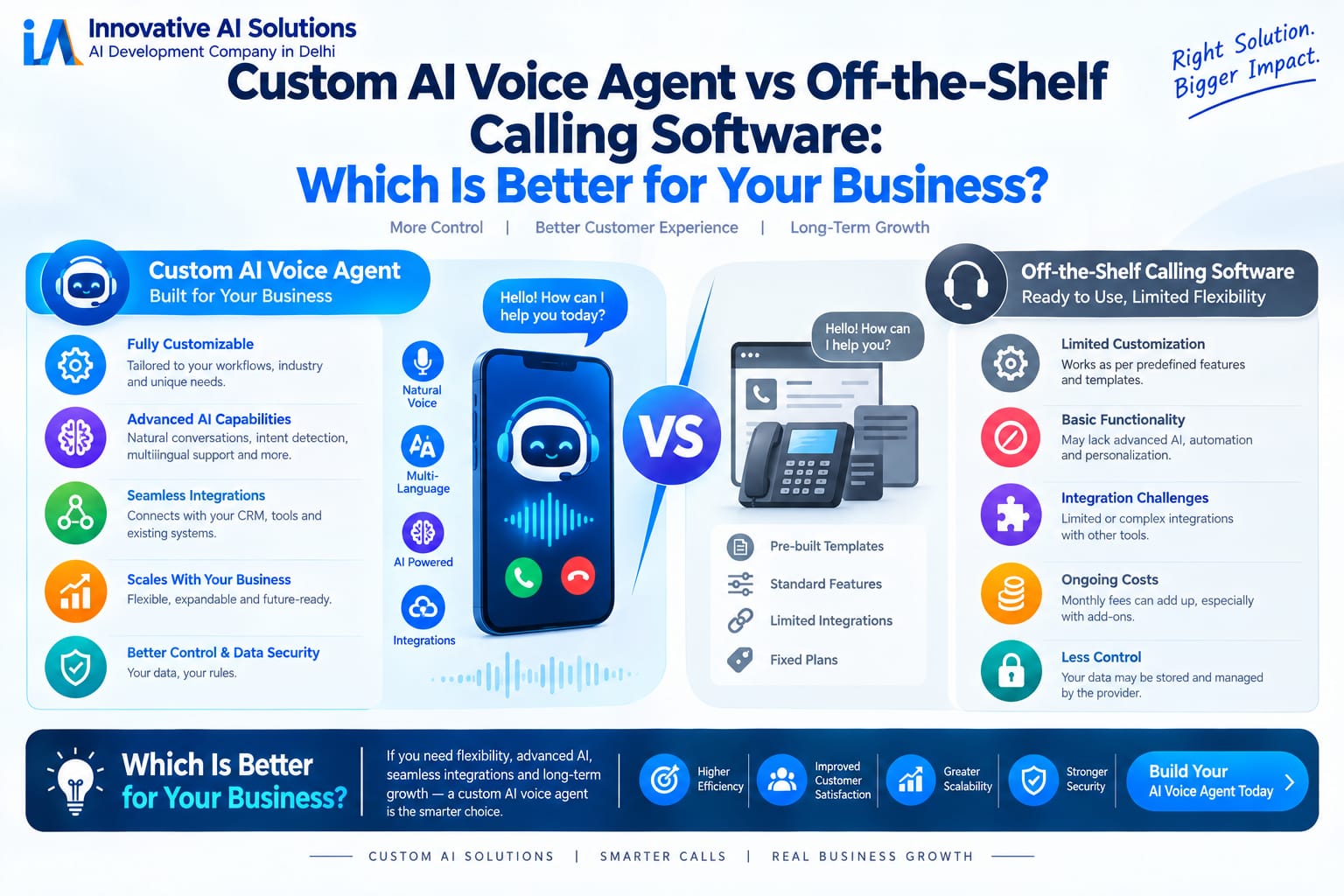
Why is the "build vs buy" decision so hard for AI voice agents?
Because both paths have compelling arguments.
Buy: You can have a working voice agent in 5 to 14 days . The platform handles telephony, speech recognition, language models, and compliance. You pay per minute and move on. For businesses that need to start calling now, this is incredibly attractive.
Build: You own the stack. You control the data. You can customize everything from the voice to the conversation logic to the integrations. For businesses where voice is a core differentiator, this control is essential.
The problem is that most vendors on both sides oversimplify. Off-the-shelf platforms make it sound like you'll never hit a limit. Custom development firms make it sound like platforms are toy solutions. Neither is true.
The reality is that the right answer depends on your specific situation your volume, your customization needs, your compliance requirements, and how central voice is to your business.
This guide will help you figure out which path fits.
The Cost Reality: What Each Path Actually Costs
Let's start with the numbers, because they tell an important story.
Off-the-Shelf (SaaS Platform)
SaaS receptionists cost $50–$300/seat/month plus $0.15–$0.40 per call minute . Agent-builder platforms offer $0.05–$0.20 per call minute all-in with no seat fee . In India, managed platforms range from ₹2 to ₹5 per minute for self-serve tools, while mid-market platforms with CRM integration and a few Indian languages run ₹4 to ₹8 per minute .
The catch: Advertised platform rates represent only about 20% of true total cost of ownership . Once you add LLM token costs, telephony markups, concurrency slots, and compliance add-ons, the real bill often comes in 3x to 5x higher .
Custom Development
Building a custom voice AI agent in India ranges from ₹75,000 to ₹1,25,000 for a starter agent (SMB, single workflow) up to ₹8,00,000+ for enterprise-grade solutions with multi-agent orchestration and on-premise deployment . Monthly running costs range from ₹4,000 to ₹40,000+ depending on complexity .
The catch: Direct-build estimates often land in six-figure labor ranges. One analysis puts Year 1 costs at $650K–$850K for a production-grade custom build, including engineering ($540K), infrastructure ($24K), ASR/TTS API passthrough ($30K–$120K), and compliance audits ($20K–$80K) .
The Crossover Point
Here's the critical insight: Cost curves hit their first inflection point around 10,000 minutes per month . Below that, bundled platforms win on total cost. Above it, building becomes more economical.
A fully custom build breaks even only past 500,000 monthly minutes a threshold that usually makes sense only when voice is a core product differentiator .
For most businesses, the honest answer is: if you're below 10,000 minutes/month, buying is usually smarter. If you're above it, model both options carefully.
What "Custom" Actually Buys You
If you're considering custom development, you need to understand what you're actually paying for.
Full Control Over the Stack
Off-the-shelf platforms are black boxes. You can configure them, but you can't inspect them. When something goes wrong and it will you're dependent on the vendor's support and roadmap .
Custom development means you own the pipeline. You choose the STT provider. You choose the LLM. You choose the TTS engine. You can swap components when better options emerge. You can debug edge cases because you have access to the code.
Data Ownership and Compliance
For regulated industries BFSI, healthcare, government data residency and compliance aren't optional. LIC's tender documents explicitly require deployment strictly within India, on MeitY-empanelled cloud or on-premise infrastructure, with no dependency on external or foreign-hosted APIs .
Off-the-shelf platforms often route data through global infrastructure. If your compliance requirements demand data sovereignty, this can be a dealbreaker. Custom deployment gives you full control over where data lives and how it's handled.
Proprietary Conversation Logic
If your competitive advantage lies in how you talk to customers your qualification criteria, your objection handling, your conversational style you need to own that logic. Off-the-shelf platforms let you configure scripts, but the underlying conversation engine is theirs. Custom development means your conversation IP is yours.
Deep Integrations
Platforms support common integrations Salesforce, HubSpot, Google Calendar. But what if your voice agent needs to read from and write to a proprietary internal system in real time? What if your core banking system has no API? Custom development gives you the flexibility to connect to systems that platforms can't reach .
What Off-the-Shelf Actually Buys You
The platform path has real advantages that custom development can't match.
Speed to Market
This is the biggest one. With a managed platform, you can go from zero to a working voice agent in 5 to 14 days . A custom build that handles interruptions, latency, and security properly takes 4 to 9 months .
In a competitive environment, that gap is enormous. Two weeks in, one team is running thousands of calls. The other is still testing.
Compliance Risk Transfer
Regulatory requirements for AI voice are strict and getting stricter. The FCC has clarified that AI-generated voices are subject to TCPA regulations, including consent and disclosure requirements . Building this independently means significant time and resources on compliance.
Buying a voice platform transfers much of that burden to the vendor. Good platforms ,services and update their systems as regulations change, maintain audit trails for consent management, and hold required certifications .
Proven Infrastructure
Off-the-shelf platforms have already solved the hard problems: low-latency telephony, barge-in handling, turn detection, and scaling. Vapi, for example, is specifically tuned for the low-latency, real-time turn-taking that live phone conversations demand . Building this from scratch is harder than it looks.
Lower Upfront Investment
A managed platform requires minimal upfront cost. You pay per minute. You don't hire engineers. You don't build infrastructure. For businesses testing voice AI or handling modest volumes, this is the pragmatic choice.
The Hidden Traps on Both Paths
The Platform Trap: The Abstraction Ceiling
Off-the-shelf platforms make the easy things easy and the hard things impossible. As Cole Medin observed, businesses that start with Vapi often "switch from Vapi to a custom solution because you run into problems with these tools" .
The abstraction that makes a platform fast becomes a ceiling once you need real control. You can't customize clarifying-question behavior. You can't swap models. You can't debug edge cases because the pipeline is hidden .
The Build Trap: Underestimated Complexity
Custom development is harder than it looks. Orchestration and edge cases eat the calendar. Telephony is its own engineering surface. Format mismatches fail silently, because "audio bugs enjoy cosplay as network bugs" .
You also need to budget for evaluation infrastructure. Real conversation data will drive iteration after launch. Without this, you'll ship an agent that works in testing and fails in production .
The Hidden Costs Both Sides Hide
On the platform side: LLM token charges, telephony markups, concurrency slots, and compliance add-ons can push true TCO to 3x to 5x the advertised rate .
On the build side: ongoing maintenance is 15–25% of the initial build cost per year . Prompt design becomes a cost lever. OpenAI prices Realtime API usage per token, not per minute, so longer system prompts add cost on every turn. One analysis estimated that a 1,000-word system prompt raises effective per-minute cost by roughly 805% for GPT-4o realtime .
When to Build vs When to Buy
Here's the decision framework.
Buy (Off-the-Shelf) When:
-
Your monthly volume is below 10,000 minutes
-
You need to start calling in weeks, not months
-
Your use case is standard: appointment booking, order status, lead qualification, FAQ handling
-
You lack in-house engineering resources to build and maintain a voice stack
-
Compliance requirements are manageable with a vendor's certifications
-
Voice is not your core product differentiator
Build (Custom) When:
-
Your monthly volume consistently exceeds 10,000–20,000 minutes
-
Voice AI is your product or a core competitive advantage
-
You have highly proprietary data workflows that can't leave your infrastructure
-
You need deep, non-standard integrations with internal systems that lack APIs
-
Compliance requires data sovereignty, on-premise deployment, or zero external API dependency
-
You have engineering bandwidth to build and maintain the stack
The Hybrid Path (Often the Best Answer)
For many businesses, the right answer is a hybrid approach: license the platform for the undifferentiated heavy lifting (telephony, DLT compliance, STT/TTS, dialog orchestration) and own the conversation IP (prompts, conversation policy, per-campaign tuning) and the data layer.
This gives you platform leverage on what doesn't differentiate you, and ownership of what does.
What This Means for Your Business
Start with the volume math. If you're handling fewer than 10,000 minutes per month, a managed platform is almost certainly the right choice. The convenience premium is worth it.
Pressure-test your "unique" requirement. Many teams assume their use case is too unique for a platform. Most of the time, that's not true. Call scripts, handoff logic, and CRM field mapping are handled by modern platform APIs . If your advantage is in how you sell not how the technology works you likely don't need to build from scratch.
Plan for the hidden costs. Whether you build or buy, the advertised rate is not the real rate. Budget 2–4x for platforms. Budget 15–25% annual maintenance for custom builds.
Consider the hybrid path. It's often the pragmatic middle ground: platform for infrastructure, custom for conversation IP and data.
Own your data and exit plan. Whatever path you choose, ensure you can export your data, switch vendors, and take your conversation logic elsewhere. Vendor lock-in is a strategic risk.
Frequently Asked Questions
Q1: What's the main difference between a custom AI voice agent and off-the-shelf software?
Custom voice agents are built specifically for your business
you own the stack, control the data, and customize everything. Off-the-shelf software is a managed platform that handles the infrastructure for you, with configuration options but limited control over the underlying pipeline .
Q2: How much does a custom AI voice agent cost in India?
Starter agent: ₹75,000–₹1,25,000 build + ₹4,000–₹6,000/month. Business agent: ₹1,50,000–₹2,50,000 + ₹6,000–₹10,000/month. Enterprise: ₹3,00,000–₹8,00,000 + ₹12,000–₹40,000/month .
Q3: How much does off-the-shelf calling software cost?
SaaS receptionists: $50–$300/seat/month plus $0.15–$0.40 per call minute. Agent-builder platforms: $0.05–$0.20 per call minute all-in. In India: ₹2–₹5/minute for self-serve, ₹4–₹8/minute for mid-market .
Q4: When does building beat buying?
Above 10,000 minutes per month, building on APIs beats SaaS on total cost. A fully custom build breaks even past 500,000 monthly minutes .
Q5: What hidden costs should I watch for?
Platforms: LLM token charges, telephony markups, concurrency fees, compliance add-ons (3–5x advertised rate) . Custom: ongoing maintenance (15–25% of build cost annually), prompt design costs, services,evaluation infrastructure .
Q6: Can I start with a platform and migrate to custom later?
Yes. Many businesses start with Vapi or a similar platform and migrate to a custom stack when they hit the abstraction ceiling. The migration is real Cole Medin notes businesses "specifically switched from Vapi to a custom solution because you run into problems with these tools" .
Q7: What compliance requirements favor custom deployment?
Data sovereignty (India-only deployment), no external API dependency, on-premise or MeitY-empanelled cloud hosting, and DPDP/RBI/IRDAI audit trails favor custom. LIC's tender explicitly requires these .
Q8: What is the hybrid approach?
License the platform for infrastructure (telephony, DLT, STT/TTS, orchestration) and own the conversation IP (prompts, policy, tuning) and data layer. This balances platform leverage with ownership of what differentiates you.
Q9: How long does each path take to launch?
Off-the-shelf: 5–14 days. Custom build: 4–9 months for a production-grade agent that handles interruptions, latency, and security properly .
Q10: What's the biggest mistake in build vs buy decisions?
Assuming your use case is too unique for a platform when it isn't. Most call scripts, handoff logic, and CRM field mapping are handled by modern platform APIs. If your advantage is in how you sell, not how the technology works, you likely don't need to build .
Frequently Asked Questions (Continued)
Q11: What is "agent washing" in this context?
Vendors claiming AI agent capabilities for what are essentially chatbots or scripted IVR systems. Look for production references, not demos.
Q12: Can off-the-shelf platforms handle Indian languages?
Yes. Platforms like Sarvam AI and Gnani specialize in Indic languages and code-mixed speech. But verify native support, not translation layers.
Q13: How do I measure ROI for either path?
Monthly call volume × average call duration × per-minute rate = AI cost. If AI cost < 50% of human cost, it works. For order status: 200 calls/day × 2 min × ₹3 = ₹36,000/month vs ₹90,000/month human cost .
Q14: What's the role of latency in the decision?
Latency is critical for voice. Interactive voice tasks begin to break down when delays exceed 0.4 seconds. Off-the-shelf platforms are often tuned for low latency. Custom builds require engineering expertise to match .
Q15: Why should I choose Innovative AI Solutions?
Because we help you make the right choice not the one that benefits us most. Because we build custom voice agents when that's the right answer, and we'll tell you when a platform is better. Because we've delivered 100+ projects. Because your code is always yours.
Contact Us
Phone:
+91 7464 099 059
+91 9689967356
Email:
info@innovativeais.com
Address:
9th Floor, Pearls Best Heights-I,
Head Office: 904, Netaji Subhash Place,
Delhi – 110034