The Big Question
What happens when a regulator, a recycler, or a consumer scans a product and needs to know what it is made of, where it came from, and how to dispose of it and that information does not exist in any reliable form? When a manufacturer cannot prove the recycled content of a component because the data was never captured? When a product reaches end-of-life and no one knows what materials it contains?
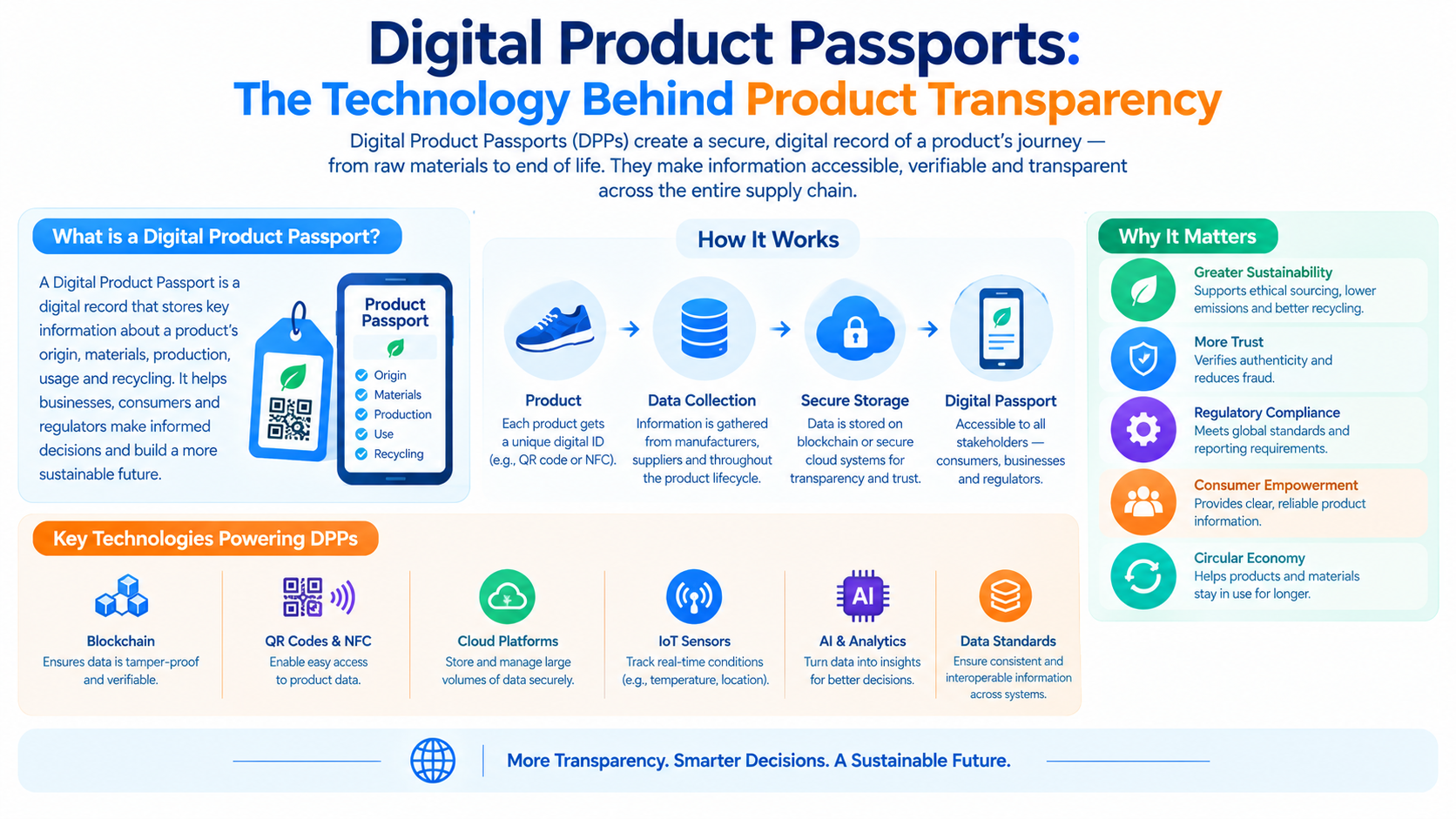
Digital Product Passports exist to close this gap. They are a structured, digital record that follows a product through its entire lifecycle, accessible via a data carrier such as a QR code .
What a Digital Product Passport Actually Is
A DPP is not a label. It is a data record linked to a physical product, part of a wider system for creating, managing, sharing, and accessing product information .
Depending on the product and applicable requirements, a DPP can include :
-
Product identity and origin
-
Materials and components
-
Environmental characteristics
-
Repair and maintenance information
-
Safety and compliance information
-
Instructions for reuse, recycling, or disposal
-
Information about actors and events in the supply chain
The connection between the physical product and its digital record is made through a data carrier typically a QR code, barcode, or RFID tag .
The Regulatory Driver: ESPR and the EU Timeline
The DPP is introduced under the EU's Ecodesign for Sustainable Products Regulation (ESPR), which entered into force in July 2024 . The regulation establishes the framework, but the detailed requirements are defined per product group through delegated acts .
The Phased Timeline
| Date | Milestone |
|---|---|
| July 2026 | DPP registry and testing environment launched |
| July 2026 | Six harmonized CEN/CENELEC standards cited in the Official Journal |
| August 2026 | Registry operating rules apply |
| February 2027 | Battery DPPs mandatory for EV, industrial (≥2kWh), and LMT batteries |
| 2028 | Packaging, iron and steel, construction products |
| 2029 | ICT products, tyres, aluminium, textiles, detergents |
| 2030 | Toys |
Each delegated act must give businesses at least 18 months before compliance becomes mandatory .
Who Is Responsible
The primary responsibility for the DPP's creation and accuracy rests with the economic operators placing the product on the EU market whether manufactured domestically or imported . This includes manufacturers, importers, authorized representatives, distributors, dealers, and fulfilment service providers .
Responsibilities include :
-
Data compilation providing product data digitally in accordance with the required data structure
-
Registration registering the DPP in the EU DPP Registry
-
Lifecycle management ensuring information remains accurate throughout the product's lifecycle
The Technical Architecture
The Eight Standards
In June 2026, the first six harmonized standards for the DPP system were published . Two more remain in draft.
| Standard | What It Covers |
|---|---|
| EN 18216 | Data exchange protocols |
| EN 18219 | Unique identifiers |
| EN 18220 | Data carriers |
| EN 18221 | Data storage, archiving, and persistence |
| EN 18222 | APIs for lifecycle management and searchability |
| EN 18223 | System interoperability |
| prEN 18239 (draft) | Access rights |
| prEN 18246 (draft) | Data authentication and integrity |
Following these standards provides a presumption of conformity with the corresponding requirements of Articles 10 and 11 of the ESPR .
Decentralized Data Storage
The DPP system is deliberately decentralized. DPPs and product-specific data are hosted by the responsible economic operators or delegated to DPP service providers . The European Commission operates only a central registry that stores high-level metadata about the DPPs and products .
The critical implication: Organizations cannot rely on the EU to host their product data. They must build or procure the infrastructure to store, serve, and maintain DPP data themselves.
The Registry and Semantic Repository
The DPP registry became operational in July 2026, alongside a testing environment and a user guide for economic operators covering enrollment, identity verification, and passport registration .
A key component is the semantic repository a collection of data models and semantic definitions that ensure common understanding across all users, including cross-lingual interpretation . This is what makes semantic interoperability possible: two systems can exchange DPP data and understand it the same way.
Data Carriers
The data carrier for each product group will be specified in its delegated act . QR codes and NFC chips are both under consideration, with the choice depending on the product's nature .
GS1 standards provide a foundation. GS1 Digital Link connects QR codes to structured product data, and GTINs provide unique product identification .
The Technology Stack
Building a DPP system requires several components working together.
Asset Administration Shell (AAS)
The AAS is a standardized digital representation of an asset, providing a common structure for exchanging information across systems . Fraunhofer ISST's DS4DPP project combines AAS with Data Spaces as the standard infrastructure for managing DPP data .
Data Spaces
Data Spaces provide the infrastructure for secure control of access, use, storage, and deletion of DPP data . They address a key challenge: not all DPP information should be public. Access rights need to vary by stakeholder a recycler needs different information than a consumer or a regulator .
Blockchain for Traceability
Blockchain is being explored for its traceability, transparency, and immutability properties . A blockchain-based DPP can capture events and transformations across the product lifecycle, with a combination of on-chain and off-chain storage .
However, interoperability gaps remain. Research identifies incompatible data formats across platforms, lack of standardized governance for data updates, and absence of universal certification standards as key barriers .
AI for Data Quality
AI is not merely an efficiency tool for DPP it is a critical strategic capability. AI is essential for managing data quality at scale, enhancing security, and transforming the DPP from a compliance burden into a value-creating asset through predictive analytics and personalized consumer engagement .
What Organizations Need to Build
1. Data Foundation
GS1 UK's guidance is direct: getting your data in order is absolutely critical. You cannot build a DPP without knowing what is in your products, how they are made, and where they have been .
The first steps :
-
Audit your data map what you have, where it lives, and what formats it is in
-
Identify what is missing and what needs updating
-
Adopt GS1 identifiers ensure every product has a unique GTIN
2. Technical Infrastructure
Organizations need infrastructure capable of hosting and maintaining DPP data . This includes:
-
Storage for DPP data
-
APIs for lifecycle management and searchability
-
Data carriers and the systems to generate and manage them
-
Access control and authentication mechanisms
-
Integration with supply chain partners
3. Supply Chain Engagement
The practical challenge for many organizations will be data collection and verification from supply chains . Product information often needs to be sourced from multiple suppliers across different jurisdictions.
Supplier engagement is a critical component of successful implementation .
4. Lifecycle Management
DPP information must remain accurate throughout the product's lifecycle . This requires:
-
Procedures for updating information
-
Mechanisms for verifying accuracy
-
Backup arrangements to ensure availability even if the original operator ceases operations
The Business Case Beyond Compliance
While compliance is the driver, the DPP creates additional value.
For supply chain management: Improved transparency and traceability can support better performance, strengthen market position, and unlock new opportunities in the circular economy .
For consumer trust: Transparency about product lifecycle is a key pillar of building trust and driving uptake of the circular economy .
For data quality: The discipline of building a DPP improves product data overall, which benefits many downstream systems.
For circular business models: The DPP enables repair, reuse, remanufacturing, and recycling by making the information needed for those activities accessible .
Implementation Roadmap
Phase 1: Assess (Weeks 1-4)
-
Determine if your products are in scope. Check the delegated act timeline for your product group.
-
Audit your data. Map what product data you have, where it lives, and what is missing .
-
Identify data gaps for the information a DPP will require.
-
Review supplier data availability and identify engagement needs .
Phase 2: Build (Weeks 5-12)
-
Adopt GS1 identifiers and implement GS1 Digital Link .
-
Build or procure DPP infrastructure storage, APIs, access control.
-
Establish data collection processes with suppliers.
-
Design the data carrier strategy for your product group.
Phase 3: Operate (Weeks 13-16+)
-
Register DPPs in the EU registry when required .
-
Implement lifecycle management procedures to keep data accurate.
-
Establish backup arrangements for data availability .
-
Monitor regulatory developments as delegated acts are published.
Frequently Asked Questions
Q1: What is a Digital Product Passport?
A structured, digital record containing information about a product, component, or material throughout its lifecycle, accessible via a data carrier such as a QR code .
Q2: Who needs a DPP?
Economic operators placing products within the scope of relevant EU legislation on the market whether manufactured domestically or imported. This includes manufacturers, importers, distributors, and dealers .
Q3: When does the DPP become mandatory?
Batteries are first, from February 2027. Other product groups follow through 2030. Each delegated act provides at least 18 months before compliance is mandatory .
Q4: Where is DPP data stored?
The system is decentralized. Data is hosted by the responsible economic operators or delegated to DPP service providers. The EU operates only a central registry storing high-level metadata .
Q5: What standards govern the DPP?
Six harmonized CEN/CENELEC standards were published in July 2026 covering data exchange, identifiers, carriers, storage, APIs, and interoperability. Two more covering access rights and authentication remain in draft .
Q6: How can Innovative AI Solutions help?
We help organizations build the data foundation and technical infrastructure for DPP compliance from product data audits and GS1 identifier adoption to DPP storage, APIs, and lifecycle management. Explore our services to see how we approach enterprise data and compliance engineering. Based in Delhi, serving clients across India.
Why Delhi is a Great Hub for DPP Readiness
Delhi is a major manufacturing and export hub, with Indian companies in textiles, electronics, automotive, and consumer goods selling into European markets. As DPP requirements phase in, the region's enterprises will need to build the data foundations and technical infrastructure to comply. The combination of IT talent, manufacturing scale, and export orientation makes Delhi a natural center for DPP readiness.
What We Offer at Innovative AI Solutions
-
DPP Readiness Assessment: We evaluate your product data and identify gaps for DPP compliance.
-
Data Foundation: We help audit product data and implement GS1 identifiers.
-
Infrastructure Design: We design DPP storage, APIs, and access control.
-
Supplier Data Integration: We help establish data collection processes across the supply chain.
-
Lifecycle Management: We implement procedures to maintain DPP accuracy over time.
Final Thought
The shift is clear: from product information as an internal asset to product information as a regulated, publicly accessible record. The DPP is not just a compliance exercise it is a data architecture that connects physical products to trusted digital records across their entire lifecycle. Organizations that build the data foundation and technical infrastructure now will turn compliance into a competitive advantage. Those that wait until the deadline will discover that the hardest part was never the technology it was the data.
Contact Us:
Phone: +91 7464 099 059 / +91 9689967356
Email: info@innovativeais.com
Address: 904, 9th floor Pearls Best Heights-I, Netaji Subhash Place, Delhi-110034
Website: https://innovativeais.com
About the Author
Abhishek Kumar
Founder & CEO, Innovative AI Solutions
5+ years building AI, cloud, and enterprise systems. Based in Delhi, serving clients across India.