What Is an Enterprise Digital Twin?
Beyond Assets to Organizations
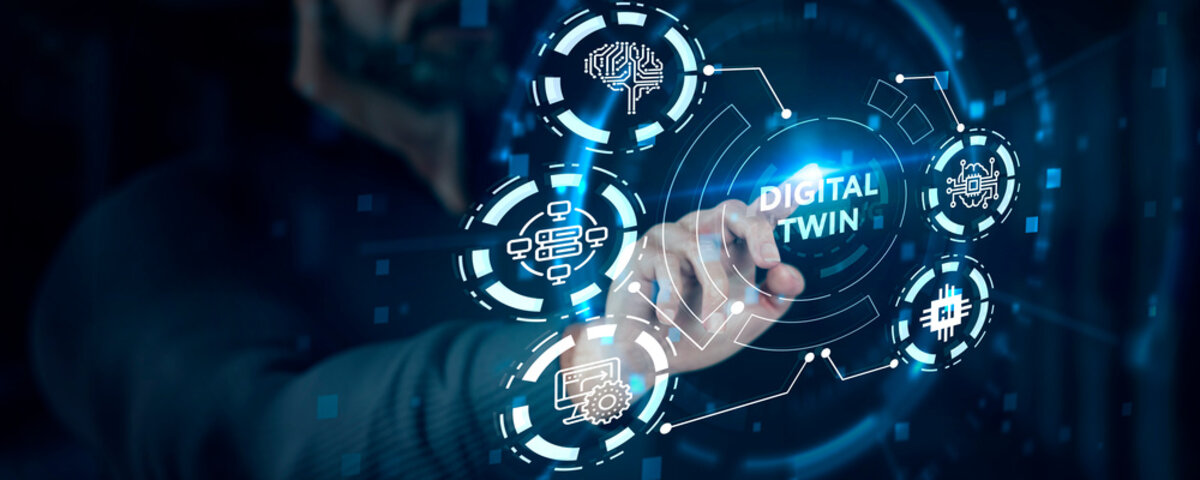
An enterprise digital twin is a dynamic virtual representation of an entire organization, including processes, people, systems, assets, and data—all the components that make up a business. Unlike traditional digital twins that model physical assets like machines or buildings, enterprise digital twins simulate how the entire business operates.
The key distinction: A Virtual Twin of Organization (VTO) integrates people, processes, systems, and agentic AI to model and optimize operating models in a virtual environment. This enables organizations to explore a vast space of strategic possibilities, anticipate disruptions, and continuously adapt with agility.
| Traditional Digital Twin | Enterprise Digital Twin |
|---|---|
| Models physical assets (machines, buildings) | Models entire business operations |
| Optimizes individual processes | Simulates cross-functional interactions |
| Focused on engineering and manufacturing | Enables strategic decision-making |
| Limited to operational data | Integrates people, processes, systems, and AI |
The concept of enterprise digital twins is still nascent, but the implications are profound. A working enterprise digital twin would give leaders a way to explore strategic tradeoffs, anticipate unintended consequences, and learn faster—without paying the traditional real-world costs.
Step 3: How AI Is Enabling Enterprise Digital Twins
The Integration Breakthrough
For years, building a full-scale enterprise digital twin remained theoretical because of data integration challenges. Enterprise data lives in dozens, sometimes hundreds, of disconnected systems—CRM platforms, supply chain databases, payroll systems, and product usage logs.
Critical information can be buried in legal contracts, spreadsheets, and internal strategy documents. Stitching these fragments together into a coherent, living model has traditionally required massive, bespoke engineering efforts so expensive that only organizations like the CIA or the Pentagon could afford it.
That barrier has begun to fall. AI coding agents can now orchestrate data integration in days. These agents can handle schemas, APIs, permissions, and business logic well enough to connect systems with far less need for custom code than before.
Agentic AI in Simulation
AI agents are making enterprise digital twins more accessible by:
| Capability | How It Works |
|---|---|
| Data orchestration | AI coding agents connect disparate systems in days |
| Natural language interaction | LLMs make it easier for people to interact with digital twins naturally |
| Predictive modeling | AI-driven simulations forecast future scenarios and anticipate challenges |
| Agentic simulation | AI agents simulate and test multiple scenarios in parallel |
The power of digital twins comes from how they let you make decisions based on predictions of the future instead of past events. By building a model of your organization and monitoring your processes on an ongoing basis, predictive algorithms can free you from much of the rework and re-planning that is a natural part of business evolution.
Step 4: Real-World Deployments
PepsiCo: Testing Plant and Warehouse Changes
PepsiCo is working with Siemens and NVIDIA to change how it designs, tests, and expands its plants and warehouses using AI and digital twins. By modeling factories and distribution centers digitally before making physical changes, PepsiCo aims to cut down on costly mistakes while improving speed and capacity.
The Technology: Powered by Siemens' Digital Twin Composer, built on NVIDIA Omniverse, the system creates detailed 3D models of facilities that recreate machines, conveyors, pallet routes, and even worker movement with physics-level accuracy.
Measured Results:
| Metric | Result |
|---|---|
| Potential issues identified before physical changes | Up to 90% |
| Factory line throughput improvement | 20% |
| Design validation delivered | 100% |
| Capital expenditure reduction | Up to 15% |
Early pilots have already delivered higher throughput and lower capital costs. Teams can now test different setups in weeks instead of months.
"In this future, our facilities don't just respond to demand, they anticipate and then adapt to it." — Athina Kanioura, Global Chief Strategy Officer, PepsiCo
Urban Planning: Virtual Twin of Jaipur
Dassault Systèmes has created a virtual twin of Jaipur city in collaboration with the state government. Urban planners use the technology to simulate real-world conditions:
-
Assessed a proposed park's location and relocated it after discovering it was too close to a noisy road
-
Simulated traffic patterns
-
Evaluated pollution and energy metrics
-
Tested infrastructure changes digitally before real-world implementation
Indian Companies Using Digital Twins: Mahindra & Mahindra, Tata Motors, Ashok Leyland, Jindal Stainless, and Larsen & Toubro use Dassault Systèmes' 3DEXPERIENCE platform to simulate, optimize, and integrate their entire value chains.
Wendy's: Supply Chain Simulation
The restaurant chain built a digital twin that integrated its 3,500 trucks, 34 distribution centers, and 6,450 restaurants. When the company faced a syrup shortage, the system identified the problem and simulated solutions in five minutes. In the past, such a task would have required more than a dozen people working a full day.
Walgreens: Scaling from Pilot to Enterprise
Walgreens scaled a similar pilot from 10 stores to 4,000 in eight months, demonstrating that enterprise digital twins can be deployed at scale once the architecture is proven.
Salesforce: Stress-Testing AI Agents
Before launching Agentforce Voice, Salesforce's AI voice platform, engineers stress-tested the system inside eVerse, a simulation environment. This revealed failure modes traditional testing would have missed—the agents struggled with regional dialects, misinterpreted overlapping speakers, and broke down when customers shifted tone mid-conversation.
Finding these problems in simulation meant fixing them before customers had to experience them.
Healthcare Application: UCSF Health is piloting eVerse to train AI billing agents. Early results show that trained AI agents can handle up to 88% of cases, freeing human experts from answering the same question over and over.
Step 5: The Future—Enterprise General Intelligence
Salesforce AI Research calls the next evolution Enterprise General Intelligence (EGI) —the ability to simulate not just individual workflows but organizational behavior itself.
The progression:
-
Single-workflow simulations (current state)
-
Multi-workflow sandboxes (emerging)
-
Enterprise-wide simulation (future)
-
Continuous autonomous optimization (long-term)
The path from narrow training environments to enterprise-wide simulation is already underway, and the results can be striking, even at the process level.
Step 6: Implementation Roadmap
Phase 1: Discovery and Foundation (Weeks 1-4)
| Action | Output |
|---|---|
| Define what you're trying to optimize and why | Clear goals and success metrics |
| Start with a focused area (procurement, supply chain, customer journey) | Priority domain |
| Baseline existing systems and data sources | Integration plan |
Phase 2: Build the Digital Twin (Weeks 5-8)
| Action | Output |
|---|---|
| Create a baseline of your processes, systems, and data | Working digital twin |
| Leverage existing software assets before investing in new solutions | Optimized cost |
| Begin with bounded simulations before expanding | Validated approach |
Phase 3: Simulate and Optimize (Weeks 9-12)
| Action | Output |
|---|---|
| Run simulations to test strategic decisions | Decision insights |
| Identify bottlenecks and inefficiencies | Optimization opportunities |
| Experiment with changes to optimize for cost, capacity, or customer experience | Improved outcomes |
Step 7: Frequently Asked Questions
Q1: What is the difference between a digital twin and an enterprise digital twin?
A traditional digital twin models physical assets like machines or buildings. An enterprise digital twin models entire business operations, including processes, people, systems, and data.
Q2: How much does building an enterprise digital twin cost?
Costs vary widely based on complexity. Start with a focused area like supply chain or customer journey rather than attempting to model the entire organization at once. The integration barrier has fallen significantly with AI coding agents now able to orchestrate data integration in days.
Q3: Is enterprise digital twin technology ready for production?
Yes—for bounded use cases. PepsiCo, Wendy's, Walgreens, and others have deployed digital twins for specific processes. The full enterprise-wide simulation is still emerging, but the components are now available.
Q4: What is the "40-70 rule" in strategic decision-making?
Former Secretary of State Colin Powell's rule: below 40% confidence, you're guessing; above 70%, you've likely waited too long. Strategic simulations don't push 70% to 100%, but they help leaders get more value from the information they do have—surfacing hidden assumptions and stress-testing them across multiple futures.
Q5: Which Indian companies are using digital twins?
Mahindra & Mahindra, Tata Motors, Ashok Leyland, Jindal Stainless, and Larsen & Toubro use Dassault Systèmes' 3DEXPERIENCE platform for digital twin applications.
Q6: How can Innovative AI Solutions help?
We help organizations design, build, and deploy AI-powered digital twins for business simulation—from data integration and process modeling to simulation and optimization.
Step 8: Final Tagline
"The companies that benefit most will be the ones that start laying the groundwork now. Enterprise digital twins won't arrive all at once. They'll be assembled piece by piece, by organizations that treat simulation not as a one-off experiment but as a core way of making decisions."
Short version:
Digital twins + AI—simulating entire businesses before making decisions. From PepsiCo to urban planning to enterprise simulation, a 2026 guide.
Hashtags:
#DigitalTwin #EnterpriseSimulation #AIDecisionMaking #VirtualTwin #BusinessSimulation #InnovativeAISolutions
Contact Us
Phone: +91 7464 099 059 / +91 96899 67356
Email: info@innovativeais.com
Address: Netaji Subhash Place, Pitampura, Delhi – 110034
Website: https://innovativeais.com
About the Author
Abhishek Kumar
Founder & CEO, Innovative AI Solutions
5+ years building AI systems for enterprise. Based in Delhi, serving clients across India.
Related services: to apply this in your business, explore our AI agent development and AI development services.