The Big Question
"We model scenarios in spreadsheets and slide decks. But we're still surprised by how customers behave, how teams respond under pressure, and how supplier delays cascade across the business. Is there a better way to stress-test our decisions before making them?"
The honest answer:
Yes. It's called an enterprise digital twin—and it's no longer just for factories.
Here is the truth:
The next generation of leadership will war-game every radical move before putting revenue or reputations on the line . In the physical world, digital twins have transformed how factories, refineries, and supply chains are designed and optimized. Formula One teams have been using digital twins for years to simulate race strategy in real time, testing thousands of pit stops before a single lap is run. Now, powered by agentic AI, the enterprise digital twin could bring that same transformation to knowledge work itself .
Step 3: What Is an Enterprise Digital Twin?
Beyond Assets to Organizations
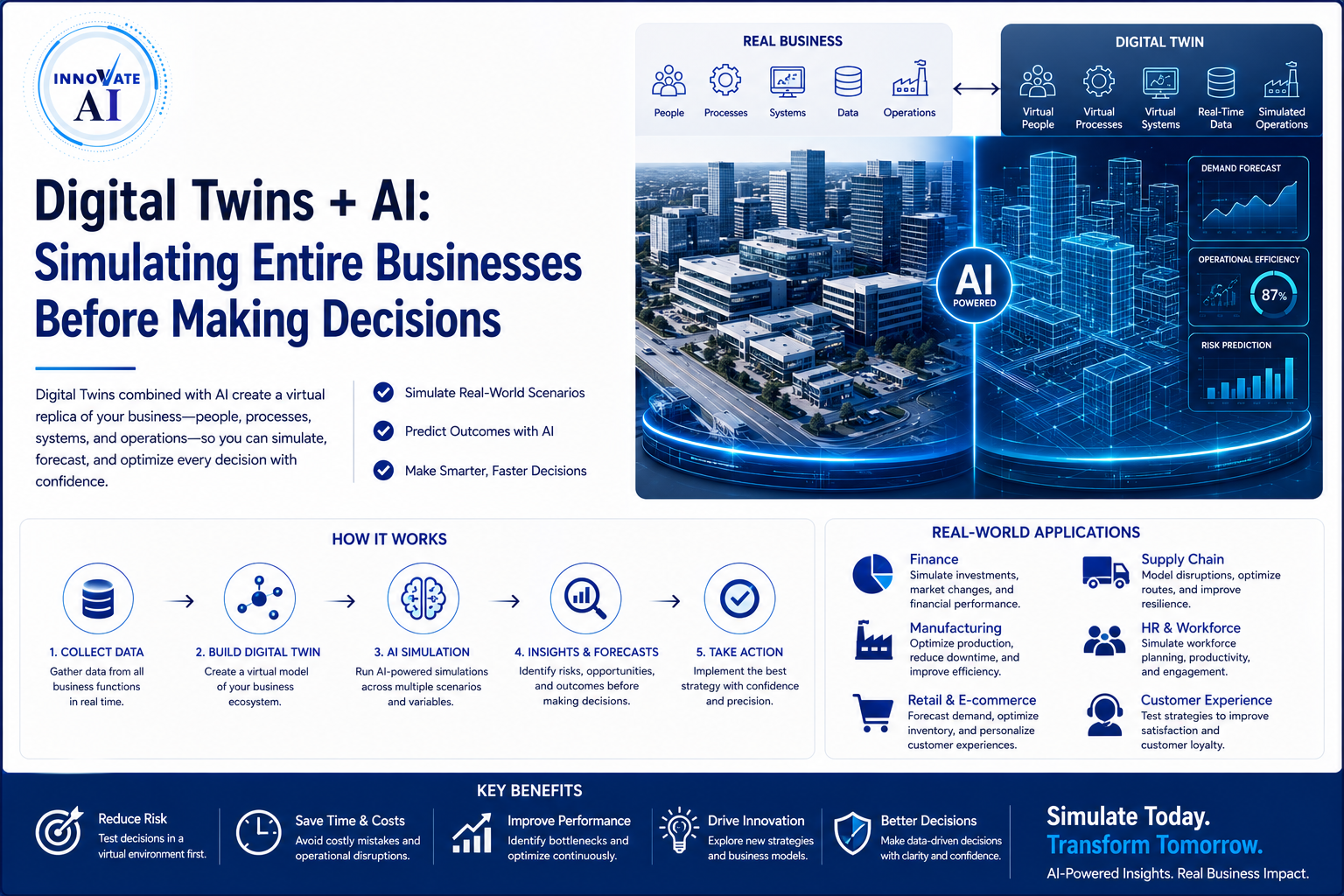
An enterprise digital twin is a dynamic virtual representation of an entire organization—including processes, people, systems, assets, and data—all the components that make up a business . Unlike traditional digital twins that model physical assets like machines or buildings, enterprise digital twins simulate how the entire business operates.
The Core Distinction
| Traditional Digital Twin | Enterprise Digital Twin |
|---|---|
| Models physical assets (machines, buildings) | Models entire business operations |
| Optimizes individual processes | Simulates cross-functional interactions |
| Focused on engineering and manufacturing | Enables strategic decision-making |
| Limited to operational data | Integrates people, processes, systems, and AI |
A Virtual Twin of Organization (VTO) integrates people, processes, systems, and agentic AI to model and optimize operating models in a virtual environment . This enables organizations to explore a vast space of strategic possibilities, anticipate disruptions, and continuously adapt with agility .
What It Enables
Building an enterprise digital twin is different from modeling machines. Simulating knowledge work means capturing why decisions get made—company values, policies, workflows, and decision traces that shape organizational behavior .
Today, a CMO typically sees the world through marketing data, while a CFO sees the world through a financial lens. A working enterprise digital twin changes that, giving each function a view of the whole system, not just its own corner of it .
Step 4: The Integration Breakthrough
Why It Wasn't Possible Before
For years, building a full-scale enterprise digital twin remained theoretical because of data integration challenges. Enterprise data lives in dozens, sometimes hundreds, of disconnected systems: CRM platforms, supply chain databases, payroll systems, and product usage logs .
Critical information can be buried in legal contracts, spreadsheets, and internal strategy documents. Stitching these fragments together into a coherent, living model has traditionally required massive, bespoke engineering efforts so expensive that only organizations like the CIA or the Pentagon could afford it .
How AI Is Changing the Game
That barrier has begun to fall . AI coding agents can now orchestrate data integration in days. These agents can handle schemas, APIs, permissions, and business logic well enough to connect systems with far less need for custom code than before .
Key AI capabilities enabling enterprise digital twins:
| Capability | How It Works |
|---|---|
| Data orchestration | AI coding agents connect disparate systems in days |
| Natural language interaction | LLMs make it easier for people to interact with digital twins naturally |
| Predictive modeling | AI-driven simulations forecast future scenarios |
| Agentic simulation | AI agents simulate and test multiple scenarios in parallel |
The Shift in Enterprise Planning
Digital twins let you make decisions based on predictions of the future instead of past events . By building a model of your organization and monitoring your processes on an ongoing basis, predictive algorithms can free you from much of the rework and re-planning that is a natural part of business evolution .
Step 5: Real-World Deployments
PepsiCo: Testing Plant and Warehouse Changes
PepsiCo is using AI and digital twin technologies with NVIDIA and Siemens to assess effectiveness in simulating, validating, and optimizing plant and warehouse facilities before making any physical changes .
The Technology: Using Siemens Digital Twin Composer, built on NVIDIA Omniverse AI toolkits, PepsiCo recreates every machine, conveyor, pallet route, and operator path with physics-level accuracy .
Measured Results :
| Metric | Result |
|---|---|
| Potential plant design issues identified before physical changes | Up to 90% |
| Factory line throughput improvement | 20% |
| Design validation delivered | 100% |
| Capital expenditure reduction | 10-15% |
Early pilots have already delivered higher throughput and lower capital costs. Teams can now test different setups in weeks instead of months .
"In this future, our facilities don't just respond to demand, they anticipate and then adapt to it." — Athina Kanioura, Global Chief Strategy and Transformation Officer, PepsiCo
Salesforce: Stress-Testing AI Agents Before Launch
Before launching Agentforce Voice, Salesforce's AI voice platform, engineers stress-tested the system inside eVerse, a simulation environment .
What they discovered: The agents struggled with regional dialects, misinterpreted overlapping speakers, and broke down when customers shifted tone mid-conversation . Finding these problems in simulation meant fixing them before customers had to experience them.
Healthcare Application: UCSF Health is piloting eVerse to train AI billing agents. In healthcare, only 60-70% of inquiries follow documented procedures. The rest require judgment, institutional knowledge, and pattern recognition across messy, incomplete records .
Early results: Trained AI agents can handle up to 88% of cases, freeing human experts from answering the same question repeatedly .
National Grid: 70% Faster Infrastructure Planning
The utility provider worked with Atos to develop Triton, a digital twin platform for streamlining the planning of electricity networks .
How it works: Triton consolidates and processes thousands of datasets from diverse sources. Engineers can run rapid simulations of complex network scenarios—modeling future demand and supply at specific grid points—to make reinforcement decisions 70% faster compared to static mapping .
Nestlé: Digital Twins for Marketing
Nestlé collaborated with NVIDIA, Microsoft, and Accenture to apply digital twins and AI to its global marketing efforts .
Key numbers:
-
4,000 digital product twins already created
-
10,000 physical products planned for conversion in the next two years
-
250+ marketing experts using the in-house, AI-powered digital twin service
Impact: Generating and adjusting packaging designs for seasonal campaigns, e-commerce, and digital media channels cuts down on reshoots and accelerates content production cycles .
Wendy's and Walgreens: From Pilot to Scale
-
Wendy's built a digital twin integrating its 3,500 trucks, 34 distribution centers, and 6,450 restaurants. When a syrup shortage occurred, the system identified the problem and simulated solutions in five minutes. In the past, such a task would require more than a dozen people working a full day .
-
Walgreens scaled a similar pilot from 10 stores to 4,000 in eight months .
General Motors: AI-Driven Manufacturing
GM has partnered with NVIDIA to pair Omniverse with Cosmos to create digital twins of assembly lines for virtual testing . Engineers can simulate and optimize production processes before physical implementation and without disrupting existing vehicle production . The effort aligns with GM's larger goal of converting roughly half of its assembly operations to electric vehicles by 2030 .
Step 6: The Future—Enterprise General Intelligence
Salesforce AI Research calls the next evolution Enterprise General Intelligence (EGI) —the ability to simulate not just individual workflows but organizational behavior itself .
The progression:
| Stage | Capability |
|---|---|
| 1. Single-workflow simulations | Current state |
| 2. Multi-workflow sandboxes | Emerging |
| 3. Enterprise-wide simulation | Future |
| 4. Continuous autonomous optimization | Long-term |
"The path from narrow training environments to enterprise-wide simulation is already underway, and the results can be striking, even at the process level" .
Step 7: The Human Factor—The 40-70 Rule
Strategic simulations don't provide certainty. They help leaders get more value from the information they do have.
Former Secretary of State Colin Powell forged his "40-70 rule" through decades of high-stakes military decision-making. Most decisions must be made with incomplete information, but below 40%, you're guessing; above 70%, you've likely waited too long .
What simulations do: They don't push 70% to 100%. But they help leaders surface hidden assumptions, stress-test them across multiple futures, and sharpen the questions that matter most .
Step 8: Implementation Roadmap—90 Days
Phase 1: Discovery and Foundation (Weeks 1-4)
| Action | Output |
|---|---|
| Define what you're trying to optimize and why | Clear goals and success metrics |
| Start with a focused area (procurement, supply chain, customer journey) | Priority domain |
| Baseline existing systems and data sources | Integration plan |
| Leverage existing software assets before investing in new solutions | Optimized cost |
Phase 2: Build the Digital Twin (Weeks 5-8)
| Action | Output |
|---|---|
| Create a baseline of your processes, systems, and data | Working digital twin |
| Begin with bounded simulations before expanding | Validated approach |
| Run simulations to test strategic decisions | Decision insights |
Phase 3: Simulate and Optimize (Weeks 9-12)
| Action | Output |
|---|---|
| Identify bottlenecks and inefficiencies | Optimization opportunities |
| Experiment with changes to optimize for cost, capacity, or customer experience | Improved outcomes |
| Expand to additional workflows | Broader deployment |
Step 9: Frequently Asked Questions
Q1: What is the difference between a digital twin and an enterprise digital twin?
A traditional digital twin models physical assets like machines or buildings. An enterprise digital twin models entire business operations, including processes, people, systems, and data .
Q2: Is enterprise digital twin technology ready for production?
Yes—for bounded use cases. PepsiCo, Wendy's, Walgreens, Nestlé, GM, and National Grid have deployed digital twins for specific processes . The full enterprise-wide simulation is still emerging, but the components are now available .
Q3: What is the 40-70 rule in strategic decision-making?
Former Secretary of State Colin Powell's rule: below 40% confidence, you're guessing; above 70%, you've likely waited too long. Strategic simulations don't push 70% to 100%, but they help leaders surface hidden assumptions and stress-test them across multiple futures .
Q4: How much does building an enterprise digital twin cost?
Costs vary widely based on complexity. Start with a focused area like supply chain or customer journey rather than attempting to model the entire organization at once . The integration barrier has fallen significantly with AI coding agents now able to orchestrate data integration in days .
Q5: What is the "left shift" in decision-making?
A "left shift" means moving decisions earlier in the process—assessing impacts before execution rather than after. Virtual Twins of Organizations enable this by allowing organizations to simulate and optimize before implementing .
Q6: How can Innovative AI Solutions help?
We help organizations design, build, and deploy AI-powered digital twins for business simulation—from data integration and process modeling to simulation and optimization.
Step 10: Final Tagline
"The companies that benefit most will be the ones that start laying the groundwork now. Enterprise digital twins won't arrive all at once. They'll be assembled piece by piece, by organizations that treat simulation not as a one-off experiment but as a core way of making decisions" .
Short version:
Digital twins + AI—simulating entire businesses before making decisions. From PepsiCo to enterprise simulation, a 2026 guide.
Hashtags:
#DigitalTwin #EnterpriseSimulation #AIDecisionMaking #VirtualTwin #BusinessSimulation #InnovativeAISolutions
Contact Us
Phone: +91 7464 099 059 / +91 96899 67356
Email: info@innovativeais.com
Address: Netaji Subhash Place, Pitampura, Delhi – 110034
Website: https://innovativeais.com
About the Author
Abhishek Kumar
Founder & CEO, Innovative AI Solutions
5+ years building AI systems for enterprise. Based in Delhi, serving clients across India.
Related services: to apply this in your business, explore our AI agent development and AI development services.