The Big Question
What happens when your organization's data is fragmented across dozens of systems, yet every AI initiative demands clean, governed access to that data? What if the platform that connects your data could also reason about your business, understand relationships between entities, and take action automatically?
This is the promise of Enterprise Intelligence Platforms—and it's rapidly becoming a production requirement for organizations serious about AI.
The Problem: Why Traditional Data Tools Are Failing
The numbers paint a stark picture. According to Mavvrik's 2025 research, 84% of companies report AI costs are reducing gross margins by more than 6% —not because AI doesn't work, but because the data beneath it doesn't .
Data remains fragmented across clouds, lakes, SaaS apps, and operational systems. This fragmentation forces expensive data movement, creates governance blind spots, and erodes confidence in AI outputs. The result? Slower, lower-confidence decisions, higher costs, and AI initiatives that stall before they scale .
Fortune 500 companies collectively lose $30 billion annually by failing to share knowledge effectively . Employees spend a quarter of their workweek searching for information . A robust knowledge management program can reduce average time spent searching from 8.5 hours to 4.6—a decrease of approximately 46% .
The problem isn't lack of data. It's fragmented, ungoverned, inaccessible data. And traditional Business Intelligence tools can't solve this because they were designed for a different era.
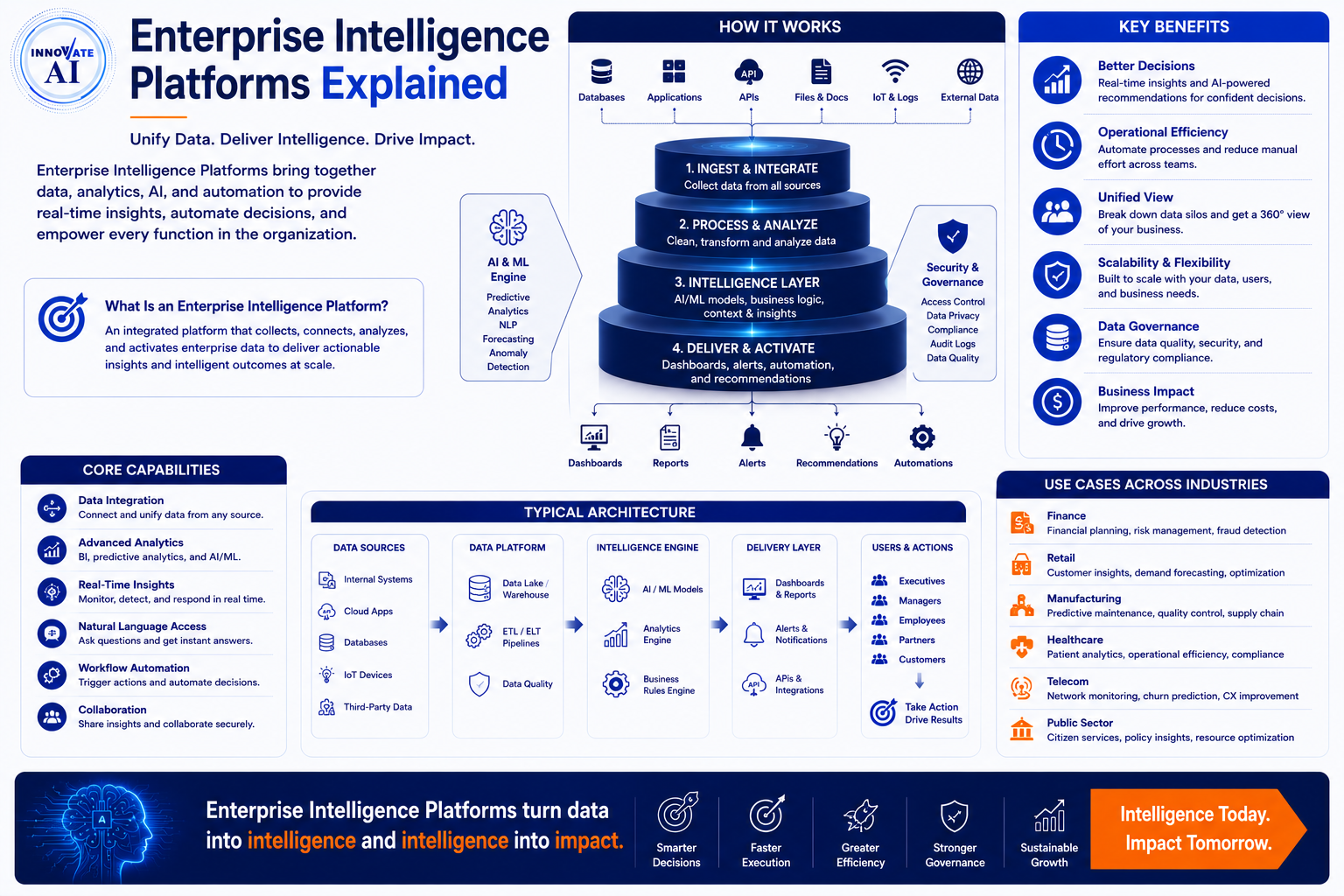
What Is an Enterprise Intelligence Platform?
An Enterprise Intelligence Platform (EIP) combines what was traditionally three separate product categories into one seamless experience: data integration, data storage, and analytics designed to meet the needs of both data consumers and data operators .
According to 451 Research, 78% of data-driven companies would consider adopting an Enterprise Intelligence Platform .
The Evolution: From ERP to EIP
The concept represents a fundamental evolution from traditional ERP systems. While an ERP integrates various areas of a company, an EIP integrates the company with the world—connecting to external data sources, social media, and market intelligence .
The key distinctions are telling :
| Traditional ERP | Enterprise Intelligence Platform |
|---|---|
| Integrated between departments | Integrated with the world |
| Proprietary language, closed system | Collaborative, open framework |
| User adapts to the system | System adapts to the user |
| Provides information for you to analyze | Analyzes information for you |
| Departmentalized multiple systems | Single, unified journey |
"EIP is a platform of intelligence that conducts each user to a unique experience, specifically adequate to their usability habits and needs" .
Why This Matters Now: The AI Imperative
AI demands enterprise intelligence as its foundation. A 2024 MIT Technology Review Insights survey exposes a stark reality: 78% of businesses are not "very ready" to deploy generative AI effectively, with many lacking the necessary data foundations .
Why AI fails without enterprise intelligence:
-
"Garbage in, garbage out" remains inviolable. When trained on redundant, outdated, or conflicting information, AI systems produce incorrect answers with high confidence, leading organizations down costly wrong paths .
-
No shared business language. AI can read the data, but it doesn't understand your business. Without grounding in business context, AI cannot reason about cascading effects, constraints, or objectives .
-
Context fragmentation. Traditional BI answers "what happened." Enterprise intelligence answers "what should we do right now, and why?" . This shift from retrospective reporting to real-time action is what makes this an entirely new category.
The mandate is clear: AI investments built on fragmented knowledge bases lead to diminishing returns. Proper implementation of an enterprise intelligence framework ensures high-quality knowledge flows that maximize AI effectiveness while minimizing risks .
The Architecture: How Enterprise Intelligence Works
The Unified Data Foundation
Leading platforms like Microsoft Fabric IQ demonstrate the shift from data platforms to intelligence platforms. Fabric IQ combines five integrated capabilities :
-
Ontology: Shared model of business entities, relationships, rules, and objectives
-
Semantic Model: Trusted BI definitions, extended beyond analytics into operations and AI
-
Graph: Native graph engine for multi-hop reasoning and system-wide insights
-
Data Agent: Virtual analysts that answer business questions using structured business meaning
-
Operations Agent: Autonomous agents that reason, learn, and act in real time
The ontology is the foundation—a formal model of your business that captures the things that matter, how they relate, what rules govern them, and what actions can be taken on them. It becomes the shared language that both teams and AI use to reason about the business .
The Active Layer vs. The Reporting Layer
Traditional BI answers "what happened?" Company intelligence answers "what should we do right now, and why?" .
Consider a practical scenario from one implementation. A global steel manufacturer struggled with chronic late shipments because no single system could identify root causes across production and logistics in real time. After adopting an enterprise intelligence platform, AI agents automatically diagnosed issues, recommended corrective actions, and triggered customer notifications without human lag. On-time delivery rates improved materially, and customer resolution times dropped .
The Shift from Observation to Agency
The year 2026 marks a definitive crossroads. We are moving from the era of Observation to the era of Agency .
In 2026, the battle for data supremacy is no longer about who has the prettiest dashboard, but who has the most capable agents . Traditional BI is a "System of Record" focused on visualization and historical accuracy. AI agents are "Systems of Action"—they interpret the data and execute tasks to achieve business goals .
Real-World Platform Examples
Microsoft Fabric IQ
At Microsoft Ignite 2025, Microsoft announced Fabric IQ, a "unified intelligence platform powered by semantic understanding and agentic AI" . The platform turns unified data into "a live, structured, connected model of how your business operates" .
The impact is already being seen. At Apollo Hospitals, Fabric Real-Time Intelligence is unifying data across the continuum of care, transforming it into "real-time intelligence that empowers clinicians, enhances operational excellence, and delivers predictive, patient-centered outcomes" .
Starburst Enterprise Intelligence Platform
Starburst's platform enables enterprises to "run AI on governed data—across models and tools—without moving or replatforming" . The solution brings AI to the data, not the other way around.
Their platform features AIDA, an AI assistant that "operates directly inside the workflows, applications, and agents where they work" and can "generate visualizations, trigger workflows, open tickets, update records, and initiate processes across connected systems" .
Capgemini's Internal AI Platform
Capgemini has built an AI enterprise intelligence platform available to all 420,000 employees . The platform provides "faster access to secure, accurate, and curated company knowledge, easily combined with external data" .
It allows users to "search for information and get answers to questions in seconds, from curated, compliant sources; generate content and create documents; complete mandatory and routine self-service tasks... and interact with dedicated smart agents designed for their specific role" .
EnterpriseIQ: Open Source Implementation
EnterpriseIQ is a production-grade, full-stack AI platform designed to ingest massive corporate datasets and translate them into real-time business intelligence . It combines Dynamic Retrieval-Augmented Generation (RAG), Knowledge Graphs, Time-Horizon Forecasting, and Sliding-Window Anomaly Detection.
The platform includes :
-
Organic Knowledge Graph Explorer: Visualizes relationships between business entities
-
Time-Horizon Forecasting Engine: Supports 30-day, 90-day, and 180-day projections
-
Sliding-Window Anomaly Monitor: Detects outlier patterns continuously
-
Vector-Embedded RAG Pipeline: Bridges natural language querying with structured data
Key Features and Capabilities
Data Integration and Semantic Layer
Enterprise BI platforms connect to dozens or even hundreds of data sources. The semantic layer sits between raw data and BI tools, defining business metrics once with all their logic, filters, and calculations .
When someone asks for "gross margin," they get the same number whether they're looking at a finance dashboard, a sales report, or an executive summary. If the definition needs to change, it updates everywhere at once .
AI and Machine Learning Capabilities
AI in enterprise BI has moved past basic automation. Modern capabilities include :
-
Natural language querying for democratized access
-
Automated insight generation that surfaces patterns humans might miss
-
Predictive analytics and forecasting
-
Anomaly detection in real time
-
Agentic execution that takes action automatically
Self-Healing Knowledge Systems
Enterprise intelligence platforms can function as "self-healing systems" that :
-
Identify redundant, outdated, trivial, conflicting, and missing information
-
Clean existing knowledge while preventing new messes from forming
-
Connect previously siloed knowledge pools, creating combinatorial value
-
Preserve institutional expertise by capturing tacit knowledge before it walks out the door
-
Deliver insights automatically within workflows, not just when explicitly requested
The Financial Impact
Implementing enterprise intelligence practices delivers measurable financial returns :
-
Productivity Transformation: Reducing search time from 8.5 to 4.6 hours per week—a 46% decrease
-
Onboarding Acceleration: Well-structured knowledge systems can increase new-hire productivity by up to 50%
-
Customer Experience Enhancement: Strong knowledge management practices achieve greater customer satisfaction and retention
-
Revenue Impact: Organizations investing in structured knowledge practices experience a 47% boost in their ability to hit OKRs
The payoff timeline is compelling: organizations implementing enterprise intelligence typically achieve payback within six to 12 months . The long-term advantage comes from the compound effect of organizational intelligence.
Implementation Roadmap
Phase 1: Foundation (Weeks 1-4)
-
Conduct a knowledge audit: Measure how many systems house critical information, quantify time employees spend searching, track new hire proficiency timelines
-
Establish asset classifications: Organize knowledge into intellectual property, explicit knowledge, and tacit knowledge
-
Select platform: Choose a solution that supports integration, semantic layer, and AI capabilities
-
Start small: Begin with two high-value departments where knowledge sharing delivers immediate value
Phase 2: Populate (Weeks 5-8)
-
Connect data sources: Integrate CRM, analytics, finance, and operational systems
-
Build semantic layer: Define consistent business metrics and relationships
-
Enable governance: Establish permissions, version history, and audit trails
-
Deploy initial agents: Start with Data Agents for querying and insight
Phase 3: Operationalize (Weeks 9-12+)
-
Enable agentic execution: Deploy Operations Agents that take action automatically
-
Measure impact: Track productivity, decision speed, and revenue impact
-
Scale: Expand to additional departments and use cases
-
Continuous improvement: Refine ontology, governance, and agent capabilities
Frequently Asked Questions
Q1: What is an Enterprise Intelligence Platform?
An Enterprise Intelligence Platform combines data integration, storage, and analytics into one seamless experience, enabling organizations to turn fragmented data into unified, actionable intelligence .
Q2: How is it different from traditional BI?
Traditional BI answers "what happened?" Enterprise intelligence answers "what should we do right now, and why?" —shifting from retrospective reporting to real-time action.
Q3: What is the semantic layer?
A semantic layer sits between raw data and BI tools, defining business metrics once with all their logic, making those definitions available everywhere. It ensures consistent definitions across the organization .
Q4: Why is enterprise intelligence critical for AI success?
AI systems trained on fragmented, ungoverned data produce unreliable outputs. Enterprise intelligence provides the clean, governed, semantically consistent foundation AI requires .
Q5: What's the difference between ERP and EIP?
ERP integrates departments; EIP integrates the company with the world. ERP provides information for you to analyze; EIP analyzes information for you .
Q6: How can Innovative AI Solutions help?
We help organizations design, build, and operationalize enterprise intelligence platforms—from platform selection and data integration to ontology design and agentic deployment. Based in Delhi, serving clients across India.
Why Delhi is a Great Hub for AI Development
Delhi is emerging as a significant hub for AI development, backed by concrete government support and infrastructure. The recent Delhi Budget 2026-27 allocated ₹8.20 crore for two Artificial Intelligence centres of excellence (AI-CoEs), functioning as hubs for research, innovation, and startup incubation.
The city's AI infrastructure is expanding rapidly. Under the IndiaAI Mission, more than 38,000 high-end GPUs have been onboarded and are available at approximately ₹65 per hour—roughly one-third of the global average cost. This makes AI development remarkably cost-effective compared to other tech hubs.
The government has also announced a ₹350 crore startup policy over five years, aiming to support the emergence of at least 5,000 startups by 2035, with key focus areas including artificial intelligence, machine learning, and automation.
The AI ecosystem in Delhi combines: cost-effective infrastructure, government support, a growing talent pool, and proximity to the country's business decision-makers.
What We Offer at Innovative AI Solutions
After five years of building AI solutions for businesses, we've developed a practical approach that focuses on what actually works:
-
Enterprise Intelligence Strategy: We help you assess your data estate and design an intelligence architecture
-
Platform Selection: We help you choose the right platform—Fabric, Starburst, or open-source solutions
-
Semantic Layer Design: We help you build the business ontology that powers AI reasoning
-
Data Integration: We connect fragmented data sources into a unified, governed estate
-
Agentic Deployment: We help you deploy Data Agents and Operations Agents
-
Governance and Compliance: We help you establish permissions, audit trails, and accountability
Our approach is built on the reality that enterprise intelligence isn't just technology—it's the foundation for AI success.
Final Thought
The shift is clear. Organizations winning today are "not merely collecting more data. They are turning data into intelligence, and intelligence into action. They are building systems that observe, understand, and reason about the business in real time and at machine scale—and then act to drive and advance business outcomes" .
That is the shift from data platforms to intelligence platforms. And it is redefining competitive advantage.
Contact Us:
Phone: +91 7464 099 059 / +91 9689967356
Email: info@innovativeais.com
Address: Netaji Subhash Place, Pitampura, Delhi – 110034
Website: https://innovativeais.com
About the Author
Abhishek Kumar
Founder & CEO, Innovative AI Solutions
5+ years building AI systems for enterprises. Based in Delhi, serving clients across India.
Hashtags: #EnterpriseIntelligence #AIPlatforms #BusinessIntelligence #DataStrategy #EnterpriseAI #AIStrategy #InnovativeAISolutions
Related services: to apply this in your business, explore our AI development services and RAG development.