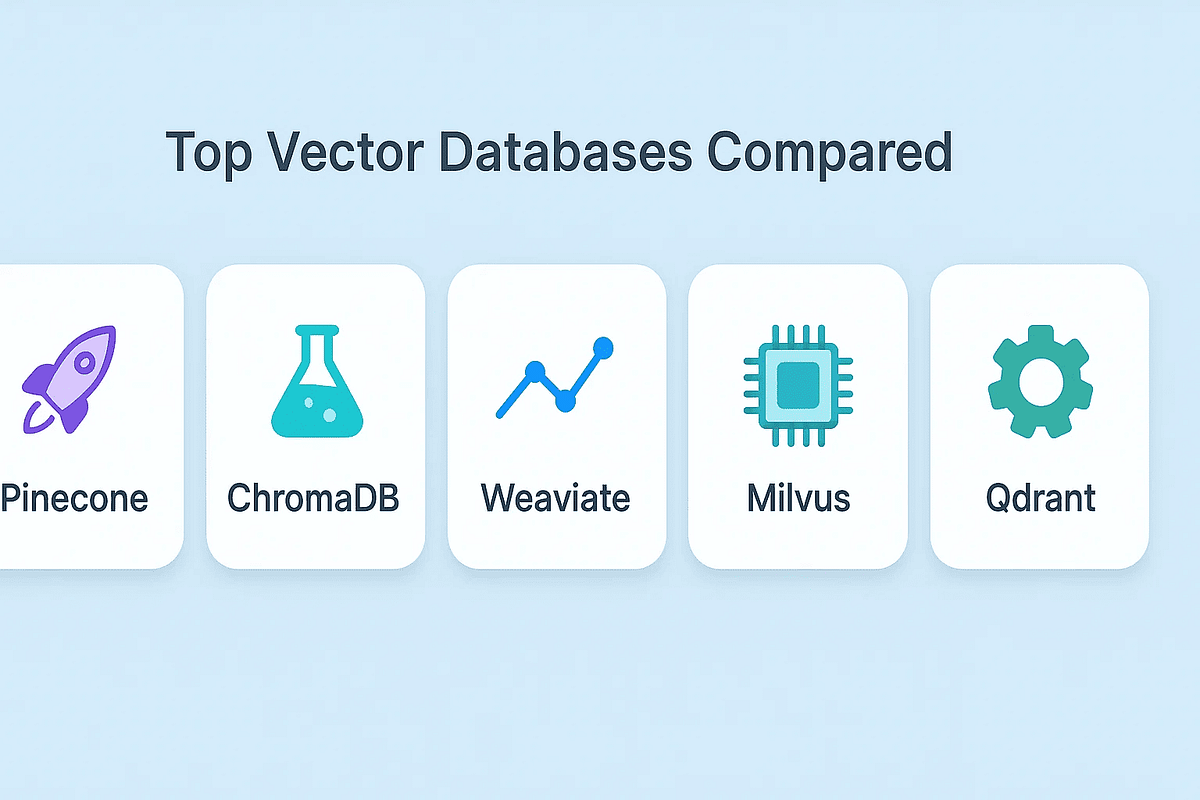
The Critical Distinction – Library vs. Database
Before comparing features, understand the fundamental difference:
| Aspect | FAISS | Pinecone | Weaviate |
|---|---|---|---|
| Type | Similarity search library | Managed vector database (SaaS) | Open-source vector database |
| Deployment | Embedded in your code (local) | Fully managed cloud service | Self-hosted or cloud |
| Persistence | Manual save/load | Automatic | Automatic |
| CRUD Operations | Rebuild index for updates | Real-time | Real-time |
| Metadata Filtering | Must implement yourself | Native support | Powerful filtering |
| Horizontal Scaling | Single machine | Automatic | Manual cluster setup |
FAISS is a library – a tool you call from your code. Pinecone and Weaviate are databases – systems that store, manage, and query vectors with persistence, updates, and filtering.
"FAISS is a brilliant library for in-memory nearest neighbor search, but it was never designed to be a production vector database."
Step 3: FAISS – The Performance Powerhouse
What It Is
FAISS (Facebook AI Similarity Search) is Meta's open-source library for efficient similarity search and clustering of dense vectors. It is written in C++ with Python bindings and supports GPU acceleration.
Strengths
| Strength | Why It Matters |
|---|---|
| Blazing fast | C++ implementation, GPU support (CUDA), advanced indexing (IVF, HNSW, PQ) |
| Battle-tested | Used across Meta, mature codebase, extensive academic citations |
| Maximum control | Fine-grained control over indexing strategy, compression, and search parameters |
| Zero operational cost | No servers, no cloud fees, no vendor lock-in |
| Large-scale capability | Handles billions of vectors efficiently on a single machine |
Weaknesses
| Weakness | The Real Cost |
|---|---|
| Not a database | No persistence, no CRUD, no real-time updates – you manage everything |
| No metadata filtering | Cannot filter by category, date, or other fields before vector search |
| No built-in scalability | Horizontal scaling requires custom engineering |
| Engineering overhead | Need to build service layer, manage indexes, handle deployment |
Ideal Use Cases
-
Research and prototyping
-
Offline batch similarity search
-
Teams with strong engineering resources
-
Single-machine deployments under 100 million vectors
-
When maximum performance is non-negotiable
"FAISS is still the fastest single-node vector search library, but lacks persistence, CRUD, and distributed scaling."
Step 4: Pinecone – The Managed Service
What It Is
Pinecone is a fully managed vector database service. You do not install, configure, or scale anything – just create an index via API and start querying.
Strengths
| Strength | Why It Matters |
|---|---|
| Zero operations | No infrastructure management – create index, start querying |
| Serverless scaling | Automatically scales up and down based on load |
| Simple API | Integrate in minutes, not days |
| Built-in filtering | Native metadata filtering without custom code |
| Production-ready | Low latency (sub-50ms p95 at 10 million vectors), high availability |
Weaknesses
| Weakness | The Real Cost |
|---|---|
| Expensive at scale | $350-700 per month for 10 million vectors |
| Closed source | Cannot self-host, vendor lock-in |
| Data sovereignty concerns | Data must leave your infrastructure |
| Limited control | Cannot tune indexing algorithms |
Ideal Use Cases
-
Teams without dedicated DevOps
-
Production RAG systems needing fast time-to-market
-
Startups where speed matters more than cost
-
Applications where data sovereignty is not a constraint
"Pinecone is the easiest managed option, but costs escalate at scale – monitor your index size."
Step 5: Weaviate – The Flexible Open-Source Database
What It Is
Weaviate is an open-source vector database that combines vector search with graph-like data modeling and hybrid search capabilities.
Strengths
| Strength | Why It Matters |
|---|---|
| Hybrid search | Native BM25 keyword search + vector similarity in one query |
| Built-in vectorization | Can call embedding models (OpenAI, Cohere, HuggingFace) directly |
| GraphQL API | Flexible, powerful queries for complex data relationships |
| Multi-modal support | Text, images, audio, video all in one database |
| Self-host or cloud | Run on your laptop, your cloud, or Weaviate Cloud |
| Active open source | BSD-3 license, Go implementation |
Weaknesses
| Weakness | The Real Cost |
|---|---|
| Operations expertise required | Self-hosted requires skilled operations for large-scale deployments |
| Resource hungry | Higher memory and compute footprint than Qdrant or FAISS |
| Performance trade-off | Pure vector search slower than FAISS or Qdrant |
| Learning curve | GraphQL and schema design add complexity |
Ideal Use Cases
-
Teams needing hybrid (keyword + vector) search
-
Knowledge graph applications
-
Organizations with open-source requirements
-
Multi-modal search (text + images + video)
-
When data sovereignty requires self-hosting
"Weaviate's hybrid search improves recall by 8% over pure vector search on ambiguous queries (e.g., 'Apple' where both fruit and company exist)."
Step 6: Head-to-Head Comparison Matrix
| Factor | FAISS | Pinecone | Weaviate |
|---|---|---|---|
| Type | Library | Managed SaaS | Open-source database |
| Deployment | Embedded | Cloud only | Self-host or Cloud |
| Open Source | Yes (MIT) | No | Yes (BSD-3) |
| Metadata filtering | No | Yes | Yes (Powerful) |
| Hybrid search (keyword + vector) | No | Partial | Yes (Native BM25) |
| GPU acceleration | Yes | No | No |
| Real-time updates | No (rebuild index) | Yes | Yes |
| Horizontal scaling | No | Yes (auto) | Yes (manual) |
| Built-in vectorization | No | No | Yes |
| Query language | Python/C++ | REST/SDKs | GraphQL + REST |
| Cost (10 million vectors) | $0 (self) | $350-700 per month | $250-500 per month (self-host) |
| Setup time | Hours (integration) | 10 minutes | 1 hour |
| Best for | Performance, research | Zero-ops production | Hybrid search, flexibility |
Step 7: Decision Framework
Start with FAISS if
-
You are building a prototype or research project
-
You can run everything on a single machine (under 100 million vectors)
-
Your team has strong engineering and can build service wrappers
-
You need maximum performance and GPU acceleration
-
Budget is your primary constraint
Start with Pinecone if
-
You need production RAG with minimal time-to-market
-
Your team has no dedicated DevOps resources
-
Budget is not the primary constraint ($350-700 per month acceptable)
-
Data sovereignty is not a concern (cloud-only)
-
You want serverless scaling without thinking about it
Start with Weaviate if
-
You need hybrid search (keyword + vector)
-
Your data has complex relationships (knowledge graph)
-
You want open source with self-hosting option
-
Your team can manage Kubernetes or Docker deployments
-
You need multi-modal search (text + images + video)
The Growth Path
Most teams follow this evolution:
| Phase | Tool | Why |
|---|---|---|
| Research / Prototype | FAISS | Fastest iteration, zero cost |
| Early Production | Weaviate (self-host) or Pinecone | Metadata filtering, real-time updates |
| Scale (over 100 million vectors) | Pinecone (managed) or Weaviate (clustered) | Horizontal scaling, production support |
"Choosing a vector database is not about trends. It is about workload, latency, cost, and retrieval strategy. Models get the attention. Infrastructure decides the outcome."
Step 8: Real-World Performance Benchmarks (2026)
Latency at 10 Million Vectors (768-dimension)
| Solution | p95 Latency | Environment |
|---|---|---|
| FAISS (GPU) | 5-15 milliseconds | Single GPU instance |
| Qdrant (self-host) | 25 milliseconds | AWS EC2 G4dn.xlarge |
| Pinecone | 42 milliseconds | Serverless managed |
| Weaviate (self-host) | 50-100 milliseconds | AWS EC2 G4dn.xlarge |
Cost Comparison (Monthly)
| Solution | 1M vectors | 10M vectors | 100M vectors |
|---|---|---|---|
| FAISS (self-host) | $50-100 (compute) | $200-500 | $1,000-2,000 |
| Pinecone | $100-200 | $350-700 | $2,000-4,000 |
| Weaviate (self-host) | $50-100 | $250-500 | $1,500-3,000 |
"Pinecone's cost is the main trade-off – it is powerful but expensive. Qdrant offers the best balance for Indian startups at ₹2,000-6,000 per month."
Step 9: Frequently Asked Questions
Q1: Can I use FAISS in production?
Yes, but it requires significant engineering. You need to handle persistence, build a service layer, manage memory, and implement metadata filtering yourself. Many teams do this successfully, but the hidden operational cost often exceeds the licensing savings.
Q2: Why is Pinecone so expensive?
Pinecone charges for operational convenience. You pay for automatic scaling, zero maintenance, built-in filtering, multi-region replication, and 99.9% uptime service level agreements. For startups with no DevOps, the trade-off often makes sense.
Q3: Is Weaviate good for RAG applications?
Yes. Weaviate is excellent for RAG due to its hybrid search (vector + keyword), built-in vectorization, and flexible GraphQL API. Many production RAG pipelines use Weaviate as the retrieval layer.
Q4: Which is fastest: FAISS, Pinecone, or Weaviate?
For single-machine, in-memory, no-filtering queries: FAISS (especially with GPU). For production with filters and real-time updates: Pinecone and Weaviate are comparable, though Qdrant often beats both in pure performance.
Q5: How do I handle metadata filtering with FAISS?
FAISS does not support metadata filtering. Common patterns include pre-filtering (filter metadata first, then run FAISS on reQ7: Can we use multiple vector databases?
Yes. Hybrid architectures are common: FAISS for offline batch processing (recommendations), Weaviate for real-time RAG, Pinecone for customer-facing search. Choose the best tool for each workload.
Q8: How can Innovative AI Solutions help?
We help teams select, deploy, and optimize vector search infrastructure – from FAISS prototypes to Pinecone production deployments.
Step 10: Final Tagline
Models get the attention. Infrastructure decides the outcome. FAISS gives you speed and control. Pinecone gives you zero operations. Weaviate gives you hybrid search and flexibility. There is no "best" – only "best for your workload."
Short version:
FAISS vs Pinecone vs Weaviate – complete 2026 comparison. Performance, cost, scaling, and decision framework for AI engineers. Choose the right vector search for your stack.
Hashtags:
#VectorDatabase #FAISS #Pinecone #Weaviate #RAG #SemanticSearch #AIInfrastructure #InnovativeAISolutions
Ready to Choose Your Vector Database?
Not sure which vector database fits your use case? Let us help you evaluate based on your data scale, latency requirements, and operational capacity.
Contact Us
Phone: +91 7464 099 059 / +91 96899 67356
Email: info@innovativeais.com
Address: Netaji Subhash Place, Pitampura, Delhi – 110034
Website: https://innovativeais.com
About the Author
Abhishek Kumar
Founder & CEO, Innovative AI Solutions
5+ years building AI infrastructure – from vector search to production RAG. Based in Delhi, serving clients across India.
Related services: to apply this in your business, explore our RAG development and API development and integration.