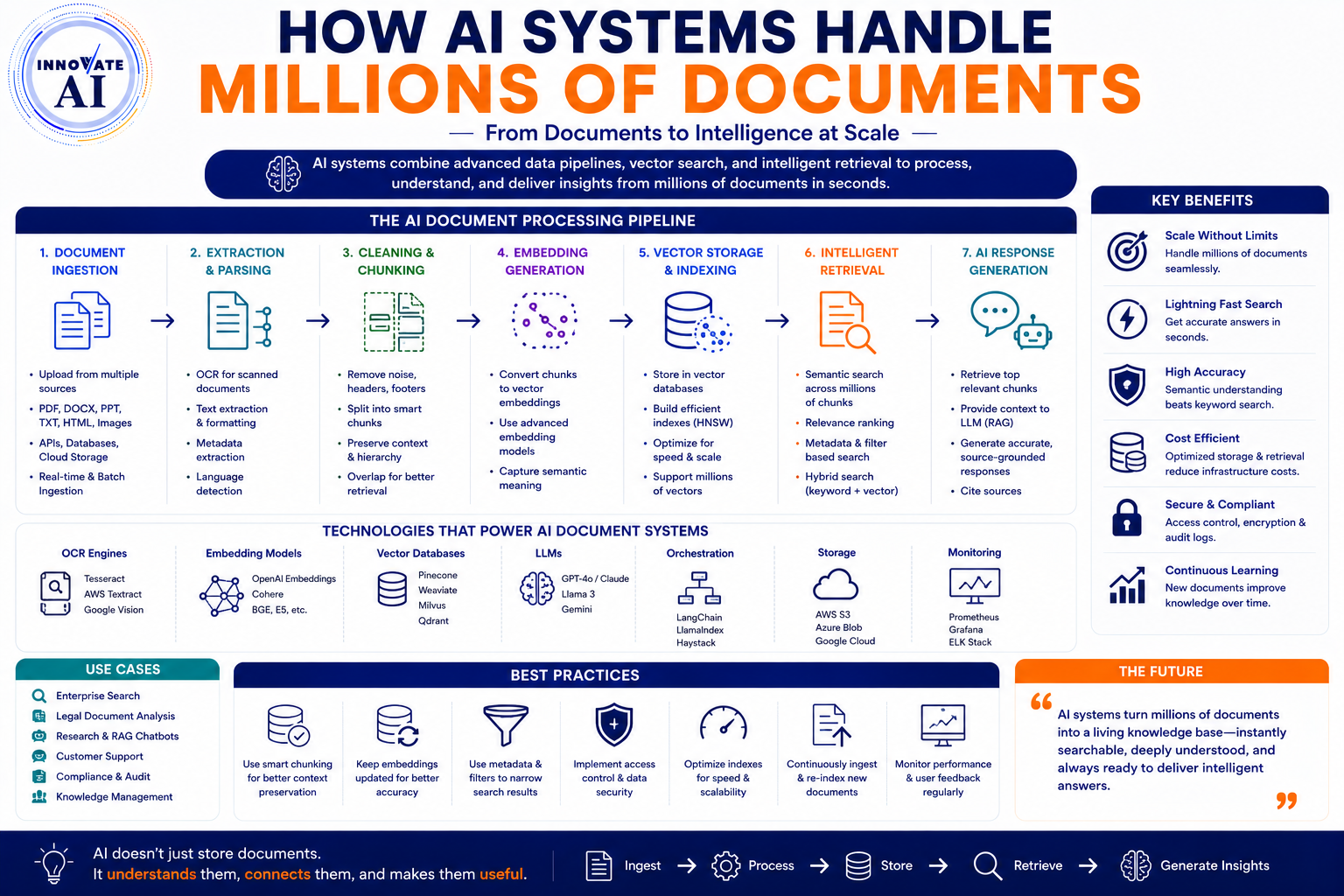
The Big Question
What happens when your organization has millions of documents scattered across systems—PDFs, scanned images, emails, spreadsheets, presentations—yet AI models can't access them because they're unstructured and unsearchable? When traditional OCR fails on complex layouts, and manual processing takes months?
Gartner estimates that 70% to 90% of enterprise data is unstructured . Fewer than one percent of the estimated 2.5 trillion PDF documents on the public web are represented in popular machine-learning corpora . The challenge isn't just storage—it's making this data accessible and actionable.
AI systems are solving this problem through scalable, intelligent document processing pipelines that turn unstructured content into structured, queryable knowledge.
The Scale Problem: Why Traditional Processing Fails
Parsing a few files on a laptop works. Processing 10,000+ documents sequentially can take 14 to 55 hours . The volume problem is compounded by:
Format heterogeneity: Documents come in PDFs, DOCX, PPTX, spreadsheets, emails, images, audio, and video—each requiring different parsing approaches. MMORE, a scalable open-source pipeline, supports more than fifteen file types, including text, tables, images, emails, audio, and video .
Layout complexity: Traditional OCR struggles with multi-column layouts, embedded figures, tables, and mathematical formulas. A layout-aware document parsing system deployed at a major academic content service firm improved extraction accuracy to over 97%, reduced costs by more than $185,000 annually, and accelerated processing speed by 8.7 times .
"Dark data": Legacy PDFs with complex tables, multi-column layouts, and embedded figures that standard extraction tools mangle or lose .
The Architecture: Distributed Document Processing
Modern AI document processing systems operate through structured pipelines that scale horizontally.
The Three-Stage Processing Model
A reference implementation using Docling for parsing and Ray for distributed execution demonstrates the pattern :
Read Stage: Creates a dataset of file paths (not contents), keeping memory low regardless of corpus size. Files are repartitioned into fine-grained blocks for even distribution.
Process Stage: Actors receive batches of file paths, load parsing models once, and process many documents. The ActorPoolStrategy scales from a warm pool up to maximum under load. Each PDF is converted to structured Markdown and JSON.
Report Stage: Results stream back as processing completes. The driver aggregates throughput, error rates, and performance metrics.
Because processing streams in parallel, wall-clock time is dominated by processing, not the sum of all stages. With 8 workers x 8 CPUs, the system processes approximately 4 to 8 files per second—10,000 files in 20 to 40 minutes .
Cloud-Native Orchestration
AWS provides a serverless approach using Step Functions, Amazon Textract, and Amazon Bedrock batch inference :
-
A Distributed Map runs parallel Amazon Textract jobs for each PDF
-
Amazon Bedrock batch inference (offering a 50% discount) analyzes extracted text to create structured metadata
-
Results load into a searchable knowledge base
The solution processes 500 research papers automatically and scales to enterprise volumes . The Step Functions Distributed Map runs up to 10 child workflows concurrently, controlled by maxConcurrency settings .
The Technology Stack: Parsing Intelligence
Layout-Aware Document Understanding
Traditional OCR is no longer sufficient. Modern systems use visual-linguistic fusion to understand document structure:
DATALUX, deployed at a major academic content service firm, uses a transformer-based detector with modules for layout refinement, text-visual fusion, and layer-wise optimization. The result: automatic structuring of over 100,000 research papers annually with 97%+ extraction accuracy .
Docling uses layout analysis models to recognize tables, code blocks, formulas, and multi-column layouts, producing structured Markdown or JSON . The quality comes at a cost—loading about 1 GB of ML models at startup, taking 5 to 20 seconds per PDF—which is why distributed processing is essential .
MMORE demonstrates a 3.8-fold speedup over single-node baselines and 40% higher accuracy than Docling on scanned PDFs. On scanned images of The Great Gatsby, MMORE achieved 0.7973 BLEU and 0.9813 ROUGE-L versus Docling's 0.5451 and 0.6582 .
Hybrid Retrieval for RAG
Once documents are processed, AI systems need to retrieve relevant information. Modern approaches use hybrid retrieval:
SRAG (Scalable RAG System) combines vector search, lexical search (BM25), and reranking with metadata filtering . Visual content (diagrams, tables, charts) is automatically detected and extracted using intelligent vision models .
MMORE uses hybrid dense-sparse retrieval and supports both interactive APIs and batch RAG endpoints. On PubMedQA, MMORE-augmented medical LLMs improved biomedical QA accuracy with increasing retrieval depth .
Governance: The Critical Enabler
Processing millions of documents means nothing without governance. IBM Content Cortex demonstrates enterprise-grade document management at scale:
-
Manages 16 billion documents, 33 PB in a single repository, and 600M API calls per month with full audit trails
-
Security enforced at every layer—storage, semantic representations, agent interactions, search results. When a document is deleted, all derived embeddings are deleted too .
-
MCP-native integration with any AI platform—watsonx Orchestrate, Claude, Copilot, or ChatGPT
Results from production deployments:
-
90% lower administrative costs, 35% less analysis time (Central Nacional Unimed)
-
Information requests reduced from 3 months to under 1 hour (Tatweer Building Company)
-
Documentation cycle time down 20–40%, employee productivity up 20–30% (SOCAR Turkey)
Real-World Impact
Academic Publishing
DATALUX processes over 100,000 research papers annually for a major academic content service firm, extracting metadata and references from thousands of papers submitted in various formats. Previously, this required manual processing; now it runs automatically with 97% accuracy .
Insurance Claims
Central Nacional Unimed processes 1.3 million medical bills per month with AI-driven document processing. Results: 90% lower administrative costs, 35% less analysis time .
Lending Operations
One bank reduced loan backlog from 6 weeks to overnight using automated document classification and processing. Lending volume grew 250% over 3 years without additional hires .
Government Records
Tatweer Building Company reduced information request fulfillment from up to 3 months to under 1 hour by centralizing and governing content for AI agents .
Implementation Roadmap
Phase 1: Foundation (Weeks 1-4)
-
Audit your document estate: What formats? What volume? Where are the bottlenecks?
-
Assess parsing needs: Do you need OCR, layout analysis, or just text extraction?
-
Define governance requirements: Permissions, audit trails, retention policies
-
Select starting point: One document type, one high-value use case
Phase 2: Build the Pipeline (Weeks 5-8)
-
Deploy distributed processing: Use Docling + Ray, MMORE, or cloud-native alternatives
-
Implement layout-aware parsing: Don't settle for basic OCR on complex documents
-
Enable hybrid retrieval: Combine vector and lexical search
-
Establish governance: Embed access controls, audit trails, and retention policies
Phase 3: Operationalize (Weeks 9-12+)
-
Connect to AI agents: Enable MCP or similar for agentic access
-
Measure impact: Track processing speed, accuracy, cost savings
-
Scale to additional document types and volumes
-
Continuous optimization: Refine parsing models and retrieval strategies
Frequently Asked Questions
Q1: How much enterprise data is unstructured?
Gartner estimates 70% to 90% of enterprise data is unstructured—PDFs, images, emails, videos, and more .
Q2: What's the scale problem with document processing?
Processing 10,000+ documents sequentially can take 14 to 55 hours. Distributed processing reduces this to 20-40 minutes with adequate compute .
Q3: What's the accuracy improvement with layout-aware parsing?
A production deployment achieved 97% extraction accuracy, up from unreliable results with traditional tools, while accelerating processing speed by 8.7 times .
Q4: What results are organizations seeing?
Information requests reduced from 3 months to under 1 hour. 90% lower administrative costs. 20-40% reduction in documentation cycle time .
Q5: How can Innovative AI Solutions help?
We help organizations design and operationalize scalable document processing pipelines—from ingestion and parsing to retrieval and governance. Based in Delhi, serving clients across India.
Why Delhi is a Great Hub for AI Development
Delhi is emerging as a significant hub for AI development, backed by concrete government support and infrastructure. The recent Delhi Budget 2026-27 allocated ₹8.20 crore for two Artificial Intelligence centres of excellence (AI-CoEs), functioning as hubs for research, innovation, and startup incubation.
Under the IndiaAI Mission, more than 10,000 GPUs have been onboarded at subsidized rates—among the lowest globally. The government has also announced a ₹350 crore startup policy over five years, aiming to support at least 5,000 startups by 2035.
What We Offer at Innovative AI Solutions
-
Document Processing Strategy: We help you assess your document estate and design a scalable pipeline
-
Platform Selection: We help you choose between open-source (Docling, MMORE) or cloud-native solutions
-
Distributed Processing Implementation: We help you deploy Ray, Kubernetes, or serverless architectures
-
Governance and Compliance: We help you establish permissions, audit trails, and retention policies
-
AI Agent Integration: We help you connect processed documents to AI assistants and agents
Final Thought
For AI systems to handle millions of documents, the challenge isn't just storage or compute—it's making unstructured content structured, governed, and accessible. From MMORE's 3.8× speedup to DATALUX's 97% accuracy and IBM Content Cortex's billion-document scalability, the technology is production-ready.
The shift is clear: from drowning in documents to turning them into your most valuable AI asset.
Contact Us:
Phone: +91 7464 099 059 / +91 9689967356
Email: info@innovativeais.com
Address: Netaji Subhash Place, Pitampura, Delhi – 110034
Website: https://innovativeais.com
About the Author
Abhishek Kumar
Founder & CEO, Innovative AI Solutions
5+ years building AI systems for enterprises. Based in Delhi, serving clients across India.
Hashtags: #DocumentProcessing #EnterpriseAI #AIParsing #RAG #DocumentManagement #AIStrategy #InnovativeAISolutions
Related services: to apply this in your business, explore our document AI and OCR and AI development services.