The Big Question
When a business starts, a monolithic application makes sense. One codebase, one deployment, one team. It ships fast and it works until it doesn't.
The problems emerge predictably. A change to the checkout flow requires redeploying the entire application. A new mobile client needs a backend endpoint that doesn't exist, so it scrapes HTML instead. A partner wants to integrate with your inventory system, and there's no clean interface to give them. The codebase grows, the release cycle slows, and every new feature carries the risk of breaking something unrelated.
This is architectural debt, and it compounds. Point-to-point integrations inflate costs by 20-35% over lifecycle, and maintenance burden grows with each connected system . The business wants to move faster, but the architecture holds it back.
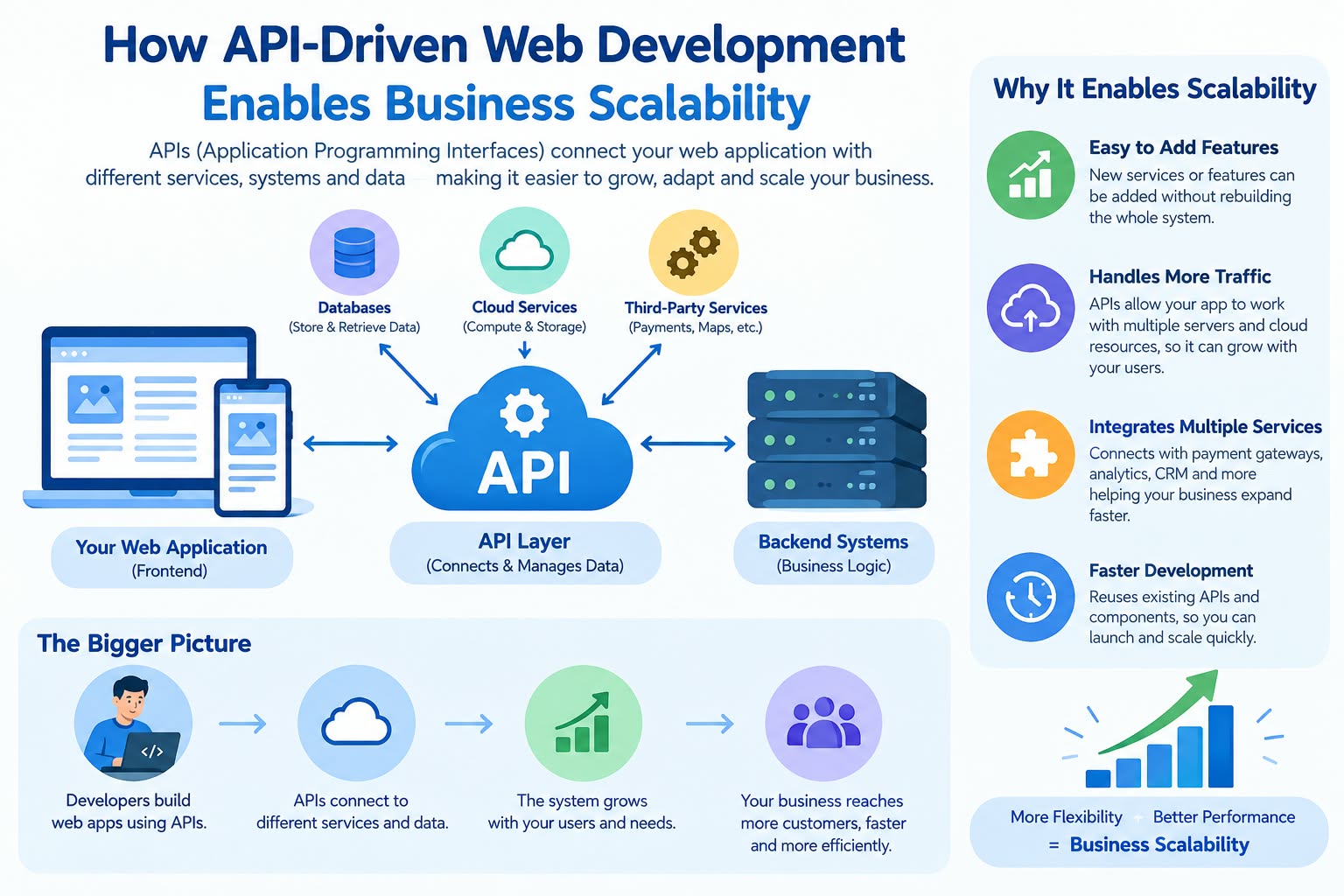
API-first architecture emerged as the answer. Instead of building applications as tightly coupled monoliths, organizations decompose functionality into services that communicate through clearly defined, standardized interfaces . APIs become the building blocks, not an afterthought.
The core principle is simple: design the interface first, then build the implementation. This forces clarity about what each service does, who consumes it, and how it evolves. It also enables parallel development frontend teams can build against a mock server while backend teams implement the real thing .
The result is not just technical elegance. It is business agility. APIs enable organizations to modularize IT landscapes, automate processes, and realize new business models . They are strategic instruments for digitalization, not just technical interfaces.
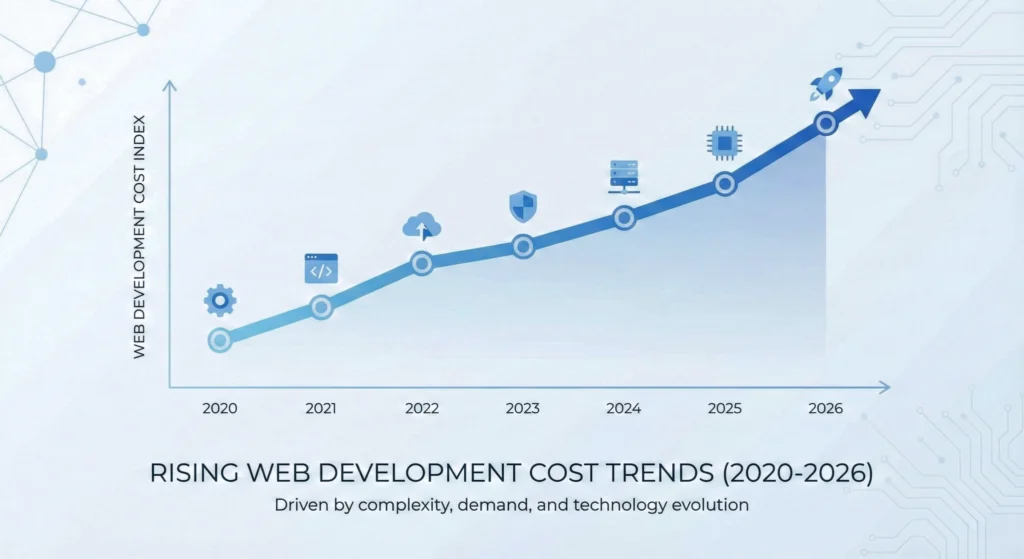
Cost Based on Project Type
API-driven development costs vary based on complexity, integration depth, and whether you are building greenfield or modernizing legacy systems. Here is the 2026 Indian market landscape:
| Project Type | Typical Budget Range | What It Covers |
|---|---|---|
| Simple REST API (CRUD) | ₹1,00,000 – ₹1,75,000 | Basic auth, database, documentation, deployment |
| Standard Backend (REST/GraphQL) | ₹1,75,000 – ₹3,00,000 | Auth, integrations, rate limiting, testing |
| Complex Multi-Service | ₹3,00,000 – ₹4,00,000+ | Real-time features, heavy integrations, orchestration |
| Full API Platform | ₹2,00,000+ | Webhooks, sandbox, developer portal, versioning |
The pricing reality: Backend architecture and API logic consume 38.2% of total project budgets the largest single component, ahead of UI/UX design (16.4%) and frontend engineering (22.1%) . This reflects the reality that APIs are not a commodity layer. They are the foundation.
What drives the range:
Integration complexity is the single biggest cost factor. Each third-party system payment gateways, CRM, ERP, logistics adds development, testing, and ongoing maintenance. The average mid-market merchant runs 35-60 apps, and each one adds licensing costs, performance risk, and integration complexity .
API style matters. REST is simpler for standard CRUD operations. GraphQL adds 10-20% to backend cost due to schema and resolver design, but reduces over-fetching for mobile clients and complex UIs . The choice should be driven by usage context, not preference .
Legacy modernization adds a different cost profile. If you are wrapping existing systems rather than building greenfield, API wrapping enables interoperability and scalability through abstraction . But the discovery work to identify what to expose, what to refactor, and what to leave alone is substantial.
Hidden costs to budget for: Hosting runs ₹1,500-₹8,000/month depending on application size . Transactional email services add ₹1,000-₹3,000/month. Ongoing maintenance is typically 15-25% of build cost annually .
Breakdown by Developer Type (2020-2026)
Who builds your API layer matters enormously. The Indian talent market offers a wide range of options:
| Developer Type | Hourly Rate (India) | Typical Engagement | What They Deliver |
|---|---|---|---|
| Freelancer | ₹2,500 – ₹5,000 | ₹50,000 – ₹5,00,000 | Focused API builds, specific feature work |
| Small Agency | ₹3,000 – ₹8,000 | ₹5,00,000 – ₹20,00,000 | Scoped backends, integrations, maintained delivery |
| Mid-Size Agency | ₹6,000 – ₹15,000 | ₹20,00,000+ | Multi-service architectures, ongoing needs |
| Dedicated Team (Offshore) | $30/hr (~₹2,500) | $4,400/month (~₹3,66,000) | Full-time engineers, IP ownership, 48-hour onboarding |
India's structural advantage: Senior developers in India bill at $30-$65/hour, compared to $100-$200 in the US and $80-$150 in the UK . For API-driven development specifically, this cost advantage is compounded by India's mature developer ecosystem English fluency, timezone overlap with Europe and US, and a deep talent pool.
The quality variance warning: If you are paying ₹500/hour, you are getting what you paid for. The critical questions before hiring: "Show me a live API you shipped in the last 90 days not a portfolio, a running production system with real consumers." Also ask: "How do you handle API versioning and deprecation?" A team that has never managed a breaking change has never built a production API.
Why Prices Changed in 2026
Three forces have reshaped API development economics.
First, the agentic web became real. Google's WebMCP standard, announced in May 2026, lets websites expose structured tools to AI agents . This changes what APIs need to do. They are no longer just for human developers and mobile apps. They are interfaces for autonomous AI agents that discover, compare, and act on structured data. Organizations that build APIs with machine-readable schemas, consistent patterns, and thorough documentation will integrate faster with the agentic ecosystem. Those that don't will be invisible to it.
Second, API monetization became mainstream. The 2025 State of the API Report found that 74% of organizations generate at least 10% of revenue from APIs, with nearly 25% deriving more than half their revenue from API programs . APIs are no longer internal plumbing. They are products. This shifts investment priorities: API governance, developer experience, and versioning strategy become revenue-critical concerns, not IT overhead.
Third, compliance and security demands intensified. APIs expose systems and create attack surfaces . Authentication, authorization, rate limiting, logging, and monitoring must be integral to API strategy, not bolted on. In India, the DPDP Act adds data residency and consent management requirements that affect API architecture. The cost of getting this wrong in fines, in breach response, in customer trust dwarfs the cost of building it right.
Pro Tips to Save Money in 2026
1. Design the contract before you write the implementation. Version-control your OpenAPI spec like any other code file and run contract linting in CI to catch inconsistencies automatically . This adds hours upfront but saves days of rework once integration begins.
2. Build frontends in parallel using mock servers. Once the contract is committed, generate a mock server from the OpenAPI file and point your React or Vue application at it. Frontend teams build complete UI flows while backend development continues. This eliminates the "last-minute integration weekend" .
3. Use API wrappers for legacy systems. If you have existing business-critical applications that work but need modern interfaces, wrap them rather than rebuild. API wrapping enables interoperability and scalability through abstraction, and it rapidly delivers business value .
4. Start with REST unless you have a specific reason for GraphQL. REST is simpler, easier to hire for, and sufficient for standard CRUD applications. Choose GraphQL when your frontend needs flexible queries or you have multiple clients with different data needs .
5. Rationalize your third-party ecosystem. The average mid-market merchant runs 35-60 apps, each adding licensing costs and integration complexity . Audit what you actually need. Point-to-point integrations inflate costs by 20-35% over lifecycle an iPaaS or API orchestration layer prevents long-term debt.
6. Budget for API governance from day one. As the number of APIs grows, reuse, consistency, and security cannot be ensured by individual teams alone. API governance guidelines, roles, processes prevents fragmentation and duplication .
Questions to Ask Before Hiring
Before you commit budget to any API development engagement, ask these questions.
1. "Show me a live API you shipped in the last 90 days not a design document, a running production system with real consumers." Portfolios show architecture diagrams. Live APIs expose real performance, real error handling, and real maintenance.
2. "How do you handle API versioning and breaking changes?" The right answer involves semantic versioning, URL path versioning, deprecation policies with sunset headers, and parallel version support during transitions . If they say "we just update it," they have never managed a production API.
3. "What's your approach to API security?" Authentication, authorization, rate limiting, and monitoring must be built in, not bolted on . Ask about OAuth 2.0, API key management, and how they handle secrets .
4. "How do you design for AI agent consumption?" Standardize formats for machine readability. Expose open APIs that enable agents to access live, trustworthy data. Structure product details in schemas, not PDFs .
5. "Who owns the API when the engagement ends?" A dev shop that builds and leaves is not a partner. Ask for the OpenAPI spec, the repository, the documentation, and the deployment pipeline.
Why Delhi is a Great Hub for API-Driven Development
Delhi-NCR has become a serious destination for API development work, and the reason isn't just cost.
The region hosts India's largest cluster of BFSI and FinTech captives 35% of NCR's GCCs constitute the largest cluster of global financial captives in the region . Financial services and fintech are the sectors where API-driven architecture matters most: regulatory integration, real-time data flows, and complex partner ecosystems. Delhi's API talent pool has been forged in this environment.
The region's agencies are actively delivering complex API work. Hivoox India, based in Delhi, operates as a major technical and engineering center for its global network, handling web development, API engineering, security, and integration for digital service providers worldwide . This is not just a cost arbitrage story. It is a capability story.
The talent density keeps improving. With a steady pipeline of backend engineers, integration specialists, and cloud architects, Delhi offers a combination of cost and capability that's hard to match. And the time zone advantage matters: a Delhi-based team can sync with Middle East morning, European afternoon, and US East Coast evening.
What We Offer
At Innovative AI Solutions, we build API-driven architectures that scale with your business.
Our approach:
-
Contract-First Design. We start with OpenAPI specifications, version-controlled and linted in CI. The interface is designed before the implementation.
-
Parallel Development Enablement. Mock servers generated from specs so frontend and backend teams work simultaneously, not sequentially.
-
Legacy Modernization via API Wrappers. Existing systems exposed through clean interfaces without full rebuilds.
-
API Governance by Default. Versioning strategy, deprecation policies, rate limiting, and security built in from day one.
-
Agent-Ready Interfaces. Structured schemas, machine-readable formats, and documentation designed for both human developers and AI agents.
-
Retained Operations. Monitoring, performance tuning, and API evolution. Your interfaces don't rot because someone forgot them.
Our principle is simple: small steps, fast iteration, data speaks.
Frequently Asked Questions
Q: What is API-first development in simple terms?
API-first means designing the interface before building the implementation. Instead of writing code and then exposing an API as an afterthought, you define the contract endpoints, request/response schemas, authentication and then build the backend to match . This forces clarity about what each service does and enables parallel development.
Q: How does API-driven development improve scalability?
APIs enable modularity. Instead of one monolithic application, you have services that communicate through defined interfaces. Each service can scale independently. Updates to one service don't require redeploying everything. Microservices combined with Kubernetes provide self-healing and auto-scaling capabilities, ensuring APIs remain accessible even during traffic surges .
Q: What's the difference between REST and GraphQL?
REST addresses resources via HTTP and is commonly used for CRUD operations. GraphQL offers greater flexibility for querying data, particularly advantageous for complex or mobile applications. The choice should be driven by usage context not every solution fits every problem . REST is simpler for standard CRUD. GraphQL helps when the frontend needs flexible queries.
Q: How much does API-driven development cost in India?
Simple REST API: ₹1,00,000-₹1,75,000. Standard backend with auth and integrations: ₹1,75,000-₹3,00,000. Complex multi-service: ₹3,00,000-₹4,00,000+ . Backend and API logic consume approximately 38% of total project budgets .
Q: How do APIs generate revenue?
Organizations monetize APIs directly (per-call pricing, subscription tiers) and indirectly through improved user experience (54%), reduced engineering overhead (42%), and improved AI readiness (34%) . In 2026, 74% of organizations generate at least 10% of revenue from APIs .
Frequently Asked Questions (Extended)
Q: How do I handle API versioning?
Treat your interface contract as immutable once released. Breaking changes belong in new versions, not patches. Use semantic versioning: increment patch for bug fixes, minor for backward-compatible additions, major for breaking changes. Expose versions through URL prefixes like /v2/. Automated schema comparison in CI prevents accidental breaking changes .
Q: What's the biggest mistake companies make with API development?
Building the implementation first and exposing an API as an afterthought. This creates inconsistent interfaces, poor documentation, and integration failures. API-first means the contract is designed, reviewed, and frozen before backend development begins .
Q: How does API-driven development support AI agents?
AI agents consume APIs directly. Standardized formats, structured schemas, and machine-readable documentation make APIs easier for agents to discover, understand, and call. Organizations that build for agent consumption will integrate faster with the agentic ecosystem .
Q: What's the first step I should take tomorrow?
Write down every integration point in your application. Every place data flows in or out. Every third-party service. Every mobile client. That list is your API surface. Then pick the highest-value integration and design a contract for it. That's how you start. Not with a strategy document about API transformation.
Contact Us:
Phone: +91 7464 099 059 / +91 9689967356
Email: info@innovativeais.com
Address: 9th Floor, Pearls Best Heights-I, Head Office: 904, Netaji Subhash Place, Delhi, 110034