The Big Question
What happens when your automation encounters something it wasn't programmed for?
For years, the answer was simple: it breaks. The bot stops. The workflow stalls. The exception gets routed to a human, who fixes the problem manually and restarts the process.
That model worked when exceptions were rare. It doesn't work anymore.
Enterprises now operate in conditions defined by constant regulatory change, fragmented technology estates, unstructured and conversational data, volatile demand, and heightened customer expectations. In this environment, exceptions have become the new norm. Every exception routed to humans erodes margin, increases cycle time, and introduces risk to the point where most automation programs now spend more time managing exceptions than delivering net efficiency.
This is the problem intelligent automation solves.
Not by eliminating exceptions. By handling them. By reasoning through situations instead of following rigid branching logic. By interpreting context, not just data.
The shift isn't incremental. It's a strategic reset.
What Intelligent Automation Actually Means
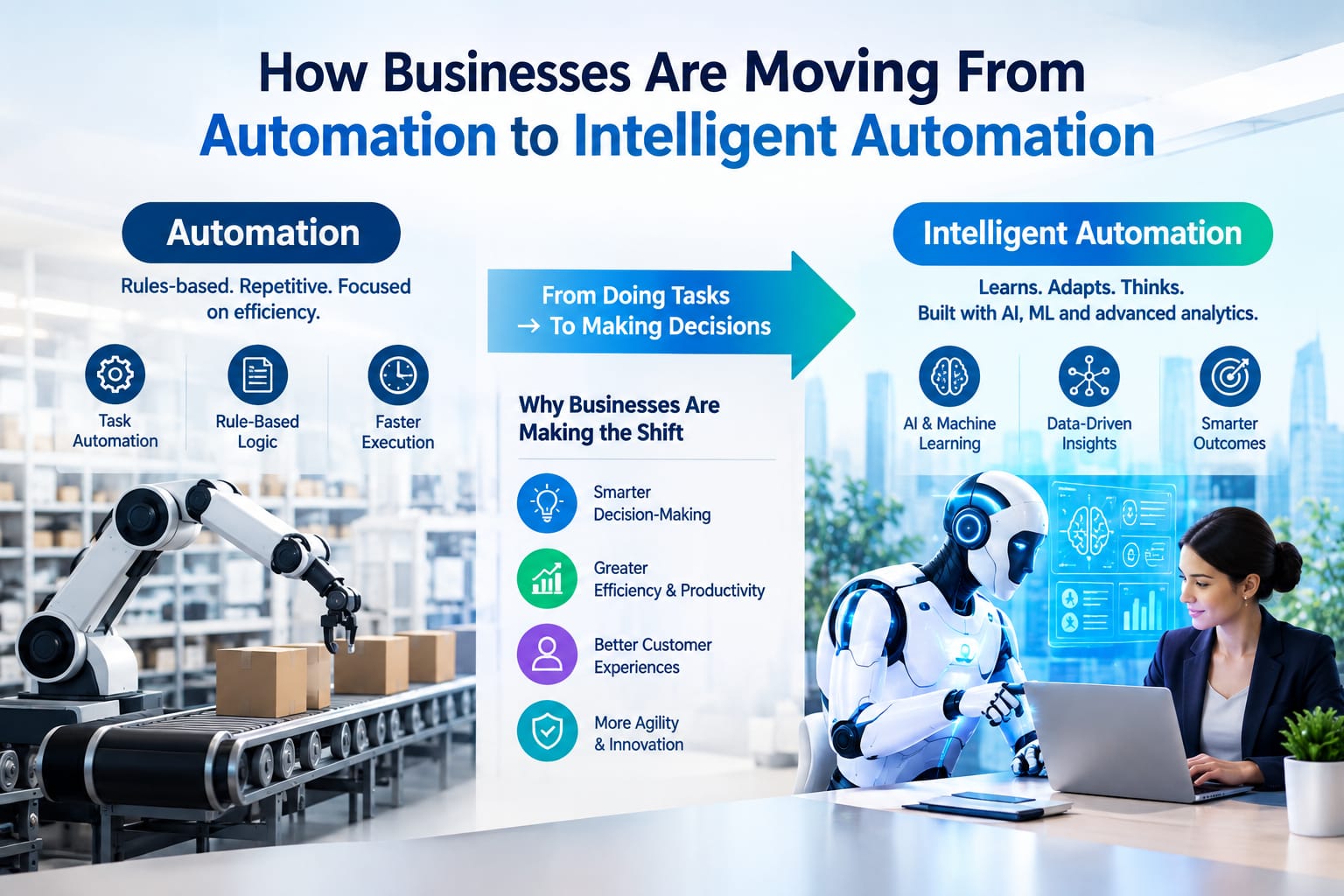
Intelligent automation is the integration of AI, machine learning, and robotic process automation to create systems that can perform both routine and complex tasks, learn from experience, and adapt to changing conditions without explicit reprogramming for each new situation.
The distinction from traditional automation is fundamental.
Traditional automation executes predefined rule sets on structured data. It's deterministic. It's predictable. It's brittle. A bot can process a form if the form always looks the same. It can't process a form if the format changes, if a field is missing, or if the handwriting is illegible.
Intelligent automation interprets unstructured inputs, infers context, makes probabilistic decisions, and improves its own performance over time. It can classify documents, extract information from unstructured text, route exceptions for human review, and refine its classification models as new examples accumulate.
This is the foundation. But the most significant shift in 2026 is happening at a higher level: agentic systems that reason and execute.
The Move to Agentic Systems
Traditional automation pipelines assume predictable inputs, rely on fixed decision logic, and expect low exception rates. That model breaks down in today's operating environment.
Agentic systems represent a fundamental change in how enterprises think about automation. Instead of encoding every decision upfront, organizations deploy teams of intelligent agents that collaborate toward defined business outcomes.
The value isn't autonomy for its own sake. It's adaptability at scale.
In an agent-driven model:
-
Automation can interpret context, not just data
-
Decisions can be validated, challenged, and corrected in real time
-
Workflows can evolve without constant re-engineering
-
Risk controls can be embedded dynamically, not hardcoded
The shift is from rule execution to agent orchestration. Instead of continuing to ask automation to "follow instructions," enterprises are asking it to reason within guardrails.
India is moving faster than most markets on this shift. According to EY's AIdea of India report, 24 percent of surveyed organizations reported active deployment of agentic AI systems, while nearly half said more than a fifth of their AI proofs-of-concept had already crossed into production. The channel ecosystem is restructuring around integration, governance, optimization, and long-term operational management of agentic deployments.
Real Deployments: What Agentic Automation Looks Like in Production
The use cases that pay off are specific, measurable, and high-volume. India's largest enterprises are already running agentic automation at scale.
Tata Steel deployed more than 300 specialized agents in nine months, part of 860 models and agents across its value chain. Its digital assistant resolves more than 70% of routine HR tickets autonomously, and agents that triage customer complaints have cut average turnaround by 50%. On the plant floor, Safety EyeQ flags hazards from live video, while Asset Sphere agents generate proactive maintenance plans.
Mahindra runs agents at both ends of the value chain: a self-healing paint shop and an agentic maintenance system in manufacturing, and WhatsApp agents that have handled approximately 400,000 customer conversations, from lead nurturing to test-drive bookings.
HDFC Bank is building a unified platform on MCP, Agentic Studio and Agentic Mesh. As of April 2026, five use cases were in production and 14 in development, targeting faster turnaround and first-time-right outcomes.
Swiggy connected its food, grocery, and dining platforms to AI assistants through the Model Context Protocol. Assistants can now search, compare, build carts, apply offers, place orders, and track deliveries. Instamart was positioned as the first quick-commerce platform globally to integrate MCP, with 40,000-plus SKUs exposed.
Godrej Enterprises Group is investing ₹1,200 crore over three to five years in AI and digital transformation under Project Amethyst. Its multi-agent Contract Analyser uses six specialized agents to segregate documents into engineering, purchasing, legal, and other norms. The group also automated B2B order booking from 7-14 days to one hour using agentic AI.
ITC Infotech is deploying Google Cloud's Gemini Enterprise across its entire organization as "customer zero" validating autonomous workflows across software engineering, corporate functions, and multi-agent orchestration before bringing proven methodologies to customers.
These aren't experiments. They're operations.
Why Indian Businesses Are Making the Shift
Three compounding pressures are driving the transition.
First, complexity has outpaced codification. No organization can realistically encode every policy interpretation, exception scenario, or cross-system dependency as fixed rules. The remaining 60% of processes where value lies is where rigid pipelines fail.
Second, cost pressure is forcing smarter automation, not more automation. Most enterprises have already automated the easy 30-40%. The next layer requires reasoning, not just rules.
Third, resilience is now a strategic mandate. Whether it's regulatory disruption, supply chain shocks, or sudden demand swings, businesses need automation that adapts instead of collapsing.
The Indian market dynamics are distinctive. PwC research shows 59% of Indian industrial manufacturers believe AI will play a significant role in achieving strategic goals within five years higher than the global average of 52%. Automation adoption is led by data capture and analytics (82%), followed by quality assurance (69%), planning and forecasting (65%), and customer interactions (63%).
But PwC also flags a critical gap: India lags in developing homegrown manufacturing capabilities, relying heavily on imported core engineering technologies. The MSME technology gap is widening, with smaller suppliers struggling to keep pace.
The Indian Ecosystem Responds
The infrastructure for agentic automation is being built domestically.
NPCI launched two agentic AI platforms at the Global Fintech Fest 2026. AiNxt is an enterprise-focused platform supporting a bring-your-own-model approach, allowing organizations to create and deploy AI agents. AtOM (Agentic Orchestration & Messaging) focuses on agent-to-agent orchestration for the payments ecosystem, managing system integration, change management, partner onboarding, testing, and certification through a single workflow. It uses machine-readable and digitally signed interactions to help with compliance and audit requirements.
One2X Tech, a Delhi-based startup, received support from the Technology Development Board to commercialize Fixit, an indigenous Agentic AI platform. Fixit combines multi-agent orchestration, contextual memory, AI reasoning, and secure tool execution. The company is initially targeting revenue operations market intelligence, customer engagement, qualification, nurturing, sales handover, and revenue attribution with real estate as the first sector.
Zensar launched ZenseAI.AgentMesh, an enterprise operating system for agentic AI with over 80 pre-built agents. Early deployments delivered 75% straight-through processing in KYC workflows for a global retail bank and a 70% reduction in fraud losses for an insurance provider.
L&T Technology Services launched AgenticIQ, an end-to-end agentic AI platform purpose-built for engineering and manufacturing. It enables autonomous, multi-agent workflows across product development, manufacturing, industrial operations, and customer experience.
Zensar and LTTS join TCS, which launched India's first lights-out factory lab in Pune a fully robotic battery pack assembly line demonstrating how AI, digital twins, robotics, and factory systems can operate with minimal human intervention.
The Governance Imperative
Autonomy without governance is risk. The market is responding.
Gartner predicts that over 40% of agentic AI projects will be canceled by the end of 2027, undone by rising costs, fuzzy business value, and weak risk controls. But in the same market, 66% of companies already deploying AI agents report measurable value through higher productivity. Same technology, opposite outcomes.
The difference is almost never the model. It's the use case and the governance around it.
The organizations that succeed pick a task with volume and a number attached. They favor bounded problems over open-ended ones. They demand clean data access. They design guardrails before the demo. And they set kill criteria in advance, so weak pilots end fast instead of draining budget.
India's evolving regulatory environment is another driver. The DPDP Act, increasing focus on sovereign AI infrastructure, and rising enterprise scrutiny around data residency and governance are forcing organizations to evaluate how AI systems access, process, and store enterprise information. This is creating demand for compliance-led architecture design, governance implementation, and audit readiness.
What This Means for Your Business
Stop extending pipelines. Start deploying agents.
Linear pipelines were never built to operate under sustained uncertainty. Pick one high-value process with clear owners, reliable data, and measurable outcomes. Deploy agents. Prove value. Then expand.
Measure outcomes, not activity.
Track cycle time, error reduction, control effectiveness, and customer satisfaction not automation volume. The businesses that can tie automation to business outcomes will have a sustainable advantage.
Build governance before you scale autonomy.
Every agent action should be logged. Permissions should be enforced. Humans should remain in control. The organizations that treat governance as a feature, not overhead, will be the ones allowed to scale.
Amplify people, don't replace them.
The data is clear: workforce reductions don't deliver ROI. The organizations that succeed invest in skills, roles, and operating models that let humans guide and scale autonomous systems. Long term, autonomous business will create more work for humans, not less.
Frequently Asked Questions
Q1: What is intelligent automation?
Intelligent automation is the integration of AI, machine learning, and robotic process automation to create systems that can perform both routine and complex tasks, learn from experience, and adapt to changing conditions without explicit reprogramming. Unlike traditional automation, it can interpret unstructured inputs, infer context, and make probabilistic decisions.
Q2: How is intelligent automation different from traditional automation?
Traditional automation executes predefined rule sets on structured data. It's deterministic and brittle. Intelligent automation interprets unstructured inputs, infers context, makes probabilistic decisions, and improves over time. It handles variation instead of breaking on it.
Q3: What are agentic systems?
Agentic systems are distributed networks of intelligent agents that collaborate toward defined business outcomes. Instead of encoding every decision upfront, organizations deploy teams of agents that interpret context, validate decisions in real time, and evolve workflows without constant re-engineering.
Q4: Why are businesses moving from RPA to intelligent automation?
Most enterprises have already automated the easy 30-40% of processes. The remaining 60% is where value lies—and where rigid pipelines fail. Exceptions have become the norm, and rule-based automation spends more time managing exceptions than delivering efficiency.
Q5: What are the most proven use cases for intelligent automation?
Customer service, software delivery, and finance/back-office operations are the most proven. Tata Steel resolves 70% of HR tickets autonomously. Mahindra handled 400,000 customer conversations with agents. The pattern: high-volume, well-documented, and expensive to staff manually.
Q6: How much are Indian businesses investing in agentic automation?
Godrej Enterprises Group is investing ₹1,200 crore over three to five years. 24% of Indian organizations report active deployment of agentic AI systems, and nearly half say more than a fifth of their AI proofs-of-concept have crossed into production.
Q7: What is the ROI of intelligent automation?
Zensar reports 75% straight-through processing in KYC workflows and 70% reduction in fraud losses for an insurance provider. Godrej reduced B2B order booking from 7-14 days to one hour. Tata Steel cut customer complaint turnaround by 50%.
Q8: What are the biggest risks in intelligent automation?
Gartner predicts over 40% of agentic AI projects will be canceled by 2027 due to rising costs, fuzzy business value, and weak risk controls. The organizations that succeed design guardrails before the demo and set kill criteria in advance.
Q9: Will intelligent automation replace jobs?
No. Gartner's research shows workforce reductions don't translate into ROI. The organizations that improve ROI amplify people, not eliminate them. Godrej's CIO said the group plans to handle twice the output with the same workforce through AI training and agent deployment.
Q10: How do I start with intelligent automation?
Pick one high-value process with clear owners, reliable data, and measurable outcomes. Deploy a bounded agent. Design guardrails. Prove value. Then expand.
Frequently Asked Questions (Continued)
Q11: What is hyperautomation?
Hyperautomation extends beyond single tasks to automate entire end-to-end processes, using a combination of technologies AI, ML, RPA, NLP to improve process performance, cut errors, and increase efficiency.
Q12: What is the difference between intelligent automation and agentic AI?
Intelligent automation is the broader category systems that reason, adapt, and handle exceptions. Agentic AI is a subset systems that plan, execute, and coordinate multi-step workflows autonomously. Multi-agent systems are the current frontier of agentic AI in enterprise automation.
Q13: What industries are adopting intelligent automation fastest in India?
BFSI, manufacturing, and retail are the earliest adoption areas. Tata Steel, HDFC Bank, Mahindra, Swiggy, and Godrej are all running production deployments.
Q14: What is the role of MCP in intelligent automation?
Model Context Protocol (MCP) standardizes how agents connect to tools and systems. Swiggy used MCP to expose 40,000+ SKUs to AI assistants. HDFC Bank is building its agent platform on MCP. It's becoming the connective tissue for agentic automation.
Q15: Why should I choose Innovative AI Solutions?
Because we focus on outcomes, not automation volume. Because we build governance and guardrails from day one. Because we understand that intelligent automation is about amplifying people, not replacing them. Because your code is always yours.
Contact Us
Phone:
+91 7464 099 059
+91 9689967356
Email:
info@innovativeais.com
Address:
9th Floor, Pearls Best Heights-I,
Head Office: 904, Netaji Subhash Place,
Delhi – 110034