The Big Question
Cloud computing delivered on its promise: infinite scale, pay-as-you-go pricing, and global reach from a handful of regions. But "global reach" comes with a physical constraint that no amount of engineering can eliminate distance.
Light travels fast, but not infinitely fast. A round-trip from a user in Mumbai to a data center in Virginia takes time that no optimization can compress below physics. Research shows that interactive applications, such as visual guiding systems, perform best with response times between 25ms and 50ms . Traditional cloud infrastructures often deliver round-trip times of around 175ms or more for users far from the origin region .
That gap matters. In e-commerce, every 100ms of latency costs conversion. In financial services, milliseconds determine whether a trade executes at the right price. In industrial IoT, a 100ms delay can mean the difference between detecting a defect and shipping a faulty product.
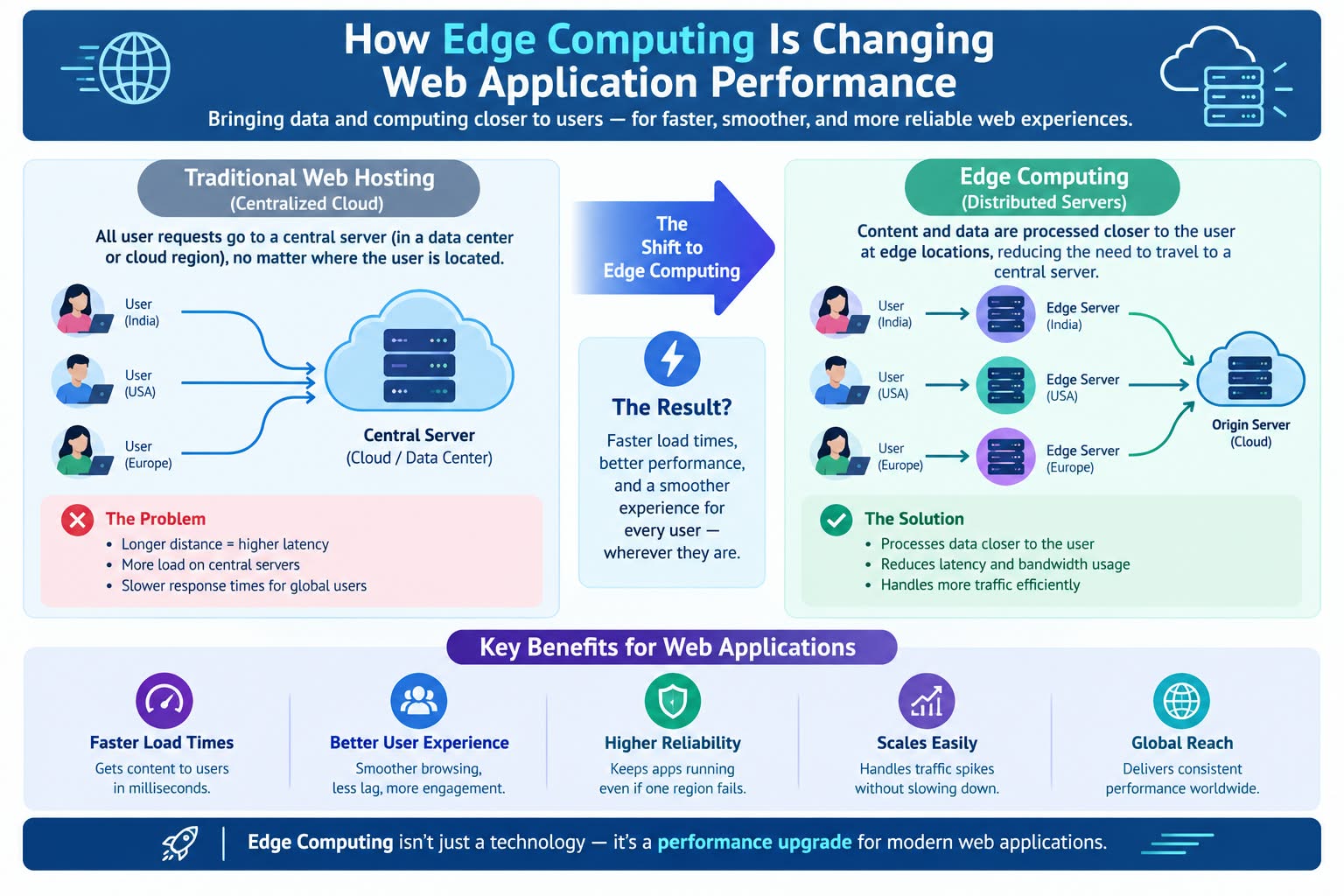
Edge computing addresses this by moving computation from centralized data centers to nodes closer to users. Instead of a handful of regions, your application code runs across hundreds of global edge locations . Requests are served within tens of milliseconds, but total latency depends on network conditions, origin calls, and workload complexity.
The performance gains are measurable. A real-world test of a simple API endpoint across platforms showed US users dropping from ~120ms to ~45ms, EU users from ~180ms to ~50-55ms, and APAC users from ~450ms to ~60-70ms . The biggest gains happen when users are far from your origin.
But edge computing isn't just about speed. It changes what's economically viable. A 2025 paper demonstrated that hybrid edge-cloud architectures compared to pure cloud processing can achieve energy savings of up to 75% and cost reductions exceeding 80% under high data-velocity workloads .
Cost Based on Application Type
Edge computing costs depend on your application's architecture, traffic patterns, and how much logic you move to the edge. Here's the 2026 landscape:
| Application Type | Monthly Cost (Edge Platforms) | What You're Funding |
|---|---|---|
| Static-Heavy / Brochure Site | $5 – $50 | CDN caching, basic edge routing |
| API-Driven Web App | $20 – $200 | Edge functions, authentication, geo-routing |
| E-commerce / Personalization | $100 – $1,000 | Dynamic content, A/B testing, session management |
| Real-Time / High-Traffic Platform | $500 – $5,000+ | Streaming, real-time data sync, AI inference at edge |
Platform cost comparison (10 million requests/month):
-
Cloudflare Workers: ~$5
-
AWS Lambda@Edge: ~$7-8
-
Vercel Edge: ~$15-20
-
Deno Deploy: ~$18-20
Note: Costs vary significantly based on execution time, data transfer, and storage usage. These estimates assume lightweight requests and minimal outbound bandwidth .
The hidden cost trap: Edge computing introduces operational complexity that doesn't appear on the invoice. Research across 86 organizations found that deployment complexity (38.6%) and onboarding difficulty (35.6%) are the dominant operational bottlenecks . Practitioners manage an average of 14 vendor tools and face 100-day onboarding cycles . The platform bill is only the beginning.
Edge AI cost arithmetic: For workloads requiring inference, NVIDIA's Jetson Orin NX at approximately $500** delivers 100 TOPS and can sustain multiple quantized 7B models. Amortized over 36 months at 100,000 daily inferences, the per-inference hardware cost reaches **$0.000005 three orders of magnitude below cloud API pricing of $0.001-0.01 per inference .
Breakdown by Edge Layer
Edge computing is not a single architecture. It's a spectrum of deployment models, each with different latency profiles and cost structures:
| Deployment Model | Typical Latency | Best For | Cost Profile |
|---|---|---|---|
| On-Premises Edge | <10ms | Industrial automation, healthcare, AR/VR | High CapEx, low OpEx |
| Service Provider Edge | 10-25ms | Telecom, real-time applications | Managed service fees |
| CDN Edge | 25-45ms | Media, e-commerce, web applications | Usage-based, lowest barrier |
The CDN edge model represented by Cloudflare Workers, Vercel Edge Functions, and AWS Lambda@Edge is where most web applications operate. These platforms have merged CDN caching with edge compute capabilities, allowing developers to run application logic at the edge without managing infrastructure .
When edge makes sense: The decision framework is straightforward. Use edge for authentication, personalization, static pages, geo-routing, real-time data sync, and session management. Keep video processing, heavy computation, complex database queries, and AI inference on cloud GPU resources .
Breakdown by Developer Type (2020-2026)
Edge computing requires specialized skills that most traditional web developers lack. The Indian talent market offers both opportunity and risk:
| Developer Type | Hourly Rate (India) | Typical Engagement | What They Deliver |
|---|---|---|---|
| Freelancer | ₹1,000 – ₹3,000 | ₹25,000 – ₹75,000 | Basic edge functions, CDN configuration |
| Small Agency | ₹2,500 – ₹6,000 | ₹1,50,000 – ₹5,00,000 | Edge routing, authentication, geo-personalization |
| Mid-Size Firm | ₹6,000 – ₹12,000 | ₹5,00,000 – ₹25,00,000 | Hybrid edge-cloud architecture, state management |
| Enterprise Consultancy | ₹12,000 – ₹20,000+ | ₹25,00,000+ | Multi-region edge deployment, AI inference optimization |
The critical question before hiring: "Show me a production edge deployment you shipped in the last 90 days not a demo, a running system with real users across multiple geographies." Edge computing looks simple in a tutorial. In production, state management, cold starts, and database access at the edge are where projects fail .
Why Prices Changed in 2026
Three forces have reshaped edge computing economics.
First, the cost curves crossed. Below approximately 10,000 daily requests, cloud is economically preferable because edge payback periods extend beyond typical hardware refresh cycles. Above 50,000 daily requests, edge deployment achieves payback within a single fiscal quarter, creating a compelling business case . The crossover analysis reveals that the question is no longer "is edge cheaper?" but "at what scale does edge become cheaper for your workload?"
Second, the operational complexity tax became visible. Edge computing delivers latency benefits but at the cost of distributed system complexity. State management across edge nodes introduces replication lag and consistency risks . Cold starts on edge functions can negate latency benefits if the function takes longer to initialize than the original round trip to the data center would have taken . These aren't theoretical problems they're why edge projects fail.
Third, hybrid architectures emerged as the practical optimum. Pure edge and pure cloud represent theoretical endpoints. Production systems increasingly route workloads based on their individual tipping point profiles: high-frequency, latency-sensitive inference at the edge; intermediate processing at local aggregation layers; training and batch workloads in the cloud . This hybrid model achieves bandwidth reduction through edge filtering, latency optimization through local inference, and computational scale through cloud training.
Pro Tips to Save Money in 2026
1. Start with the decision framework, not the technology. Map your application's needs against the edge/cloud decision matrix. Authentication, personalization, geo-routing, and session management belong at the edge. Video processing, heavy computation, and complex database queries belong in the cloud . Don't move logic to the edge just because you can.
2. Measure your actual latency distribution before optimizing. Edge computing delivers the biggest gains when users are far from your origin. If 90% of your users are within 500km of your cloud region, the performance gain may not justify the complexity .
3. Plan for state management from day one. The hardest part of edge computing isn't the compute—it's the data. Connecting to centralized databases from the edge reintroduces latency through round-trip queries. Data replication to the edge introduces consistency risks and replication lag . Design your data architecture before you write edge functions.
4. Use islands architecture for interactive pages. Instead of making entire pages dynamic, mark only the interactive portions as "islands" to be loaded with specific strategies. This keeps initial page payload small while preserving interactivity where it matters. Etsy pioneered this pattern to solve exactly this problem .
5. Budget for operational overhead. Edge fleet management adds 15-25% to base hardware and energy costs . Model versioning, security patching, hardware monitoring, and failure recovery require dedicated tooling and personnel. If you don't plan for this, you'll discover it during your first major incident.
6. Consider serverless edge platforms before building custom infrastructure. Cloudflare Workers, Vercel Edge, and Deno Deploy handle the operational complexity of global distribution. You write functions, they handle the rest. For most web applications, this is the right starting point .
Questions to Ask Before Hiring
Before you commit budget to any edge computing engagement, ask these questions.
1. "What's our current latency distribution by geography, and where would edge compute help most?" If they can't produce this data, they haven't done the analysis. Edge computing isn't a blanket optimization it's a targeted fix for specific geography-to-origin gaps .
2. "How will you handle state management across edge nodes?" The hardest problem in edge computing is data consistency. The right answer involves a clear data architecture: what lives at the edge, what stays centralized, and how consistency is maintained .
3. "What's your cold start strategy?" Edge functions that take longer to initialize than the original cloud round trip defeat the purpose. Ask about warm startup times, runtime selection, and workload sizing .
4. "What's the migration path if we outgrow this platform?" Edge platforms have different runtimes, APIs, and limits. Ask about portability and exit strategy before you commit.
5. "Who owns the edge deployment when the engagement ends?" A consultancy that builds and leaves is not a partner. Ask for documentation, monitoring setup, and handover training.
Why Delhi is a Great Hub for Edge Computing
Delhi-NCR has become a serious destination for edge computing work, and the reason isn't just cost.
The region hosts India's largest cluster of BFSI and FinTech captives the exact sectors where latency matters most. Financial services require real-time data processing, geo-distributed compliance, and sub-100ms response times for trading and fraud detection. Delhi's edge computing talent pool has been forged in this environment.
India's digital infrastructure is also driving demand. The country's mobile-first population, expanding 5G coverage, and government digital initiatives are creating workloads that centralized cloud architectures struggle to serve efficiently. Edge computing addresses these workloads by moving computation closer to where data is generated and consumed.
The talent density keeps improving. With a steady pipeline of cloud architects, backend engineers, and DevOps specialists, Delhi offers a combination of cost and capability that's hard to match. And the time zone advantage matters: a Delhi-based team can sync with Middle East morning, European afternoon, and US East Coast evening.
What We Offer
At Innovative AI Solutions, we treat edge computing as an architectural decision, not a technology trend.
Our approach:
-
Latency Audit First. We map your users, their geographies, and your current response time distribution. You cannot optimize what you haven't measured.
-
Decision Framework Application. We apply the edge/cloud decision matrix to your workloads. Authentication, personalization, and geo-routing go to the edge. Heavy computation and complex queries stay in the cloud.
-
Hybrid Architecture Design. We design for the practical optimum: edge for latency-sensitive workloads, cloud for scale and training, and a clear data flow between them.
-
State Management Strategy. We solve the hardest problem first: what lives at the edge, what stays centralized, and how consistency is maintained.
-
Retained Operations. Monitoring, performance tuning, and platform optimization. Your edge deployment doesn't rot because someone forgot it existed.
Our principle is simple: small steps, fast iteration, data speaks.
Frequently Asked Questions
Q: What is edge computing in simple terms?
Edge computing means running application logic closer to users instead of in a centralized data center. Instead of a request traveling from Mumbai to Virginia and back, it's served from an edge node in Mumbai or a nearby city. The result is lower latency, faster load times, and more responsive applications .
Q: How much faster is edge computing compared to cloud?
Real-world tests show US users dropping from ~120ms to ~45ms, EU users from ~180ms to ~50-55ms, and APAC users from ~450ms to ~60-70ms . The biggest gains happen when users are far from your origin region. Research on edge-native web architecture shows average page load time reductions of up to 45% compared to centralized deployments .
Q: When does edge computing make financial sense?
The crossover point is approximately 50,000 daily requests. Below 10,000 daily requests, cloud is economically preferable. Above 50,000 daily requests, edge deployment achieves payback within a single fiscal quarter . For high-traffic applications with global users, edge is demonstrably cheaper at scale.
Q: What's the biggest challenge with edge computing?
State management. Connecting to centralized databases from the edge reintroduces latency through round-trip queries. Data replication to the edge introduces consistency risks and replication lag . The hardest part isn't the compute it's the data.
Q: Should I move my entire application to the edge?
No. Use edge for authentication, personalization, static pages, geo-routing, real-time data sync, and session management. Keep video processing, heavy computation, complex database queries, and AI inference on cloud GPU resources . The right architecture is hybrid, not edge-only.
Frequently Asked Questions (Extended)
Q: What is the difference between CDN and edge computing?
CDN caches and delivers static content globally. Edge computing executes application logic at distributed locations near users . Modern platforms like Cloudflare and Fastly offer both capabilities in one service. Think of edge computing as globally distributed serverless functions triggered by HTTP requests.
Q: Does edge computing help with mobile battery life?
Research shows that edge computing can have a measurable effect on mobile application battery consumption and may increase client device battery longevity when considered during application design . Less data transmission and faster processing mean less radio activity and lower power draw.
Q: What's the first step I should take tomorrow?
Measure your current latency distribution. Run a simple test from multiple geographies to your origin server. If your APAC or EU users are seeing response times above 200ms, edge computing is worth evaluating. If most of your users are within 500km of your origin, the complexity may not justify the gain. That's how you start. Not with a strategy document about edge transformation.
Contact Us:
Phone: +91 7464 099 059 / +91 9689967356
Email: info@innovativeais.com
Address: 9th Floor, Pearls Best Heights-I, Head Office: 904, Netaji Subhash Place, Delhi, 110034