The Big Question
Let me start with a question I hear from IT leaders struggling with information overload.
"Abhishek, our employees can't find what they need. We have Confluence, SharePoint, Slack, Jira—and nobody can find anything. Wouldn't an AI just hallucinate if we asked it to search across all this?"
The honest answer:
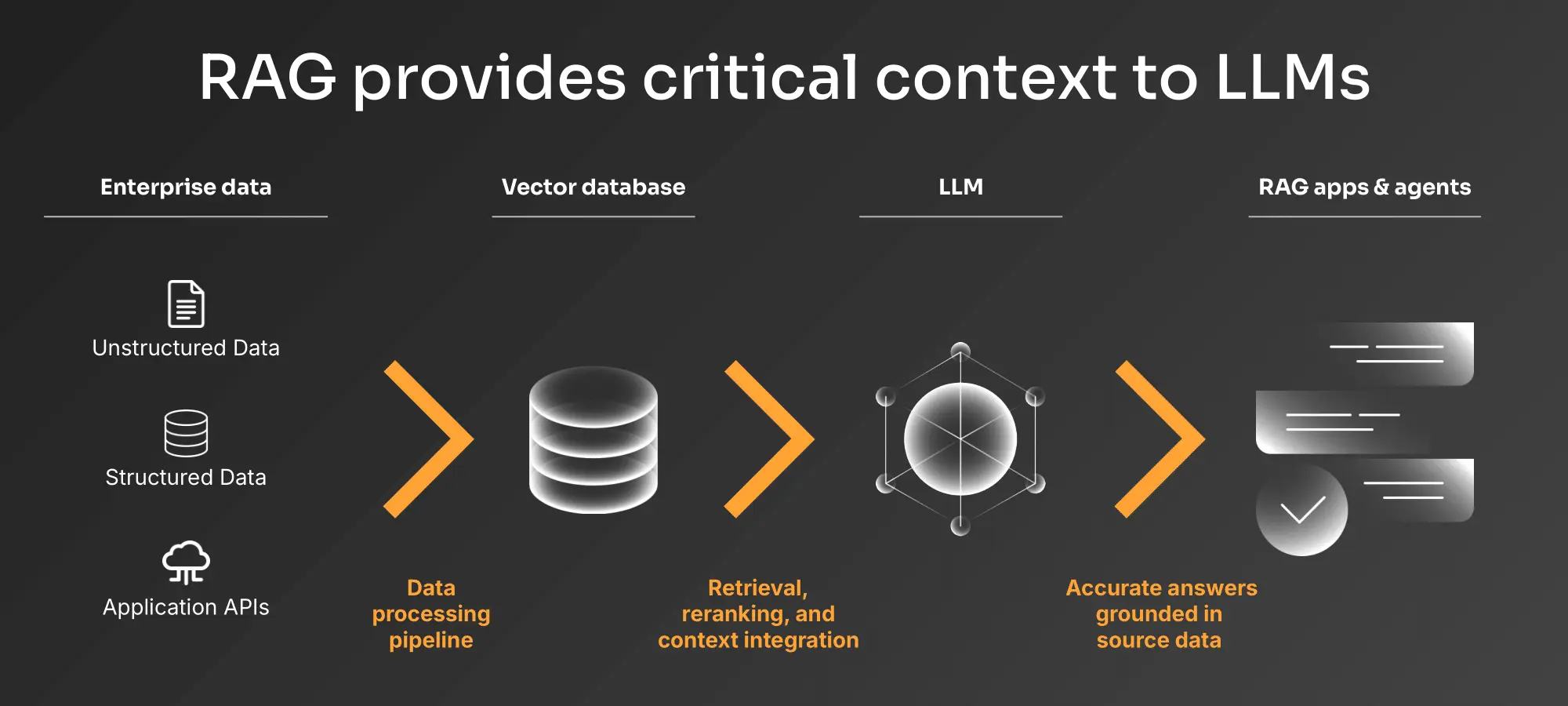
RAG is the technology that prevents hallucination by grounding AI in your actual documents.
Here is the truth:
The core purpose of RAG is giving AI models access to information outside of their training data. Instead of relying only on what a model already knows, RAG helps AI applications retrieve relevant information before generating an answer .
Step 3: What Makes Enterprise RAG Different
Enterprise RAG addresses a specific challenge: critical knowledge is distributed across documentation, tickets, code repositories, and collaboration tools, while static keyword search and periodically retrained language models cannot keep pace with rapidly changing operational data .
The Enterprise Gap
| Challenge | Why It Matters |
|---|---|
| Information scattered across systems | Employees waste hours searching |
| Rapidly changing operational data | Static search becomes outdated |
| Proprietary knowledge not in public LLMs | Models can't answer domain-specific questions |
| Risk of hallucination | Wrong answers in enterprise contexts are costly |
The Enterprise RAG Solution
A 2026 research paper presented a framework for enterprise RAG that combines multi-source ingestion, semantic indexing with embedding models, metadata-aware retrieval, and grounded LLM generation . The results were significant:
| Metric | Before | After | Improvement |
|---|---|---|---|
| Precision@10 | 0.58 | 0.81 | +40% |
| Documentation retrieval latency | 45.6 sec | 12.3 sec | -73% |
| Average bug-resolution time | 18.4 hr | 7.2 hr | -61% |
The findings indicate that enterprise RAG can materially improve troubleshooting speed, knowledge reuse, and decision support while maintaining stronger control over sensitive organizational data .
Step 4: Reference Architectures
OpenRAG on watsonx.data – IBM's Approach
IBM's OpenRAG on watsonx.data gives teams an out-of-the-box agentic RAG solution for turning unstructured data into searchable enterprise knowledge . It connects to sources where content already lives—Google Drive, Microsoft OneDrive, AWS S3—and works across common file types including PDFs, images, PowerPoint, and Excel.
OpenRAG is built on three open-source technologies :
| Component | Purpose |
|---|---|
| Docling | Document ingestion and preparation |
| OpenSearch | Hybrid search and retrieval |
| Langflow | Agent orchestration |
The platform moves from traditional RAG to agentic retrieval, where the AI agent can decide how to approach a task, search and retrieve as needed, refine its query, call tools, and validate whether it has enough information before responding .
PDI Technologies – PDI Intelligence Query (PDIQ)
PDI Technologies, a global leader in convenience retail and petroleum wholesale, built an enterprise-grade RAG system on AWS using serverless technologies . The system addresses challenges including:
-
Automatically extracting content from diverse sources with different authentication requirements
-
Processing and indexing content for semantic search
-
Continuously refreshing information through scheduled crawling
-
Supporting enterprise-specific context in AI interactions
Key architecture components :
| Component | Function |
|---|---|
| Amazon EventBridge | Scheduler for crawlers |
| AWS Lambda + ECS | Crawlers for web, Confluence, Azure DevOps, SharePoint |
| Amazon S3 | Document storage with metadata tags |
| Amazon Bedrock | Foundation models (Nova, Titan) |
| Aurora PostgreSQL | Vector embeddings storage |
Zero-trust security: PDIQ implements role-based access control with Amazon Cognito user groups integrated with enterprise single sign-on. End users access knowledge bases based on group permissions validated at the application layer .
Outcome: Approval rate for accuracy increased from 60% to 79% using their customized chunking approach, which prepends document summaries to each chunk for better context .
ElasticGPT – Elastic's Internal AI Assistant
Elastic developed ElasticGPT, an internal generative AI assistant built on their own technology stack to provide secure, context-aware knowledge discovery . The core component is SmartSource, an internally built RAG model that retrieves relevant context from internal data sources (Wiki, ServiceNow Knowledge Articles, ServiceNow News Articles) and passes it to OpenAI's GPT-4o .
Key features :
-
Live source attribution: Every answer cites its sources
-
Real-time streaming: Responses unfold naturally
-
Feedback buttons: Users rate answer quality for continuous improvement
-
30-day data retention: Balances data availability with cost and privacy
-
Okta SSO: Enterprise-grade authentication
Step 5: Advanced RAG Methods for Enterprise Accuracy
Nippon India Mutual Fund – Improving RAG Accuracy
Nippon India Mutual Fund used advanced RAG methods on Amazon Bedrock to improve AI assistant accuracy . The challenges included:
| Challenge | Solution |
|---|---|
| Lower accuracy with large document volumes | Semantic chunking, multi-query RAG, results reranking |
| Complex document structures (tables, graphs) | Amazon Textract for parsing into markdown |
| Compound questions | Query reformulation and results reranking |
| Incomplete retrieval | RAG evaluation to measure and improve |
Key Advanced Methods :
-
Advanced parsing: Using Amazon Textract to extract complex structures
-
Query reformulation: Splitting compound questions into sub-queries
-
Multi-query RAG: Generating multiple query variants and executing in parallel
-
Hybrid search: Combining semantic and keyword search with metadata pre-filtering
TP ICAP – ClientIQ CRM Integration
TP ICAP built ClientIQ to transform thousands of CRM meeting records into real-time insights using Amazon Bedrock . The solution uses a dual-path architecture :
| Path | Use Case | Technology |
|---|---|---|
| RAG workflow | Insights from unstructured meeting notes | Amazon Bedrock Knowledge Bases |
| SQL generation | Analytical queries on structured data | Amazon Athena |
The system respects Salesforce's granular permissions model—users only access data they're authorized to see .
Step 6: The Shift to Agentic RAG
Traditional RAG follows a fixed retrieve-and-generate pattern. Agentic RAG is different—retrieval becomes part of the reasoning process itself .
| Traditional RAG | Agentic RAG |
|---|---|
| Single retrieval step | Adaptive, multi-step retrieval |
| Static chunking | Context-aware query refinement |
| Fixed response | Self-correction and validation |
| No tool use | Can call tools and APIs |
In an agentic RAG system, the AI agent can decide how to approach the task, search and retrieve as needed, refine its query, call tools, and validate whether it has enough information before responding .
Step 7: Implementation Roadmap
Phase 1: Source Identification and Access (Weeks 1-3)
| Action | Output |
|---|---|
| Inventory internal data sources (Confluence, SharePoint, Slack, Jira, email, CRM) | Data source map |
| Establish authentication and access controls for each source | Access governance framework |
| Identify high-value knowledge domains to prioritize | Prioritized roadmap |
| Define success metrics (time saved, accuracy, adoption) | KPI baseline |
Phase 2: Ingestion Pipeline (Weeks 4-6)
| Action | Output |
|---|---|
| Build crawlers for priority sources | Working ingestion pipeline |
| Implement document parsing and chunking | Processed knowledge base |
| Set up vector database (OpenSearch, pgvector, etc.) | Vector index |
| Establish metadata enrichment strategy | Enriched knowledge base |
Phase 3: Retrieval and Generation (Weeks 7-10)
| Action | Output |
|---|---|
| Deploy hybrid search (semantic + keyword) | Retrieval pipeline |
| Implement reranking for improved accuracy | Higher precision retrieval |
| Build agent orchestration for complex queries | Agentic RAG pipeline |
| Set up source attribution and citation | Trustworthy outputs |
Phase 4: Governance and Scale (Ongoing)
| Action | Output |
|---|---|
| Implement RBAC and multi-tenancy | Secure knowledge base |
| Deploy evaluation and monitoring | Production visibility |
| Establish continuous refresh cycle | Current knowledge base |
| Expand to additional sources and use cases | Scaled deployment |
Step 8: Key Statistics Driving Enterprise RAG
| Statistic | Source |
|---|---|
| EnterpriseRAG-Bench dataset: 500K documents across 9 enterprise source types | arXiv 2026 |
| OpenRAG improved Precision@10 from 0.58 to 0.81 | Research paper 2026 |
| PDIQ improved accuracy approval rate from 60% to 79% | AWS case study |
| PDIQ reduced bug-resolution time from 18.4h to 7.2h | Research paper 2026 |
| A European law firm reduced manual research time for 300 professionals | Progress Software |
Step 9: Frequently Asked Questions
Q1: What is the difference between traditional search and RAG?
Traditional search returns links to documents. RAG retrieves the most relevant content from documents and uses it to generate a specific answer. Instead of asking employees to read through search results, RAG gives them the answer with source citations.
Q2: Is RAG secure for sensitive enterprise data?
Yes—when implemented with proper governance. Leading enterprise RAG deployments include RBAC, multi-tenancy (department-level isolation), LDAP/AD integration, and zero-trust security models .
Q3: What data sources can enterprise RAG connect to?
Common sources include Confluence, SharePoint, Slack, Jira, Gmail, Google Drive, Azure DevOps, ServiceNow, GitHub, and CRM systems .
Q4: How do I prevent hallucinations in enterprise RAG?
Source attribution and citation are built into enterprise RAG systems. The AI cites the specific documents and passages used to generate each answer. If the retrieved context doesn't contain the answer, the system can say "I don't know" .
Q5: What is agentic RAG?
Agentic RAG moves beyond fixed retrieve-and-generate patterns. The AI agent decides how to approach the task, searches and retrieves as needed, refines its query, calls tools, and validates whether it has enough information before responding .
Q6: How can Innovative AI Solutions help?
We help enterprises design and implement RAG-powered internal knowledge systems, from source identification and ingestion pipelines to retrieval optimization and governance.
Step 10: Final Tagline
"The core purpose of RAG is giving AI models access to information outside of their training data. Enterprise RAG connects AI to the knowledge that makes your business unique—turning scattered documents into searchable, actionable intelligence with source attribution and governance built in."
Short version:
Enterprise RAG for internal knowledge systems – reference architectures, advanced retrieval methods, real-world deployments (PDI, IBM, Elastic, Nippon India), and implementation roadmap.
Hashtags:
#EnterpriseRAG #InternalKnowledge #KnowledgeManagement #AIAdoption #RAGImplementation #GenerativeAI #InnovativeAISolutions
Ready to Build Your Internal Knowledge System?
Your organization's knowledge is scattered across documents, chat, and email. Let us help you turn it into a searchable, actionable intelligence layer.
Contact Us
Phone: +91 7464 099 059 / +91 96899 67356
Email: info@innovativeais.com
Address: Netaji Subhash Place, Pitampura, Delhi – 110034
Website: https://innovativeais.com
About the Author
Abhishek Kumar
Founder & CEO, Innovative AI Solutions
5+ years building AI systems for enterprise knowledge management. Based in Delhi, serving clients across India.
Related services: to apply this in your business, explore our RAG development and AI agent development.