The Big Question
"We have tried chatbots and virtual tours. But AI still feels like a gimmick. Where is the real value?"
The honest answer:
The real value is not in isolated tools. It is in end-to-end workflow transformation.
Here is the truth:
Forward-looking leaders are shifting from tools to workflows. Instead of layering AI onto existing processes, they are redesigning entire domains—such as leasing, operations, and asset management—end to end, with humans and agents working in partnership .
Step 3: The Market Context—Why AI Is Becoming Essential
The Indian Real Estate Paradox
The Indian residential market is at a turning point. Housing sales across India's top seven cities declined 9% year-on-year in Q3 2025, but total sales value surged 14% to INR 1.52 lakh crore, driven by premium and luxury housing demand .
The paradox: Developers are competing for a shrinking pool of high-intent buyers who are willing to pay premium prices—but many lack the tools to efficiently identify and engage these buyers in today's digital-first environment .
The Demographic Shift
Millennials and Gen Z, who will constitute 60% of India's homebuyer base by 2030, expect seamless digital experiences. Over 80% of prospective homebuyers begin their property search online, and 73% of active real estate seekers engage with platforms at least three times weekly .
The Investment Gap
Only 25% of real estate firms qualify as AI leaders, compared with 40% across industries . The sector is investing roughly half the cross-industry average in AI, lagging even other asset-heavy sectors .
The implication: Early movers can still establish a structural advantage—but only with decisive action .
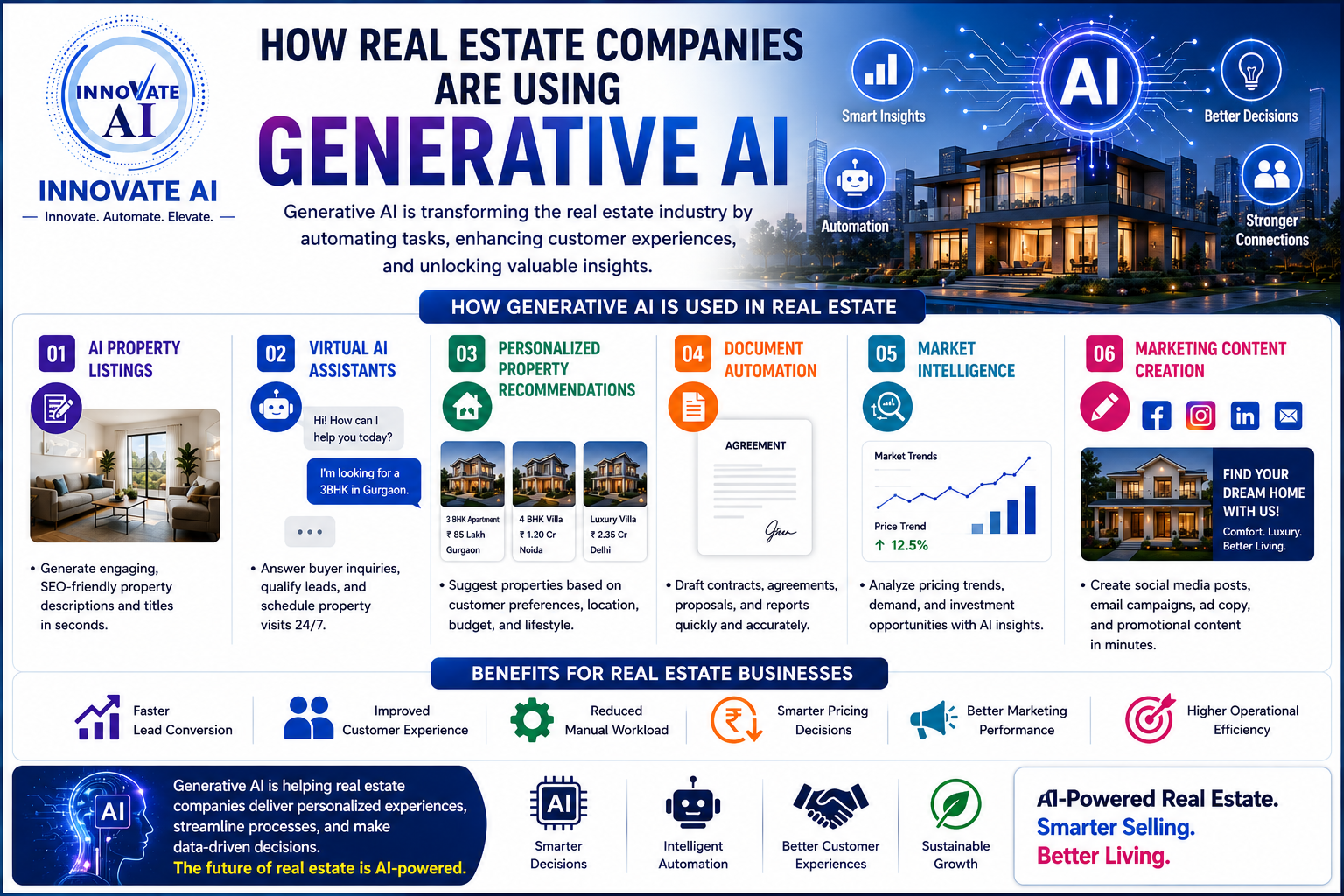
Step 4: Key Applications of Generative AI in Real Estate
1. Sales and Marketing—Hyper-Personalization at Scale
Generative AI is transforming how properties are marketed and sold.
| Application | How It Works | Measured Impact |
|---|---|---|
| Hyper-personalized campaigns | AI generates tailored content based on user preferences, search behaviors, and engagement patterns | 30–50% higher sales velocity |
| AI-powered lead qualification | Predictive models identify high-intent leads from massive inquiry pools | Top 10% of AI-identified leads generate 40–60% of bookings |
| Dynamic content generation | AI creates listing descriptions, social media posts, and email campaigns at scale | 20–50% lower customer acquisition costs |
| 24/7 engagement | AI chatbots and voice bots engage dropped leads and night leads | Walk-in Genie engages 24/7 with leads that would otherwise be lost |
ANAROCK.AI—A Comprehensive Indian Platform
ANAROCK, one of India's leading real estate services companies, launched ANAROCK.AI, a comprehensive AI-powered residential sales platform combining generative AI and predictive AI/ML .
The platform comprises nine AI tools in three suites:
| Suite | Tools | Function |
|---|---|---|
| Genie Suite (Generative AI) | Walk-in Genie, CP Genie, ORM Genie, Referral Genie | Engage customers and channel partners via chatbot and voice bot |
| Astra Suite (Predictive AI) | Astra Platinum, Astra Phoenix, Astra Hire, Astra Sales Boost | Identify high-potential leads, revive failed opportunities, optimize sales team performance |
| CP 360 | CP Ranker, CP Genie, Walk-in Genie | Maximize channel partner engagement and effectiveness |
Measured results across 80+ projects:
-
700 home sales valued at INR 750 crore (10–15% of total sales)
-
AI-assisted bookings contribute 15–45% of all sales
-
In one Chennai project, AI enabled as much as 60% of sales
-
Top 10% of leads identified by Astra Platinum yield 40–60% of bookings
2. Property Search and Discovery—Immersive and Personalized
Generative AI is making property search more intuitive and immersive.
| Application | How It Works | Why It Matters |
|---|---|---|
| Personalized property recommendations | AI analyzes budget, location, preferences, and behavior to generate customized property lists | 73% of active seekers engage with platforms at least three times weekly |
| Virtual tours and AR visualization | AI creates immersive 3D experiences; AR allows users to visualize furniture and layouts in real space | Remote property viewing reduces site visits and accelerates decisions |
| AI-powered chatbots | 24/7 assistance answering questions, scheduling tours, providing pricing, and suggesting floor plans | Immediate response builds trust and engagement |
The convergence of GenAI and XR is creating new opportunities for personalized recommendations and virtual tours, automated design solutions, price predictions, and interactive buying platforms .
3. Design and Development—Accelerating Project Launches
Generative AI is reshaping how properties are conceived and built.
| Application | How It Works | Measured Impact |
|---|---|---|
| Generative design | AI generates multiple layout options and architectural plans based on requirements | 20–30% faster project launches |
| Automated BoQs | AI generates Bills of Quantities automatically | 18–20% cost reduction |
| Drone-based monitoring | AI compares actual construction progress against plans | Deviation detection and predictive schedule control |
| Feasibility modeling | AI generates IRR/ROI scenarios and seller assessments automatically | 50% reduction in deal evaluation time; 2.5× more deals evaluated |
The development opportunity is significant. AI-enabled construction management has demonstrated meaningful improvements, including substantial reductions in safety incidents and measurable productivity gains .
4. Construction and Project Management—Predictive and Proactive
AI is making construction management more efficient and predictable.
| Application | How It Works | Impact |
|---|---|---|
| Predictive schedule control | AI forecasts delays and recommends corrective actions | 66% of development projects still finish late without AI |
| Quality control | AI-powered vision systems detect defects during construction | Reduced rework and improved quality |
| Material forecasting | AI predicts material requirements based on project progress | Reduced waste and optimized procurement |
The broader opportunity: Embedding AI across the development cycle can compress timelines by up to 30%, reducing exposure to volatility, increasing project throughput, and accelerating capital deployment .
5. Property Management and Operations—Intelligent and Responsive
Generative AI is transforming how properties are managed and maintained.
| Application | How It Works | Impact |
|---|---|---|
| Maintenance triage | AI classifies, prioritizes, and routes maintenance requests | 24/7 engagement model improves response times |
| Predictive maintenance | AI analyzes building systems to predict failures before they occur | Reduced downtime and repair costs |
| Tenant communication | AI-powered chatbots handle tenant inquiries and service requests | Improved tenant satisfaction |
| Workforce scheduling | AI optimizes technician dispatch and scheduling | Increased workforce productivity |
6. Investment and Asset Management—Data-Driven Decisions
AI is enabling more sophisticated investment decisions.
| Application | How It Works | Impact |
|---|---|---|
| Market forecasting | AI predicts demand, occupancy, and pricing trends | More precise capital allocation |
| Transaction acceleration | AI automates sourcing, screening, and due diligence | Shortened transaction timelines |
| Risk assessment | AI evaluates property value and risk using multiple data sources | Improved investment outcomes |
| Portfolio optimization | AI identifies emerging high-growth micro-markets earlier | Enhanced portfolio performance |
The shift: Investment managers can capture value through both enhanced portfolio performance and faster execution .
Step 5: The Shift from Tools to Domains
Forward-looking leaders are moving from isolated use cases to end-to-end domain transformation .
The Domain Approach
| Level | Approach | Impact |
|---|---|---|
| Enterprise | Too big to transform all at once | Impractical |
| Use Cases | Tiny steps that don't connect | Fragmented |
| Domains | Full workflows redesigned end to end | 10–30% improvements in NOI, operating costs, and cycle times |
A simple example: Financial reporting can be transformed from data aggregation to compiled bespoke reporting, cutting 60–80% of the time .
The AI-First Real Estate Company
BCG's research identifies the opportunity for AI-first real estate companies to achieve 400–700 basis point improvements in operating profit .
Key characteristics of AI-first companies:
-
End-to-end AI integration across the value chain
-
CEO-led transformation
-
Focus on business outcomes, not technology
-
Investment in talent and upskilling
-
Unified data and technology platforms
The risk of inaction: As AI adoption accelerates, lagging players will face structurally higher costs and reduced market relevance .
Step 6: The Technology Stack for Real Estate AI
The Three Layers of Real Estate AI
Based on McKinsey's framework, real estate AI deployments typically involve:
| Layer | What It Does | Examples |
|---|---|---|
| Data Foundation | Clean, governed data infrastructure | Proprietary transaction data, property databases, market data |
| AI Capabilities | Models and agents | Predictive models, generative AI, agentic AI |
| Workflow Integration | End-to-end domain redesign | Leasing, operations, asset management |
The data advantage: Organizations with unique internal trace data can differentiate their AI systems from competitors .
Generative AI in Real Estate—Market Size
The generative AI in real estate market was valued at $0.77 billion in 2025 and is projected to reach $1 billion in 2026, growing at a 30.4% CAGR, with a forecast of $2.86 billion by 2030 .
Major players include: Compass, Zillow, Redfin, Keller Williams, Matterport, CoreLogic, and Indian players like ANAROCK .
Step 7: Challenges and Barriers to Adoption
Data Infrastructure
If you build an AI agent on top of erroneous or dirty data, it will take actions based on that data. There is no substitute for a clean, governed data infrastructure .
Organizational Inertia
Massive organizational inertia and risk aversion are primary barriers. Organizations that wait for error rates to go down before experimenting will not build conviction or improve outcomes .
Leadership Gap
Only 25% of real estate firms qualify as AI leaders, compared with 40% across industries. Real estate leaders must act as Chief AI Officers—owning, prioritizing, and leading the AI transformation journey .
The Risk of Fragmentation
AI adoption that remains fragmented—focused on improving individual steps rather than transforming entire workflows—will not capture the full opportunity .
Trust and Safety
Organizations must be proactive in establishing guardrails, data governance, and human-in-the-loop mechanisms . As AI capabilities grow, so do potential threats—deepfake videos, cloned voices, and convincing fake communications are becoming easier to create and harder to detect .
Step 8: Implementation Roadmap—90 Days
Month 1: Assessment and Strategy
| Action | Output |
|---|---|
| Audit current AI capabilities and data readiness | Baseline assessment |
| Identify high-impact domains for transformation | Priority roadmap |
| Define success metrics (sales velocity, cost reduction, time savings) | KPI baseline |
| Establish AI governance and leadership ownership | Governance framework |
Month 2: Pilot and Measure
| Action | Output |
|---|---|
| Deploy one AI tool for a high-impact workflow | Working pilot |
| Measure performance against baseline | Early ROI data |
| Build internal capability and upskill teams | Trained workforce |
Month 3: Scale and Optimize
| Action | Output |
|---|---|
| Expand to full domain transformation | End-to-end deployment |
| Integrate AI into core operating model | Production deployment |
| Establish continuous improvement cycles | Ongoing optimization |
Step 9: Frequently Asked Questions
Q1: Is generative AI in real estate just hype?
No. The EY-Parthenon-CREDAI report estimates $14–17 billion in value addition to India's real estate sector over the next seven years . McKinsey estimates $430–550 billion globally . Real deployments like ANAROCK.AI have already generated 700 home sales worth INR 750 crore .
Q2: What is the biggest barrier to AI adoption in real estate?
Data infrastructure and organizational inertia. If AI is built on dirty data, it will fail. Organizations must invest in clean, governed data and overcome risk aversion .
Q3: Will AI replace real estate agents?
No. The goal is to automate repetitive administrative work while keeping real estate professionals in control of decision-making. AI is about helping people work smarter, not replacing them .
Q4: What is the difference between AI-enabled and AI-first real estate companies?
AI-enabled companies have fragmented AI tools. AI-first companies have integrated AI across the entire value chain, with CEO-led transformation and focus on business outcomes .
Q5: How much value can AI unlock for developers?
End-to-end AI transformation can deliver 400–700 basis point improvements in operating profit for developers. Early adopters can see 30–50% higher sales velocity and 20–30% faster launches .
Q6: How can Innovative AI Solutions help?
We help real estate companies design, build, and deploy AI solutions across the value chain—from lead generation and sales acceleration to property management and investment analytics.
Step 10: Final Tagline
"The next phase of growth in Indian real estate will be driven not only by scale, but increasingly by intelligence, speed and the ability to make better decisions across the project lifecycle. GenAI is fast becoming central to value creation and competitiveness, making inaction a growing strategic risk" .
Short version:
How real estate companies are using generative AI in 2026—sales acceleration, property search, design automation, property management, and investment analytics.
Hashtags:
#RealEstateAI #GenerativeAI #PropertyTech #IndianRealEstate #Proptech #DigitalTransformation #InnovativeAISolutions
Related services: to apply this in your business, explore our generative AI development and AI development services.