The Shift from Reaction to Anticipation
The Discovery Revolution
Retailers used to own the discovery moment. Customers landed on their site, used their search bar, and browsed their categories. That control is eroding. 58% of consumers now begin product discovery on AI tools, and AI is becoming the place where shoppers build the shortlists that shape every downstream decision .
As Melissa Burdick, Co-founder and President of Pacvue, explains: "AI is going to sit between the shopper and the shelf—whether that shelf is physical or digital. Instead of typing 'best moisturizer' or scrolling endlessly, consumers will increasingly rely on AI to surface options, compare prices, check ingredients and personalize recommendations based on context—and the shopper's personal history" .
The implication is profound: retailers must rethink what it means to "win" discovery when they no longer control the entry point.
The Agentic Commerce Opportunity
Agentic AI's ability to not simply provide recommendations but also complete transactions is being heralded as a major improvement to the online commerce experience. However, many retail experts are concerned that it also will diminish retailers' roles—at least until they figure out how to be "found" by AI agents .
Deloitte's Brian McCarthy notes: "The higher-ROI applications of AI will be those, like agentic commerce, that focus primarily on driving topline growth, rather than those that are limited to operational productivity alone. AI-driven solutions that enable new forms of customer engagement, digital discovery and sales growth will ultimately unlock the biggest wins" .
Step 3: Predictive Analytics in Action
Demand Forecasting and Inventory Optimization
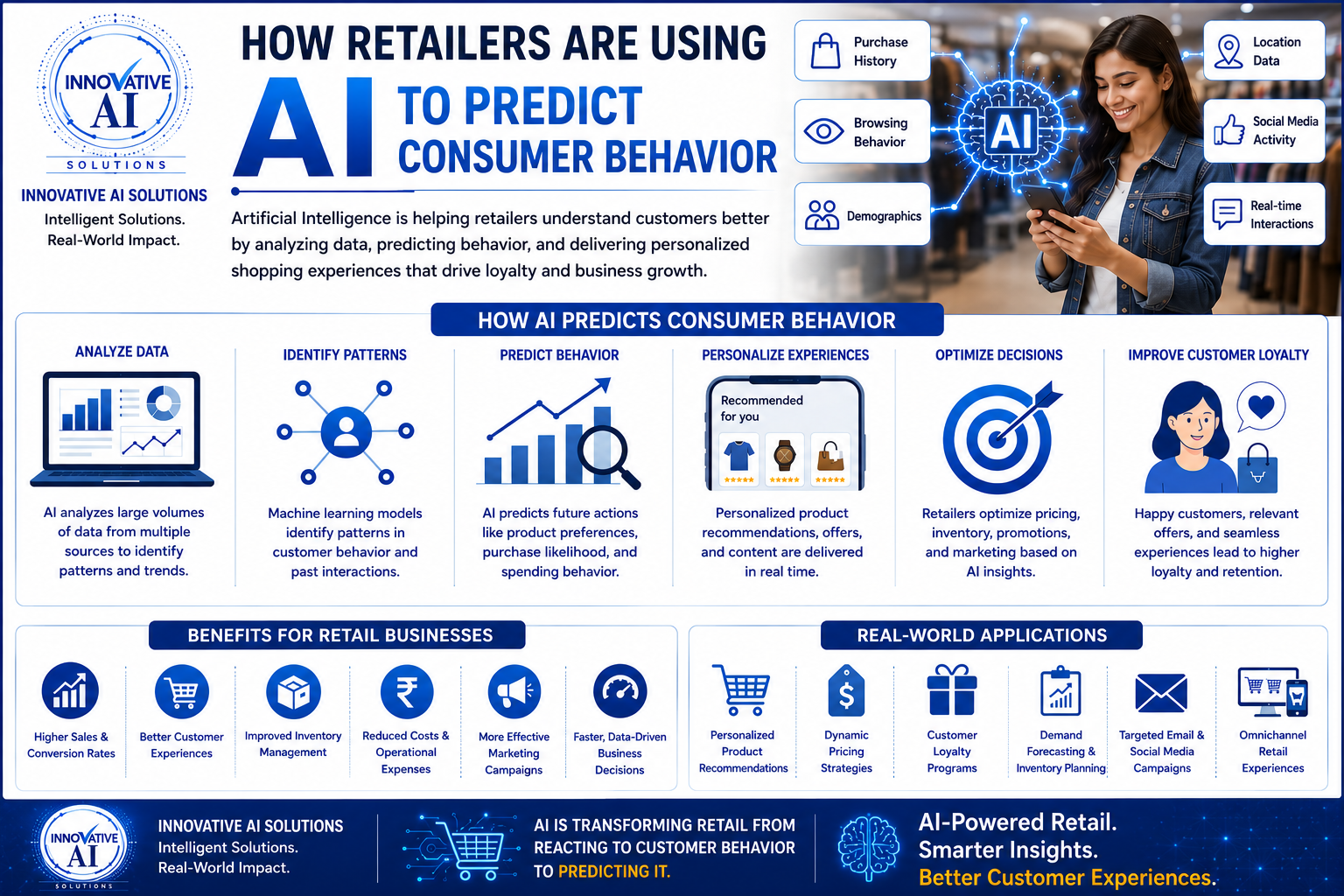
AI is transforming how retailers predict demand and manage inventory. ML-powered demand models incorporate historical sales, weather, social media trends, and other factors, including anomalies such as sudden sales spikes . Some grocery stores now use AI-powered shelf scanners to see when products are sold out and automatically order more .
The impact is significant. Better demand predictions allow for tighter inventory control and better management of supply chain-related functions, including procurement and logistics . According to a recent ISG report, retailers are starting to implement data-driven capabilities throughout their businesses, from product innovation to supply chain management, merchandising, sales and customer engagement .
Forward-looking retailers are piloting the use of AI agents to proactively update orders and reroute shipments on the fly as demand forecasts change .
Behavioral Segmentation
The challenge of understanding consumer shopping behavior from transaction data represents a fundamental tension in retail analytics. While retailers possess unprecedented volumes of purchase data, translating these observations into actionable insights requires bridging statistical rigor with behavioral meaning.
A recent study in the Journal of Retailing developed a hierarchical Bayesian mixture model that uncovers household shopping segments from large-scale transaction data . The research identified four distinct behavioral segments:
| Segment | Characteristics | Response to Retailer Strategies |
|---|---|---|
| Essentials and value-focused | High price sensitivity, staple-driven | Display higher price elasticity |
| Wellness and lifestyle-oriented | Less responsive to discounts | More loyal to category preferences |
| Convenience-driven | Time-sensitive, impulse-influenced | Moderate responsiveness |
| Seasonal and celebratory | Event-driven purchases | Varies by occasion |
The study's causal validation showed that wellness-oriented households respond less to discounts than staple-driven shoppers, reinforcing the importance of segment-specific marketing actions .
Advanced Predictive Modeling
Innovative research is pushing the boundaries of consumer prediction. A DQN-inspired deep learning model combining LSTM networks with reinforcement learning concepts achieved 88% accuracy and an AUC-ROC score of 0.88 on predicting purchase intent from over 885,000 user sessions .
The model demonstrated robust performance in handling the inherent class imbalance typical in e-commerce data, where purchase events are significantly less frequent than non-purchase events . This capability is crucial for real-world e-commerce applications dealing with high-dimensional, sequential data.
Another study introduced a framework for predicting consumer purchase paths in the food and beverage industry. The proposed Behavioral-Economic Hyper Graph Network (BEHGN) achieved AUC scores of 0.984 and 0.923 on complex path selection tasks, and generated 12.1% purchase conversion rates in simulated coupon recommendation scenarios .
Step 4: Personalization—The Next Battleground
India's Retail Transformation
Indian retailers are at the forefront of AI-driven personalization. At Reliance Retail, AI is being used to solve complex inventory optimization problems that reflect India's diverse markets. As Ankit Gupta, VP - Head of Product & Tech at Reliance Retail, explained: "The demand for XS (extra small) size in Meghalaya, for example, is quite different from that in Punjab" .
The transformation is moving beyond "recognize and recommend" to true anticipation. Rahul Kothari, COO of Razorpay, described the vision: "Imagine a grocery app that knows I usually buy three days' worth of groceries on Sundays. It should anticipate that and proactively recommend what I need" .
The Data Foundation
The foundation of this personalized future is first-party data. As Gupta noted: "First-party data is a moat in a world where third-party data, including cookies, is declining. AI models can also be far more customer-centric if trained on first party data" .
The decline of third-party cookies is forcing a fundamental shift in how retailers approach personalisation. Companies that can build direct relationships with customers and collect rich first-party data are gaining significant competitive advantages over those dependent on external data sources .
The Trust Dimension
Both Gupta and Kothari emphasized transparency as the cornerstone of their data strategies. As Kothari explained: "Customers must be told what exactly their data is being used for... we have to build the kind of muscle where data privacy is embedded in product design" .
Step 5: The Technology Stack
Open Source as Foundation
79% of retailers say open-source models and software are moderately to extremely important to their AI strategy . Open source has quickly become the foundation of many retail AI systems, giving teams the flexibility to adapt models to their data and use cases while maintaining strong governance.
As Jason Goldberg, chief commerce strategy officer of Publicis Groupe, noted: "Most retailers first started experimenting with AI using proprietary AI vendors. They had the models, but they didn't own the keys to their own kingdom. Open source flips that script, allowing retailers to leverage their proprietary data, avoid vendor lock-in and benefit from open-source community innovation" .
Video Analytics and Physical AI
Beyond transactional data, retailers are now using video analytics to capture real-time behavioral signals. A 2026 IEEE study tested new AI methods for consumer behavior and demand forecasting using video analytics and transactional data .
Using state-of-the-art computer vision, deep learning, and multimodal learning frameworks, store video streams can be mined for data such as dwell length, frequency of product interactions, consumer trajectories, and emotion recognition. When paired with transactional data, these behavioral signals reveal shifts in customer intent and demand .
Physical AI is gaining ground in the industry, with 17% of retailers using or evaluating the technology. As one industry expert noted: "The real transformation will come from AI that makes existing physical infrastructure smarter. Through in-store robotics, you get better pricing, better inventory management and better presentation quality" .
Step 6: Internal AI Applications—Scaling Efficiency
While customer-facing AI gets the attention, internal AI applications are delivering measurable operational impact.
Key Internal Use Cases
| Application Area | What AI Does | Impact |
|---|---|---|
| Demand Forecasting | Predicts demand with greater accuracy | Cuts inventory carrying costs |
| Returns Management | Algorithms deny or apply charges selectively | Reduces return fraud |
| Workforce Automation | Optimizes scheduling and automates repetitive tasks | Addresses labor shortages |
| Trade Document Processing | Automates customs clearance and paper-based processes | Improves supply chain transparency |
Sudip Mazumder, SVP at Publicis Sapient, notes: "Retailers will harness AI for inventory and merchandising, predicting demand with greater accuracy to cut inventory carrying costs and redefining return policies by using algorithms to deny or apply charges to certain shoppers selectively" .
The Productivity Gains
When asked how AI has improved their business, retailers cited:
-
54% improved employee productivity
-
52% operational efficiencies
-
41% improved customer service
Step 7: The Challenges Ahead
The AI Data Divide
While 90% of retailers are using or exploring AI, only a small percentage are prepared to scale it. As Mazumder warned: "Siloed, fragmented and poor-quality customer data could render enormous AI investments ineffective, resulting in poor customer experiences and inaccurate automation" .
The Widening Gap
Nick Drabicky, SVP at January Digital, expressed concern about "the widening gap between companies that know how to deploy AI effectively and those that don't. We're heading toward a two-speed retail economy: brands with modern data infrastructure and AI governance will accelerate, while legacy organizations will fall behind faster than they expect" .
Consumer Trust
The rise of cyber threats, including advanced deepfakes targeting executives and polymorphic malware, is anticipated to significantly escalate the risk and cost of cybersecurity across retail operations and supply chains .
Melissa Minkow, Global Director at CI&T, added another concern: "I'm just deeply hoping that none of the AI platforms begin monetizing search results. Our data repeatedly shows consumers' concern with biased outputs, and if AI platforms monetize results, it will completely diminish the power of the shopping experience it's meant to facilitate" .
Step 8: Implementation Roadmap—90 Days
Phase 1: Foundation (Weeks 1-4)
| Action | Output |
|---|---|
| Audit current AI capabilities and data readiness | Baseline assessment |
| Clean and structure product data | Machine-readable data |
| Identify high-impact use cases (demand forecasting, personalization) | Priority roadmap |
| Establish AI governance framework | Security and compliance |
Phase 2: Pilot (Weeks 5-8)
| Action | Output |
|---|---|
| Deploy predictive demand model for one product category | Working prototype |
| Implement AI-powered personalization for one customer segment | Performance data |
| Measure against baseline | Early ROI data |
Phase 3: Scale (Weeks 9-12)
| Action | Output |
|---|---|
| Expand to additional categories and segments | Broader deployment |
| Deploy agentic AI for supply chain optimization | Production deployment |
| Establish continuous improvement cycles | Ongoing optimization |
Step 9: Frequently Asked Questions
Q1: What is the biggest opportunity for AI in retail?
Demand forecasting and inventory management currently deliver the highest measurable ROI. AI-powered demand models can reduce inventory carrying costs by 20-30% and cut stockouts significantly.
Q2: What is agentic AI in retail?
Agentic AI refers to AI agents that don't just provide recommendations but also complete transactions and take actions autonomously. 47% of retailers are using or assessing agentic AI, with applications in inventory rebalancing, dynamic pricing, and vendor negotiations .
Q3: How does AI personalize shopping in India?
Indian retailers like Reliance Retail use AI to solve complex inventory optimization problems reflecting regional preferences. The vision is proactive assistance—apps that anticipate needs based on shopping patterns and life context .
Q4: What is the AI Data Divide?
The gap between companies that know how to deploy AI effectively and those that don't. While 90% of retailers are exploring AI, only a small percentage are prepared to scale it. Siloed, fragmented data can render AI investments ineffective .
Q5: How can Innovative AI Solutions help?
We help retailers design and implement AI solutions for consumer behavior prediction, demand forecasting, personalization, and agentic commerce—from data foundation to production deployment.
Step 10: Final Tagline
"The retailers that win will not be those who have the most AI, but those who use AI to build deeper trust, deliver seamless experiences, and anticipate customer needs before they are even expressed. AI favors clarity. Retailers win when their product data is clean, structured and machine-readable, because that's how AI builds confident answers" .
Short version:
How retailers are using AI to predict consumer behavior in 2026—demand forecasting, personalization, agentic AI, and implementation roadmap.
Hashtags:
#RetailAI #ConsumerBehavior #PredictiveAnalytics #AgenticAI #RetailTech #Personalization #InnovativeAISolutions
Contact Us
Phone: +91 7464 099 059 / +91 96899 67356
Email: info@innovativeais.com
Address: Netaji Subhash Place, Pitampura, Delhi – 110034
Website: https://innovativeais.com
About the Author
Abhishek Kumar
Founder & CEO, Innovative AI Solutions
5+ years building AI solutions for retail and enterprise. Based in Delhi, serving clients across India.
Related services: to apply this in your business, explore our AI agent development and machine learning and predictive analytics.