The Big Question
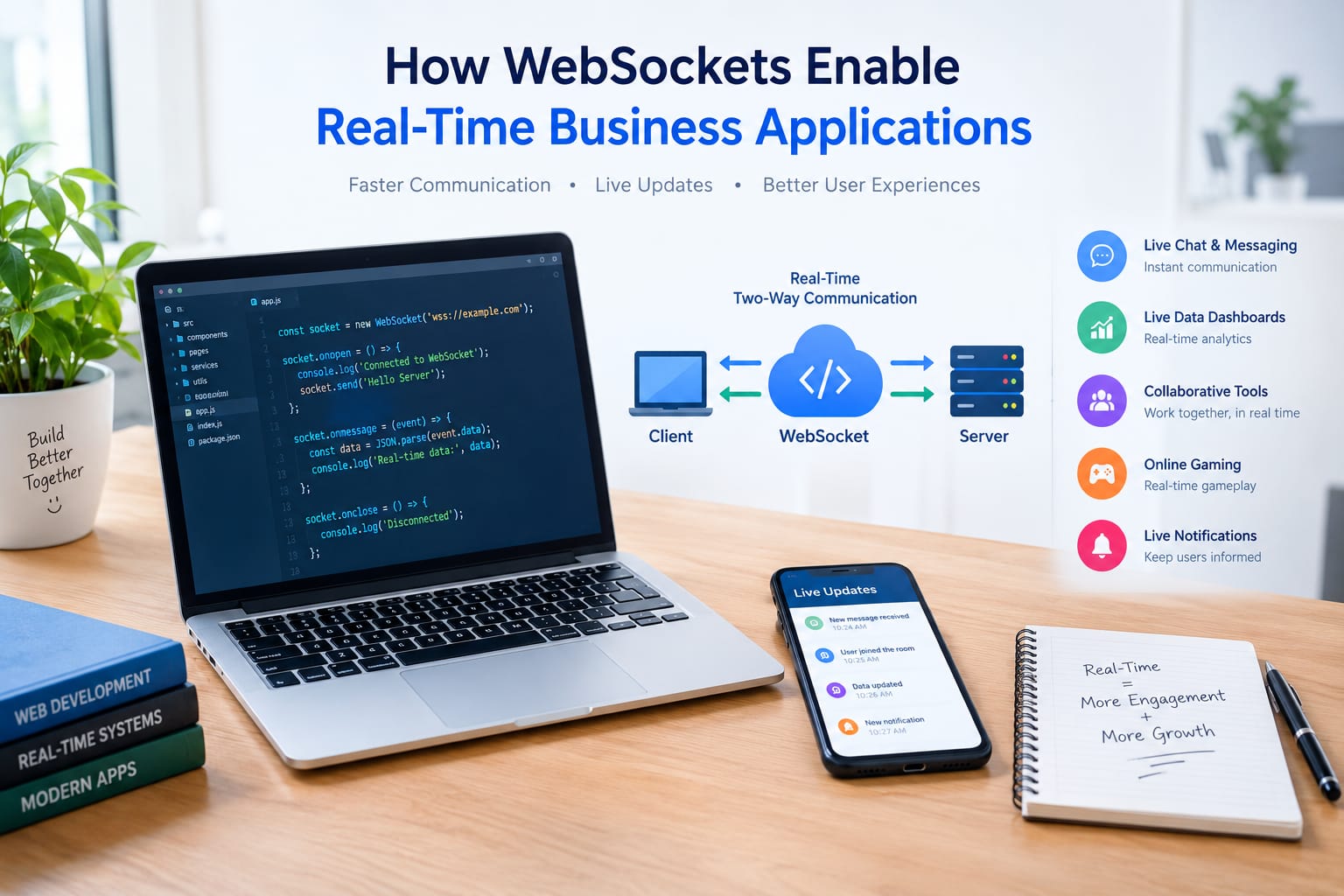
HTTP was designed for a world where clients ask and servers answer. That model works beautifully for loading web pages. It fails completely for applications where the server needs to tell the client something happened.
The workarounds are all expensive. Polling asking the server every few seconds wastes resources on requests that return nothing. Long polling holds requests open until data arrives, but each response requires a new connection. Both approaches treat real-time as a patch on top of a protocol that was never designed for it.
The math reveals the inefficiency. A comparison of 1,000 clients polling every 2 seconds versus the same clients using push technology shows 500 requests per second sustained, with nearly every response empty, consuming approximately 0.4 MB/s of pure header tax. The same 1,000 clients using WebSocket or SSE generate zero requests at rest, with bytes flowing only when actual data exists .
WebSockets solve this by upgrading an HTTP connection to a persistent TCP channel. The handshake looks like a standard HTTP request with an Upgrade: websocket header. The server responds with 101 Switching Protocols, and from that point forward, both sides can send frames independently no new connections, no request headers, no polling interval delay .
The result is full-duplex communication with 2-14 bytes of frame overhead, compared to ~600 bytes of HTTP headers per request . For applications sending 100 messages per second, that's the difference between 60 KB/s of headers alone versus almost nothing .
Cost Based on Application Type
WebSocket development costs depend on the complexity of state management, the number of concurrent connections, and the real-time features required. Here's the 2026 Indian market landscape:
| Application Type | Build Cost (India) | Monthly Run Cost | Core WebSocket Use |
|---|---|---|---|
| Chat / Messaging Platform | ₹8,00,000 – ₹25,00,000 | ₹40,000 – ₹1,50,000 | Private messaging, presence, read receipts |
| Live Dashboard / Analytics | ₹5,00,000 – ₹15,00,000 | ₹25,000 – ₹80,000 | Real-time metrics, alerts, KPI updates |
| Collaborative Editor | ₹15,00,000 – ₹40,00,000+ | ₹75,000 – ₹3,00,000 | Multi-user editing, cursor sync, conflict resolution |
| Live Streaming Social Platform | ₹20,00,000 – ₹60,00,000+ | ₹1,00,000 – ₹5,00,000+ | Real-time comments, reactions, viewer counts |
| Trading / Financial Platform | ₹25,00,000 – ₹75,00,000+ | ₹1,50,000 – ₹6,00,000+ | Price feeds, order updates, instant execution |
What drives the range:
The single biggest cost factor is state synchronization complexity. A live dashboard pushes updates from server to client with minimal state management. A chat application must track message delivery, read receipts, presence, and conversation history across multiple servers. A collaborative editor must handle conflict resolution when two users edit the same document simultaneously.
Concurrent connection scaling adds another dimension. WebSocket connections are stateful, meaning they occupy server resources for their entire lifetime. Research on resource-constrained VPS deployments (1 vCPU, 4 GB RAM) shows servers sustaining 335 simultaneous WebSocket connections with zero real errors . Scaling to hundreds of thousands of connections requires kernel tuning, sticky routing, and a pub/sub backplane.
India-specific reference points: A live streaming social platform built in India with WebSockets and Agora SDK integration cost $25,000+ (₹21 lakh+) over 7-12 months . A PHP/Laravel WebSocket chat application with private messaging, user authentication, and AWS load balancer deployment was quoted at ₹12,500 to ₹37,500 for the build .
Breakdown by Communication Technology
WebSockets are not the only real-time option. The choice depends on the direction of communication and the payload requirements:
| Technology | Direction | Transport | Best For | Complexity |
|---|---|---|---|---|
| Polling | One-way (pull) | HTTP | Occasional updates, simple status checks | Low |
| SSE | One-way (push) | HTTP | Feeds, notifications, AI streams | Low |
| WebSocket | Bidirectional | TCP (HTTP upgrade) | Chat, games, collaboration, trading | Medium |
| WebRTC | Bidirectional (P2P) | UDP | Voice/video calls, screen sharing | High |
The selection framework is straightforward:
If the client never needs to send data back on the same connection use SSE. It works through every proxy, has built-in reconnection via Last-Event-ID, and requires no special server configuration .
If bidirectional communication is required with strict in-order, reliable delivery use WebSocket. This remains the correct default for chat, collaborative cursors, and most interactive applications .
If the interaction never touches a server two browsers exchanging media directly use WebRTC.
Breakdown by Developer Type (2020-2026)
Real-time WebSocket development requires specialized skills. The Indian talent market offers a range of options:
| Developer Type | Hourly Rate (India) | Typical Engagement | What They Deliver |
|---|---|---|---|
| Freelancer | ₹750 – ₹3,000 | ₹12,500 – ₹75,000 | Basic chat apps, simple live dashboards |
| Small Agency | ₹2,500 – ₹6,000 | ₹1,50,000 – ₹5,00,000 | Scoped real-time features, reconnection logic |
| Mid-Size Firm | ₹6,000 – ₹12,000 | ₹5,00,000 – ₹25,00,000 | Multi-server scaling, pub/sub backplanes, presence systems |
| Enterprise Consultancy | ₹12,000 – ₹20,000+ | ₹25,00,000+ | Collaborative editing, SFU architecture, multi-region deployment |
The critical question before hiring: "Show me a production WebSocket system you built that handles reconnection and state recovery." Every WebSocket client disconnects eventually. The difference between a demo and a production system is what happens next.
ASP.NET Core's documentation is explicit: "If the WebSocket connection gets disconnected by the client or server, or by a network disruption, the client application is expected to reinitiate the connection with the server" . Raw WebSocket offers no built-in reconnection exponential backoff, missed-message recovery, and resume protocol are all application code .
Why Prices Changed in 2026
Three forces have reshaped WebSocket development economics.
First, managed real-time platforms matured. AWS AppSync Events lets you create serverless WebSocket APIs that broadcast to millions of subscribers without managing connections or resource scaling. No API code required to get started . Azure Web PubSub provides similar capabilities with built-in support for large-scale client connections and highly available architectures . For many applications, the build-vs-buy calculation now favors managed services.
Second, the reconnection tax became visible. The most underestimated line item in "we'll just use WebSockets" is reconnection logic. Exponential backoff with jitter, missed-message recovery, and state resynchronization are all application code . A client offline for minutes needs catch-up (re-running the base query), not just reconnection push transports deliver deltas, and deltas assume a baseline .
Third, security considerations tightened. WebSocket connections send access tokens in the query string, which web servers log by default. ASP.NET Core's documentation warns that "logging the URLs may log the access token" . For production applications, this requires either disabling request logging or implementing middleware to filter sensitive query parameters.
Fourth, the idle timeout reality. Azure Front Door imposes a 5-minute idle timeout and a 2-hour maximum connection duration. WebSocket connections are closed due to server upgrades or maintenance. Applications must implement retry logic .
Pro Tips to Save Money in 2026
1. Use SignalR or equivalent abstraction for most applications. ASP.NET Core SignalR "uses WebSocket whenever possible" but provides fallback transports when WebSocket isn't available. It also provides a basic remote procedure call (RPC) application model. In most cases, SignalR has no significant performance disadvantage compared to raw WebSocket .
2. Implement heartbeat and ping-pong. WebSocket connections appear open but may be dead zombie connections accumulate without detection. A 30-second ping with termination on missed pong keeps the connection state accurate .
3. Plan for reconnection from day one. Every WebSocket client disconnects eventually. Implement exponential backoff with jitter to prevent thundering herd. Store the last received message ID and request catch-up on reconnection .
4. Set message size limits. Without maxPayload limits, malicious clients can send oversized messages causing memory pressure and DoS. 1 MB is a reasonable default . ASP.NET Core's SignalR limits buffers to 32 KB by default increasing this allows larger messages but reduces concurrent connection capacity .
5. Use channels/topics instead of broadcasting to all connections. Broadcasting to all connections "does not scale, wastes bandwidth." Use channels/topics and send only relevant updates .
6. Store connection state externally. In-process session state "breaks with multiple instances." Use Redis or an external store for connection state . Research shows Redis pub/sub increases average broadcast delivery latency from 23.78 ms to 42.05 ms on constrained hardware, caused by O(N) broadcast fan-out on the Node.js event loop rather than Redis itself .
7. Disable caching for WebSocket routes. Azure Front Door documentation warns: "For routes with caching enabled, Azure Front Door doesn't forward the WebSocket Upgrade header to the origin and treats it as an HTTP request" resulting in a failed upgrade .
Questions to Ask Before Hiring
Before you commit budget to any WebSocket development engagement, ask these questions.
1. "How do you handle reconnection and state recovery?" Every WebSocket client disconnects. The right answer involves exponential backoff with jitter, missed-message recovery, and catch-up logic .
2. "What's your approach to message size limits?" Without maxPayload limits, malicious clients can cause memory pressure and DoS. Ask about buffer sizing and enforcement .
3. "How do you scale WebSocket horizontally?" Three things are required: sticky routing, a pub/sub backplane, and external connection state storage .
4. "How do you handle authentication token expiry on long-lived connections?" Authentication only at connection time means long-lived connections bypass token expiry. The right answer involves periodic re-authentication or token refresh .
5. "Show me a production WebSocket system you shipped in the last 90 days." Portfolios show demos. Production systems expose real reconnection logic, real error handling, and real monitoring.
Why Delhi is a Great Hub for WebSocket Development
Delhi-NCR has become a serious destination for real-time WebSocket development work, and the reason isn't just cost.
The region hosts a growing cluster of companies building real-time platforms. India-based agencies have delivered live streaming social platforms with WebSocket integration for $25,000+ over 7-12 months . The talent pool spans full-stack engineers, backend specialists, and cloud architects with real-time experience.
India's developer ecosystem is actively engaged in real-time research and implementation. The WebSocket.org decision matrix and Back4app's transport comparison both reflect the kind of practical engineering thinking that Indian teams are applying to production systems .
The time zone advantage matters too. A Delhi-based team can sync with Middle East morning, European afternoon, and US East Coast evening covering the full global support window.
What We Offer
At Innovative AI Solutions, we build real-time WebSocket applications that stay connected and scale.
Our approach:
-
Technology Selection First. We map your use case to the right communication technology. SSE for one-way push. WebSocket for bidirectional interaction. No default choices.
-
Reconnection and Resilience. Exponential backoff with jitter, heartbeat monitoring, and state recovery. Your system survives disconnections.
-
Scalable Architecture. Sticky routing, pub/sub backplane, and external connection state. Your system scales horizontally.
-
Security by Default. Token filtering in logs, message size limits, and CORS configuration. Your system doesn't leak credentials.
-
Retained Operations. Connection monitoring, failover testing, and scaling adjustments. Your real-time system doesn't rot because someone forgot it existed.
Our principle is simple: small steps, fast iteration, data speaks.
Frequently Asked Questions
Q: What is a WebSocket in simple terms?
A WebSocket is a persistent, bidirectional communication channel between a client and a server. It starts as a standard HTTP request with an Upgrade: websocket header. The server responds with 101 Switching Protocols, and from that point forward, both sides can send data frames independently no new connections, no request headers, no polling .
Q: When should I use WebSocket instead of HTTP?
Use WebSocket when the overhead of HTTP matters. Every HTTP request carries ~600 bytes of headers. A WebSocket frame adds 2-6 bytes. If your application sends or receives more than one message every few seconds, or if latency under 100ms matters, WebSocket is the right choice .
Q: What happens when a WebSocket connection drops?
Raw WebSocket simply closes. The client application is expected to reinitiate the connection . Exponential-backoff reconnection, missed-message recovery, and resume protocol are all application code the single most underestimated line item in "we'll just use WebSockets" .
Q: How do I scale WebSocket connections?
Three things are required: (1) Sticky routing so reconnects land on the same gateway. (2) A pub/sub backplane so any gateway can deliver any channel's messages. (3) External connection state storage in-process session state breaks with multiple instances .
Q: How much does a WebSocket application cost in India?
Build costs range from ₹12,500 for a basic chat app to ₹60,00,000+ for a live streaming platform with real-time features . Monthly run costs scale with concurrent connections and data volume.
Frequently Asked Questions (Extended)
Q: What is the thundering herd problem in WebSockets?
When a gateway restarts, all disconnected clients reconnect simultaneously, overwhelming surviving gateways and auth services. Mitigate with exponential backoff plus full jitter on the client .
Q: How do I handle authentication on long-lived WebSocket connections?
Authentication only at connection time means long-lived connections bypass token expiry. Implement periodic re-authentication or token refresh. Also, filter access tokens from request logs by default, web servers log the query string containing the token .
Q: What kernel parameters need tuning for WebSocket scaling?
Raise fs.file-max and ulimit -n for file descriptors. Shrink per-socket TCP buffers so idle sockets fit in memory. The Phoenix team documented hitting every one of these ceilings on the road to 2 million connections on a single 40-core server.
Q: Should I use SignalR or raw WebSocket?
SignalR "uses WebSocket whenever possible" but provides fallback transports and an RPC application model. In most cases, SignalR has no significant performance disadvantage compared to raw WebSocket . Use raw WebSocket only when you need frame-level control or are working in a runtime without SignalR support.
Q: What's the first step I should take tomorrow?
Pick one real-time feature. Just one. A live notification feed is the simplest starting point. Choose WebSocket. Build it. Measure the reconnection behavior under load. Then expand. That's how you start. Not with a strategy document about real-time transformation.
Contact Us:
Phone: +91 7464 099 059 / +91 9689967356
Email: info@innovativeais.com
Address: 9th Floor, Pearls Best Heights-I, Head Office: 904, Netaji Subhash Place, Delhi, 110034