The Big Question
Why do businesses keep buying more software yet struggle to act on what they know?
The answer is fragmentation.
Enterprise data is scattered across ERP applications, customer systems, operating systems, and external solutions. Legacy customizations and separate processes hamper rapid adoption of new technology and keep operations unstable . Organizations collect data from SAP and non-SAP systems, but keeping the business meaning of that data as it flows between systems is a more challenging task .
This is the core problem intelligent digital platforms solve.
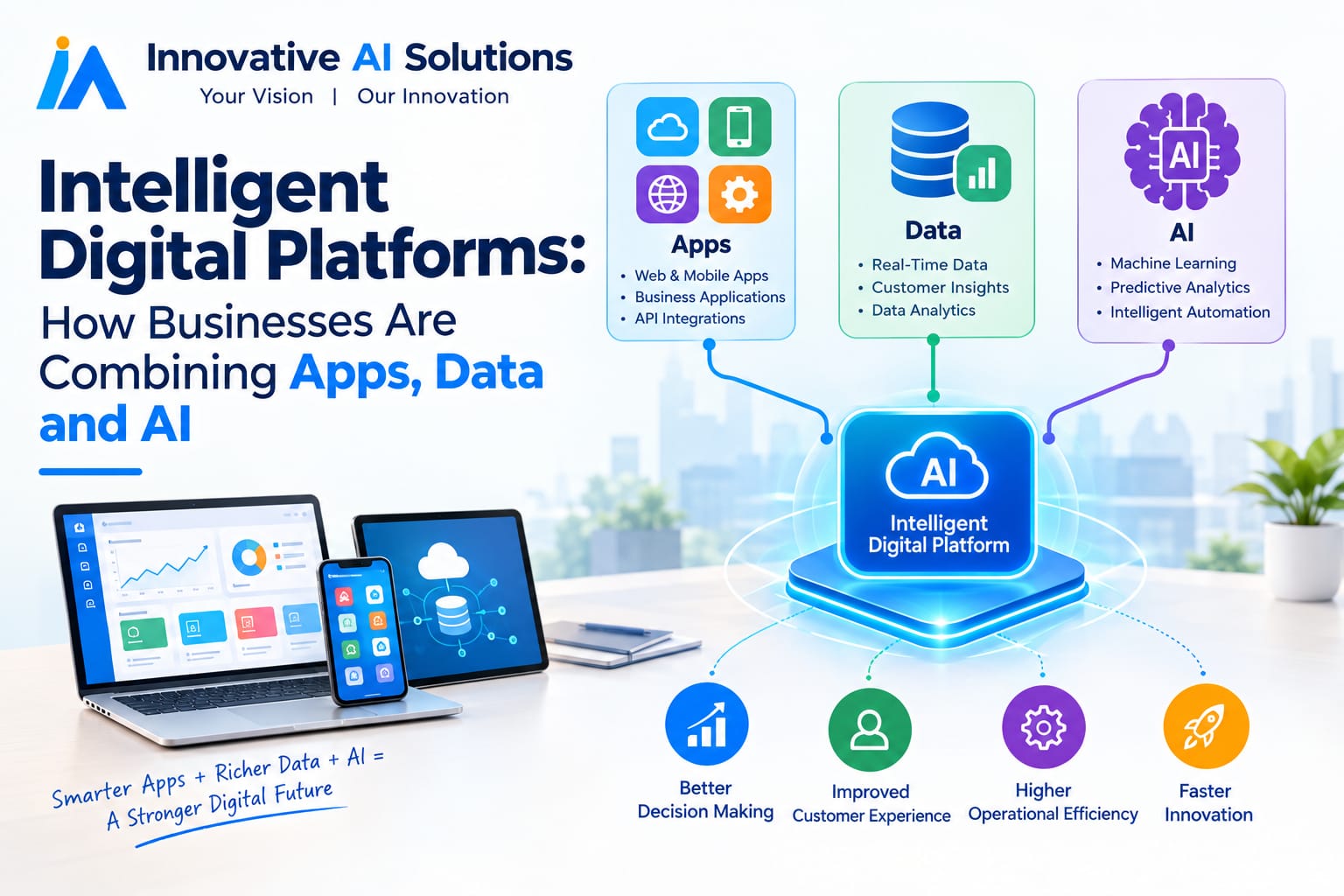
The concept isn't new. SAP laid out the framework years ago: an Intelligent Suite (modular business applications), a Digital Platform (data management and cloud technologies), and Intelligent Technologies (AI, ML, IoT) that turn intelligence into business outcomes . What's changed in 2026 is that the platform layer has become the center of gravity.
AI has made data fragmentation more expensive. Every disconnected system is a place where context gets lost, where agents can't reason, where workflows break. The businesses that thrive are those that treat apps, data, and AI as a single system not a collection of tools.
What an Intelligent Digital Platform Actually Is
An intelligent digital platform is not a product you buy. It's an architecture you build.
It has four layers that work together:
Application layer: Modular business applications ERP, CRM, HCM that provide core transactional capabilities. Increasingly, these are composable, meaning they're built from interchangeable components rather than monolithic suites .
Data layer: A governed foundation that connects structured and unstructured data from SAP and non-SAP systems while preserving business context. This is where data fabric and data mesh converge fabric provides the integration, mesh determines ownership .
AI layer: Models, agents, and services that reason over enterprise data to predict, recommend, and act. The shift is from AI embedded inside applications to AI agents operating across applications .
Orchestration layer: The connective tissue that coordinates agents, systems, and humans while applying validation, policy, and auditability. This is becoming the primary control point for automation .
The value isn't in any single layer. It's in the connections between them.
The Data Foundation: Where Intelligence Lives
Every intelligent platform rests on a data foundation. And the way businesses build that foundation has evolved.
Data fabric and data mesh are converging. Data fabric provides a governed integration layer that connects sources without requiring migration essential for enterprises running complex mixes of legacy on-premises systems and modern cloud platforms . Data mesh distributes ownership so domain teams are accountable for their data products. The two aren't competing approaches; they're layered. Fabric handles the plumbing. Mesh handles the accountability .
Business context is the differentiator. SAP Business Data Cloud was designed specifically to preserve the business meaning of data as it flows between systems. It aggregates structured and unstructured data from SAP and non-SAP sources while maintaining business semantics. Without this context, AI can't reliably interpret relationships or orchestrate end-to-end processes .
AI-ready data is the constraint. Most enterprises have the ambition to deploy agentic AI but lack the foundation to run it at scale. The AI-ready data problem and the legacy application layer are the two biggest barriers .
The Application Layer: From Monoliths to Composables
The application layer is becoming modular. This shift matters because it changes how fast businesses can adapt.
Composable enterprise architecture structures capabilities as modular, interchangeable components packaged business capabilities (PBCs) that can be composed and reused. Instead of a monolithic ERP that takes months to modify, you have building blocks like "account management" or "payment processing" that can be swapped or upgraded independently .
Telstra adopted this model with its Telstra Reference Architecture Model, based on TM Forum's Open Digital Architecture. Group executive Kim Krogh Andersen explained the motivation: "Providers out there are really hiking the prices of their technology. They have recognised that many companies are locked in. That's why composability is so critical because we now have that ability to actually shift if we are not treated with the respect we believe we deserve" .
The composable model isn't just about vendor leverage. It's about release velocity. "With the composable architecture, you have that ability to decouple systems and release things in one product like the My Telstra app without necessarily touching the core systems" .
Gartner predicts that by 2027, 80% of AI-generated business applications will be 80% composable to support engineering and business agility .
The AI Layer: Agents That Operate Across Applications
The most significant shift in 2026 is the move from AI embedded inside applications to AI agents that operate across them.
SAP's Autonomous Enterprise concept describes the new model: "AI-native applications... an agent-based engagement layer that operates across applications, workflows, and data domains. These agents can reason over business intent, traverse processes, and execute actions using governed enterprise data" .
The results are measurable. SAP reports 83% reduction in invoice cycle time, greater than 99% billing accuracy, and 98% reduction in time to reconcile ICT postings from autonomous system implementations .
Siemens is rolling out its Intelligence Center X platform to help companies move from isolated AI pilots to agentic AI-driven business transformation. The strategy is to connect enterprise data, business rules, and AI agents within a common operational context not just bolt AI onto existing processes. "Adding AI to existing processes alone does not constitute transformation," said Tarik Elomari, head of strategic solutions at Siemens .
The governance layer is critical. AI agents must operate within enterprise-grade guardrails preserving security, governance, and compliance controls while maintaining transparency .
The Orchestration Layer: Where Control Lives
As agents proliferate, orchestration becomes the strategic control point.
ServiceNow describes its platform as "an AI control tower for business reinvention" that integrates with any cloud, model, and data source to orchestrate how work flows across the enterprise. By unifying legacy systems, departmental tools, cloud applications, and AI agents, it provides a single pane of glass connecting intelligence to execution .
The orchestration layer handles: agent coordination, task routing, validation, policy enforcement, human-in-the-loop approval, and audit logging. It's what prevents "agent sprawl" large numbers of autonomous systems operating without central oversight.
For businesses, owning the orchestration layer is a strategic imperative. Platform-native orchestration is convenient but creates lock-in. The organizations that control their own orchestration layer control their own automation strategy.
Cost of Building an Intelligent Platform
What does it cost to build this architecture?
Foundation layer (data integration, governance): ₹15,00,000 to ₹50,00,000. This includes connecting core systems, establishing data governance, and building the retrieval layer.
Application layer (composable components): ₹20,00,000 to ₹75,00,000+. Depends on how many PBCs you build versus buy, and how much legacy modernization is required.
AI layer (agents, models, orchestration): ₹25,00,000 to ₹1,00,00,000+. Agents that operate across systems require guardrails, audit trails, and human-in-the-loop workflows.
Ongoing platform management: 20–30% of build cost annually.
The total investment for a mid-sized enterprise is ₹60,00,000 to ₹2,00,00,000+. But the key insight: you don't build it all at once. Start with the data foundation. Add AI where it solves a specific problem. Add orchestration as agents multiply.
What This Means for Your Business
Stop buying software. Start building platforms.
The era of disconnected applications is ending. The era of intelligent platforms where apps, data, and AI work as one has begun. This doesn't mean abandoning your ERP or CRM. It means treating them as components in a larger system, not as standalone destinations.
Own your orchestration layer. Platform native agents are convenient. But if you don't control the layer that coordinates them, you don't control your automation strategy. Build the orchestration layer as a strategic asset.
Context is the moat. Models are commoditized. Data is abundant. What's scarce is business context the understanding of how your organization actually works, the relationships between entities, the rules and exceptions that no generic model knows. Preserve it. Encode it. Use it.
Start with the data foundation. AI agents can't reason over data they can't access. Governance can't enforce policies on data it can't see. Build the data layer first. Everything else depends on it.
Frequently Asked Questions
Q1: What is an intelligent digital platform?
An intelligent digital platform is an architecture that combines business applications, governed data, and AI capabilities into a unified foundation. Unlike traditional software stacks, it treats apps, data, and AI as interconnected components rather than isolated systems .
Q2: How is this different from a traditional software stack?
Traditional stacks are collections of disconnected applications with separate data models and interfaces. Intelligent platforms provide a governed data layer that connects systems, an AI layer that reasons across them, and an orchestration layer that coordinates actions .
Q3: What is a composable enterprise?
A composable enterprise structures capabilities as modular, interchangeable components called packaged business capabilities (PBCs). Instead of monolithic suites, businesses assemble solutions from reusable building blocks, enabling faster adaptation and reducing vendor lock-in .
Q4: What is the difference between data fabric and data mesh?
Data fabric provides a governed integration layer that connects sources without migration. Data mesh distributes ownership so domain teams are accountable for their data products. They work together fabric for integration, mesh for accountability .
Q5: Why does business context matter for AI?
Without business context, AI agents can't reliably interpret relationships among enterprise data or orchestrate end-to-end processes. Preserving business semantics as data flows between systems is essential for reliable AI .
Q6: What is the SAP Business Technology Platform?
SAP BTP is a platform that combines integration, AI, data, and application development capabilities. It enables organizations to automate processes, develop AI-based apps, and establish governed foundations without disrupting their core ERP .
Q7: How much does it cost to build an intelligent digital platform?
Foundation layer: ₹15–50 lakhs. Application layer: ₹20–75 lakhs+. AI layer: ₹25 lakhs–1 crore+. Total for mid-sized enterprise: ₹60 lakhs–2 crores+. Ongoing management: 20–30% of build cost annually.
Q8: What is agentic AI in the context of digital platforms?
Agentic AI refers to systems that can reason, plan, and act across applications and data domains. Unlike AI embedded in a single application, agents operate across the enterprise, traversing processes and executing actions using governed data .
Q9: Why is orchestration important?
Orchestration coordinates agents, systems, and humans while applying validation, policy, and auditability. It prevents agent sprawl and ensures that autonomous actions comply with enterprise governance .
Q10: What results can businesses expect from intelligent platforms?
SAP reports 83% reduction in invoice cycle time, 99%+ billing accuracy, and 98% reduction in reconciliation time from autonomous implementations .
Frequently Asked Questions (Continued)
Q11: Can I start with a small implementation?
Yes. Start with the data foundation connecting one or two critical systems. Add an AI agent for a specific workflow. Expand orchestration as agents multiply.
Q12: What happens to my existing ERP and CRM?
They become components in the larger platform. You don't replace them. You connect them to the data layer and enable AI to operate across them .
Q13: How do I prevent vendor lock-in?
Adopt composable architecture. Use open standards like TM Forum's Open Digital Architecture. Own your orchestration layer. Ensure APIs are documented and portable .
Q14: What is the role of platform engineering?
Platform engineering teams build and maintain the internal platforms that host, orchestrate, and govern AI agents. They shift from an efficiency function to a strategic discipline .
Q15: Why should I choose Innovative AI Solutions?
Because we build intelligent platforms, not disconnected tools. Because we focus on data foundations and orchestration. Because your code is always yours.
Contact Us
Phone:
+91 7464 099 059
+91 9689967356
Email:
info@innovativeais.com
Address:
9th Floor, Pearls Best Heights-I,
Head Office: 904, Netaji Subhash Place,
Delhi – 110034