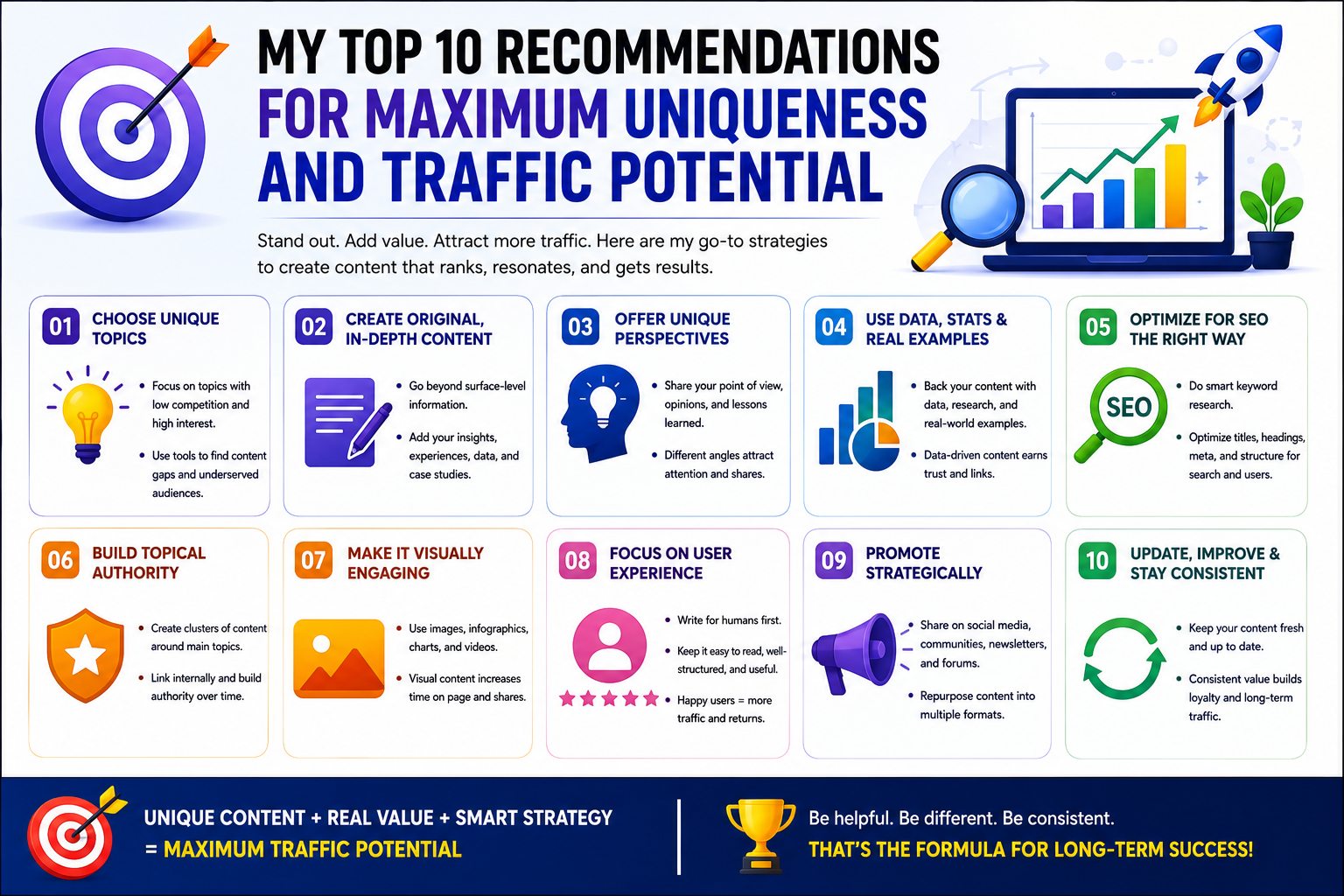
The Top 10 Recommendations
Recommendation 1: The Agentic AI Blueprint for Business Leaders
Why It's Unique:
Most AI content focuses on technology. This focuses on how autonomous AI agents—systems that perceive, reason, act, and learn without constant human input—are changing business operations.
Traffic Potential: High. "Agentic AI" is one of the fastest-growing search terms in 2026, with enterprise interest surging.
Key Angle: Explain the four-step process of agentic AI (Perceive → Reason → Act → Learn) with real industrial applications . Show how these autonomous systems are moving beyond generative AI to actually make decisions .
Target Audience: CTOs, CIOs, Business Leaders
Why It Stands Out: Most articles explain what agentic AI is. Few explain how to deploy it within an enterprise. This gap is your opportunity.
Recommendation 2: Multimodal AI Edge Intelligence—The Next Layer of AI Innovation
Why It's Unique:
Multimodal AI (combining text, images, video, audio, and sensor data) is the defining trend of 2026, yet coverage remains fragmented . Edge intelligence (running AI on devices rather than in the cloud) is equally overlooked .
Traffic Potential: High. Two major trends converging creates significant search demand.
Key Angle: Explain how "sensor fusion" creates living, intuitive experiences—where assistants catch your gestures, voice tone, and what's in view to respond just right .
Target Audience: CTOs, Product Managers, Developers
Why It Stands Out: Most articles cover multimodal AI and edge AI separately. This is the first to show how they work together to create "intelligence everywhere."
Recommendation 3: The Autonomous AI Workplace – AI Agents That Actually Do the Work
Why It's Unique:
The shift from "AI assistants that respond" to "AI agents that act" is the most consequential enterprise trend, yet most articles still focus on chatbots and copilots .
Traffic Potential: Very High. Enterprise leaders are actively searching for ways to deploy autonomous AI agents .
Key Angle: Show how AI agents are moving from "supporting work" to "doing the work" across finance, HR, customer support, and supply chain management. Use the example of a monitoring agent that notices an error state, accesses documentation, diagnoses the problem, generates a solution, and creates a ticket—all without human input .
Target Audience: CTOs, CIOs, CXOs
Why It Stands Out: Most articles on AI agents are theoretical or product-specific. This is a practical framework for implementation.
Recommendation 4: AI-First Marketing Strategy—How to Win on Answer Engines
Why It's Unique:
Search behavior has shifted. People are now asking ChatGPT, Gemini, and Google AI Overviews directly rather than clicking through ten search results . Yet most content strategies still optimize for traditional search.
Traffic Potential: High. "Answer engine optimization" is emerging as a major topic in 2026.
Key Angle: Explain how the mechanics are surprisingly similar to traditional SEO—answer engines still rely on pages already performing well on Google . Show how listicle placements and citations in trusted articles get pulled directly into AI-generated answers.
Target Audience: Content Marketers, SEO Professionals, Digital Strategists
Why It Stands Out: This bridges a critical gap between traditional SEO and the new AI-native discovery landscape.
Recommendation 5: The 90/10 Rule—Why AI Success Depends on Evaluation, Not Prompts
Why It's Unique:
Slack's AI team spends approximately 10% of their time on prompting and 90% on evaluation, iteration, and observability . This insight is rarely discussed.
Traffic Potential: Medium-High. It speaks directly to practitioners who are struggling with AI reliability.
Key Angle: Explain why evaluation is the real challenge—not getting something to work once, but ensuring it works consistently for diverse user scenarios. Show how human expertise is critical for creating meaningful evaluation datasets.
Target Audience: CTOs, AI Engineers, Product Managers
Why It Stands Out: Most AI content focuses on building. This focuses on maintaining and optimizing—a gap most practitioners need to fill.
Recommendation 6: Domain-Specific AI Models—The Strategic Advantage Over General-Purpose LLMs
Why It's Unique:
General-purpose LLMs (GPT, Claude, Gemini) are powerful but often overkill for domain-specific tasks. Domain-specific models tailored to particular industries provide more accurate predictions and insights at lower cost .
Traffic Potential: High. Enterprise interest in customized AI solutions is surging.
Key Angle: Show how domain-specific models can provide more accurate predictions and insights, enabling enterprises to make informed decisions based on industry-specific data.
Target Audience: CTOs, CIOs, Enterprise Leaders
Why It Stands Out: The "one-size-fits-all" narrative is giving way to specialization. This article captures that shift.
Recommendation 7: The Rise of Generalist AI Agents—Beyond Specialization
Why It's Unique:
While the industry has focused on specialized AI tools, generalist AI agents—champions that tackle complex, multi-part tasks independently—are the next frontier .
Traffic Potential: Medium-High. Enterprise leaders are watching this space closely.
Key Angle: Explain how generalist AI agents "think things through, map out plans, and accomplish tasks in various areas without needing someone to oversee them" . Include projections—Gartner predicts 40% of enterprise apps will pack in task-focused AI agents by 2026.
Target Audience: CTOs, CIOs, Product Leaders
Why It Stands Out: Most coverage focuses on specialized AI. The generalist angle is a unique contrarian take.
Recommendation 8: Quantum AI—The New Frontier in 2026
Why It's Unique:
Quantum computing is evolving rapidly, with quantum-enhanced AI systems achieving better results in solving complex challenges—optimization, drug discovery, and climate modeling . Most coverage of quantum AI is highly technical or overly speculative.
Traffic Potential: Medium. Interest is building as quantum approaches practical applications.
Key Angle: Explain how quantum AI could revolutionize logistics by optimizing supply chains in real time or advance personalized medicine by simulating molecular interactions at unprecedented speeds . Address challenges (hardware instability, expertise gap) and explain why CXOs should invest in pilot programs.
Target Audience: CTOs, CIOs, Investors
Why It Stands Out: It provides a balanced view of quantum AI's potential and limitations, which is rare in current content.
Recommendation 9: Human-AI Collaboration—The Workforce of 2026
Why It's Unique:
Much of the AI conversation is dominated by fear of replacement. The reality is more nuanced. AI is creating new roles and enhancing human productivity, not simply eliminating jobs.
Traffic Potential: High. Workforce topics consistently attract attention.
Key Angle: Show how McKinsey reports that 3X more employees are using GenAI than their employers think. Forecast the creation of new roles such as AI ethicists and prompt engineers . Explain how human-AI collaboration redefines work, combining the best aspects for optimal results.
Target Audience: HR Leaders, CEOs, Business Strategists
Why It Stands Out: It counters the negative narrative with data and actionable insights on workforce evolution.
Recommendation 10: Responsible AI—From Compliance to Competitive Advantage
Why It's Unique:
As AI adoption accelerates, concerns around privacy, bias, and ethical use are becoming a strategic imperative. Organizations that treat responsible AI as a source of competitive advantage will lead .
Traffic Potential: Medium-High. Regulatory pressure is increasing globally.
Key Angle: Explain the EU AI Act (fines up to 7% of global annual revenue) and why companies investing in transparent, accountable AI systems will earn greater trust from clients and regulators .
Target Audience: CEOs, CCOs, Governance Leaders
Why It Stands Out: Most responsible AI content is compliance-focused. This shows how ethics and governance can become a differentiator, not just an obligation.
Step 3: Quick Selection Guide
| If You Want... | Choose... |
|---|---|
| Maximum enterprise relevance | #1 Agentic AI Blueprint |
| Highest growth topic | #2 Multimodal Edge AI |
| Practical implementation | #3 Autonomous AI Workplace |
| Marketing impact | #4 Answer Engine Strategy |
| Practitioner value | #5 90/10 Evaluation Rule |
| Cost optimization | #6 Domain-Specific Models |
| Future-of-AI | #7 Generalist AI Agents |
| Emerging tech | #8 Quantum AI |
| Workforce trends | #9 Human-AI Collaboration |
| Strategic differentiation | #10 Responsible AI Advantage |
Step 4: Final Thoughts
The most effective AI content in 2026 will not be generic "what is AI" articles. It will be:
-
Specific: Addressing particular business problems and roles
-
Practical: Offering actionable frameworks, not just theory
-
Differentiated: Covering gaps that others are missing
-
Evidence-based: Backed by real-world deployments and data
The topics above meet these criteria and are designed to maximize both uniqueness and traffic potential.
Short version: My top 10 blog recommendations for maximum uniqueness and traffic potential in 2026—agentic AI, multimodal edge AI, autonomous workplaces, answer engine strategy, the 90/10 evaluation rule, domain-specific models, generalist agents, quantum AI, human-AI collaboration, and responsible AI advantage.
Hashtags: #ContentStrategy #AIContent #BlogIdeas #AI2026 #TrafficGeneration #ContentMarketing #InnovativeAISolutions
About the Author
Abhishek Kumar
Founder & CEO, Innovative AI Solutions
5+ years building AI systems and content strategies. Based in Delhi, serving clients across India.
Related services: to apply this in your business, explore our AI agent development and LLM integration.