The Big Question
What happens when a CNC spindle motor fails in the middle of a production run, costing $82,000 in downtime and emergency parts? When a critical turbine in a power plant shows early signs of degradation that no one notices until it's too late?
The shift from reactive to predictive maintenance represents a fundamental change in industrial strategy. With IoT sensors, AI-powered analytics, and digital twins, organizations can now anticipate failures and act before they occur.
Why Predictive Maintenance Matters
Unplanned downtime remains one of the largest operational expenses in manufacturing and industrial settings. Businesses lose billions of dollars annually due to unexpected machine failures. Traditional maintenance strategies repairing after failure or scheduled servicing based on time are becoming less effective in environments that demand continuous operation.
The Cost of Reactive Maintenance
A mid-size manufacturer documented the costs of reactive maintenance over a single fiscal year:
| Cost Category | Amount |
|---|---|
| Lost production output from 847 downtime events | $4.2M |
| Emergency maintenance parts (30-40% premium) | $680,000 |
| Contractual penalty payments for delivery delays | $290,000 |
With the rapid growth of the Internet of Things and more than 75 billion connected devices projected online in the near term, the opportunity to transform maintenance is unprecedented.
How Predictive Maintenance Works
The Core Architecture
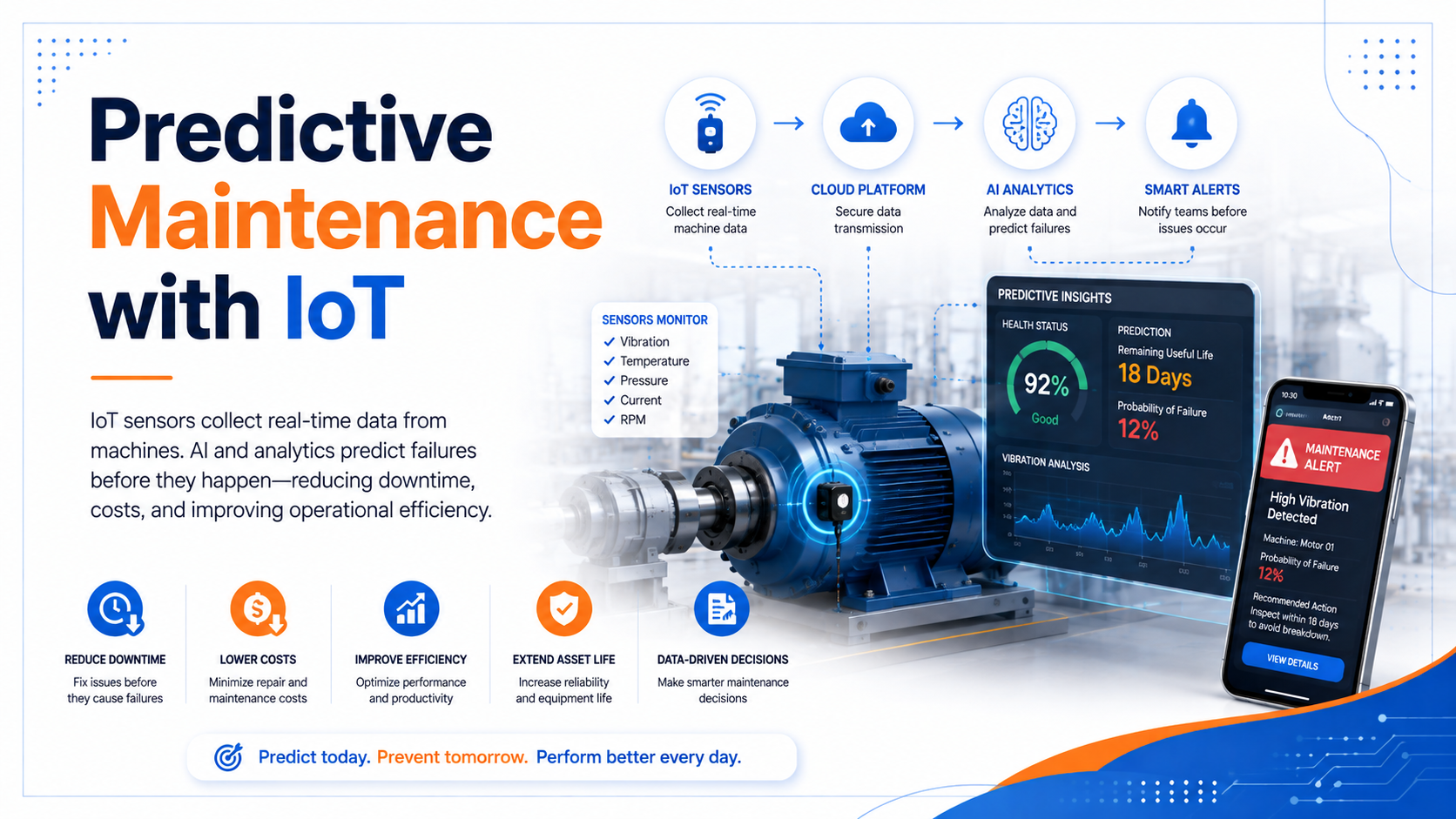
A modern IoT predictive maintenance system operates through a multi-layered architecture:
Data Collection and Ingestion: IoT sensors monitor critical parameters including temperature, vibration, current consumption, pressure, and rotational position. These sensors feed continuous telemetry data into the system.
Real-Time Data Processing: Edge devices process data locally for immediate decision-making. For safety-critical alerts, edge processing can trigger responses within 400 milliseconds, independent of cloud connectivity.
Cloud Analytics and Model Training: Cloud infrastructure stores historical data, trains machine learning models, and performs complex analytics that require more computational resources.
Anomaly Detection and Prediction: Machine learning models including Random Forest, LSTM, and CNN architectures analyze sensor patterns to detect anomalies and predict failures before they occur.
Visualization and Alerts: Dashboards display equipment health and trigger alerts at defined severity thresholds, enabling proactive maintenance scheduling.
The Technology Stack
| Layer | Technologies |
|---|---|
| Hardware | Industrial PLCs, OPC-UA servers, vibration sensors, thermal sensors, IoT gateways |
| Edge Processing | AWS IoT Greengrass, edge PCs, local inference engines |
| Platform | AWS IoT SiteWise, Apache Kafka, Spark, MongoDB, Amazon S3 |
| Machine Learning | Random Forest, LSTM, CNN, autoencoders |
| Visualization | Streamlit, React dashboards, Grafana |
Real-World Results
Manufacturing: 40% Downtime Reduction on AWS
A mid-size manufacturer connected 280 production assets CNC machining centers, assembly robots, and conveyor systems to AWS IoT SiteWise. By prioritizing the 124 assets that accounted for 71% of downtime costs, the deployment achieved:
-
40% reduction in unplanned downtime
-
Sensor-to-alert latency under 8 seconds
-
Three-tier anomaly detection triggering maintenance actions at score thresholds of 0.7, 0.85, and 0.95
Smart Manufacturing Plants: 50% Downtime Reduction
An IoT-enabled predictive maintenance system in automotive manufacturing reduced unplanned downtime by 50% and boosted overall production uptime by 11.25%. The system integrated IoT sensors, edge computing for local processing, and cloud analytics for model training.
Deep Learning Implementation: 60% Downtime Reduction
A CNN-Autoencoder model deployed across 10 critical machines over 60 days achieved:
-
94.6% test accuracy and 91.5% precision
-
60% reduction in unplanned downtime and 34% lower maintenance costs
-
Prediction error of less than 2 days for most machines
-
False positive rate below 3% for anomaly detection
Energy Efficiency: Up to 30% Energy Reduction
Deep learning-based predictive maintenance in IoT networks demonstrated reductions in energy waste of up to 30%, with machine learning models optimizing both failure prediction and network resource distribution.
Digital Twins and Advanced Models
CNN-LSTM Framework for Intelligent IIoT Systems
A hybrid CNN-LSTM deep learning architecture using digital twins has achieved a 96% classification accuracy, outperforming traditional machine learning and standalone deep learning models. The framework:
-
Captures discriminative spatial features using convolutional layers
-
Learns temporal dependencies from sequential sensor readings using LSTM networks
-
Enables proactive, data-driven asset management
Edge-Cloud IIoT Framework
The IntelliPdM framework provides an end-to-end predictive maintenance solution for smart manufacturing, featuring:
-
Separate data pipelines for structured and unstructured data
-
Synthetic data generation for addressing data sparsity
-
API-based model deployment at the edge
-
Production validation in a large-scale Singapore manufacturing unit over one year
Implementation Roadmap
Phase 1: Discovery and Prioritization (Weeks 1-4)
-
Analyze maintenance history: Identify asset types with the most frequent and expensive failure modes. In one case study, just 124 of 280 assets accounted for 71% of downtime costs.
-
Define success metrics: Establish clear targets for downtime reduction, maintenance cost savings, and equipment lifespan extension.
-
Select starting assets: Begin with the highest-value assets those that cause the most financial impact when they fail.
Phase 2: Instrumentation and Integration (Weeks 5-8)
-
Deploy IoT sensors: Install vibration, temperature, current, and other sensors on target equipment.
-
Connect to edge gateways: Use industrial PCs or gateways with OPC-UA protocol translation for PLC integration.
-
Establish data pipelines: Implement ingestion and storage infrastructure for real-time telemetry.
Phase 3: Model Development and Deployment (Weeks 9-12+)
-
Train machine learning models: Use historical data to train Random Forest, LSTM, or CNN models.
-
Deploy anomaly detection: Configure real-time monitoring with severity-based alerting.
-
Integrate with maintenance systems: Connect to CMMS or ERP for automated work order generation.
Frequently Asked Questions
Q1: What is predictive maintenance with IoT?
Predictive maintenance with IoT uses connected sensors and machine learning to monitor equipment condition in real-time, detecting anomalies and predicting failures before they occur. This enables maintenance to be scheduled exactly when needed rather than on a fixed schedule or after failure.
Q2: What kind of sensors are used?
Common sensors include vibration sensors, temperature sensors, current/power sensors, pressure sensors, and acoustic sensors. For CNC spindles, vibration is often the most reliable indicator of impending bearing failure.
Q3: How much can predictive maintenance save?
Organizations typically achieve 20-60% reduction in unplanned downtime, 10-40% reduction in maintenance costs, and 10-20% extension in equipment lifespan.
Q4: What is the role of digital twins?
Digital twins create virtual replicas of physical equipment that link operational data to simulated physical behavior. They enable virtual failure mode analysis, simulation-based "what-if" testing, and improved anomaly detection.
Q5: How can Innovative AI Solutions help?
We help organizations design, build, and operationalize predictive maintenance systems from sensor selection and data pipelines to AI model deployment and integration with maintenance workflows. Based in Delhi, serving clients across India.
Why Delhi is a Great Hub for Industrial AI Innovation
Delhi and India are at the forefront of industrial AI adoption. Indian researchers are publishing extensively on predictive maintenance for smart manufacturing, with conferences and studies in Indore, Bhubaneswar, Coimbatore, and New Delhi. Toshiba is deploying AI-driven monitoring across 165 power plants in India for NTPC. The region's combination of manufacturing scale, IT talent, and government support for Industry 4.0 initiatives positions it as a leader in IoT-driven predictive maintenance.
What We Offer at Innovative AI Solutions
-
Predictive Maintenance Strategy: We help you identify high-value assets and design a predictive maintenance roadmap.
-
IoT Implementation: We help you deploy sensors, edge gateways, and data pipelines.
-
AI Model Development: We build custom anomaly detection and failure prediction models.
-
System Integration: We connect predictive maintenance to CMMS and ERP platforms.
Final Thought
The shift is clear: from reactive repairs to proactive prediction, from scheduled maintenance to condition-based action. Organizations that implement predictive maintenance with IoT will achieve the reliability, cost savings, and operational efficiency needed to compete in Industry 4.0.
Contact Us:
Phone: +91 7464 099 059 / +91 9689967356
Email: info@innovativeais.com
Address: Netaji Subhash Place, Pitampura, Delhi – 110034
Website: https://innovativeais.com
About the Author
Abhishek Kumar
Founder & CEO, Innovative AI Solutions
5+ years building AI, IoT, and enterprise systems. Based in Delhi, serving clients across India.
Related services: to apply this in your business, explore our machine learning and predictive analytics and AI development services.