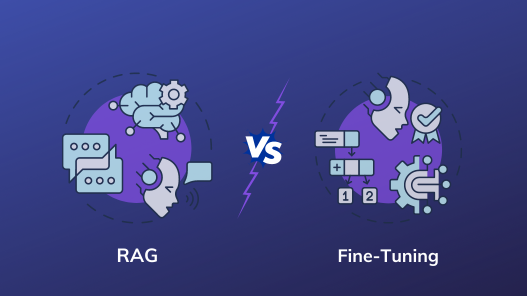
What Is RAG?
RAG adds a retrieval step before generation. When a user asks a question, the system first searches a knowledge base for relevant documents. It then appends those documents to the prompt, and the LLM generates an answer grounded in that retrieved context.
RAG requires no model training. You simply index your documents, build a retrieval pipeline, and the base model answers questions based on the context you provide. When your documents change, you update the index. The model itself remains unchanged.
The primary strengths of RAG are that knowledge updates are instantaneous, source attribution is possible, and no training compute is required. The primary weaknesses are that retrieval latency adds overhead, long prompts increase token costs, and answer quality depends entirely on retrieval quality. RAG also cannot change the model's underlying behavior or output format.
Step 3: What Is Fine-Tuning?
Fine-tuning continues training a pre-trained model on a domain-specific dataset. You provide examples of desired inputs and outputs, and the model adjusts its internal weights to produce similar responses.
Unlike RAG, fine-tuning bakes knowledge directly into the model. When you update your knowledge, you must retrain the model. Fine-tuning can also modify the model's behavior, tone, and output format in ways that prompting alone cannot achieve.
The strengths of fine-tuning are lower inference latency, consistent output formatting, and the ability to teach the model domain-specific terminology and reasoning patterns that are difficult to capture in retrieval. The weaknesses are high upfront compute costs, stale knowledge between retraining cycles, and no source attribution for answers. Fine-tuning also requires a high-quality, labeled dataset, which is often the most expensive component to create.
Step 4: Direct Comparison
The following dimensions capture the most important differences between the two approaches.
Knowledge Freshness: RAG can update knowledge in minutes by adding documents to the index. Fine-tuning requires hours or days of retraining to incorporate new information. If your knowledge changes daily or weekly, RAG is strongly preferred.
Source Attribution: RAG can cite the documents used to generate each answer. Fine-tuning cannot explain why it produced a particular response. For regulated industries or customer-facing applications where provenance matters, RAG is essential.
Latency: Fine-tuning has lower inference latency because there is no retrieval step. RAG adds the time for embedding generation, vector search, and context fetching. For sub-second response requirements, fine-tuning or an optimized RAG pipeline is necessary.
Output Consistency: Fine-tuning reliably produces outputs in specific formats, such as JSON schemas or consistent brand voice. RAG depends on prompt engineering, which is less reliable for complex formatting requirements.
Development Speed: RAG can be implemented in hours or days with off-the-shelf tools. Fine-tuning requires weeks of dataset preparation, experimentation, and evaluation. For rapid iteration, RAG is the clear winner.
Cost Structure: RAG has low upfront costs but pays per-query for retrieval and longer prompts. Fine-tuning has high upfront training costs but lower per-query costs at scale. The crossover point depends on query volume and model size.
Privacy: RAG can keep sensitive data in your own infrastructure, sending only retrieved snippets to the LLM. Fine-tuning bakes training data into model weights, which can be harder to audit and purge.
Offline Capability: Fine-tuning can run entirely offline after training. RAG requires access to both the vector database and the LLM API during inference, which may be problematic for edge or air-gapped deployments.
Step 5: When to Use RAG
RAG is the right choice when your knowledge changes frequently. If your information updates daily or weekly, fine-tuning would require constant retraining, which is operationally expensive. RAG simply updates the index.
Use RAG when you need source attribution. If your users or regulators require knowing where answers came from, RAG's ability to cite documents is essential. Fine-tuning provides no explanation for its outputs.
Use RAG when you have extensive unstructured documents. If you have thousands of pages of documentation, customer support articles, or technical manuals, preparing a labeled dataset for fine-tuning is prohibitively expensive. RAG works directly from existing documents.
Use RAG when you are starting a new project. RAG gives you a working system in hours, with clear metrics for retrieval quality. You can later add fine-tuning for behavior if needed.
Use RAG when you cannot store sensitive data in the model. If your data is subject to compliance requirements like GDPR, HIPAA, or DPDP, RAG keeps sensitive information out of model weights, making compliance easier.
Use RAG when you want rapid iteration. Changing your RAG pipeline involves updating prompts, chunking strategies, or retrieval parameters. Changing a fine-tuned model requires retraining and redeployment, which takes days or weeks.
Step 6: When to Use Fine-Tuning
Fine-tuning is the right choice when you need consistent output formatting. If your application requires specific JSON schemas, markdown structures, or XML outputs that prompting cannot reliably produce, fine-tuning can lock in those formats.
Use fine-tuning when you need a specific tone or voice. RAG cannot change how the model expresses itself. If your brand voice requires formal, casual, or technical language, fine-tuning teaches the model that style.
Use fine-tuning when you have stable knowledge that changes rarely. If your domain knowledge is static, such as tax codes, medical classifications, or fixed product catalogs, you train once and deploy for months.
Use fine-tuning when latency is critical. For sub-second response requirements like voice assistants or real-time chat, the retrieval overhead of RAG may be unacceptable. A fine-tuned model responds instantly.
Use fine-tuning when you need offline capability. If your application runs on edge devices or in air-gapped environments without API access, a fine-tuned model can run entirely locally.
Use fine-tuning when you have high query volume. For millions of queries per month, RAG's per-token costs for long prompts can exceed the amortized training cost of fine-tuning. The crossover depends on your model size and volume.
Use fine-tuning when prompting has failed to produce reliable results. If you have spent weeks on prompt engineering and still cannot achieve consistent outputs, fine-tuning is the next step.
Step 7: The Hybrid Approach
Most successful production systems in 2026 use both RAG and fine-tuning together. They are not alternatives. They are complements.
The most common hybrid pattern is to fine-tune for tone and format, then use RAG for current knowledge. The fine-tuned model speaks in your brand voice and produces the required output structure. RAG supplies up-to-date facts and documents. This combination gives you consistent behavior with fresh knowledge.
Another pattern is to fine-tune the retriever. Most RAG systems use general-purpose embedding models. For specialized domains with unique terminology, fine-tuning the embedding model on your documents can improve retrieval accuracy by 10 to 30 percent.
A third pattern is to use RAG to generate training data for fine-tuning. Run RAG on your documents, collect high-quality question-answer pairs, and use them to train a smaller, faster fine-tuned model for low-latency use cases.
The RAFT (Retrieval-Augmented Fine-Tuning) approach explicitly fine-tunes models to use retrieved information correctly, combining the strengths of both methods. Research consistently shows that hybrid systems outperform either approach alone on complex knowledge tasks.
Step 8: Decision Framework
A practical decision tree helps choose the right starting point. Start with RAG. It is faster, cheaper to start, and requires no training data. Use RAG until you hit a specific limitation.
If your knowledge changes daily or weekly, RAG is the only practical choice. Fine-tuning would cost too much in retraining time and compute.
If you need source attribution for compliance or user trust, RAG is required. Fine-tuning cannot provide this.
If you cannot get consistent output formatting with prompting alone, consider fine-tuning for format, keeping RAG for content.
If you need sub-second latency, consider fine-tuning a smaller model, or optimize your RAG pipeline with caching and faster vector search.
If you have stable knowledge and high query volume, fine-tuning may be more cost-effective at scale. Calculate your break-even point.
If you have tried RAG and prompting without success, and you have a high-quality labeled dataset, fine-tuning may be necessary.
The most important principle is to start with RAG. It gives you a working baseline quickly. Measure its performance. Identify specific failure modes. Then add fine-tuning only for the aspects RAG cannot solve. Many teams never need fine-tuning. Those that do, need it for behavior and format, not for factual knowledge.
Step 9: Cost Comparison Example
Consider a customer support RAG system handling 100,000 queries per month. Each query retrieves five chunks of 500 tokens each, for 2,500 prompt tokens per query, plus 500 output tokens. Using GPT-4o-mini, the monthly API cost would be approximately $75. The vector database and embedding costs add approximately $10 to $30. Total monthly cost is approximately $100.
The same system fine-tuned on 10,000 examples might cost $500 to train once. Inference on a fine-tuned model of similar size would cost approximately $30 per month for 100,000 queries. After three months, the fine-tuned model becomes cheaper.
For low volume, RAG is cheaper. For high volume and stable knowledge, fine-tuning eventually wins. The crossover point depends on training costs, query volume, and the price of your base model.
For dynamic knowledge, RAG is the only practical choice regardless of volume, because fine-tuning cannot keep up with daily changes.
Step 10: Common Mistakes
The most common mistake is fine-tuning too early. Teams invest weeks in dataset preparation and training before they have validated that RAG cannot solve their problem. Start with RAG. It works for most use cases.
Another mistake is using RAG when fine-tuning would be better. If you need consistent JSON output or specific brand voice and prompting has failed, fine-tuning is the right tool.
A third mistake is assuming RAG and fine-tuning are mutually exclusive. The most successful systems use both. Fine-tune for behavior. Use RAG for facts.
A fourth mistake is neglecting retrieval quality in RAG. Teams spend weeks optimizing the LLM and prompts while retrieval returns irrelevant documents. If the context is wrong, the answer will be wrong regardless of the model.
Step 11: Frequently Asked Questions
Q1: Is RAG always better than fine-tuning?
No. RAG is better for dynamic knowledge, source attribution, and rapid iteration. Fine-tuning is better for consistent output format, low latency, and high-volume static knowledge.
Q2: Can I use both RAG and fine-tuning together?
Yes. Most production systems do. Fine-tune for tone, format, and behavior. Use RAG for up-to-date facts and documents.
Q3: Which is cheaper?
For low volume, RAG is cheaper. For high volume with stable knowledge, fine-tuning is cheaper after the break-even point. For dynamic knowledge, RAG is the only practical choice regardless of volume.
Q4: Does fine-tuning replace RAG for knowledge injection?
No. Fine-tuning bakes knowledge into model weights, but that knowledge becomes stale immediately after training. For fresh information, RAG is superior.
Q5: Which has lower latency?
Fine-tuning has lower latency because there is no retrieval step. RAG adds embedding generation, vector search, and context fetching, typically 50 to 500 milliseconds.
Q6: Can RAG work without an LLM?
Technically yes, but then it is just retrieval. The value of RAG is combining retrieval with generation. The LLM synthesizes the retrieved information into a coherent answer.
Q7: What is the single biggest factor in choosing?
Knowledge freshness. If your information changes daily or weekly, RAG is the only practical choice. If your knowledge is stable and you need consistent formatting, fine-tuning may be better.
Q8: How can Innovative AI Solutions help?
We help teams choose between RAG and fine-tuning based on their use case, build production pipelines, and implement hybrid systems that combine the strengths of both.
Step 12: Final Tagline
RAG gives you fresh knowledge and source attribution. Fine-tuning gives you consistent behavior and low latency. They are not alternatives. They are complements. Start with RAG. Add fine-tuning for behavior when needed. Use both for the best of both worlds.
Short version: RAG vs fine-tuning for LLM applications in 2026 – decision framework, cost comparison, hybrid patterns, and practical recommendations. When to use which and how to combine them.
Hashtags: #RAG #FineTuning #LLM #GenerativeAI #RetrievalAugmentedGeneration #AIDevelopment #MachineLearning #InnovativeAISolutions
Ready to Choose Your RAG or Fine-Tuning Path?
Not sure which approach fits your use case? Let us help you evaluate your requirements and build a production-ready system.
Contact Us
Phone: +91 7464 099 059 / +91 96899 67356
Email: info@innovativeais.com
Address: Netaji Subhash Place, Pitampura, Delhi – 110034
Website: https://innovativeais.com
About the Author
Abhishek Kumar
Founder & CEO, Innovative AI Solutions
5+ years building RAG pipelines and fine-tuned models for production. Based in Delhi, serving clients across India.
Related services: to apply this in your business, explore our RAG development and LLM integration.