The Big Question
What happens when your business needs to detect a fraudulent transaction before it completes, adjust pricing based on demand in real time, or reroute a shipment around a traffic delay? When even minutes-old data is too stale to act on?
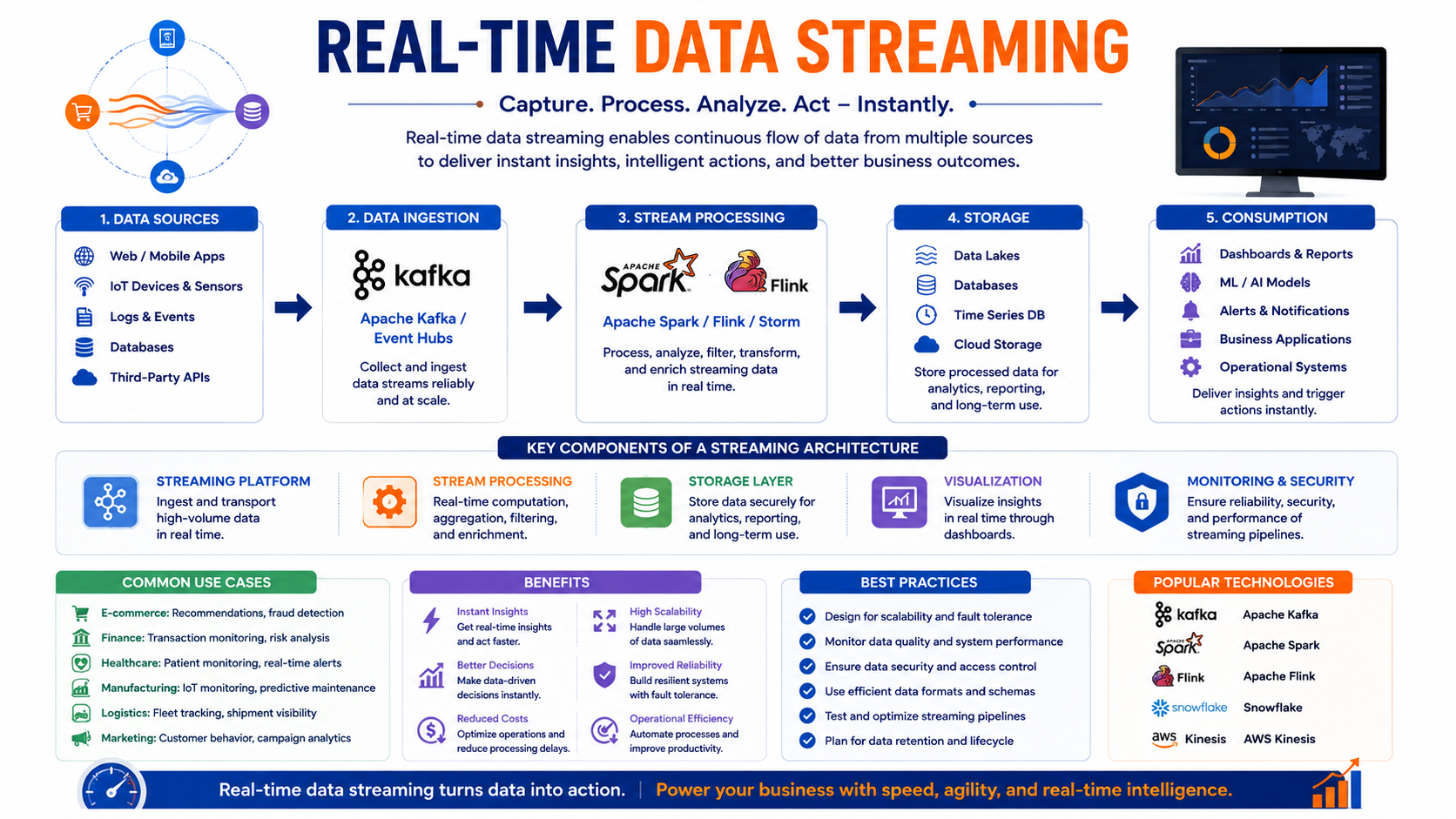
Real-time data streaming answers these questions. It continuously captures, processes, and analyzes data as it flows moving insights from milliseconds after an event occurs to the systems that need them.
What Is Real-Time Data Streaming?
Real-time data streaming is the continuous collection, processing, and analysis of data as it's generated, enabling immediate insights and responsive decision-making. Unlike batch processing, which handles data in scheduled chunks, streaming processes each data point individually as it enters the system.
Streaming vs. Batch Processing
| Aspect | Real-Time Streaming | Batch Processing |
|---|---|---|
| Processing Model | Continuous, event-by-event | Scheduled in fixed intervals |
| Latency | Milliseconds to seconds | Hours to days |
| Data Freshness | Current state, always up-to-date | Snapshot from last run |
| Use Case | Fraud detection, live dashboards, personalization | Routine reports, historical analysis, data warehousing |
In streaming, data flows through a pipeline of producers (which publish events), brokers (which store and distribute events), and consumers (which process and analyze events). This architecture enables multiple consumers to process the same event for different purposes simultaneously a fraud detection service can analyze a transaction while an inventory service updates stock levels and a recommendation engine updates a customer profile.
The Four Layers of a Streaming Pipeline
A modern real-time data pipeline has four distinct layers:
1. Storage
Where data originates. A relational database like PostgreSQL handles transactions and serves as the source of truth. Every insert, update, and delete is recorded in a write-ahead log the starting point for everything downstream.
2. Streaming
How data moves. Apache Kafka captures changes from the database the moment they happen and distributes them to downstream consumers as events. Kafka's core design principle is decoupling: producers write events without knowing who will consume them, and consumers read events without touching the source system.
3. Analytics
Where data becomes answers. Two distinct engines cover the main use cases: ClickHouse handles OLAP workloads fast columnar queries, real-time aggregations, and time-series analysis. OpenSearch handles full-text search, log analytics, and observability. Both engines are designed for reads at scale, not transactional consistency.
4. Visualization
How the answers reach people. Grafana connects to analytics engines, pulling from live data to power dashboards, alert panels, and operational monitors.
The Data Flow
Change Data Capture (CDC) reads your database's internal write log and turns each modification into a stream of structured events. In PostgreSQL, this works through logical replication a connector reads the write-ahead log and emits each change as a structured event with the full before and after state of the row.
Why Real-Time Streaming Matters
Immediate Insights and Faster Decisions
One of the primary benefits of real-time data streaming is the ability to gain immediate insights from data as it is generated. This enables organizations to make faster, more informed decisions in environments like financial markets, where rapid responses can mean the difference between profit and loss, or in cybersecurity, where suspicious activity must be addressed immediately.
Agentic AI and Autonomous Action
The agility enabled by real-time data is amplified when paired with agentic AI. Agentic AI leverages real-time data to support fast, autonomous real-world decision-making identifying and responding to cybersecurity threats or adjusting shipping routes during traffic delays.
Fresh Information for Accurate Insights
Fresh information can yield more accurate insights, especially in situations where even hours-old data could be considered stale whether in healthcare or stock trading. With incoming real-time data, businesses are empowered to make decisions for operational efficiency, such as identifying and addressing production bottlenecks.
Real-World Applications
E-Commerce Order Processing
When a customer clicks "Buy Now," the web application publishes an "OrderPlaced" event to a Kafka topic. Multiple consumers process the same event for different purposes: a fraud detection service analyzes the order for suspicious patterns, an inventory service reserves products, a recommendation engine updates the customer's profile, and an analytics pipeline computes real-time sales metrics.
Financial Market Analytics
StockHouse demonstrates real-time market analytics using ClickHouse, ingesting live market data from WebSocket APIs and visualizing it in a dashboard that updates within milliseconds. It's designed to handle high-frequency, high-volume data end-to-end: ingestion, storage, aggregation, and real-time visualization.
The Stream Processing Challenge
Exactly-Once Semantics
Ensuring each event is processed exactly once is difficult. If a consumer processes an event and crashes before committing its offset, the event might be processed twice on restart potentially double-charging a customer. Many systems settle for at-least-once delivery, requiring idempotent processing logic to handle duplicates safely.
State Management
Computing aggregations, joins, or complex patterns requires maintaining state across many events. Calculating a 30-day rolling average of user activity requires storing activity counts for each user and updating them as new events arrive. This state must be durable, consistent, and recoverable after failures.
Ordering Guarantees
While individual partitions in systems like Kafka maintain order, processing events across partitions or in distributed consumers can result in out-of-order processing. Applications must decide whether strict ordering is necessary and design accordingly.
Implementation Roadmap
Phase 1: Foundation (Weeks 1-4)
-
Identify streaming use cases: Where is stale data costing your business? Fraud detection, dynamic pricing, and operational monitoring are high-value starting points.
-
Map event sources: Document where events originate applications, databases, IoT sensors, and external APIs. This is your source inventory.
-
Select a streaming platform: Kafka for high-throughput streaming, managed services (AWS Kinesis, Azure Event Hubs) for reduced operational overhead, or cloud-native brokers like Redpanda.
Phase 2: Build the Pipeline (Weeks 5-8)
-
Implement CDC: Configure change data capture from your source database. Debezium integrated with Kafka Connect is the common pattern.
-
Set up streaming infrastructure: Deploy Kafka or your chosen platform. Configure topics, partitions, and retention policies based on your event volume.
-
Build initial consumers: Start with one high-value consumer fraud detection, real-time inventory, or operational monitoring.
Phase 3: Operationalize (Weeks 9-12+)
-
Add analytics layer: Deploy ClickHouse for fast columnar queries or OpenSearch for full-text search and observability.
-
Implement observability: Monitor consumer lag, processing latency, and error rates. Set up alerts for pipeline failures.
-
Scale consumers: Add additional consumers for new use cases. Add new use cases without modifying producers or existing consumers.
Frequently Asked Questions
Q1: How is real-time streaming different from batch processing?
Real-time streaming processes each event as it arrives, enabling millisecond response times. Batch processes data in scheduled intervals, creating latency between event generation and action. Use streaming when stale data costs you money; use batch for routine reporting and historical analysis.
Q2: What is Change Data Capture (CDC)?
CDC reads your database's internal write log and turns each modification into a stream of structured events. In PostgreSQL, this works through logical replication a connector reads the write-ahead log and emits each change as a structured event with the full before and after state of the row.
Q3: What's the difference between event streaming and real-time data streaming?
The difference is subtle. Event streaming captures events from various sources and transports them for immediate processing. Real-time data streaming includes event streaming and adds continuous processing and analysis. The solutions for both are the same—Apache Kafka, Amazon Kinesis, and other streaming platforms are also known as event streaming platforms.
Q4: What's the role of ClickHouse in streaming?
ClickHouse handles OLAP workloads fast columnar queries, real-time aggregations, and time-series analysis over millions of rows per second. It ingests directly from Kafka topics, materializes views that dashboards query in milliseconds, and handles aggregations over hundreds of millions of rows without breaking a sweat.
Q5: How can Innovative AI Solutions help?
We help organizations design, build, and operationalize real-time streaming architectures from use case identification and platform selection to pipeline implementation and agentic AI integration. Based in Delhi, serving clients across India.
Why Delhi is a Great Hub for Real-Time Data Innovation
Delhi is emerging as a hub for real-time data and AI innovation, backed by a thriving IT services ecosystem and a growing focus on real-time analytics in fintech, e-commerce, and logistics. As Indian enterprises adopt event-driven architectures, real-time streaming has become a critical capability for maintaining competitive advantage.
What We Offer at Innovative AI Solutions
-
Streaming Strategy: We help you identify high-value use cases and design a streaming architecture roadmap
-
Platform Selection: We help you choose Kafka, managed services, or cloud-native solutions
-
Pipeline Implementation: We help you build end-to-end streaming pipelines with CDC, analytics, and visualization layers
-
Observability: We help you monitor consumer lag, processing latency, and pipeline health
Final Thought
The shift is clear: from batch processing to real-time streaming, from scheduled reports to continuous insights. Organizations that master real-time data streaming will be the ones that can respond to threats instantly, personalize experiences dynamically, and make decisions at the speed of the market. The technology is mature, the patterns are proven, and the use cases are multiplying.
Contact Us:
Phone: +91 7464 099 059 / +91 9689967356
Email: info@innovativeais.com
Address: Netaji Subhash Place, Pitampura, Delhi – 110034
Website: https://innovativeais.com
About the Author
Abhishek Kumar
Founder & CEO, Innovative AI Solutions
5+ years building AI, data, and enterprise systems. Based in Delhi, serving clients across India.
Related services: to apply this in your business, explore our AI development services and AI agent development.