The Big Question
Where are Indian businesses actually investing in technology in 2026?
Not the headlines. Not the vendor pitches. The real budget allocations.
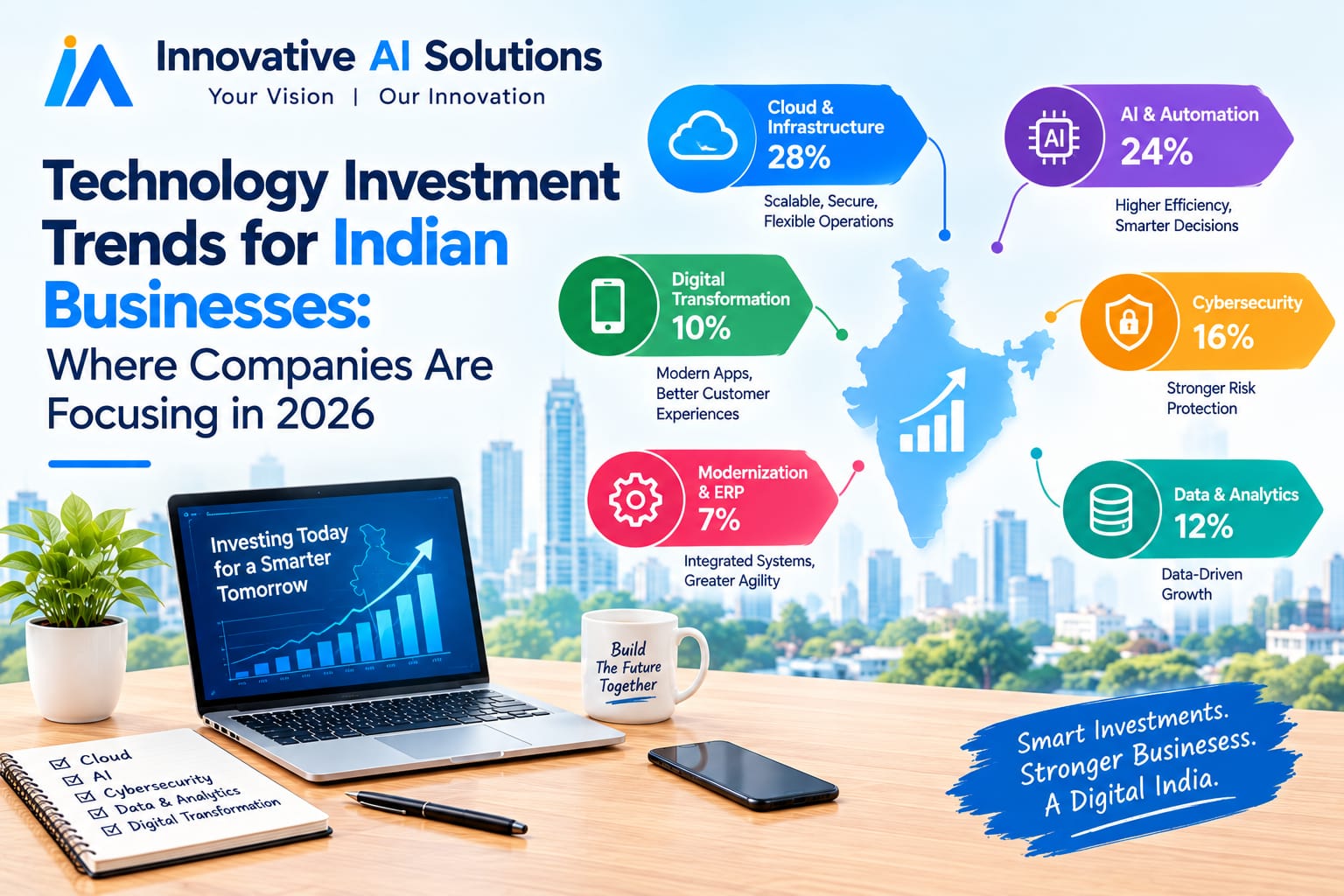
The answer is clear from the data: Indian enterprises are spending more than their global peers, allocating more to capital expenditure, and directing the largest share of new investment toward AI platforms, data foundations, and cybersecurity.
Bain & Company's India Enterprise Technology Report 2026 reveals that Indian enterprises are expected to increase annual technology spend as a percentage of revenue by 6%–8% in 2026, outpacing the 4%–6% increase expected among global peers . More than 70% of CIOs surveyed are planning 5%–20% increases in technology spend .
But the more important story isn't how much is being spent. It's where and whether that spending delivers value.
Only 15% of business leaders view IT as truly strategic, while 70% rate it as "good, but not great" . The gap between investment and realized value is the defining challenge of 2026.
Where the Money Is Going: The Capex Shift
Indian enterprises are making a decisive shift toward capital expenditure. Roughly 50-60% of technology budgets are directed toward capex, compared to 20-30% among global peers . Indian firms are spending 2.5-3x more on technology capex than global peers .
This isn't incremental spending. It's structural.
The allocation tells the story :
AI platforms and data modernization: 30% of capex. The largest single category. Enterprises are building the foundations for AI at scale—unifying data, connecting systems, and enabling real-time digital interactions.
Core application modernization: 25% of capex. End-of-life ERP systems are being re-platformed. Legacy cores are being thinned. Technical debt is being addressed—though 72% of CIOs still cite legacy tech debt as the top barrier to transformation .
Cloud and IT infrastructure: 25% of capex. AI-ready infrastructure—GPUs, high-performance compute, high-speed networking—is driving data center investments. The data center systems segment is forecast to grow 20.5% in 2026, the highest growth rate across all IT categories .
Cybersecurity: 20% of capex. Roughly half of CIOs identified cybersecurity modernization as a core focus. Spending is directed at countering next-generation, AI-powered threats .
Approximately 40% of 2026 technology budgets are allocated to change initiatives, with 40-45% of that change spend focused on AI and data-led transformations .
AI: The Dominant Investment Theme
AI has moved from experiment to infrastructure.
Approximately 60% of CIOs identified agentic AI and digital capability development as core priorities . Roughly 30% of technology capex will be directed toward AI platform development, including enterprise roadmaps for process reimagination across product development, supply chain, customer experience, and IT .
The Moneycontrol-Deloitte CXO Survey confirms the intensity. 27.7% of executives expect a significant increase in AI-related spending, while 55.3% anticipate a slight increase. None indicated a cutback .
AI funding is following the same trajectory. Indian AI startups raised $1.07 billion in the first half of 2026**, up 33% from the same period last year. For the full year 2025, Indian AI startups raised **$1.6 billion .
The largest single investment went to Sarvam AI, a full-stack sovereign AI startup that raised $234 million** . Agentic AI development startup **Emergent Labs** raised **$70 million .
Infrastructure is also attracting capital. Neysa AI, a Mumbai-based AI infrastructure company, secured a $1.2 billion investment led by Blackstone one of the largest single AI infrastructure raises in India to date . This signals institutional confidence in AI cloud and GPU-backed infrastructure as a scalable asset class .
But the AI investment isn't just about models. It's about foundations. More than half of Indian CIOs (52%) cited data modernization as an immediate priority to enable data-as-a-product and lay the foundation for future AI efforts .
Cloud: AI-Ready Infrastructure Takes Center Stage
India's public cloud spending is forecast to reach $17.5 billion in 2026, growing 28.1% year-on-year . But the nature of cloud spending has changed.
The focus has shifted from migration to platform-led execution. IaaS is projected to grow 40%, driven by demand for AI-ready infrastructure GPUs, high-performance compute, high-speed networking, scalable storage, and always-on inference capacity .
PaaS is the largest spending category at $6.4 billion, as enterprises rebuild their technology foundations to support AI-driven initiatives. Growth is driven by organizations unifying data, connecting systems, and enabling real-time digital interactions .
SaaS growth is more moderate, reflecting its established adoption base. Enterprises are optimizing licenses and shifting incremental spending toward infrastructure and platform capabilities .
The cloud challenge for 2026 is governance of increasingly complex hybrid, multicloud, and AI-enabled environments. Gartner predicts that by 2030, over 60% of enterprises will perform intensive AI model activity in one cloud but leverage it with their data in another, up from less than 10% today .
Cybersecurity: Identity-First Defense Emerges
Information security spending in India is projected to reach $3.4 billion in 2026, up 11.7% from 2025 . But the focus has shifted.
Identity-based attacks credential compromise and deepfake-enabled fraud are expanding the threat surface. Identity threat detection and response (ITDR) is becoming a core priority, reinforced by the requirements of the Digital Personal Data Protection (DPDP) Act .
Security software spending is being driven by endpoint protection platforms (EPP) and security information and event management (SIEM). Cloud security is expanding to cover AI-specific configurations and runtime requirements .
Managed security services are the fastest-growing subsegment, with an estimated growth rate of 15.1%. Indian enterprises are adopting managed detection and response (MDR) as a scalable, cost-efficient way to navigate cyber complexity .
The rise of agentic AI is exposing gaps in traditional identity and access management. Organizations need clearer identity registration and governance for machine actors, automated credential lifecycle management, and policy-based authorization designed specifically for AI agents .
The Execution Gap: Spending Without Value
Despite record investments, a significant gap remains between spending and realized business value.
Only 15% of business leaders see current IT spending as truly strategic . Approximately 90% of leaders believe current data and AI capabilities can't support enterprise-scale scaling .
The barriers are consistent :
Legacy tech debt: Cited by 72% of CIOs as the top barrier to transformation.
Skill shortages: 57% cite shortages in next-generation domains as a critical constraint.
Unproven ROI: 49% point to unproven returns from new-age technology initiatives as a barrier to scaling.
Bain's advice is direct: technology leaders must reset operating models, talent strategies, and supplier engagement models—and start treating technology portfolios as business builders rather than cost centers .
The organizations that succeed will measure technology investments by results linked to growth, efficiency, and profit, not just completion milestones .
The GCC Shift: Capability Centers, Not Cost Centers
Global Capability Centers are evolving. The next wave isn't driven by large multinationals seeking cost savings. It's driven by private equity backed and mid market companies building advanced capabilities in AI, engineering, and product development .
India has more than 500 GCCs owned or acquired by PE-backed companies, with nearly 31% of new GCC additions coming from this segment between FY21 and FY26 .
These centers are being established with ownership of product engineering, cybersecurity, platform development, and AI initiatives from inception not traditional support functions .
PE-backed GCCs typically start with lean teams of 20-25 employees in the first year, before reaching an average headcount of about 70 .
"The first GCC wave was built on scale," said Amita Goyal of Zinnov. "The next wave will be driven by speed, focus and capability ownership" .
What This Means for Your Business
For enterprise leaders:
The investment cycle is strong, but spending alone won't deliver value. The organizations that thrive will be those that fix data foundations, address legacy debt, and measure outcomes not activity. Start with data modernization. Build the AI platform incrementally. Don't let technical debt compound while you chase AI.
For mid-market and SMB leaders:
The capex-heavy approach of large enterprises may not apply. Focus on targeted AI investments that solve specific problems. Use cloud for scale. Use managed security services for protection. Prioritize data quality in the workflows you automate.
For everyone:
The gap between investment and value is real. 72% cite legacy tech debt as the top barrier . 90% say data and AI capabilities can't support scale . These are execution problems, not technology problems. The winners will be those who redesign processes, not just deploy tools.
Frequently Asked Questions
Q1: How much are Indian enterprises spending on technology in 2026?
Indian enterprises are expected to increase technology spend as a percentage of revenue by 6-8%, outpacing the 4-6% increase among global peers. More than 70% of CIOs plan 5-20% increases in technology spend .
Q2: Where is the largest share of technology capex going?
AI platforms and data modernization account for approximately 30% of capex. Other major categories include application modernization (25%), cloud and infrastructure (25%), and cybersecurity (20%) .
Q3: How much are Indian businesses spending on cloud in 2026?
Public cloud spending is forecast to reach $17.5 billion**, growing **28.1%**. IaaS is growing **40%**, and PaaS is the largest category at **$6.4 billion .
Q4: What is driving cybersecurity spending in India?
Sophisticated AI-driven threats and tighter regulatory requirements. Identity-based attacks and the DPDP Act are driving identity-first security. Information security spending will reach $3.4 billion in 2026, up 11.7% .
Q5: What is the biggest barrier to technology transformation in India?
Legacy tech debt, cited by 72% of CIOs. Other barriers include skill shortages (57%) and unproven ROI (49%) .
Q6: Why do many Indian enterprises struggle to see ROI from technology investments?
Only 15% of business leaders view IT as truly strategic. 90% say data and AI capabilities can't support enterprise-scale scaling. The challenge is execution misalignment between business and IT, gaps in data foundations, and outdated operating models .
Q7: How much are Indian AI startups raising in 2026?
Indian AI companies raised $1.07 billion in H1 2026**, up **33%** from **$802 million a year earlier. For all of 2025, AI startups raised $1.6 billion .
Q8: What is the GCC shift in India?
Global Capability Centers are evolving from cost centers to capability centers. PE-backed and mid-market companies now account for 31% of new GCC additions. These centers build AI, engineering, and product capabilities not just support functions .
Q9: What is the outlook for IT spending in India?
India's IT spending is projected to surpass $176 billion in 2026, growing 10.6%. Data center systems will grow 20.5%, the highest across all categories .
Q10: What should businesses prioritize in 2026?
Data modernization first. AI platforms incrementally. Cybersecurity continuously. Outcome measurement relentlessly. The winners will be those who measure technology by business impact, not delivery milestones .
Frequently Asked Questions (Continued)
Q11: How does India's tech spending compare to global peers?
Indian enterprises are expected to spend 2.5-3x more on technology capex than global peers. 50-60% of tech budgets go to capex, compared to 20-30% globally .
Q12: What is the DPDP Act, and how is it affecting security spending?
The Digital Personal Data Protection Act imposes consent-first processing, algorithmic due diligence, and breach notification requirements. It's driving identity-first security and ITDR adoption .
Q13: What is agentic AI, and why are CIOs prioritizing it?
Agentic AI refers to systems that plan, execute, and adapt not just respond. 60% of CIOs identified agentic AI as a core priority. 30% of capex is directed toward AI platform development .
Q14: How are Indian companies addressing skill shortages?
Through GCCs, managed services, and academic partnerships. Companies are partnering with IITs and universities to build AI and deep-tech research hubs .
Q15: Why should I choose Innovative AI Solutions?
Because we focus on practical AI that delivers measurable outcomes. Because we understand that data foundations matter more than models. Because your code is always yours.
Contact Us
Phone:
+91 7464 099 059
+91 9689967356
Email:
info@innovativeais.com
Address:
9th Floor, Pearls Best Heights-I,
Head Office: 904, Netaji Subhash Place,
Delhi – 110034