The Big Question
What will separate thriving Indian businesses from struggling ones in 2027?
It's not access to technology. That's become commoditized. Cloud platforms are everywhere. AI models are open-sourced. Compute is available through the IndiaAI Mission at subsidized rates.
The differentiator is execution.
Indian enterprises have spent the past three years experimenting with AI. Pilots. Proofs-of-concept. Innovation labs. The experimentation phase is ending. According to EY's AIdea of India report, nearly half of surveyed organizations said more than a fifth of their AI proofs-of-concept have already crossed into production, while 24 percent reported active deployment of agentic AI systems .
The question for 2027 isn't "should we adopt AI?" It's "how do we operationalize it?"
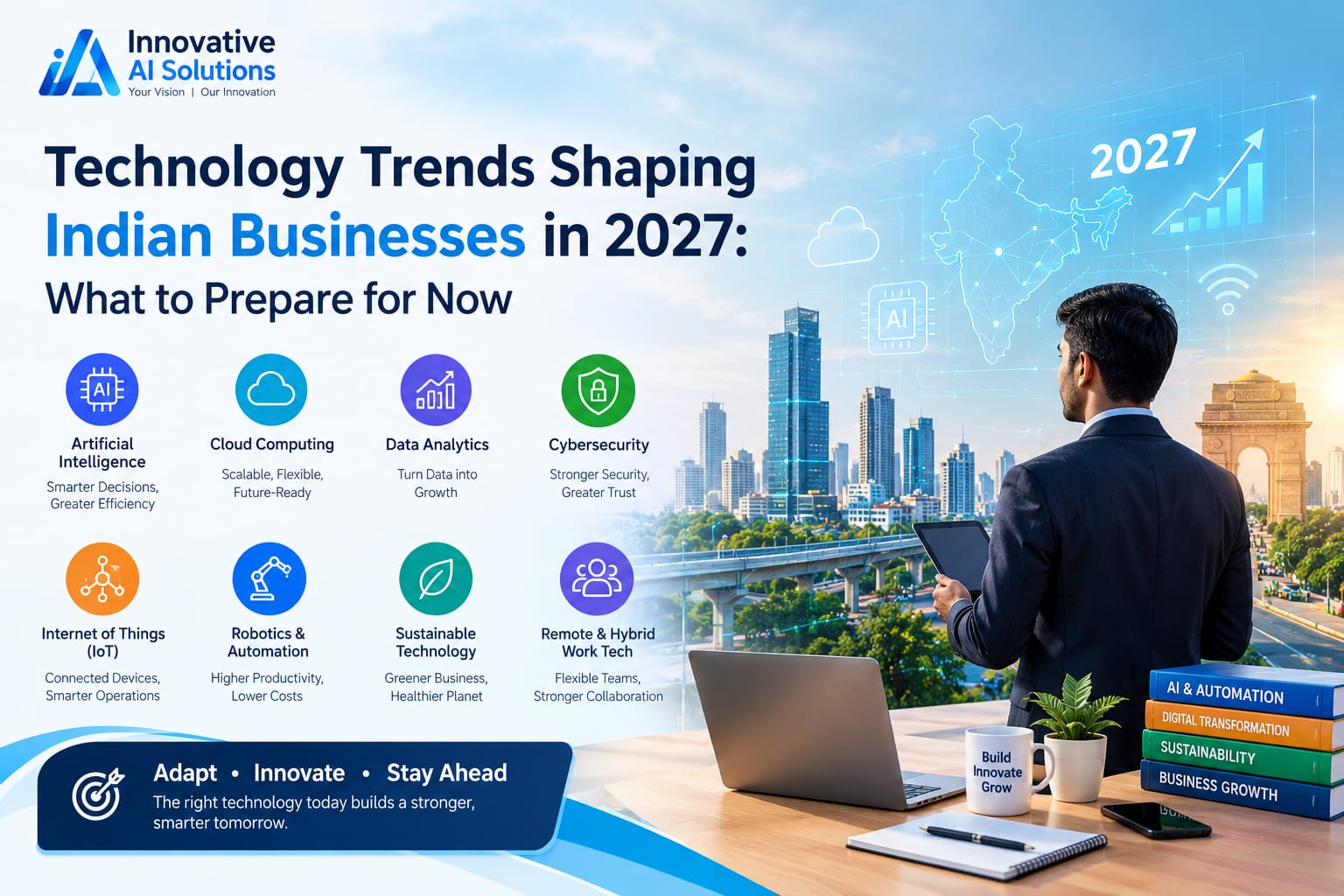
This guide covers the trends that matter—not the hype cycles, but the shifts that will actually affect how you run your business. From agentic AI to cloud economics to the governance requirements you can't ignore, here's what to prepare for now.
Trend 1: Agentic AI Moves from Pilot to Production
The most significant shift for 2027 is the transition from AI assistants to AI agents.
The difference matters. An assistant waits for instructions. An agent understands intent, accesses data across systems, and executes resolutions autonomously. It doesn't just suggest a response—it handles the workflow.
The adoption data is striking. SAP's Value of AI Report 2026 found that 67% of Indian organizations are already piloting agentic AI use cases, while 85% believe the technology has significant potential to transform business operations . Agentic AI investment is projected to increase fivefold over the next two years .
Tata Steel deployed 300+ AI agents across operations within nine months, moving beyond isolated use cases into enterprise-wide orchestration . Wipro launched a dedicated AI-Native Business & Platforms Unit focused on enterprise-scale agentic deployments .
But here's the gap: while 54% of Indian organizations are deploying AI agents, only 11% have moved to autonomous workflows . The hesitation is understandable. Letting AI act independently—especially with access to company data and decision-making systems—requires trust, governance, and safeguards that most organizations haven't built yet.
What to prepare for now: Start with bounded agents that handle well-defined workflows with human approval gates. Build the governance layer before you scale autonomy. The organizations that master agent orchestration in 2026 will have a significant advantage in 2027.
Trend 2: Cloud Spending Surges—and Gets More Complex
India's cloud market is booming. Gartner forecasts end-user spending on public cloud services in India to grow **28.1% to $17.5 billion in 2026**, up from $13.7 billion in 2025 .
But the nature of cloud spending is changing. The focus has shifted from migration to platform-led execution. IaaS is projected to grow 40%, driven by demand for AI-ready infrastructure—GPUs, high-performance compute, and always-on inference capacity . PaaS is the largest spending category at $6.4 billion, as enterprises rebuild their technology foundations to support AI-driven initiatives .
The architecture is also becoming more complex. Forrester's research found that 96% of Indian enterprises operate a hybrid cloud strategy, placing workloads across public cloud, private cloud, and on-premises systems . 67% have established FinOps practices, and another 18% plan to adopt one within the next year .
Gartner predicts that by 2030, over 60% of enterprises will perform intensive AI model activity in one cloud but leverage it with their data in another, up from less than 10% today .
What to prepare for now: Cloud adoption is no longer the goal. Disciplined execution is. Prioritize AI-ready data infrastructure, FinOps maturity, and dynamic workload placement across hybrid environments. Don't assume public cloud is always the answer—workload placement should be driven by cost, performance, and compliance requirements.
Trend 3: AI Governance Becomes Non-Negotiable
The governance gap in Indian enterprises is significant.
ServiceNow's Enterprise AI Maturity Index 2026 found that only 22% of Indian enterprises have processes in place for testing, auditing, and assessing AI-related risks . India's overall AI governance score stands at 55 out of 100, well below the 78 scored by APAC's AI Pacesetters .
This gap is becoming a business risk. Transparency and misinformation concerns are cited by 60% of organizations, regulatory complexity by 55%, and data privacy by 50% .
The regulatory environment is also tightening. The DPDP Act and its rules, the AI Governance Guidelines launched at the February 2026 AI Impact Summit, and the IndiaAI Safety Institute are creating a formal compliance framework .
Gartner's prediction is telling: by 2030, insurers—not regulators—will drive AI governance, as strict underwriting standards for AI liability insurance push organizations to embed operational controls directly into AI systems . By 2030, 80% of the Global 500 will contractually designate their CIO or chief AI officer as the "Evidence Custodian" responsible for AI accountability .
What to prepare for now: Build governance into your AI systems from day one. Not as a compliance checkbox, but as an enabler of scale. Define who is accountable for AI decisions. Implement audit trails. Test your controls in real environments. The organizations that can demonstrate responsible AI will be the ones allowed to scale it.
Trend 4: AI Cost Management Becomes a Discipline
AI isn't free. And the costs are becoming harder to ignore.
Gartner predicts that by 2029, 60% of organizations deploying AI will establish a dedicated function responsible for mapping AI total cost to value . By 2028, 60% of Global 500 companies will embed AI FinOps controls at inference, shifting cost governance from retrospective reporting to real-time optimization .
The threat isn't just internal. Gartner warns of "cost exhaustion attacks" —where malicious actors deliberately drive excessive AI usage to inflate operational costs. By 2030, 80% of organizations with public-facing AI are expected to have experienced such an attack .
What to prepare for now: Treat token consumption as both a cost management and security concern. Implement runtime cost controls. Monitor usage patterns. Build in step limits and cost ceilings for agents. The organizations that can tie AI spending to measurable business outcomes will have a sustainable advantage.
Trend 5: The Skills Gap Widens and Workforce Transformation Becomes Priority
The talent challenge is intensifying.
SAP's study found that 80% of Indian organizations believe maximizing AI value requires workforce transformation beyond upskilling alone . Yet almost 8 in 10 organizations are not convinced their upskilling can keep up with AI advancements .
The skills shortage is real. ServiceNow found that only 18% of Indian organizations have replaced fragmented legacy systems with an integrated platform, and AI-enabled workflows scored just 41 out of 100 .
But there's a positive signal. Salesforce's research found that 69% of employees using AI agents report a positive career outlook, compared to 12% of non-users . Workers with AI skills see reduced repetitive work and more opportunities for specialization.
What to prepare for now: Invest in workforce transformation, not just training. Redesign roles around human-agent collaboration. Build career paths for employees who work alongside AI. The organizations that treat AI as an augmentation tool—not a replacement—will attract and retain better talent.
Trend 6: Physical AI and Disposable Applications Emerge
Two trends on the horizon will reshape how businesses operate.
Physical AI extends AI into the physical world robots, drones, autonomous vehicles. Gartner predicts that by 2030, 80% of front-line workers employed by international companies will be assisted by physical AI systems . Manufacturing, logistics, and utilities are early adopters.
Disposable applications represent a new software lifecycle. By 2029, Gartner predicts 80% of new applications will be intentionally disposable—built for use cases lasting less than a year . AI is making development accessible enough for non-technical staff to create temporary tools. This creates governance, compliance, and records management challenges.
What to prepare for now: For physical AI, start with safety first pilots in controlled environments. For disposable apps, establish risk-based governance frameworks and automated registries to monitor business-created applications. Don't let uncontrolled proliferation create security and compliance risks.
What This Means for Your Business
Let me distill this into actionable priorities.
If you're a small or medium business in India:
The MSME sector is accelerating. 57% of MSMEs view AI as central to growth, and 25% have already integrated AI . The Digital Maturity Index rose to 60.8, up from 55.9 in 2023 . 46.3% have adopted cyber defence solutions .
Your priority: Start with one AI use case that solves a real problem. Don't wait for the perfect strategy. The MSMEs that are moving now will have a compounding advantage.
If you're an enterprise:
The gap between AI leaders and laggards is widening. APAC Pacesetters are generating 149% ROI from AI, expected to rise to 181% . They are six times more productive than their peers.
Your priority: Close the governance gap. Only 22% have AI risk processes. Build the controls that let you scale safely. Invest in data quality and legacy modernization—74% say data accuracy needs strengthening .
For everyone:
The experimentation phase is over. The operationalization phase has begun. The organizations that thrive in 2027 will be those that can move from pilot to production, from AI assistants to AI agents, from cost surprises to cost discipline.
Frequently Asked Questions
Q1: What is agentic AI, and why does it matter for 2027?
Agentic AI refers to AI systems that can act autonomously—planning multi-step workflows, using tools, and executing resolutions without constant human prompting. It matters because it shifts AI from "assistant" to "collaborator," enabling automation of complex processes that were previously impossible.
Q2: How much are Indian enterprises investing in AI?
Indian enterprises plan to invest $25.9 million in AI, with spending expected to grow 45% over the next two years . AI now accounts for 16.6% of average IT budgets, expected to rise to 21.3% by 2027 .
Q3: What is the biggest barrier to AI adoption in India?
Governance and data quality. Only 22% of enterprises have AI risk assessment processes. 74% say data accuracy, access, and management need strengthening . Transparency concerns are cited by 60% of organizations .
Q4: What is hybrid cloud, and why is it important?
Hybrid cloud means placing workloads across public cloud, private cloud, and on-premises systems based on business and regulatory needs. 96% of Indian enterprises operate hybrid cloud strategies . It matters because not all workloads belong in public cloud sensitivity, cost, and performance requirements vary.
Q5: What is FinOps, and why does it matter?
FinOps is a practice centered on cloud cost visibility and accountability. 67% of Indian enterprise cloud decision-makers have established FinOps practices, with another 18% planning to adopt one . It matters because AI is driving up cloud spending—and without discipline, costs spiral.
Q6: How will AI change customer service in India?
Salesforce predicts that by 2027, AI will handle 50% of customer service cases in India, up from 30% today . Agentic AI will autonomously handle routine cases, while employees focus on strategic work.
Q7: What are "cost exhaustion attacks"?
Cost exhaustion attacks occur when malicious actors deliberately drive excessive AI usage to inflate operational costs. Gartner predicts 80% of organizations with public-facing AI will experience such an attack by 2030 .
Q8: What is the skills gap in Indian AI adoption?
80% of organizations believe workforce transformation beyond upskilling is required for AI value. Nearly 8 in 10 are not convinced their training can keep pace with AI advancements . Only 11% feel fully prepared on skills, and 14% on processes .
Q9: What should small businesses do now?
Start with one AI use case. The MSME Digital Maturity Index is rising—60.8 in 2026, up from 55.9 in 2023 . 57% of MSMEs view AI as central to growth, and 25% have already integrated it . Don't wait for perfect strategy.
Q10: What is the ROI of AI for Indian enterprises?
APAC Pacesetters are generating 149% ROI from AI, expected to rise to 181% over the next two years . They are six times more productive than peers. But these returns require governance, data quality, and workforce transformation.
Frequently Asked Questions (Continued)
Q11: What is the IndiaAI Mission?
The IndiaAI Mission is a government initiative expanding access to AI infrastructure and affordable compute across enterprises, public sector organizations, and mid-market institutions. It aims to democratize AI capabilities beyond large enterprises .
Q12: How is DPDP Act affecting AI adoption?
The Digital Personal Data Protection Act requires consent-first processing, algorithmic due diligence for significant data fiduciaries, and breach notification. AI systems processing personal data must be built with compliance from day one .
Q13: What are "disposable applications"?
Gartner predicts that by 2029, 80% of new applications will be intentionally disposable built for use cases lasting less than a year. AI is making development accessible enough for non-technical staff to create temporary tools .
Q14: What is physical AI?
Physical AI extends AI into the physical world through robots, drones, autonomous vehicles, and embodied systems. Gartner predicts 80% of front-line workers at international companies will be assisted by physical AI by 2030 .
Q15: What should enterprises prioritize for 2027?
Close the governance gap. Invest in data quality and legacy modernization. Build FinOps maturity. Redesign roles around human-agent collaboration. The organizations that move from experimentation to disciplined execution will outperform.
Contact Us
Ready to prepare your business for 2027? Let's talk.
Phone:
+91 7464 099 059
+91 9689967356
Email:
info@innovativeais.com
Address:
9th Floor, Pearls Best Heights-I,
Head Office: 904, Netaji Subhash Place,
Delhi – 110034