The Big Question
What happens when your digital workplace no longer forces you to juggle separate apps for documents, communication, project management, and data analysis? What if a single AI-powered workspace understood your context, anticipated your needs, and orchestrated the work across tools automatically? And what if the workspace itself could think, act, and evolve alongside your team?
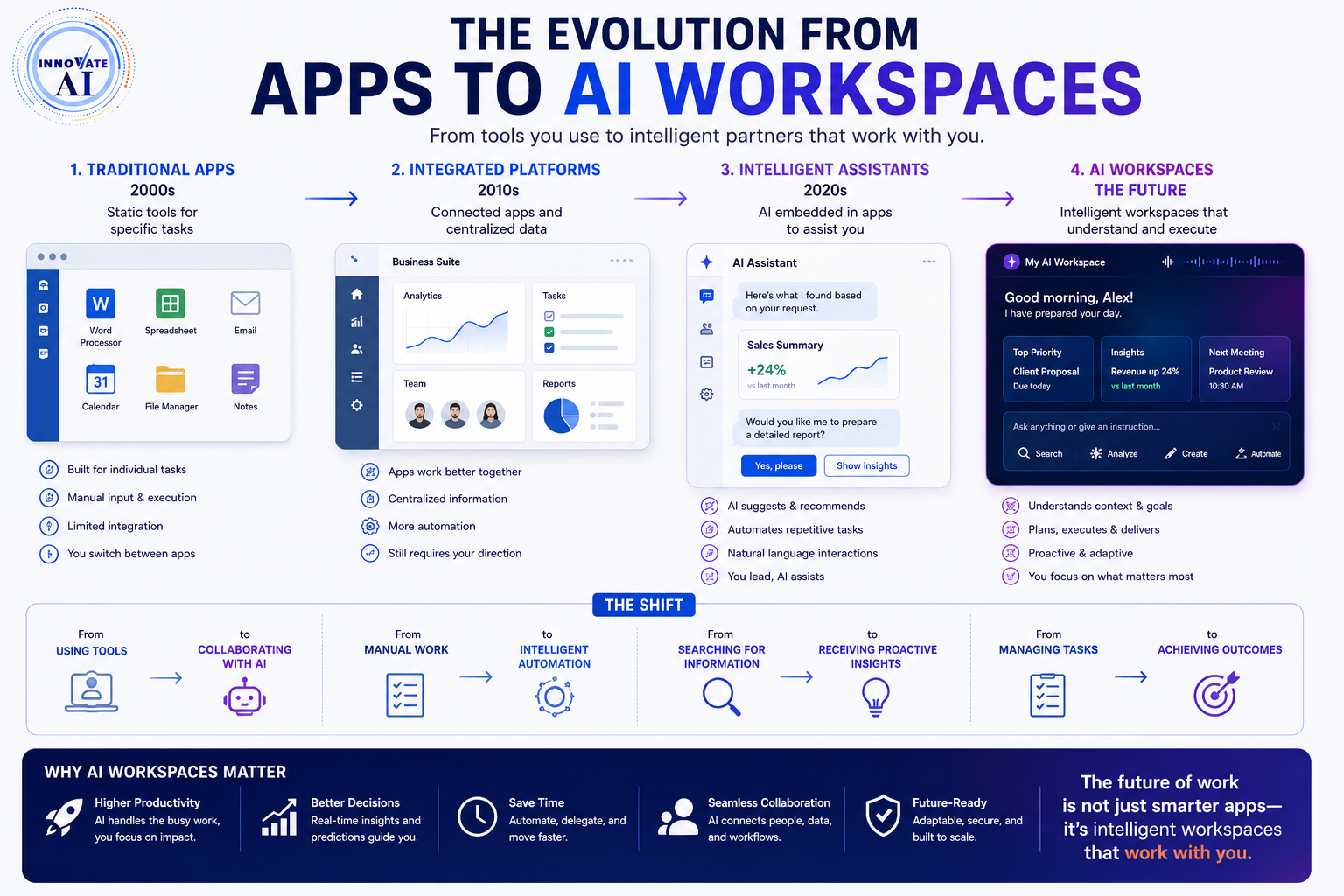
The transition from apps to AI workspaces is already underway. And it's redefining everything about how knowledge work gets done.
The App-Centric Era: Why It's Breaking
For over two decades, the enterprise software landscape has been defined by fragmentation. The average knowledge worker switches between apps 1,100 times per day. Employees spend a quarter of their workweek searching for information. Teams juggle documents in one app, chat in another, project tracking in a third, and data analysis in a fourth.
The consequences are well-documented:
-
Lost context: Conversations and decisions are scattered across threads, making it impossible to maintain continuity
-
Cognitive overload: Tool-switching drains focus and energy
-
Repeated work: Teams duplicate efforts because they can't find existing solutions
-
Fragmented institutional knowledge: When people leave, their context leaves with them
As one industry observer noted, "Tools designed to boost productivity were creating productivity debt".
Satya Nadella captured the fundamental problem: "Business applications are essentially CRUD databases with a bunch of business logic. In the agent era, all of that collapses".
What Is an AI Workspace?
An AI workspace is a connected environment where AI agents are core participants—not add-ons—in how work gets organized and executed. Unlike traditional productivity suites, AI workspaces:
-
Unify tools and information: Files, messages, and projects live in a single cohesive space with context preserved across functions
-
Embed intelligence in workflows: The AI layer understands your projects, documents, and conversations—making connections and surfacing what matters most
-
Enable agentic execution: AI agents don't just suggest—they execute. They plan, coordinate, and carry out multi-step workflows across enterprise systems
-
Compile institutional memory: Every interaction, decision, and file is automatically stored and structured for easy retrieval
As Gartner puts it, AI workhubs represent "the use of artificial intelligence to enhance content creation and automate workplace tasks, decision making and collaboration, increasing efficiency and effectiveness for employees".
The New Architecture: From Apps to Orchestration Layers
Traditional software was built around predictable, static components: workflow builders, data entry forms, business logic rules, approval gates, and dashboards.
AI is transforming each of these primitives into something fundamentally different:
| Traditional Primitive | New AI Workspace Primitive |
|---|---|
| Workflow Builders (users design sequences) | Agentic Workflows (agents execute multi-step tasks from intent) |
| Data Entry (humans input structured data) | Automatic Ingestion (agents read emails, documents, APIs) |
| Business Logic (static rules maintained manually) | Self-Optimizing Policies (rules adapt from outcomes and edge cases) |
| Approvals (humans gatekeep every decision) | Decision Delegation (agents execute, escalate only when needed) |
| Dashboards (humans interpret charts) | Narrative Insights (agents explain what changed, why, and what to do) |
The shift is from "software that requires human-driven workflows to software that operates on behalf of humans".
The Players: Who's Building AI Workspaces
OpenAI: ChatGPT Work and the Super App Vision
OpenAI has taken its biggest step yet toward an enterprise AI workspace. ChatGPT Work, announced alongside GPT-5.6, brings coding, document creation, and workflow automation into a single interface.
The tool can "gather context from the apps, files and workflows users choose, then turn that information into finished outputs such as documents, spreadsheets, presentations and web applications".
OpenAI's strategy is clear: ChatGPT is no longer a chatbot—it's becoming a unified workspace where users can research, write code, generate documents, build websites, and automate workflows without leaving the application. The redesigned desktop app integrates Chat, Work, and Codex modes, with a unified plugins directory connecting to Slack, Gmail, Google Drive, calendars, and CRM platforms.
Anthropic: Claude Cowork
Anthropic introduced Claude Cowork, an autonomous AI agent designed to "plan and execute complex workplace tasks". Both OpenAI and Anthropic are targeting knowledge workers—not just developers—with increasingly capable AI agents that can:
-
Plan projects independently
-
Execute multi-step workflows
-
Work across enterprise software
-
Write code when required
-
Produce complete business outputs rather than individual responses
Beevibe: The Agent-Native OS
Beevibe describes itself as "the agent-native operating system for companies"—a shared workspace where people and AI agents work side by side. Key features include:
-
Persistent specialists: Each agent has an identity, domain, hierarchy level, and bounded memory that deepens across sessions
-
Agent-to-agent coordination: When an agent leaves its domain, it can ask another specialist for context
-
Human-in-the-loop control: Humans review, redirect, revise, and resolve blockers from the dashboard
-
BYO CLI: Each user runs their own AI coding tool on their own machine—your tools, your files, your tokens
Beevibe addresses a critical problem: individual AI tools make developers faster, but team coordination remains slow. "The problem isn't that the agents are too weak. The problem is that each person's AI work lives in a private bubble, and no shared intelligence compounds".
Taskade Genesis: Living Software Platform
Taskade Genesis represents one of the most ambitious visions: a platform where "one prompt becomes a system with memory, intelligence, and execution"—not a mockup or demo, but a working app that adapts and runs real workflows.
Genesis has generated over 150,000 apps from natural language prompts. It combines:
-
Workspace DNA: Memory (databases, documents), Intelligence (AI agents with 34 tools), and Execution (100+ integrations running 24/7)
-
15+ AI models (Claude, GPT, Gemini) working in multi-agent collaboration
-
Custom domains and password protection for deployed applications
Taskade's evolution mirrors the broader shift: from productivity tool (2017-2022) to AI assistance (2023-2024) to AI infrastructure (2025-2026).
Dropbox Dash
Dropbox Dash takes a different approach—turning "disconnected tools into connected progress". Key features include:
-
Universal Search: Spans Dropbox, Google Drive, Slack, and other tools—understanding meaning, not just keywords
-
Dash Chat: A conversational layer that summarizes meetings, extracts insights, and answers questions with links to relevant files
-
Dash Stacks: Group related files, links, and notes into shared hubs for projects
Miro and Gartner's $58B Prediction
Gartner predicts a $58 billion market shake-up by 2027 as organizations move toward a modular, "agent-focused" model. Miro positions itself as an "agentic orchestration layer"—where specialized platforms "intake, triage, and route work through agents and automated workflows".
The traditional productivity suite model is vulnerable because current licensing costs "will absolutely demand" change. As Gartner notes: "Relying solely on a monolithic ecosystem risks prioritizing vendor-driven continuity over innovation, creating a document-centric workflow trap that fails to deliver value commensurate with rising prices".
The Technology Stack: How AI Workspaces Function
Industry analysts break AI workspace architecture into four layers:
-
Intent Interface Layer: Where users describe outcomes
-
Planning Layer: Where agents decompose goals into action sequences
-
Execution Runtime Layer: Invokes APIs and tools, interacts with enterprise applications
-
Control Layer: Identity, governance, and auditability
Google's Workspace CLI serves as a prime example—dynamically generating commands from API discovery services, allowing agents to interact with Gmail, Drive, and Sheets on a user's behalf without custom integrations.
With Workspace Studio, any employee can build agents using natural language that orchestrate work across apps, "understanding the full context of work across the organization, matching company policies and generating content in the user's own tone and style".
The Trust and Governance Challenge
While the promise of AI workspaces is compelling, significant barriers remain.
The Reliability Gap
"Enterprise workflows require deterministic outcomes, while large language models are inherently probabilistic," warns one industry leader. More than 60% of enterprises are exploring AI agents, but less than a quarter have scaled them into production workflows.
Agents often fail when interacting with dynamic systems where interfaces shift, data schemas change, or permissions vary. Small errors compound quickly through iterative reasoning loops.
Three Non-Negotiables
Industry experts identify three critical requirements for enterprise AI workspaces:
-
Role-based permissions: Agents operate within defined policies
-
Full auditability and traceability: Every action is logged and reviewable
-
Human-in-the-loop oversight: Especially for high-impact decisions
The Lock-in Risk
"Whoever owns the agentic workspace layer may effectively own the operating system for knowledge work," creating "a new form of enterprise lock-in more complex than anything the SaaS era produced". Switching costs become compounding as organizations integrate deeply with libraries, governance structures, and connectors.
Implementation Roadmap: The First 90 Days
Phase 1: Foundation (Weeks 1-4)
-
Audit current tool fragmentation: Measure how much time employees spend switching between apps and searching for information
-
Identify high-value workflows: Which multi-step processes consume the most human effort and would benefit most from agentic automation?
-
Establish governance: Define permissions, audit requirements, and human oversight policies
-
Select starting point: Choose one team and one workflow for a pilot
Phase 2: Pilot and Learn (Weeks 5-8)
-
Deploy an AI workspace tool: Options include ChatGPT Work, Taskade, Miro, or Dropbox Dash depending on use case
-
Enable agentic execution: Start with bounded, low-risk workflows
-
Train on human-AI teaming: Teams learn to delegate tasks, review agent outputs, and maintain accountability
-
Measure impact: Track time saved, quality improvements, and adoption
Phase 3: Scale and Transform (Weeks 9-12+)
-
Expand to additional teams and workflows
-
Build institutional memory: Ensure all agent actions, decisions, and outputs are stored and searchable
-
Enable cross-team coordination: Agents begin collaborating across domains
-
Continuous optimization: Refine governance, models, and workflows based on real-world usage
Frequently Asked Questions
Q1: What is an AI workspace?
An AI workspace is a connected environment where AI agents are core participants in organizing and executing work—unifying tools, preserving context, and enabling autonomous execution.
Q2: What's the difference between an AI workspace and a traditional productivity suite?
Traditional suites are collections of separate apps (documents, spreadsheets, email, chat). AI workspaces have a unified intelligence layer that understands context across functions and can execute work autonomously.
Q3: What results are organizations seeing with AI workspaces?
Companies report tasks that took days now taking hours, 150,000+ apps generated from prompts, and Gartner predicting a $58B market shake-up by 2027.
Q4: What are the governance challenges with AI workspaces?
Key challenges include deterministic vs. probabilistic execution, role-based permissions, full auditability, human oversight for high-impact decisions, and the risk of new enterprise lock-in.
Q5: How can Innovative AI Solutions help?
We help organizations design, pilot, and scale AI workspace strategies—from platform selection and governance frameworks to workflow redesign and human-AI teaming. Based in Delhi, serving clients across India.
Why Delhi is a Great Hub for AI Development
Delhi is emerging as a significant hub for AI development, backed by concrete government support and infrastructure. The recent Delhi Budget 2026-27 allocated ₹8.20 crore for two Artificial Intelligence centres of excellence (AI-CoEs), functioning as hubs for research, innovation, and startup incubation.
The city's AI infrastructure is expanding rapidly. Under the IndiaAI Mission, more than 38,000 high-end GPUs have been onboarded and are available at approximately ₹65 per hour—roughly one-third of the global average cost.
The government has also announced a ₹350 crore startup policy over five years, aiming to support the emergence of at least 5,000 startups by 2035, with key focus areas including artificial intelligence, machine learning, and automation.
The AI ecosystem in Delhi combines: cost-effective infrastructure, government support, a growing talent pool, and proximity to the country's business decision-makers.
What We Offer at Innovative AI Solutions
After five years of building AI solutions for businesses, we've developed a practical approach that focuses on what actually works:
-
AI Workspace Strategy: We help you assess your tool fragmentation and design an AI workspace roadmap
-
Platform Selection: We help you choose between OpenAI, Anthropic, Miro, Taskade, Dropbox Dash, or custom solutions
-
Workflow Redesign: We help you reimagine processes with AI as the execution layer
-
Governance and Compliance: We help you establish permissions, audit trails, and human oversight
-
Change Management: We help your organization shift from app-centric to workspace-centric culture
Our approach is built on the reality that AI workspaces aren't just a product category—they're the new operating model for knowledge work.
Final Thought
The shift from apps to AI workspaces is not incremental. It's structural. The companies that win in this transition will be those that move beyond "AI features" to fundamentally redesign how work is organized, executed, and learned from. As one industry leader put it: "The future of AI at work may depend less on access to intelligence and more on how organizations structure work around it".
The workspace became software. Now software is becoming alive.
Contact Us:
Phone: +91 7464 099 059 / +91 9689967356
Email: info@innovativeais.com
Address: Netaji Subhash Place, Pitampura, Delhi – 110034
Website: https://innovativeais.com
About the Author
Abhishek Kumar
Founder & CEO, Innovative AI Solutions
5+ years building AI systems for enterprises. Based in Delhi, serving clients across India.
Hashtags: #AIWorkspaces #AINative #FutureOfWork #AgenticAI #Productivity #AIStrategy #InnovativeAISolutions
Related services: to apply this in your business, explore our AI agent development and AI development services.