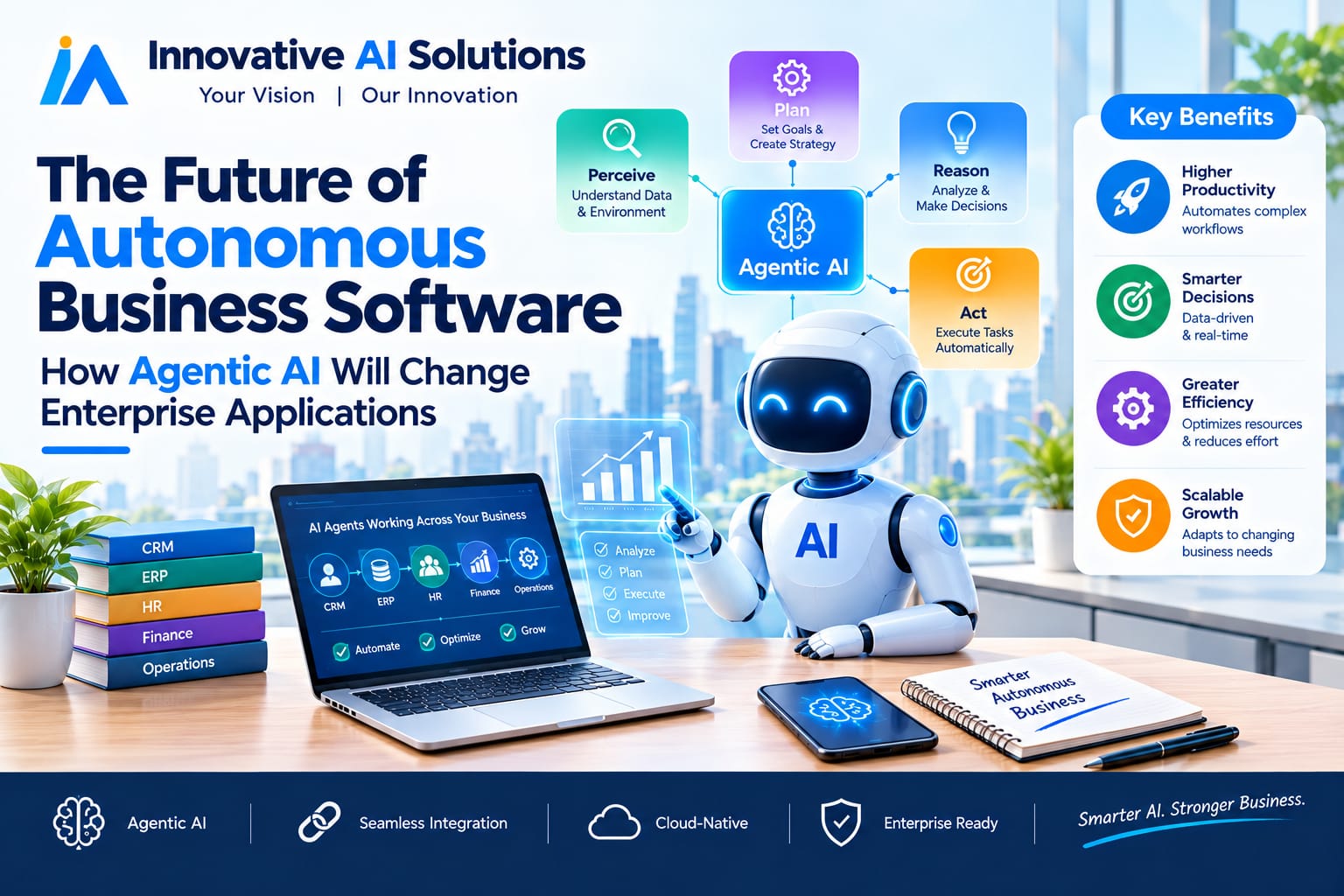
The Big Question
What happens when enterprise software stops being software?
For three decades, business applications followed the same pattern. Employees navigated apps. They executed tasks. They manually coordinated work across silos. The software recorded what happened, but it didn't act.
AI fundamentally reverses that model.
Forrester calls this the agentic business fabric a new architecture where AI agents operate across applications with employee oversight, and data, workflows, and AI orchestrate work to achieve business outcomes . Gartner describes it as the shift from digital business to autonomous business. Digital business changed what organizations do. Autonomous business changes how they do it .
The market is responding. Agentic AI sits at the Peak of Inflated Expectations on Gartner's 2026 Hype Cycle. According to Gartner's CIO survey, only 17% of organizations have deployed AI agents, yet more than 60% expect to do so within two years the most aggressive adoption curve among all emerging technologies measured .
But ambition is outpacing execution. Most deployments remain narrowly scoped. Fully autonomous agents are not ready for the majority of enterprise use cases. The gap between hype and production reality is the defining challenge of 2026.
What "Autonomous" Actually Means
Autonomous business software is not "automation with AI added." It's a different category of enterprise application.
Traditional enterprise software is built around APIs and workflows. The API defines what the system can do. The workflow defines the sequence of tasks. Deciding what should be done next requires human interpretation.
Agentic applications change this. APIs still define what can be done. But now, agents determine what should be done and carry it forward. Enterprise systems no longer wait. They continuously evaluate the state of the business and advance work toward predefined goals .
SAP's Autonomous Enterprise vision captures this shift. The concept: AI-native applications with an agent-based engagement layer that operates across applications, workflows, and data domains. These agents reason over business intent, traverse processes, and execute actions using governed enterprise data .
The results in production are measurable. SAP reports 83% reduction in invoice cycle time, greater than 99% billing accuracy, and 98% reduction in time to reconcile ICT postings from autonomous system implementations .
But autonomy doesn't mean "humanless." It means human-amplified with graduated levels. Organizations start with human-in-the-loop, where the system recommends and humans approve. They progress to human-in-the-lead, where the system advances work and escalates key decisions. Only then do they reach autonomous execution for well-defined processes .
What's Actually Working: Domain-Specific Agents
The biggest lesson from early agentic AI deployments is counterintuitive: general-purpose agents don't deliver ROI. Domain-specific agents do.
Gartner's analysis of 107 agentic AI deployments found that 80% of tangible ROI will come from specialized, domain-specific agents by 2028 .
The reason is context. A general-purpose agent doesn't understand your industry's edge cases. It can't navigate compliance requirements. It doesn't know how work actually gets done in your organization.
Domain-specific agents do. They're built for specific processes and trained on domain data. Gartner's examples of high-ROI use cases include :
Healthcare claims processing: An AI agent reviews medical claims, applies clinical and coding rules, and corrects diagnosis errors before payment.
Workers' compensation insurance: An agentic platform reviews medical and legal records to identify claims that may be safely rejected.
Prior authorization processing: A domain-specific pipeline integrates with electronic health records, reviews requests against medical policies, and delivers immediate, auditable decisions.
Parts ordering automation: An industrial services provider achieved $3 million annual ROI and returned 90,000 hours to technicians through a digital worker that automates parts ordering .
The pattern is consistent: agents that execute specific business processes within enterprise systems deliver measurable outcomes. Agents that offer general assistance don't.
The Governance Imperative
Autonomy without governance is risk. The market is responding.
Gartner's 2026 Hype Cycle shows that governance, security, and cost-focused profiles are emerging alongside core agentic AI technologies not as an afterthought, but as essential enablers . The need for oversight is becoming evident early in the adoption cycle, not only after large-scale deployment.
The stakes are high. Gartner identifies six common pitfalls that prevent agentic AI from delivering value :
Agent washing: Mistaking basic AI assistants for agents with greater agency. This creates unrealistic expectations and fragmented deployments.
Weak data foundations: Poor data quality or architecture prevents AI from delivering expected value.
Agent sprawl: Deploying too many unmanaged agents leads to fragmented governance and security risk.
Unmanaged token costs: Uncontrolled API consumption drives up costs and poses operational threats.
Overestimated reliability: Removing human-in-the-loop causes context loss, goal drift, and compounding mistakes.
Insufficient change management: Scaling without redefining roles and addressing job security concerns undermines outcomes.
SAP's AI Agent Hub, built on LeanIX, governs both SAP and non-SAP agents with verified-agent enforcement and telemetry. Microsoft launched Agent 365 for the same purpose. The control point for the next decade is agent governance .
The Architecture Shift
The technology stack for autonomous business software is different from traditional enterprise architecture.
Forrester describes the emerging model: data, workflows, and AI orchestrate work to achieve outcomes . The traditional boundaries between functions sales, marketing, service, finance begin to blur as end-to-end workflows replace departmental handoffs.
Forrester also identifies an important asymmetry: front-office applications will lead, back-office applications will follow .
Front-office platforms like CRM and customer service sit closest to customer interactions. They generate rich behavioral and conversational data. Human oversight can correct mistakes. These factors make them suitable for early agent adoption. They're evolving from systems of engagement into systems of autonomous action.
Back-office applications face a steeper path. ERP, supply chain, and financial processes operate under strict controls, audit requirements, and regulatory mandates. An incorrect recommendation in a customer conversation creates inconvenience. An incorrect financial posting creates legal exposure. These domains require far stronger governance and deterministic guardrails before organizations can trust autonomous execution .
The implication is clear: start where failure is tolerable. Scale where governance is proven.
What This Means for Your Business
Stop thinking about software as a tool. Start thinking about it as a participant.
Traditional software waits for instructions. Autonomous software evaluates the business, determines what should happen next, and executes within boundaries you define. This is a fundamental mental model shift.
Start with domain-specific agents, not general purpose assistants.
Gartner's data is unambiguous: 80% of ROI comes from specialized agents . Pick one process that's high-volume, well-defined, and measurable. Build a domain-specific agent for it. Prove value. Then expand.
Build governance before you scale autonomy.
The organizations that succeed don't focus on eliminating people. They focus on governance, observability, and human oversight that allow autonomy to scale safely. Every agent action should be logged. Permissions should be enforced. Humans should remain in control.
Fix your data foundation first.
Agents that can't access data can't reason about it. Agents that operate on fragmented, inconsistent data will make fragmented, inconsistent decisions. 74% of organizations struggle with incomplete data; 67% with low-quality data. This is the prerequisite, not the afterthought.
Own your orchestration layer.
Platform-native agents are convenient. But if you don't control the layer that coordinates them, you don't control your automation strategy. Build the orchestration layer as a strategic asset, not a vendor dependency.
Frequently Asked Questions
Q1: What is autonomous business software?
Autonomous business software is enterprise software that doesn't just record transactions—it reasons, decides, and acts. It evaluates the state of the business, determines what should happen next, and executes within governance boundaries. It's built on agentic AI and represents a shift from systems of record to systems of action .
Q2: How is this different from traditional automation?
Traditional automation follows predefined rules. Autonomous software senses conditions, reasons about options, and selects actions based on objectives adapting to situations the designer didn't anticipate. Automation does what it's told. Autonomy decides what to do .
Q3: What is the difference between agentic AI and autonomous business software?
Agentic AI is the technology systems that can plan, execute, and adapt. Autonomous business software is the application of that technology to enterprise operations. The software uses agentic AI to run business processes end-to-end .
Q4: Will autonomous software replace human workers?
No. The organizations that succeed use autonomous software to amplify human capabilities, not replace them. Gartner's research shows workforce reductions don't translate into ROI. The focus should be on governance, observability, and human oversight that allow autonomy to scale safely .
Q5: What industries are adopting autonomous business software fastest?
Healthcare claims, workers' compensation insurance, prior authorization processing, and industrial services are early adopters. Gartner's analysis of 107 deployments found the highest ROI in domain-specific processes with clear operational outcomes .
Q6: What are the three levels of autonomy?
Human in the loop: System recommends, human approves. Human in the lead: System advances work, escalates key decisions. Autonomous execution: System executes within policy. Organizations start at level one and scale as trust grows .
Q7: What is the biggest challenge in adopting autonomous software?
Governance and data quality. Gartner identifies six common pitfalls: agent washing, weak data foundations, agent sprawl, unmanaged token costs, overestimated reliability, and insufficient change management .
Q8: What is "agent washing"?
Mistaking basic AI assistants for agents with greater agency for decision making. It creates unrealistic expectations and leads to fragmented deployments that don't deliver value .
Q9: What is the "agentic business fabric"?
Forrester's term for the new operating model where AI agents operate across applications with employee oversight, and data, workflows, and AI orchestrate work to achieve business outcomes. It replaces the traditional model where employees navigate apps and manually coordinate work across silos .
Q10: How do I start with autonomous business software?
Start with human-in-the-loop systems that recommend actions and require approval. Pick one well-defined process. Build trust. Then expand autonomy as governance matures. Gartner's data shows domain-specific agents deliver the highest ROI .
Frequently Asked Questions (Continued)
Q11: What is the role of governance in autonomous software?
Governance is the foundation that allows scale. Every agent action should be logged. Permissions should be enforced. Humans should remain in control. SAP and Microsoft both launched agent governance platforms in 2026 because this is becoming the control point for the next decade .
Q12: Why do front-office apps lead in agentic adoption?
Front-office applications generate rich behavioral and conversational data, rely on judgment-based decisions, and produce measurable outcomes. Human oversight can correct mistakes. Back-office apps face stricter controls and regulatory requirements .
Q13: What is the ROI of autonomous business software?
Gartner's analysis found $3 million annual ROI from a parts ordering digital worker that returned 90,000 hours to technicians. SAP reports 83% reduction in invoice cycle time and 98% reduction in reconciliation time .
Q14: What's the biggest risk in autonomous software?
Overestimating reliability. Removing human-in-the-loop oversight can cause context loss, goal drift, repeated error loops, and compounding mistakes. Governance and observability are essential safeguards .
Q15: Why should I choose Innovative AI Solutions?
Because we focus on domain-specific agents that deliver measurable ROI. Because we build governance and observability from day one. Because we've delivered 100+ projects. Because your code is always yours.
Contact Us
Phone:
+91 7464 099 059
+91 9689967356
Email:
info@innovativeais.com
Address:
9th Floor, Pearls Best Heights-I,
Head Office: 904, Netaji Subhash Place,
Delhi – 110034