The Big Question
What happens when your workforce isn't entirely human? When AI agents join your teams as colleagues—not just tools—how does leadership, accountability, and collaboration change?
This question is no longer hypothetical. McKinsey recently announced it added 25,000 "digital employees" to complement its 40,000-person workforce. Goldman Sachs deployed "Devin," its first autonomous software engineer. Ford unveiled an automated sales agent named Otto. Moderna merged its IT and HR departments to better manage the overlap between digital and human talent pools .
The digital employee era has arrived. And it's changing everything about how corporate teams operate.
What Is a Digital Employee?
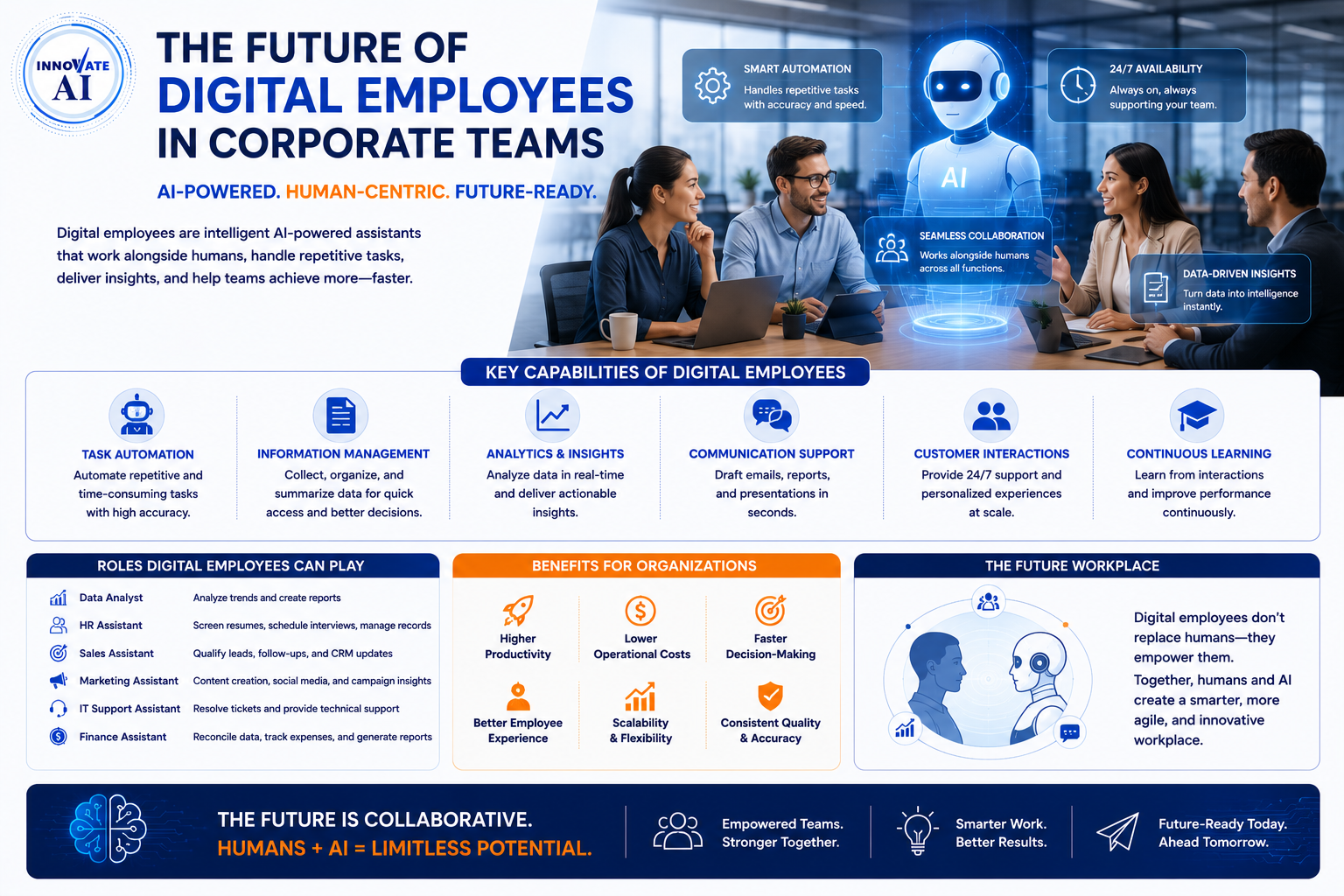
A digital employee—often called an AI agent—is an autonomous system that independently executes complex tasks or end-to-end processes, acting as a virtual member of a team to automate skills and enhance performance .
Unlike traditional chatbots or copilots that wait for prompts, digital employees are programmed to work in a loop until they achieve a goal . They can plan, reason, act, and learn with minimal human oversight. They handle entire workflows, not just individual tasks .
The market has already moved beyond task-based AI. The next leap is "role-based" AI agents that orchestrate and complete tasks across multiple systems . These aren't tools you use. They're teammates you manage.
The Numbers Don't Lie
The adoption of digital employees is accelerating rapidly:
-
76% of executives view agentic AI as more like a coworker than a tool
-
35% of organizations have already adopted agentic AI, with another 44% planning deployment soon
-
70% of businesses plan to integrate AI agents into their workflows in 2026
-
84% will use AI agents for IT service management functions, while more than half will deploy them in customer service
-
75% of current roles will need reshaping with new or different skill mixes
The era of digital employees isn't coming. It's here.
The Evolution: From Task Automation to Role-Based Agents
For decades, enterprise software focused on aiding humans with digital tools. In 2026, that's shifting dramatically. Enterprise applications are moving beyond enabling employees to accommodating a digital workforce of AI agents .
The progression is clear:
-
Task-based AI: Chatbots and copilots that handle individual requests
-
Workflow-based AI: Agents that execute multi-step processes
-
Role-based AI: Digital employees that own entire functions, orchestrating tasks across multiple systems
This evolution forces tech leaders to decide how far to go in digitizing business processes and orchestrating workflows independent of human workers . The question isn't whether to deploy digital employees—it's how many and where.
The New Workforce: Humans + Digital Employees
Smaller Teams, Greater Impact
AI is fundamentally changing team structures. The standard "pizza team"—one product manager and six to eight engineers—is giving way to hybrid-agentic pods: three to five humans working alongside AI agents that handle coding, testing, review, and deployment .
In one AI-first healthcare company, a team of 10 software engineers was replaced with a three-person unit overseeing AI agents. The unit consists of a product owner, a software engineer who can effectively prompt AI coding tools, and a systems architect who ensures integration with the broader tech ecosystem .
McKinsey is deploying thousands of AI agents to support consultants with tasks such as building decks, summarizing research, and verifying the logic of arguments. Around 40% of the company's revenue now comes from advising on AI and related technologies .
The "Megamanager" Emerges
Instead of large pyramids of junior analysts and mid-level managers, leaner teams led by experienced generalists are emerging. These "megamanagers" oversee both human employees and AI agents, orchestrating workflows rather than just managing people .
"You're going to have teams which are manager-heavy—where everybody is a manager, sometimes manager of humans, but always manager of agents."
The Agent-to-Human Ratio
In early examples, companies building agent factories supporting multiple business workflows manage about 50 to 100 AI agents with just two or three human overseers . This ratio is likely to increase as agents become more capable and autonomous.
Leadership in the Agentic Era
Your Personal AI Strategic Bench
Harvard Business School Professor Tsedal Neeley and Expedia Group's Ritcha Ranjan describe how agentic AI could power a digital support team for leaders :
A competitive intelligence analyst that continuously monitors external signals, scans the internet for everything written about competitors, synthesizes information, and translates it into action items related to strategic goals .
A chief of staff that mines calendars and emails to create an accurate picture of how time is actually spent, evaluates meeting transcripts to determine what was actually discussed, and recommends how leaders could use their time better .
An executive coach that anticipates feedback from managers, analyzes patterns from past interactions, creates working profiles of colleagues, and provides tips on how to respond to likely concerns .
Shifting Leadership Roles
In the agentic era, leadership roles are evolving :
-
Orchestrators of hybrid intelligence: Leaders design and deliver AI transformation, making ethical decisions about where AI fits
-
Strategic visionaries: Leaders shift focus to strategic direction, prioritizing outcomes over ownership
-
Cultural change agents: Leaders drive continuous experimentation, adaptability, and a "test and learn" mindset
Leaders must become greater strategic visionaries, role-modeling new ways of managing the co-intelligent workforce by orchestrating human + agent teams and workflows themselves .
The Organizational Transformation
Six Critical Shifts
McKinsey identifies six shifts for building the agentic organization of the future :
-
Workflows: End-to-end redesign, AI-first by design. Work should be reimagined as AI-first, domain by domain, beginning with desired outcomes. Humans are brought in deliberately where they add unique value through judgment, empathy, and creativity .
-
Talent: A new human-agent frontier. New capabilities will be needed—some performed by technology, others by humans. New profiles are emerging: agent orchestrators, hybrid managers, and AI coaches .
-
Structure: Dynamic organizations. Hierarchical pyramids built around knowledge silos won't survive. Organizations should take leaner, flatter, more fluid shapes, organized around autonomous "human + agent teams" .
-
Leadership: Orchestrators of hybrid intelligence. Leaders need stronger technological capabilities, system thinking, and the ability to make ethical decisions .
-
Culture and skills: Continuous reinvention. Every employee should move beyond AI fluency toward integrating AI in daily roles. Organizations should shift from an expertise culture to a learning culture .
-
HR: Building a co-intelligent talent system. HR should become the engine of transformation, reimagining jobs, redeploying talent, and embedding trust into the system .
The Onboarding Challenge
Companies are learning that integrating digital employees requires as much care as onboarding human ones .
Key Questions to Answer
Do you even need an agent for this? Organizations need to re-examine existing workflows and streamline or abandon those that no longer add value. Companies that don't have their workflows in order first will have AI agents automating the wrong things .
What rules do they need to follow? Strong governance is essential—defining how agents are built, how they operate, and who audits them. When something goes wrong, who's responsible?
What are you hiring them to do? Strict limits on data and systems access are required, along with clear determination of autonomy levels before humans are brought into the loop. One simple rule: "The AI proposes and the humans decide" .
How do you know they're doing a good job? Clear KPIs and performance metrics are essential. For example, Chicago's E-Zmovers & Storage added three full-time AI dispatch agents, giving each quarterly performance reviews identical to those used for human dispatchers. The AI agents achieved 91% accuracy and reduced long-haul travel times by 2.7 hours .
Who's the boss of that bot? Every organization needs to decide who's ultimately responsible for a digital employee's performance—the tech team, the business unit, or HR .
The Human Factor: Why Naming Matters
A Boston University study revealed something striking: people caught 18% fewer errors when work was said to have come from an "AI employee" rather than a chatbot. They were also 44% more likely to escalate questionable work to a manager rather than trusting their own corrections .
The research suggests that treating AI agents as "coworkers" inverts our sense of who's in charge. When an AI tool is framed as an employee, participants feel less responsible for its output, potentially reducing oversight quality .
The Engagement Risk
Gartner warns that representing AI agents as digital workers alongside employees in org charts signals their equivalence and potential replacement, likely negatively impacting employee engagement and morale .
By 2028, organizations that display AI agents in team structures will have 15% lower employee engagement compared to those that don't .
The Rehiring Paradox
Gartner also predicts that by 2029, 30% of employees terminated and replaced by AI will be rehired—often at a higher cost—due to ineffective workforce transition strategies . The lesson: thoughtful integration beats hasty replacement.
The Skills Transformation
The half-life of technical skills is shrinking from 8-12 years to just 2-5 years by 2030 . Adaptability and learning velocity are becoming the primary metrics for hiring .
In the agentic era, value will accrue to people who :
-
Think broadly but also go deep—"T-shaped" professionals
-
Have deep expertise and broad capabilities
-
Can act as orchestrators directing AI agents
New roles are emerging :
-
Agent orchestrators: Design and supervise agent workflows
-
Hybrid managers: Lead blended human-agent teams
-
AI coaches: Help employees integrate AI into daily work
Governance and Accountability
As digital employees take on more responsibility, governance becomes critical :
Autonomous Governance Modules
Half of enterprise ERP vendors will launch autonomous governance modules combining explainable AI, automated audit trails, and real-time compliance monitoring. SAP, Microsoft, and Oracle are already investing heavily in governance infrastructure .
Model Context Protocol (MCP)
Thirty percent of enterprise app vendors will launch MCP servers, allowing external AI agents to collaborate with their platforms. This creates an open ecosystem where businesses aren't locked into a single AI provider and can leverage the best agents for specific tasks .
Human-in-the-Loop
As workflows become more agentic, the human-in-the-loop moment becomes critical. People should periodically check agent work and review output at crucial junctures before making major decisions .
Real-World Examples
Adecco Group
The leading UK employment agency is deploying digital recruitment agents that function as team members. They analyzed their entire recruitment lifecycle to determine where digital employees add value versus where humans are essential. Their goal: 50% of global revenues powered by agentic AI by end of 2026 .
Klarna
Klarna tracked $40 million in annual profit improvement and 25% reduction in repeat inquiries through deploying an OpenAI-powered assistant. They automated 67% of all customer service chats—the equivalent workload of 700 full-time human agents .
Siemens Energy
Siemens implemented location-aware agentic AI through their askPixi system, using real-time location data from 1,500 tracked assets to trigger workflow actions automatically in SAP. This autonomous loop led to 90% reduction in search time and 20% increase in parts throughput .
Implementation Roadmap: The First 90 Days
Phase 1: Foundation and Pilot (Days 1-30)
-
Map value drivers and identify use cases for automating heavy execution tasks
-
Initiate culture change by moving from operators to agent leaders
-
Run early adopter workshops to build initial action flows
-
Conduct AI readiness assessment: data, tech stack, and people
Phase 2: Refine and Track (Days 31-60)
-
Refine data and discernment settings
-
Establish weekly metrics meetings with business and IT leaders
-
Develop career paths for agent leaders
Phase 3: Scale and Strategize (Days 61-90+)
-
Hold first quarterly business review to reallocate resources based on value tracking
-
Launch second discovery phase to extend AI into finance, HR, and supply chain
-
Establish internal AI thought leadership
Frequently Asked Questions
Q1: What is a digital employee?
A digital employee is an autonomous AI agent that independently executes complex tasks or end-to-end processes, acting as a virtual member of a team to automate skills and enhance performance .
Q2: How many organizations are using AI agents?
35% have already adopted agentic AI, with another 44% planning deployment soon . 70% of businesses plan to integrate agents into their workflows in 2026 .
Q3: Will AI agents replace human workers?
Not entirely. While 75% of roles will need reshaping, AI is rarely the primary cause of workforce reductions. 32 million jobs will require refactoring every year through 2031, but massive scale job reduction is not expected .
Q4: What leadership skills matter in the agentic era?
Leaders need technological capabilities, system thinking, ethical decision-making skills, and the ability to orchestrate human + agent teams. They must shift from directing to enabling .
Q5: How should organizations onboard digital employees?
Organizations need to answer key questions: Do you need an agent for this task? What rules should they follow? What are you hiring them to do? How do you measure performance? Who is responsible for oversight?
Q6: How can Innovative AI Solutions help?
We help businesses design, build, and deploy digital employee strategies—from workflow redesign and human-AI teaming frameworks to AI-native operating models and governance structures. Based in Delhi, serving clients across India.
Why Delhi is a Great Hub for AI Development
Delhi is emerging as a significant hub for AI development, backed by concrete government support and infrastructure. The recent Delhi Budget 2026-27 allocated ₹8.20 crore for two Artificial Intelligence centres of excellence (AI-CoEs), functioning as hubs for research, innovation, and startup incubation.
The city's AI infrastructure is expanding rapidly. Under the IndiaAI Mission, more than 38,000 high-end GPUs have been onboarded and are available at approximately ₹65 per hour—roughly one-third of the global average cost. This makes AI development remarkably cost-effective compared to other tech hubs.
The government has also announced a ₹350 crore startup policy over five years, aiming to support the emergence of at least 5,000 startups by 2035, with key focus areas including artificial intelligence, machine learning, and automation.
The AI ecosystem in Delhi combines: cost-effective infrastructure, government support, a growing talent pool, and proximity to the country's business decision-makers. For businesses looking to develop practical AI solutions, it's becoming an increasingly attractive location.
What We Offer at Innovative AI Solutions
After five years of building AI solutions for businesses, we've developed a practical approach that focuses on what actually works:
-
Digital Employee Strategy: We help you design, deploy, and manage AI agents as part of your workforce
-
Workflow Redesign: We help you reimagine processes as AI-first, identifying where digital employees add maximum value
-
Human-AI Teaming: We help you build frameworks for effective collaboration between human and digital employees
-
Organizational Transformation: We help you flatten structures, redefine roles, and build agentic governance models
-
Onboarding and Training: We help you onboard digital employees and reskill your human workforce
-
Governance and Compliance: We help you establish guardrails, audit trails, and compliance frameworks
Our approach is built on the reality that digital employees aren't just technology—they're a fundamental shift in how work gets done.
Final Thought
The future of corporate teams isn't human or AI. It's human AND AI. Companies that embrace this reality, redesigning workflows and leadership models around hybrid teams, will unlock unprecedented productivity and innovation. Those that cling to old structures—treating AI as just another tool—will be left behind.
The digital employee era is here. The question isn't whether to join it. It's how to lead it.
Contact Us:
Phone: +91 7464 099 059 / +91 9689967356
Email: info@innovativeais.com
Address: Netaji Subhash Place, Pitampura, Delhi – 110034
Website: https://innovativeais.com
About the Author
Abhishek Kumar
Founder & CEO, Innovative AI Solutions
5+ years building AI systems for enterprises. Based in Delhi, serving clients across India.
Hashtags: #DigitalEmployees #AIAgents #FutureOfWork #AINative #HybridTeams #AIStrategy #InnovativeAISolutions
Related services: to apply this in your business, explore our AI agent development and AI development services.