The Big Question
What happens when enterprise software stops being software?
For thirty years, enterprise software followed the same pattern. You bought applications—ERP, CRM, HCM—and humans used them to do work. The software recorded transactions. It enforced rules. It maintained records. But it didn't think. It didn't act. It waited for instructions.
That model is ending.
The convergence of AI, automation, and cloud is creating something fundamentally different: enterprise systems that don't just support work they perform it services . Software that senses conditions, reasons about options, decides on actions, and executes them. Autonomously.
Forrester calls this the rise of the "digital workforce" AI agents that sit alongside human staff inside enterprise systems, not as tools but as colleagues. Deloitte describes it as the shift from "systems of record" to "systems of agency," where autonomous AI agents actively execute work and generate revenue rather than merely documenting business activity.
The numbers confirm the shift. Global IT spending is projected to reach $6.37 trillion in 2026**, growing 14.2% year-over-year, with data center systems the infrastructure powering AI growing at **62.5%**. Software spending alone is forecast to reach **$1.47 trillion, growing 15.5%.
But the spending isn't the story. The story is what that spending buys: enterprise software that thinks, acts, and coordinates with other software to get work done.
What Convergence Actually Means
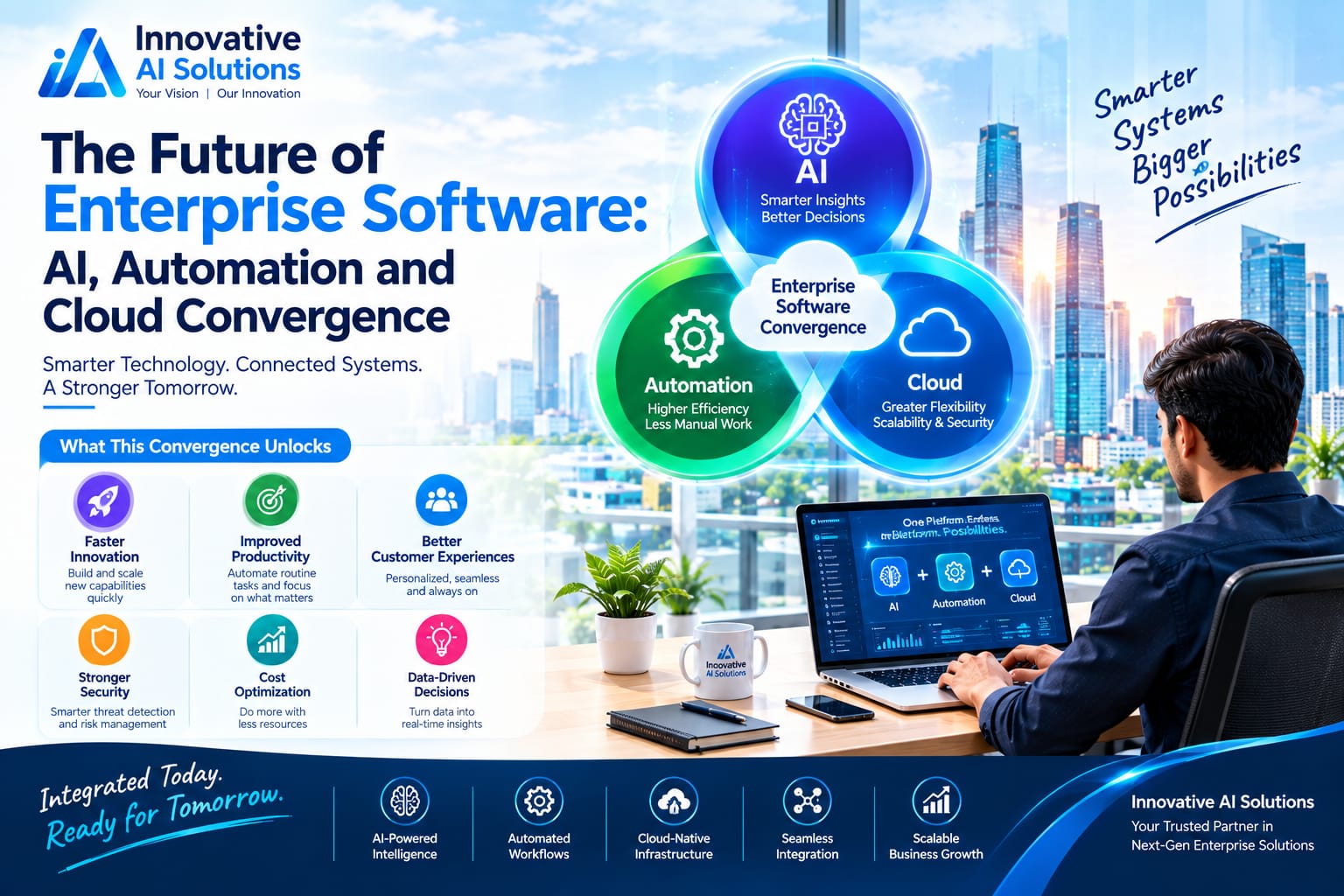
Convergence isn't just "AI added to existing software." It's a fundamental architectural shift.
The old architecture: Applications were central. ERP had its interface. CRM had its interface. HCM had its interface. Humans navigated between them, moving data, making decisions, triggering actions.
The new architecture: Agents are the connective tissue. As Metis Strategy describes it, organizations are building an enterprise orchestration layer that coordinates agents, systems, and humans while applying validation, policy, and auditability across workflows. Core platforms—ERP, CRM, HCM—still exist. But their native interfaces become less central to daily work. They execute transactions and maintain records. The orchestration layer handles coordination.
This is why the "SaaS Mandate" is now absolute. Cloud-native deployments are expected to capture 86% of the total enterprise software market by 2031, relegating on-premise solutions to what Futurum calls a "legacy tax".
The convergence has three visible layers:
Cloud infrastructure: AI-ready compute, hybrid architectures, and the shift toward "AI-native clouds" and "private AI factories".
Intelligent automation: Workflows that don't just follow scripts but adapt, reason, and handle exceptions. Forrester predicts AI will automate more than 20% of enterprise application workflows in 2026, with half of ERP vendors introducing autonomous governance modules.
Agentic AI: Digital workers that plan, execute, and coordinate. Deloitte's Tech Trends 2026 calls this the "agentic reality check" early initiatives failed because they automated old processes instead of redesigning them. Leading organizations are now adopting agent-first process models, orchestrating multi-agent systems, and developing management frameworks for this emerging digital workforce.
The Digital Workforce Emerges
The most visible manifestation of convergence is the emergence of digital workers inside enterprise systems.
Microsoft's September 2026 Copilot redesign illustrates the direction. The new architecture combines Home (conversational AI), Code (application generation from natural language), and Autopilot a persistent agent that monitors projects, coordinates with employees, and continues assignments after humans sign off. Microsoft CEO Satya Nadella framed the requirement simply: "Every agent has to have an identity. Everything it does needs to be observed."
This isn't theoretical. Microsoft demonstrated an Autopilot named "Dot" monitoring Black Friday preparations gathering information from email, Teams, inventory records, and spreadsheets, identifying a shipment problem affecting 18 stores, bringing employees into a discussion, and reporting resolution.
ServiceNow and Google Cloud are building similar capabilities. Their joint solutions enable AI agents across Gemini Enterprise and ServiceNow AI Platform to work as "one autonomous chain" across 5G networking, retail, and IT systems. When a network issue surfaces, agents detect it, diagnose root cause, pass context to remediation agents, deploy the fix, and validate resolution all autonomously.
The vision is clear: enterprise systems where human employees work alongside AI colleagues, each with identity, memory, and defined responsibilities.
The Infrastructure Reckoning
Convergence has a cost. And it's forcing a fundamental rethink of infrastructure strategy.
Deloitte's Tech Trends 2026 identifies the "AI infrastructure reckoning" many organizations are reaching a tipping point where cloud-only approaches become cost-prohibitive. Per-token inference costs have dropped significantly, but total AI spending has soared because usage has grown faster than unit costs have fallen.
The result: strategic hybrid architectures are emerging as the dominant model. Deloitte recommends a three-layer approach:
Public cloud for elasticity and experimentation.
On-premises (or co-located) infrastructure for predictable, high-volume production inference.
Edge computing for latency-critical, bandwidth-constrained, or offline scenarios.
Forrester predicts private AI factories will reach 20% adoption in enterprises in 2026, with on-premises servers accounting for half of server share. At least 15% of enterprises will seek private AI options as an alternative to placing corporate data in public cloud models.
The infrastructure shift isn't about abandoning cloud. It's about placing workloads where they make sense—balancing cost, latency, data sovereignty, and resilience.
What This Means for Indian Businesses
India is positioned uniquely in this convergence—with significant advantages and significant gaps.
The advantages: India ranks second globally in strategic AI investment. 55% of Indian organizations have dedicated AI leaders, the highest globally. 71% have AI strategies aligned with business goals. The APAC region is "leapfrogging Western technical debt," moving straight to mobile-first, cloud-native AI platforms to achieve a market-leading 17.2% CAGR in enterprise software.
The gaps: Only 22% of Indian enterprises have processes for testing, auditing, and assessing AI-related risks. 54% are deploying AI agents, but just 11% have moved to autonomous workflows. 74% struggle with incomplete data; 67% with low-quality data.
The convergence doesn't eliminate these gaps. It amplifies them. Organizations with clean data, strong governance, and redesigned processes will capture disproportionate value. Those without will build expensive systems that create friction instead of removing it.
Deloitte's warning is direct: existing IT governance doesn't address autonomous decision-making, leading to "agent washing," shadow implementations, and "workslop" where agents create friction instead of removing it.
What Comes Next
The convergence of AI, automation, and cloud isn't a destination. It's an accelerating trajectory.
Near-term (2026–2027): Agent orchestration becomes the strategic control point. Enterprises build orchestration layers to coordinate agents, systems, and humans. Multi-agent systems move from pilot to production. The "digital workforce" becomes an operational reality, not a marketing concept.
Medium-term (2028–2029): The enterprise software market bifurcates sharply. Futurum forecasts a "K-shaped" divergence where capital flows aggressively toward AI-native infrastructure while deflating labor-intensive, seat-based software sectors. Vendors that pivot from selling software seats to monetizing AI-driven outcomes thrive. Those tethered to legacy models struggle.
Long-term (2030+): Gartner predicts 80% of enterprises will transform large software engineering teams into AI-enhanced small teams. 40% of enterprise application portfolios will include custom applications built with AI-native platforms—up from just 2% in 2025. The enterprise software stack becomes fundamentally different: smaller, more modular, more autonomous, and orchestrated by enterprise-owned control layers rather than vendor-native workflows.
The organizations that thrive will be those that treat governance as a leadership issue, not a tooling decision. Those that redesign processes for agent-native operations rather than automating legacy workflows. Those that own their orchestration layer rather than ceding control to vendors.
The question is no longer "should we adopt these technologies?" It's "how fast can we redesign our organization, infrastructure, and security to leverage them?"
Frequently Asked Questions
Q1: What is enterprise software convergence?
Convergence refers to the integration of AI, automation, and cloud into a unified enterprise architecture. Instead of separate systems for intelligence, execution, and infrastructure, they work together—AI provides reasoning, automation executes actions, and cloud provides scalable infrastructure.
Q2: What is a "digital workforce"?
Digital workforce refers to AI agents that operate inside enterprise systems alongside human employees. Forrester predicts the top five HCM platforms will offer digital employee management features in 2026. These agents have identity, memory, and defined responsibilities—like human colleagues.
Q3: How is enterprise software changing in 2026?
The shift is from "systems of record" to "systems of agency". Software no longer just documents work—it executes it. AI agents plan, decide, and act autonomously within defined guardrails. Forrester predicts AI will automate more than 20% of enterprise application workflows in 2026.
Q4: What is the "AI infrastructure reckoning"?
Deloitte's term for the tipping point where cloud-only AI infrastructure becomes cost-prohibitive. Total AI spending has soared even as per-token costs dropped, because usage grew faster than unit costs fell. Organizations are adopting hybrid architectures—balancing public cloud, on-premises, and edge as the dominant model.
Q5: What is the difference between automation and agentic AI?
Traditional automation follows scripts. Agentic AI plans, reasons, and adapts. Deloitte notes that early agentic initiatives failed because they automated old processes instead of redesigning them. Leading organizations now adopt "agent-first" process models.
Q6: How much is being spent on enterprise software in 2026?
Global software spending is forecast at $1.47 trillion in 2026**, growing 15.5% year-over-year. Total IT spending will reach **$6.37 trillion, with data center systems growing at 62.5%.
Q7: What is the "agentic reality check"?
Deloitte's term for the gap between agentic AI hype and production reality. Many early initiatives didn't deliver transformative results because they automated old processes. Leading organizations are now adopting agent-first process models and developing management frameworks for digital workers.
Q8: How are Indian businesses positioned for this convergence?
India has strengths—55% have dedicated AI leaders, the highest globally. But gaps remain: only 22% have AI risk processes, and 80% say workforce transformation is required. The convergence amplifies both advantages and gaps.
Q9: What is the enterprise orchestration layer?
A control layer above core platforms (ERP, CRM, HCM) that coordinates agents, systems, and humans while applying validation, policy, and auditability. It becomes the primary control point for automation and a strategic asset for enterprises that own it.
Q10: What is the "SaaS Mandate"?
Futurum's term for the dominance of cloud-native deployments. 86% of the enterprise software market will be cloud-native by 2031, relegating on-premise solutions to a "legacy tax".Frequently Asked Questions (Continued)
Q11: What is a "private AI factory"?
Forrester predicts private AI factories will reach 20% adoption in 2026. These are dedicated environments for AI workloads, often on-premises or co-located, optimized for predictable high-volume inference.
Q12: What is the "K-shaped" enterprise software market?
Futurum's forecast that capital will flow aggressively toward AI-native infrastructure while deflating labor-intensive, seat-based software sectors. Winners and losers diverge sharply.
Q13: What is "agent washing"?
Deloitte's term for vendors and organizations claiming agentic capabilities without genuine autonomous function. It creates shadow implementations and friction rather than removing it.
Q14: What is a "digital worker" identity?
Microsoft CEO Satya Nadella: "Every agent has to have an identity. Everything it does needs to be observed". Digital workers need distinct identity, memory, computing environment, and governance—like human employees.
Q15: What should enterprises prioritize now?
Own your orchestration layer. Build governance by design, not by exception. Redesign processes for agent-native operations. Treat governance as a leadership issue. The organizations that move fastest will gain exponential advantages.
Contact Us
Ready to explore what convergence means for your enterprise software? Let's talk.
Phone:
+91 7464 099 059
+91 9689967356
Email:
info@innovativeais.com
Address:
9th Floor, Pearls Best Heights-I,
Head Office: 904, Netaji Subhash Place,
Delhi – 110034