The Big Question
What happens when databases stop being passive storage and become active intelligence platforms that think, reason, and act on your behalf? What if you could ask your database a question in plain English and it returned not just data, but synthesized insights with citations and confidence scores?
And what if AI agents were the primary users of your database—creating and destroying millions of database instances daily, mutating schemas at machine speed, and demanding hyper-elasticity that human-centric systems were never designed for?
This is the future of intelligent databases. And it's already here.
The Database Revolution: From Storage to Intelligence
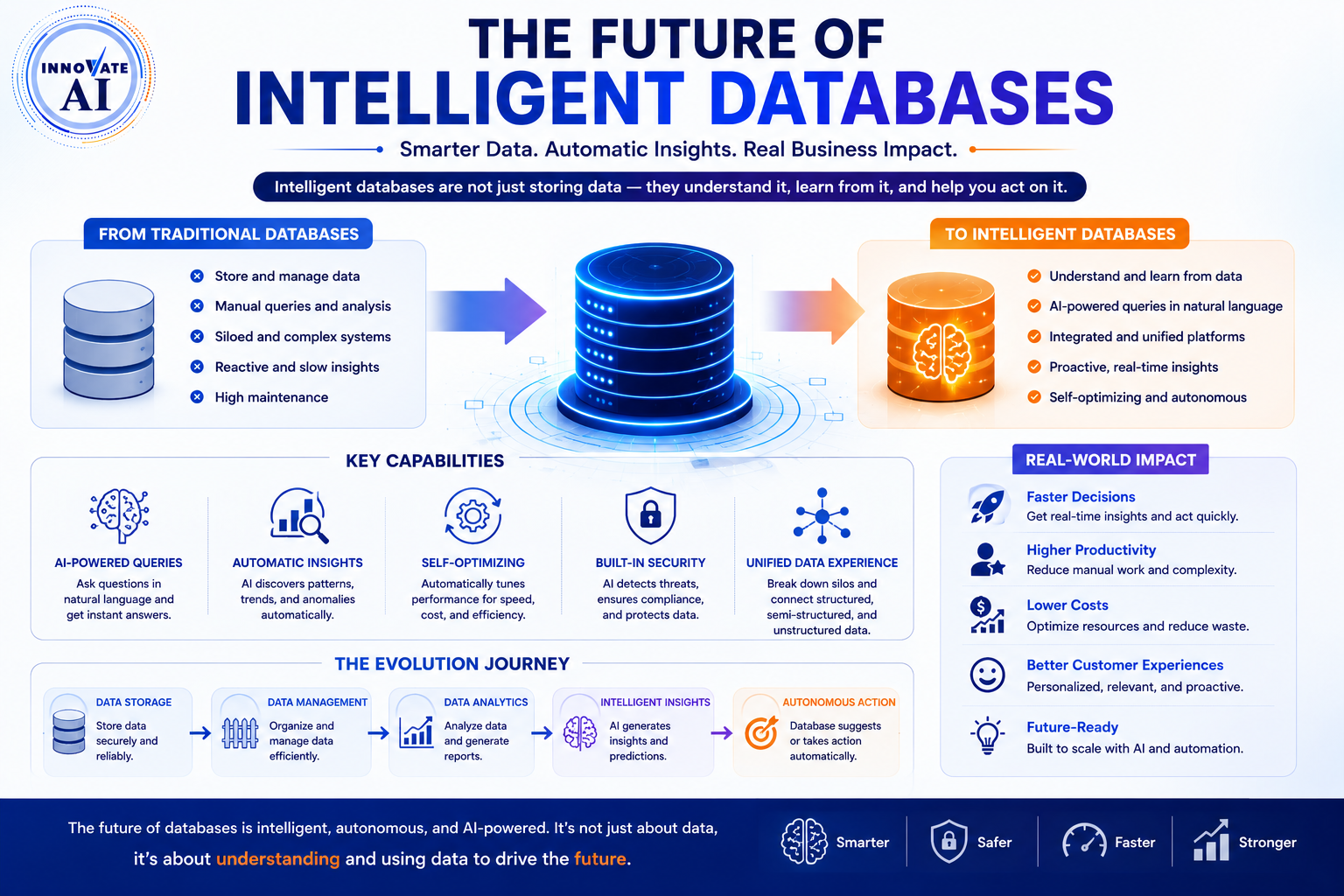
The database market is at an inflection point. Organizations are no longer evaluating databases as isolated persistence layers but as intelligent, integrated platforms that unify transactions, analytics, and search while incorporating GenAI functionality .
The Numbers Tell the Story
-
87% of organizations now prioritize platforms that support both operational and analytical workloads
-
85% rate GenAI capabilities as critical to their platform selection
-
87% consider cloud object storage integration a baseline requirement
-
80% rate enabling access to LLMs and embedding models as important
As 451 Research notes: "We are moving from a database mindset for AI to an AI database mindset" .
The Agent Era: When AI Agents Became the Primary Database Users
The most profound shift in database architecture isn't technical—it's behavioral. AI agents don't behave like developers. They don't throttle themselves. They don't batch work. They don't wait for off-peak periods .
The result is staggering: More than 90% of new daily database clusters are now created not by humans, but by AI agents .
The Agent Explosion
The math is telling. Consider a platform with 100,000 users (not a huge number), each running 10 tasks by agents, each testing 10 branches:
100,000 × 10 × 10 = 10,000,000 databases
As TiDB CTO Ed Huang explains: "Agents treat the database not as a single shared global resource, but as a programmable substrate: create a database, evolve it, test it, deploy it, delete it. Traditional shared-nothing systems were simply not built for this" .
The new metaphor isn't a central warehouse—it's version control: clone, branch, experiment, merge, discard .
The New Requirements
Agent workloads demand capabilities traditional databases weren't designed for:
-
Second-level creation of databases
-
S3-backed compute-storage separation
-
Non-blocking, agent-friendly schema evolution
-
Unified OLTP + analytics + vector search
-
Branching via copy-on-write storage
The Cost Reality
When a single human creates a database, the cost is trivial. When an agent creates a thousand in a day, the cost is existential .
Agents operate databases with 1,000× the efficiency of human engineers. Their natural state is a combinatorial explosion. The new requirement is explicit: costs must fall to zero when the workload falls to zero .
Autonomous Database Management: The Self-Driving Database
AI is transforming database administration from a manual, reactive process into an autonomous, self-optimizing system .
The Components of Autonomous Database Management
| Component | What It Does |
|---|---|
| Self-Tuning | Analyzes workloads, optimizes resource allocation, dynamically adjusts system parameters |
| Predictive Query Optimization | Uses deep learning to enhance query execution plans, reduce latency, anticipate performance issues |
| Intelligent Indexing | Automates index selection, adaptation, and maintenance based on access patterns |
| Anomaly Detection | Identifies potential security threats and data inconsistencies proactively |
Oracle Autonomous AI Database
Oracle's Autonomous AI Database provides a fully autonomous service that handles provisioning, backup, patching, upgrading, and scaling—all without human intervention . It supports all modern Oracle data types and workloads, including transaction processing, AI, and analytics, reducing the need for multiple specialty databases .
The platform includes built-in AI Vector Search, enabling users to combine proprietary data with LLMs for accurate, context-aware answers without duplicating data to a separate vector database .
Natural Language: The New Database Interface
For 50 years, databases had one job: store data and return exact results on demand. AI changes that contract entirely .
SQL as Artifact, Not Primary Interface
MariaDB Cloud CTO Jags Ramnarayan captures the shift: "SQL won't disappear, but it will become an artifact rather than the primary interface. Developers, analysts, and operators will interact with databases through natural language, with platforms automatically translating requests into SQL and providing explanations" .
Every database platform will need:
-
Embedded semantic layers that understand schemas, relationships, and business terminology
-
Planning capabilities to decompose complex requests into executable steps
The Text-to-SQL Challenge
Google's Sailesh Krishnamurthy explains the complexity: "One part of it is context. The more you can tell the model about the schema and the metadata, the better it's going to get" .
But challenges remain. "There are implicit assumptions by the people who designed the schema. If you know that assumption, then the SQL query against the system is going to be more accurate" .
Google's team recently took the leaderboard position on the world's leading Text-to-SQL benchmark—demonstrating the rapid progress in this area .
Parameterized Secure Views
Security is critical. Google has built technology called parameterized secure views in the database itself. "The LLM can generate any query it wants, but with respect to the logged-in user we will not let them see any information that they are not supposed to see" .
Convergence: The End of the OLTP/Analytics Boundary
The distinction between transactional and analytical workloads is dissolving .
The Unified Platform
87% of organizations now consider platforms supporting both operational and analytical workloads important . Future platforms will deliver "Operational Analytics with Transactions" through architectures featuring:
-
One SQL surface with multiple engines (transactions, analytics, vectors)
-
Independent scaling of each engine
-
Data freshness within seconds
MariaDB's Unified Platform
MariaDB Enterprise Platform 2026 integrates transactional, analytical, and AI (vector) database engines within a single platform, avoiding the complexity of fragmented systems . The platform introduces built-in RAG pipelines and AI agents that can autonomously access and analyze enterprise data .
As MariaDB CPO Vikas Mathur explains: "The future of applications is agentic. AI agents need to probe, analyze and transact in real time and at enormous scale" .
Google Cloud's Evolution
Google Cloud databases are evolving from passive storage systems into intelligent context hubs that power agentic AI applications . Applications today need the best results, not just exact ones—demanding that graph traversal, vector embeddings, full-text search, and relational operations coexist in a single system .
RAG-in-the-Database: "Instant RAG" Becomes Table Stakes
Retrieval-Augmented Generation capabilities are being built directly into database platforms rather than requiring separate systems .
The Convergence of Structured and Unstructured Data
Google's Krishnamurthy explains the shift: "For 50 years, databases had one job: store the data, don't lose the data, and then when you ask a question, give the exact result. The biggest change is that we are no longer just dealing with structured data. We're also dealing with unstructured data. When you combine structured and unstructured data, it's not just about exact results but about the most relevant results" .
The key insight: databases start to have capabilities of search engines—relevance, ranking, precision vs. recall .
MariaDB's "RAG-in-a-Box"
MariaDB's native RAG solution automates and optimizes all processes required for RAG within the platform, grounding LLMs with specific business data .
Real-World Example: Target.com
Target moved its entire online catalog and vector search to AlloyDB. "One of the key requirements they had was in addition to searching by image or searching by description the customer may also care about price, which is there in the database. They may care about the inventory of the item in the physical store closest to the logged-in user. It becomes a geospatial parameter predicate. If you were to stitch this at the application level, it's really hard to do" .
Governance and Explainability: Embedded in Every Response
As conversational interfaces become standard, governance and explainability will travel with every answer .
What Must Be Included
Each natural language result will include:
-
The underlying SQL
-
Document citations
-
Vector distances
-
Consistency classes used
-
Confidence scores
Built-in Governance
Audit trails, cost/time budgets, and human-in-the-loop gates for high-stakes actions will be built into the conversation flow . This moves governance from an afterthought to a native capability.
The DBMS-LLM Integration Challenge
The Integration Gap
The efficient integration of DBMSs and LLMs within a unified system offers significant opportunities but introduces new technical challenges . Research identifies five representative architectural patterns for DBMS-LLM integration, each with distinct design principles, strengths, and trade-offs .
The MCP Toolbox for Databases
Google built the MCP Toolbox for Databases—an open-source solution that makes it easy to connect LLMs or orchestration systems to databases. It supports first-party databases and many competitors have signed on to use it .
The toolbox provides:
-
Standard tools for interrogating databases
-
The ability for users to add custom tools (templated queries with parameters)
-
Solutions for connectivity and security
Implementation Roadmap: The First 90 Days
Phase 1: Foundation (Weeks 1-4)
-
Audit your current database estate: How many databases? What workloads? Where is fragmentation?
-
Assess AI readiness: Do you have vector support? Can your platform handle agent-level concurrency?
-
Define governance requirements: Permissions, audit trails, human oversight
-
Evaluate platforms: Consider converged platforms like MariaDB or Google Cloud
Phase 2: Enable Intelligence (Weeks 5-8)
-
Deploy vector search capabilities within your existing platform
-
Implement RAG pipelines to combine structured and unstructured data
-
Enable natural language interfaces with semantic layers
-
Test autonomous capabilities (self-tuning, query optimization) on bounded workloads
Phase 3: Operationalize and Scale (Weeks 9-12+)
-
Enable agentic access with MCP or similar toolboxes
-
Implement governance embedded in responses (citations, confidence scores, audit trails)
-
Measure impact: Query speed, agent efficiency, cost optimization
-
Scale to additional workloads and teams
Frequently Asked Questions
Q1: What is an intelligent database?
An intelligent database evolves from passive storage to active reasoning—unifying transactions, analytics, and vector search, embedding AI capabilities natively, and enabling natural language interaction .
Q2: How many organizations prioritize AI database capabilities?
85% rate GenAI capabilities as critical to platform selection, and 87% prioritize platforms supporting both operational and analytical workloads .
Q3: Are AI agents becoming the primary database users?
Yes. More than 90% of new daily database clusters are created not by humans, but by AI agents .
Q4: What's the new database metaphor?
The old metaphor was a central warehouse. The new metaphor is version control: clone, branch, experiment, merge, discard .
Q5: What is "RAG-in-the-Database"?
RAG (Retrieval-Augmented Generation) capabilities built directly into the database, allowing a single query to touch both documents and tables and return answers with citations and confidence scores .
Q6: How can Innovative AI Solutions help?
We help organizations design, build, and operationalize intelligent database strategies—from platform selection and migration to governance frameworks and agentic access implementation. Based in Delhi, serving clients across India.
Why Delhi is a Great Hub for AI Development
Delhi is emerging as a significant hub for AI development, backed by concrete government support and infrastructure. The recent Delhi Budget 2026-27 allocated ₹8.20 crore for two Artificial Intelligence centres of excellence (AI-CoEs), functioning as hubs for research, innovation, and startup incubation.
The city's AI infrastructure is expanding rapidly. Under the IndiaAI Mission, more than 38,000 high-end GPUs have been onboarded and are available at approximately ₹65 per hour—roughly one-third of the global average cost.
The government has also announced a ₹350 crore startup policy over five years, aiming to support the emergence of at least 5,000 startups by 2035, with key focus areas including artificial intelligence, machine learning, and automation.
What We Offer at Innovative AI Solutions
-
Intelligent Database Strategy: We help you assess your data landscape and design an AI-native database roadmap
-
Platform Selection: We help you choose between converged platforms (Oracle, MariaDB, Google Cloud) and best-of-breed approaches
-
Vector Search Implementation: We help you deploy and optimize vector capabilities
-
RAG Pipeline Integration: We help you combine structured and unstructured data
-
Agentic Access: We help you implement MCP and secure agent-database interactions
-
Governance and Compliance: We help you establish permissions, audit trails, and explainability
Final Thought
We are moving from a database mindset for AI to an AI database mindset . The machine era is here . A database built for humans will collapse under agent-level concurrency, agent-level branching, and agent-level iteration speed. A database built for agents unlocks something entirely new: software that builds itself, personalized systems at massive scale, and a world where experimentation costs pennies instead of days of engineering time .
The question isn't whether intelligent databases are coming. The question is whether you'll be ready when they do.
Contact Us:
Phone: +91 7464 099 059 / +91 9689967356
Email: info@innovativeais.com
Address: Netaji Subhash Place, Pitampura, Delhi – 110034
Website: https://innovativeais.com
About the Author
Abhishek Kumar
Founder & CEO, Innovative AI Solutions
5+ years building AI systems for enterprises. Based in Delhi, serving clients across India.
Hashtags: #IntelligentDatabases #AIDatabases #AutonomousDB #AgenticAI #DatabaseManagement #AIStrategy #InnovativeAISolutions
Related services: to apply this in your business, explore our RAG development and AI agent development.