The Big Question
What happens when a software purchase delivers a license but not the result the business needed? When a platform is adopted but the process it was supposed to improve is unchanged? When the vendor's incentive is to sell more seats, not to produce better outcomes?
Traditional procurement optimizes for acquisition. It answers "what do we buy?" and "how much does it cost?" It does not answer "what will change as a result?" That gap is where technology investments fail.
Outcome-based procurement closes the gap by making the result the thing being purchased.
Why the Traditional Model Is Breaking Down
Several forces are converging to make software-centric procurement increasingly inadequate.
Capability Is Abundant
Software capability that once required a purchase reporting, workflow automation, document processing, basic analytics—is now available in many products and increasingly built into platforms. Differentiation is shifting from features to outcomes.
AI Changes the Unit of Value
Traditional software is priced per user, per seat, or per subscription. AI-driven systems are priced per use, per task, or per result. The unit of value is shifting from access to output.
Buyers Are More Sophisticated
Organizations have accumulated experience with technology purchases that did not deliver. They are asking harder questions about expected outcomes and accountability.
Vendors Are Experimenting
Vendors are testing outcome-based pricing, consumption pricing, and hybrid models. The market is moving, even if not uniformly.
Budget Pressure Is Real
Technology budgets are scrutinized more closely than in the past. Demonstrating return requires linking spend to outcomes.
What "Buying Outcomes" Actually Means
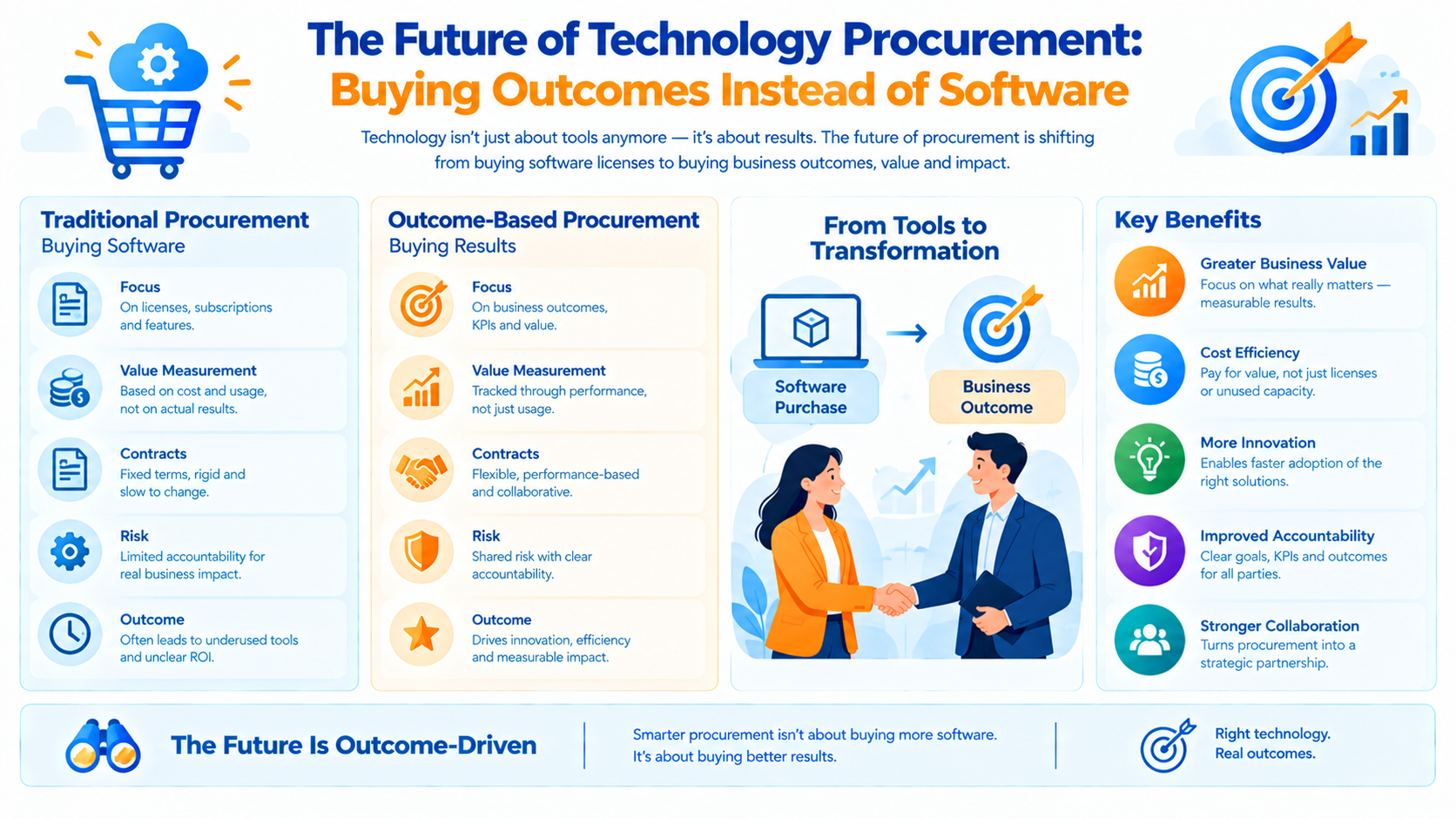
Outcome-based procurement is the practice of contracting for a defined result rather than for access to a tool.
The shift in framing:
| Traditional | Outcome-Based |
|---|---|
| What product? | What result? |
| How many seats? | How much of the outcome? |
| What does it cost? | What is it worth? |
| Who uses it? | Who delivers it? |
| How do we deploy it? | How do we measure it? |
The practical difference is accountability. In traditional procurement, the vendor sells a tool and the buyer is responsible for results. In outcome-based procurement, the vendor is accountable for the result.
The Spectrum of Outcome-Based Models
Outcome-based procurement is not a single model. It is a spectrum.
| Model | What Is Purchased | Risk Bearer |
|---|---|---|
| License / subscription | Access to software | Buyer |
| Consumption | Usage (tokens, API calls, hours) | Buyer |
| Managed service | Operation of a system | Shared |
| Outcome-based | A defined result | Vendor |
| Gain-share | A share of value created | Shared |
As you move down the spectrum, the vendor takes on more risk and more accountability. The trade-off is that the buyer typically pays more per unit when the vendor bears more risk.
The practical reality: Most organizations use a mix. Some capabilities are best purchased as tools. Others are best purchased as outcomes.
What Makes an Outcome Contractable
Not every outcome can be purchased. An outcome must be measurable, attributable, and verifiable.
Measurable. The outcome must be defined in terms that can be quantified cost reduced, time saved, revenue generated, error rate reduced.
Attributable. It must be possible to attribute the outcome to the vendor's work, not to other factors.
Verifiable. Both parties must agree on how the outcome is measured, and the measurement must be trustworthy.
Bounded. The outcome must be achievable within a defined scope and timeframe.
The common failure: Contracting for outcomes that are not cleanly attributable. If the vendor's work contributes to a result that has many causes, the outcome cannot be fairly measured.
The Pricing Models
Outcome-based pricing takes several forms, each with different risk profiles.
Pay-Per-Outcome
The vendor is paid when a defined outcome occurs.
Example: A vendor is paid per resolved support ticket, per qualified lead, or per completed transaction.
Strengths: Clear alignment between payment and value.
Weaknesses: Requires precise definition of the outcome and reliable measurement.
Gain-Share
The vendor receives a share of the value created.
Example: A vendor receives a percentage of cost savings, revenue growth, or productivity gains.
Strengths: Aligns incentives strongly with value creation.
Weaknesses: Attribution is difficult, and disputes over measurement are common.
Tiered Outcomes
The vendor is paid based on the level of outcome achieved.
Example: A base payment for meeting a threshold, with additional payment for exceeding it.
Strengths: Provides incentive for high performance while limiting downside.
Weaknesses: Requires careful threshold design.
Hybrid Models
A base fee plus a variable component tied to outcomes.
Example: A platform fee plus a per-outcome component.
Strengths: Provides vendor with baseline revenue and buyer with aligned incentives.
Weaknesses: Complexity in structuring and managing.
The Risks of Outcome-Based Procurement
Outcome-based models are not free of risk. They introduce new ones.
Measurement Disputes
If the outcome is not precisely defined and the measurement not agreed, disputes are inevitable.
Mitigation: Define the outcome precisely, agree on measurement methodology, and establish a dispute resolution process before signing.
Cherry-Picking
A vendor paid per outcome may select only the easiest cases.
Mitigation: Define the scope inclusively and include quality metrics alongside volume metrics.
Attribution Conflicts
When multiple vendors or internal teams contribute to an outcome, attribution becomes contested.
Mitigation: Define boundaries clearly and use attribution methodologies both parties accept.
Hidden Costs
A vendor taking on outcome risk will price that risk into the contract.
Mitigation: Compare total cost of ownership across models, not just headline rates.
Vendor Viability
If the vendor bears too much risk, it may fail leaving the buyer without a partner.
Mitigation: Structure contracts so that both parties have a reasonable path to success.
What Procurement Needs to Change
Outcome-based procurement requires capabilities that traditional procurement does not.
Outcome Definition
Someone must define the outcome precisely what it is, how it is measured, and what threshold constitutes success.
Measurement Infrastructure
Someone must build the capability to measure the outcome accurately.
Contract Structure
Legal and procurement teams must structure contracts that align incentives without creating disputes.
Vendor Management
Ongoing management shifts from license compliance to outcome performance management.
Internal Alignment
The business, finance, and technology teams must agree on what outcome matters and how it will be measured.
What Vendors Need to Change
Outcome-based procurement is not only a buyer-side shift. Vendors must adapt.
Pricing models. Vendors must be able to price outcomes, not just products.
Measurement. Vendors must be able to measure and demonstrate outcomes.
Risk tolerance. Vendors must be willing to bear more risk in exchange for higher potential returns.
Delivery model. Vendors must be organized to deliver results, not just to ship software.
Implementation Roadmap
Phase 1: Identify Candidates (Weeks 1-3)
-
Review current technology spend. Where is spend tied to outcomes that can be measured?
-
Identify outcomes worth contracting. Which results matter enough to purchase directly?
-
Assess attribution. Can the outcome be cleanly attributed to a vendor's work?
Phase 2: Define (Weeks 4-6)
-
Define outcomes precisely. What exactly is being purchased?
-
Define measurement. How will it be measured, and by whom?
-
Define thresholds and pricing. What constitutes success, and what triggers payment?
-
Define dispute resolution.
Phase 3: Pilot (Weeks 7-12+)
-
Start with a bounded outcome. Choose one where measurement is straightforward.
-
Structure the contract with clear definitions.
-
Measure and validate.
-
Expand to additional outcomes as the model proves workable.
Frequently Asked Questions
Q1: Is outcome-based procurement replacing traditional software purchasing?
Not entirely. It is expanding the options. Some capabilities are best purchased as tools; others are best purchased as outcomes.
Q2: Which outcomes are easiest to contract?
Outcomes that are measurable, attributable, and bounded. Support resolution, transaction processing, and document extraction are common examples.
Q3: How do I avoid measurement disputes?
Define the outcome precisely, agree on measurement methodology, and establish a dispute resolution process before signing.
Q4: Is outcome-based procurement more expensive?
Per unit, often yes—the vendor is bearing more risk. But the total cost may be lower if the outcome is delivered reliably.
Q5: Does this work for large organizations?
It requires more from procurement, legal, and vendor management. Organizations with mature procurement functions are adopting it first.
Q6: How can Innovative AI Solutions help?
We help organizations define outcomes, structure measurement, and design procurement models that align incentives. Explore our services to see how we approach technology partnerships. Based in Delhi, serving clients across India.
Why Delhi is a Great Hub for Procurement Innovation
Delhi is emerging as a hub for enterprise technology and procurement innovation, backed by a large base of organizations modernizing their technology stacks and increasing pressure to demonstrate returns. As Indian enterprises adopt AI and automation, outcome-based procurement becomes a practical way to align vendor incentives with business results.
What We Offer at Innovative AI Solutions
-
Outcome Identification: We help you identify outcomes worth contracting.
-
Measurement Design: We build the capability to measure outcomes accurately.
-
Contract Structuring: We help define outcomes, thresholds, and pricing models.
-
Vendor Evaluation: We help assess vendors for outcome-based engagement.
-
Ongoing Management: We help manage outcome performance and dispute resolution.
Final Thought
The shift is clear: from buying tools to buying results. Outcome-based procurement makes the vendor accountable for the outcome, not just for the software. It requires more discipline in defining what is being purchased and how it will be measured. But it aligns incentives in a way that traditional procurement cannot. Organizations that make this shift will spend less on capability that is not used and more on results that matter.
Contact Us:
Phone: +91 7464 099 059 / +91 9689967356
Email: info@innovativeais.com
Address: 904, 9th floor Pearls Best Heights-I, Netaji Subhash Place, Delhi-110034
Website: https://innovativeais.com
About the Author
Abhishek Kumar
Founder & CEO, Innovative AI Solutions
5+ years building AI, cloud, and enterprise systems. Based in Delhi, serving clients across India.