The Big Question
"We are investing in AI. We have chatbots, copilots, and dashboards. But I keep hearing about AI that 'just works' in the background. What does that actually mean, and why does it matter?"
The honest answer:
The most impactful AI isn't the AI you see—it's the AI you don't.
Here is the truth:
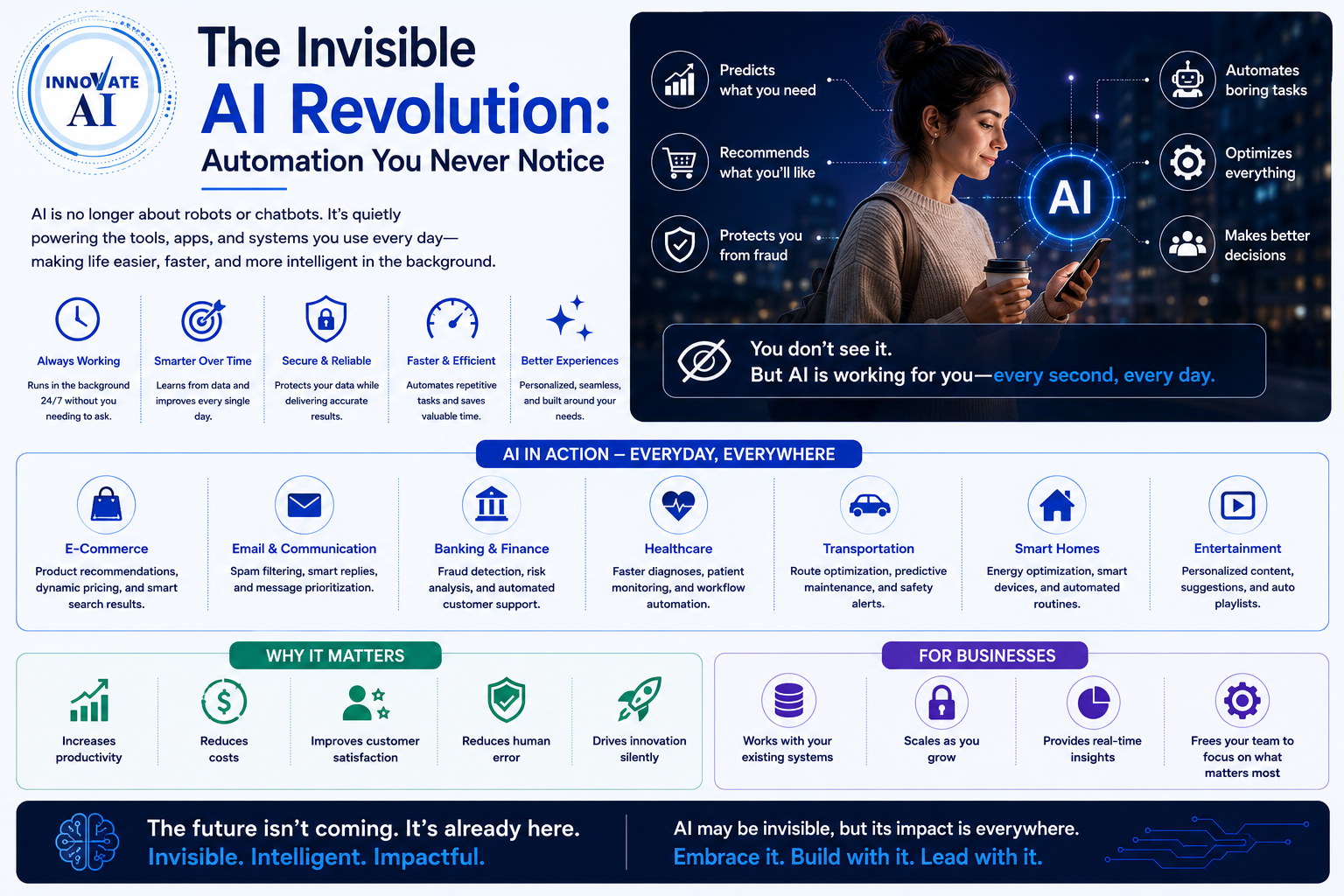
For years, AI has been presented as a competitive edge—showcasing chatbots, predictive analytics, and automation as customer-facing applications. But today, invisible AI also transforms industries in ways most people don't even see.
When AI slips into businesses the way water finds cracks—quietly, casually, often unintentionally—it becomes more powerful than any flashy rollout.
Step 3: The Web Playbook
This seamless integration mirrors the web's evolution in the 1990s and early 2000s. Initially, businesses treated the internet as a separate channel—creating dedicated "web departments" and standalone websites disconnected from core operations. Early adopters proudly displayed "Now on the Web!" badges, treating online presence as an additional service rather than integrated capability.
By the mid-2000s, the web had become invisible infrastructure. Businesses stopped having separate "internet strategies" because web connectivity became fundamental to how every department operated, from supply chain management to customer service.
Today, no one announces "we use the internet" because it's simply how business gets done.
AI is following this exact trajectory.
McKinsey's recent "The State of AI" report states that 34% of organizations use embedded AI as their primary deployment method, compared to only 19% favoring standalone applications like ChatGPT or Claude. When AI features appear in tools employees already use—like smart insights in their CRM—adoption happens naturally because there's nothing new to learn.
Step 4: What Invisible AI Actually Looks Like
The Unseen Engine of Efficiency
Businesses are using AI to enhance operational efficiencies behind the scenes, automating communications, optimizing routing, and improving fleet management. New AI-driven solutions provide real-time data insights, allowing companies to consolidate packages more effectively, plan better delivery routes, and optimize capacity.
Financial services: AI is a powerful tool for risk management, fraud detection, and compliance. With access to vast datasets and machine learning models, businesses can detect anomalies in real time, preventing fraud before it happens.
Customer experience: In retail, AI-powered recommendation engines tailor product suggestions in real time, without customers even realizing AI is at work. In financial services, AI-driven insights help banks pre-emptively identify issues, such as unusual spending patterns, before they become problems.
The Shift from Reactionary to Anticipatory
More than ever, AI is shifting from reactionary to anticipatory. By analyzing behavioral data, businesses can anticipate customer needs and offer solutions before they even ask.
| Visible AI | Invisible AI |
|---|---|
| Chatbots you interact with | Fraud detection blocking transactions |
| Copilots you summon | Email autocomplete as you type |
| AI tools you launch | Route optimization in logistics |
| Prompts you craft | Smart insights in your CRM |
Step 5: Why Invisible AI Is More Powerful
Reason 1: Lower Barriers to Adoption
When AI is embedded in tools employees already use, adoption happens naturally. There's nothing new to learn.
Reason 2: Consistent Integration
AI becomes part of the workflow, not a separate tool that employees have to remember to use.
Reason 3: Reduced Cognitive Load
Instead of forcing users to figure out how to "talk to AI," invisible AI works in the background, surfacing value without effort.
Reason 4: Competitive Parity
Differentiation now comes not from implementing AI, but from strategic deployment across entire business ecosystems rather than isolated pilot projects.
Step 6: The Governance Challenge
Here is where the invisible revolution becomes uncomfortable.
AI is doing work inside your business every day—some of it helpful, some of it inconsistent, and most of it invisible to leadership.
The Experimentation Gap
AI slipped into businesses quietly, often unintentionally. A manager tried a tool at home and then used it to speed up a report. A customer service team borrowed a prompt from LinkedIn and found their replies sounded smoother. A frustrated analyst used an online model to produce a more accurate forecast.
No grand announcement. No governance meeting. Just small improvements happening in odd pockets of the organisation.
The Visibility Problem
Once a strategy director understands how AI is influencing the organisation, everything becomes easier. Direction replaces guesswork. Confidence replaces caution.
But right now, most strategy directors are looking through frosted glass, trying to interpret shapes they can't quite see clearly.
The uncomfortable truth is that many organisations will fund observability only after the first near-miss. The smarter move is treating it as foundational infrastructure, not an add-on.
Step 7: The Invisible Workforce Behind AI
What makes invisible AI truly invisible is the human labor behind the scenes. Researchers call this "ghost work"—work carried out behind the scenes to make automation appear seamless.
The Reality of Human-in-the-Loop
All AI models are in some way highly dependent on human labour. From self-driving cars to virtual assistants, the AI industry thrives on data. This data needs to be meticulously labelled, categorised, and annotated. This requires human intelligence and labour—both of which still cannot be replaced by machines.
The human cost:
-
Data labelers annotate images and text
-
Content moderators filter toxic content
-
Quality checkers validate model outputs
-
Micro-task workers perform fragmented tasks on digital platforms
This type of work is often overlooked and is carried out by workers who lack proper labour rights.
The Recognition Gap
Google Books, for instance, publishes digitised texts. To do that, they employ low-wage workers who are scanning pages manually. A data-processing task totalling five hours at one research institute only took two minutes of mainframe time while the remaining four hours and 58 minutes depended on human hands.
The user interfaces, often both functional and elegantly designed, help automation appear seamless. But human input is necessary and often takes place in non-Nordic contexts, while systems are increasingly integrated into our everyday lives.
Step 8: Observability—The Cost of Invisibility
If invisible AI is the goal, observability is the insurance policy.
Why Traditional Monitoring Isn't Enough
Classic observability stacks—metrics, logs, traces—were designed around deterministic systems and failures we can name. Agentic systems break that neat model. An agent can complete a workflow successfully while making a series of decisions an organisation would consider unacceptable if it could see them.
AI observability is emerging to solve a simple but uncomfortable problem: autonomous agents do real work, yet their work is inherently hard to observe.
What AI Observability Requires
-
Real-time activity monitoring across systems
-
Reasoning-chain visibility (explainability you can operationalise)
-
Guardrails, policy enforcement, and compliance boundary monitoring
-
Drift detection across prompts, tools, data sources, and feedback loops
-
Audit trails that satisfy regulators and customers
If you can't answer "why did it do that?" you don't have observability—you have hope.
Step 9: Implementation Roadmap
Phase 1: See What's Already There
| Action | Output |
|---|---|
| Ask teams how they use AI (off the record) | Honest inventory |
| Identify unofficial AI experiments | Shadow AI map |
| Spot departments moving faster than others | Performance signal |
| Document how AI is influencing critical decisions | Decision impact analysis |
Phase 2: Shape the Invisible
| Action | Output |
|---|---|
| Embed AI into existing tools (API-first) | Frictionless integration |
| Set guardrails and policy boundaries | Governed autonomy |
| Implement AI observability | Visibility into agent behaviour |
| Deploy human review for high-risk decisions | Trust framework |
Phase 3: Scale Intentionally
| Action | Output |
|---|---|
| Move from ad-hoc to coordinated AI | Coherent capability |
| Train teams on AI literacy | AI-fluent workforce |
| Measure outcomes, not activity | Business impact data |
Step 10: Frequently Asked Questions
Q1: What is invisible AI?
Invisible AI is artificial intelligence that works seamlessly in the background—embedded in existing tools and workflows rather than standing alone as a separate application or chatbot. The best AI is the AI you don't even notice.
Q2: Why is invisible AI more powerful than visible AI?
Invisible AI lowers the barrier to adoption, ensures consistent integration, reduces cognitive load on users, and makes AI a natural part of how work gets done.
Q3: What is the biggest risk of invisible AI?
Governance and observability. Because invisible AI operates in the background, organizations often don't know what decisions it's making or how it's influencing outcomes. Without visibility, you can't audit, correct, or trust the system.
Q4: What is AI observability?
AI observability is the ability to monitor, trace, and explain how AI systems—especially agents—behave in production. It goes beyond uptime and performance to capture decision context, tool use, policy enforcement, and auditable records of actions.
Q5: Is invisible AI really invisible?
No—it's invisible to users, but there is often human labour behind the scenes. Data labelers, content moderators, and micro-task workers keep AI systems running. This "ghost work" is often overlooked and poorly compensated.
Q6: How can Innovative AI Solutions help?
We help organizations design, build, and govern invisible AI systems—from embedding intelligence into existing workflows to establishing observability and governance frameworks. Based in Delhi, serving clients across India.
Step 11: Final Tagline
"The post-digital era isn't about adopting technology as a box-ticking exercise; it's about using AI effectively to boost operations, elevate experiences, and strengthen teams behind the scenes. In this new paradigm, the best AI is the AI you don't even notice, yet can't imagine working without."
Short version:
The invisible AI revolution—when automation works so well, you forget it's there. A 2026 guide to embedded intelligence, observability, and the future of enterprise AI.
Hashtags:
#InvisibleAI #EmbeddedAI #AIInfrastructure #AIObservability #EnterpriseAI #InnovativeAISolutions
Contact Us
Phone: +91 7464 099 059 / +91 96899 67356
Email: info@innovativeais.com
Address: Netaji Subhash Place, Pitampura, Delhi – 110034
Website: https://innovativeais.com
About the Author
Abhishek Kumar
Founder & CEO, Innovative AI Solutions
5+ years building AI systems for enterprises. Based in Delhi, serving clients across India.
Related services: to apply this in your business, explore our AI development services and AI chatbot development.