The Big Question
A CEO recently posed a question that captures the anxiety of our era: "If my junior analyst can get the same AI-generated insights as my senior strategist, why am I paying for expertise?"
It's not hyperbole. We're witnessing an unprecedented democratization of knowledge. Information once locked in specialized databases, consulting reports, and expert minds is now instantly available to anyone with access to generative AI. A startup founder in Indonesia can access strategic frameworks that once required McKinsey consultants. A nurse practitioner in rural Kansas can synthesize medical research like a specialist at Mayo Clinic .
This isn't simply another wave of automation—it's a fundamental restructuring of knowledge itself .
The Knowledge Commoditization Shift
The End of Knowledge as a Differentiator
For decades, career success followed a simple formula: acquire knowledge, develop expertise, and become indispensable. Artificial intelligence is rewriting that formula. Today, AI gives everyone immediate access to more knowledge than any individual could ever possess .
The signals are everywhere:
Content is infinite; trust is limited. AI now generates roughly half of all newly published article-style content online. But while content has become infinite, trust remains scarce—and that scarcity makes trust more valuable than ever. When everyone can create content, people choose people before they choose content .
Expertise is abundant; perspective is scarce. Everyone has access to the same tools and information. The professionals who stand out won't be the ones who know the most. They'll be the ones who interpret, connect, and communicate ideas in ways that reflect their unique point of view—shaped by their life experiences, values, observations, and judgment .
Information is abundant; intellectual property is transformative. In a world overflowing with information, structure becomes a competitive advantage. Developing frameworks, systems, methodologies, and experiences that help people understand and apply ideas becomes the new differentiator .
The Three Transformations
When knowledge becomes commoditized, its value paradoxically shifts from content to context :
1. From Answers to Questions: AI excels at providing comprehensive answers, but only to questions we know to ask. The most valuable human expertise lies in identifying unasked questions and recognizing unknown unknowns. A seasoned strategist understands not only current industry patterns but also hidden assumptions and unexplored adjacencies—the white spaces that don't yet exist in any AI model's training data .
2. From Information to Judgment: While AI can instantly synthesize vast amounts of information, it cannot bear the weight of consequences. When an AI system recommends restructuring your supply chain or entering a new market, the accountability remains entirely human. This gap between intelligence and responsibility creates an irreplaceable role for human judgment .
3. From Static to Liquid Knowledge: Traditional knowledge management treats information as a fixed asset to be stored and retrieved. AI reveals knowledge dynamically, reshaping it based on context, user, and moment. Each prompt generates a unique knowledge artifact tailored to specific needs .
The New Competitive Advantage: Perspective and Meta-Expertise
What Is Perspective?
Perspective is the human ability to connect information, experience, and intuition to create meaning that drives action. Where AI can summarize what is known and model scenarios, perspective explains why it matters and what to do next .
It is not simply opinion, but earned subjectivity—insight shaped by domain experience, judgment, and context .
The Rise of Meta-Expertise
Rather than making human expertise obsolete, AI is elevating what expertise means. The most valuable professionals are developing what experts call meta-expertise—the ability to orchestrate knowledge from multiple AI systems, validate outputs, and synthesize information across domains .
This requires three distinct capabilities that AI cannot replicate :
1. Creative Synthesis: While AI excels at pattern recognition within existing data, breakthrough innovation comes from connecting seemingly unrelated ideas. The creative leaps—seeing connections between a butterfly's wing structures and drug delivery mechanisms, or applying jazz improvisation principles to smart building design—represent uniquely human cognition .
2. Contextual Wisdom: The intuitive understanding built through years of experience remains difficult to codify. The experienced plant manager who senses equipment problems before sensors detect them, or the sales director who discerns unspoken client concerns, possesses wisdom that transcends data patterns .
3. Ethical Navigation: As AI handles more analytical work, human expertise must increasingly focus on ethical judgment, cultural sensitivity, and stakeholder management. The ability to navigate competing interests, understand unspoken cultural norms, and make principled decisions under pressure remains fundamentally human .
Building AI-Driven Knowledge Systems
The Strategic Imperative
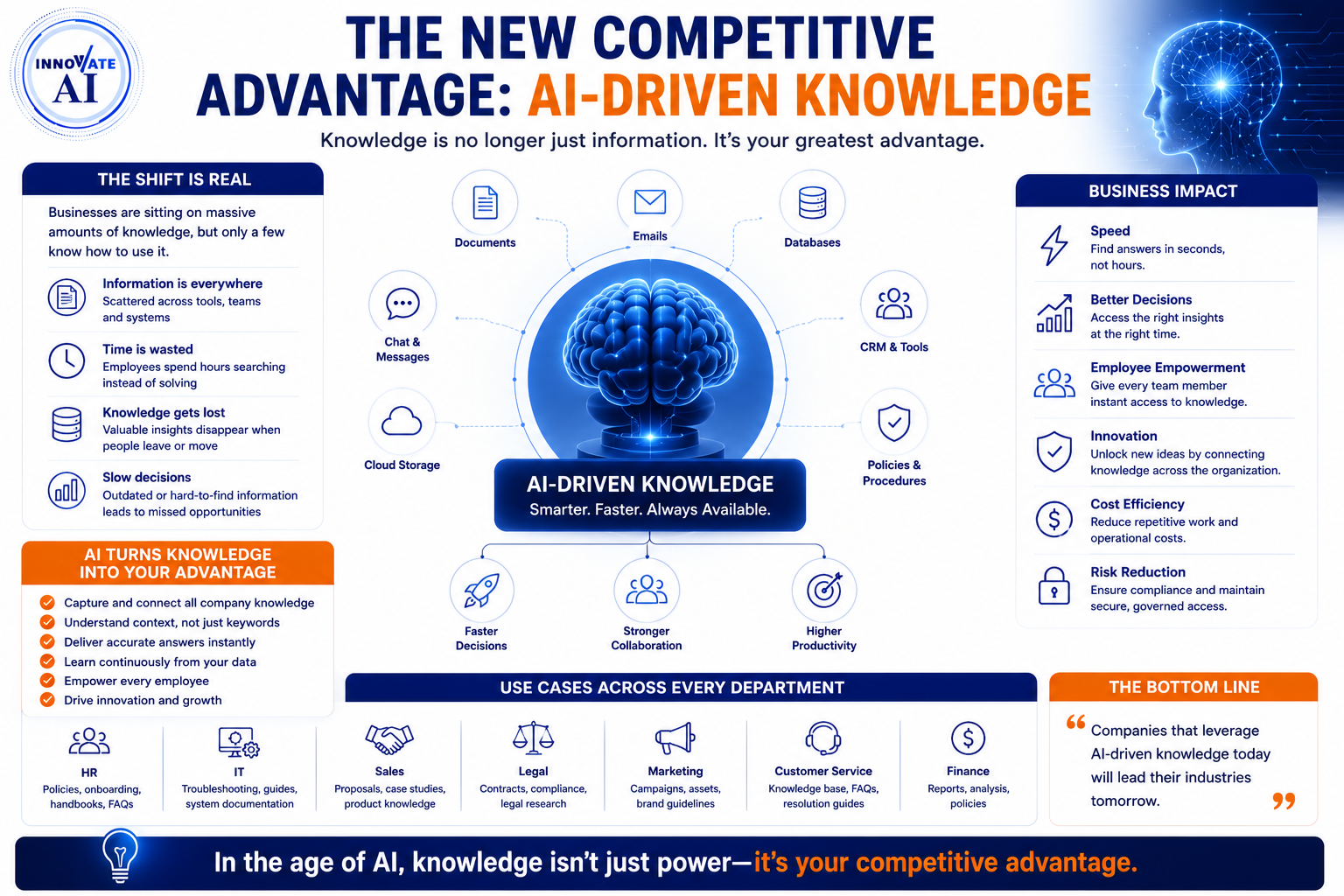
The only path to sustainable business advantage lies in capturing and putting your organization's unique and proprietary knowledge, expertise, and capabilities to work through AI models, apps, and agents . General-purpose models trained on public data cannot differentiate your business .
This requires developing your knowledge capacity—the ability to deploy proprietary knowledge through AI-powered tools, systems, and workflows. This involves:
-
Capturing tacit knowledge trapped in file systems, informal processes, and human expertise
-
Optimizing existing knowledge stored in databases, documents, and other digital assets
-
Building proprietary knowledge graphs that connect disparate data sources
-
Deploying AI agents that can reason over this knowledge
The Knowledge-First Approach
A knowledge-first approach isn't just a technological initiative—it's a strategic transformation. It involves connecting disparate data sources, adding semantic context, and applying AI in a way that empowers teams to ask better questions and get precise answers .
The shift in mindset: Instead of asking "What data do we have?" ask "What knowledge do we need to answer our most critical business questions?" .
The Knowledge Automation Opportunity
The challenge is urgent. Inefficient knowledge management reduces annual revenue by 25% on average. Employees spend an average of 8.5 hours per week searching across disconnected systems. 65% of employees spend one hour or more per week duplicating or re-creating work that already exists .
AI-powered knowledge automation addresses this by:
-
Intelligent Discovery: AI automatically analyzes conversations and questions to identify what knowledge truly matters
-
Content Cleansing: AI eliminates duplicate or conflicting content
-
Automated Curation: Trusted knowledge content is sourced, connected, and curated automatically in seconds
-
Continuous Optimization: Ongoing maintenance and publishing is automated, including content taxonomies and metadata generation
What Perspective Looks Like in Practice
The Human Skills That Matter Now
AI is creating what experts call the "Great Human Premium"—an economic shift that makes uniquely human qualities more valuable as AI becomes more capable .
The five key ways organizations are building perspective :
1. Ask Better Questions: AI is excellent at responding, but it cannot reframe a problem. Use the 5 Whys technique to reach underlying drivers. Replace brainstorming with "question storms"—timeboxed sessions where no one can propose solutions, only better questions. The quality of your questions determines the quality of your insights .
2. Facilitate Collaboration: Collaboration is harder in virtual environments, which makes it more valuable. Create spaces where teams can cross-pollinate ideas through workshops and ideation sprints that allow people to challenge, defend, and refine their thinking .
3. Build Multidisciplinary Skills: The most valuable people are "T-shaped"—combining deep expertise in one area with broad knowledge across others. Create cross-functional projects where analysts and creatives review the same insight from different viewpoints .
4. Practice Radical Synthesis: We are not short of data. The opportunity is to strengthen your ability to synthesize and extract clarity from complexity. Ask each participant to summarize what the data means for the business in a single sentence. Compare answers until a unifying perspective emerges .
5. Turn Knowledge Into Storytelling: When everyone has access to the same facts, your advantage lies in how you tell the story. The real question isn't the data—it's "So what?" The story transforms a statistic into a strategic conversation .
The Cognitive Sovereignty Imperative
Research shows that using generative AI systems reduces humans' ability to think creatively, resulting in more homogeneous ideas and fewer truly innovative ones . More concerning is the homogenization of thought—when millions pose similar questions and receive similar AI-generated answers, we risk intellectual convergence, a flattening of diverse thinking .
Organizations must deliberately preserve human thinking capabilities:
-
Mandate that strategic proposals include sections developed through human analysis
-
Implement "human thinking sprints" where teams solve problems without AI assistance
-
Insert deliberate friction in certain processes to test cognitive fitness
Implementation Roadmap: The First 90 Days
Phase 1: Knowledge Audit and Foundation (Weeks 1-4)
-
Audit knowledge assets: Identify where critical knowledge resides and where fragmentation exists. Map existing knowledge flows .
-
Define competitive knowledge: Identify what proprietary knowledge truly differentiates your business .
-
Select starting points: Begin with 1-2 departments with significant knowledge challenges and strategic importance .
-
Establish governance: Define permissions, data boundaries, and security requirements .
Phase 2: Build Knowledge Capacity (Weeks 5-8)
-
Connect data sources: Integrate CRM, analytics, finance, and operational systems .
-
Build knowledge graph: Model a chosen domain as a knowledge graph, unifying disparate data sources into a single queryable asset .
-
Deploy AI agents: Start with virtual analysts that answer business questions using structured business meaning .
-
Establish semantic layer: Define consistent business metrics and relationships .
Phase 3: Operationalize and Scale (Weeks 9-12+)
-
Measure impact: Track decision speed, time saved, and revenue impact against predefined metrics .
-
Scale to additional domains: Expand the knowledge-first architecture to other high-value areas .
-
Develop AI orchestration capabilities: Build teams that design workflows integrating AI and human capabilities .
-
Invest in meta-expertise: Develop training programs focused on creative synthesis, ethical reasoning, and critical evaluation .
Frequently Asked Questions
Q1: If AI makes knowledge a commodity, what becomes the new competitive advantage?
Perspective, judgment, and the ability to ask better questions. Organizations that combine AI-driven knowledge systems with uniquely human capabilities like creative synthesis, contextual wisdom, and ethical navigation will thrive .
Q2: What is meta-expertise?
The ability to orchestrate knowledge from multiple AI systems, validate outputs, and synthesize information across domains. It requires creative synthesis, contextual wisdom, and ethical navigation—capabilities AI cannot replicate .
Q3: How much does fragmented knowledge cost organizations?
Inefficient knowledge management reduces annual revenue by 25% on average. Employees spend 8.5 hours per week searching across disconnected systems .
Q4: What is "enterprise intelligence"?
Enterprise intelligence converges knowledge management, enterprise search, and business intelligence into a transformative force that anticipates, connects, and delivers insights in real time across the organization .
Q5: What are the risks of over-relying on AI for thinking?
Research shows that using generative AI reduces creative thinking ability and leads to more homogeneous ideas. The homogenization of thought—when millions receive similar AI-generated answers—risks intellectual convergence that stifles innovation .
Q6: How can Innovative AI Solutions help?
We help organizations design, build, and operationalize AI-driven knowledge systems—from knowledge audits and platform selection to governance design and meta-expertise development. Based in Delhi, serving clients across India.
Why Delhi is a Great Hub for AI Development
Delhi is emerging as a significant hub for AI development, backed by concrete government support and infrastructure. The recent Delhi Budget 2026-27 allocated ₹8.20 crore for two Artificial Intelligence centres of excellence (AI-CoEs), functioning as hubs for research, innovation, and startup incubation.
The city's AI infrastructure is expanding rapidly. Under the IndiaAI Mission, more than 38,000 high-end GPUs have been onboarded and are available at approximately ₹65 per hour—roughly one-third of the global average cost. This makes AI development remarkably cost-effective compared to other tech hubs.
The government has also announced a ₹350 crore startup policy over five years, aiming to support the emergence of at least 5,000 startups by 2035, with key focus areas including artificial intelligence, machine learning, and automation.
The AI ecosystem in Delhi combines: cost-effective infrastructure, government support, a growing talent pool, and proximity to the country's business decision-makers.
What We Offer at Innovative AI Solutions
After five years of building AI solutions for businesses, we've developed a practical approach that focuses on what actually works:
-
Knowledge Strategy: We help you assess your knowledge assets and design a competitive knowledge architecture
-
Platform Selection: We help you choose and deploy the right knowledge management and AI platforms
-
Governance Design: We help you establish permissions, audit trails, and accountability
-
Enterprise Intelligence Implementation: We help you build knowledge graphs and semantic layers that power AI reasoning
-
Meta-Expertise Development: We help you build training programs that develop uniquely human capabilities
-
Change Management: We help your organization shift from information accumulation to perspective development
Our approach is built on the reality that knowledge isn't the differentiator anymore—perspective is.
Final Thought
As AI capabilities expand, the ultimate competitive advantage may be the courage to remain cognitively sovereign. This means deliberately preserving and cultivating uniquely human capabilities, even when outsourcing them would be more efficient at certain times .
The question facing leaders isn't whether human expertise remains relevant in the AI age. It's whether organizations will thoughtfully cultivate the uniquely human capabilities that no algorithm can replicate—the weight of accountability, the spark of creativity, and the wisdom to know which questions shouldn't be outsourced to machines .
The organizations that navigate this challenge successfully won't just survive the AI revolution. They'll define what human-centered innovation looks like in an age of ubiquitous intelligence.
Contact Us:
Phone: +91 7464 099 059 / +91 9689967356
Email: info@innovativeais.com
Address: Netaji Subhash Place, Pitampura, Delhi – 110034
Website: https://innovativeais.com
About the Author
Abhishek Kumar
Founder & CEO, Innovative AI Solutions
5+ years building AI systems for enterprises. Based in Delhi, serving clients across India.
Hashtags: #AIDrivenKnowledge #CompetitiveAdvantage #KnowledgeManagement #MetaExpertise #EnterpriseAI #AIStrategy #InnovativeAISolutions
Related services: to apply this in your business, explore our AI development services and RAG development.