The Big Question
Let me start with a question that every product leader building AI applications must answer.
"We have built an AI product. Users have to type a prompt to get value. But most people don't want to think about how to talk to an AI. How do we make it work for everyone?"
The honest answer:
You don't need users to write better prompts. You need AI that doesn't need prompts at all.
Here is the truth:
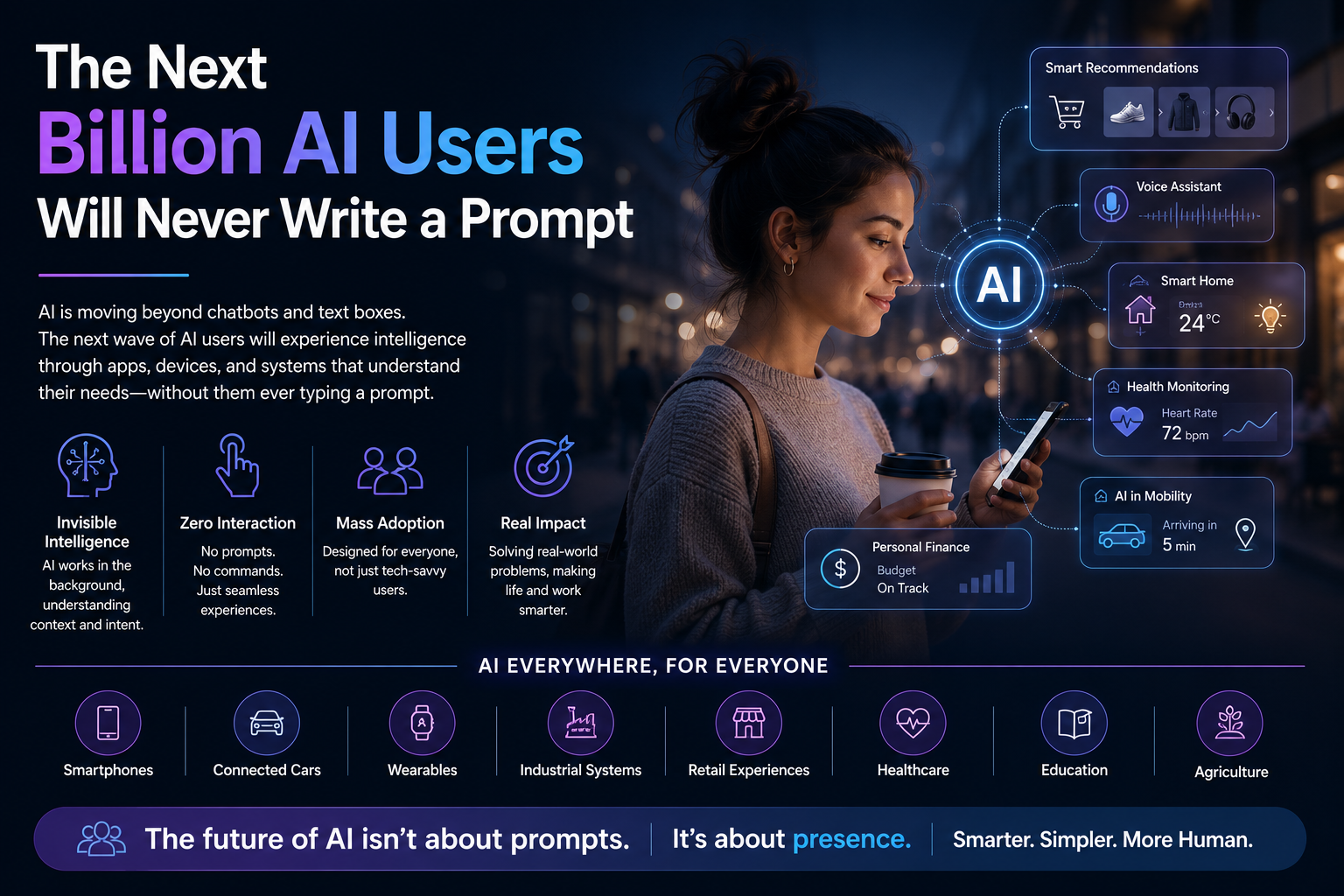
The vast majority of people will never use a chatbot interface the way tech enthusiasts do. They will not type "write a professional email" or "summarize this document." They will simply go about their day—and the AI will be there, working, without ever being asked.
When AI becomes invisible, it becomes universal. When the interface disappears, the user base expands exponentially.
Step 3: The Prompt Barrier
Why Prompting Excludes Most People
For AI to reach its next billion users, the interface must evolve beyond the prompt. The current mode of interaction—a blinking cursor, an empty text box, and an expectation that the user knows what to ask—is a profound barrier.
Prompting assumes several things that are not true for most of the world:
-
Users understand what the AI is capable of
-
Users can articulate their needs in a structured way
-
Users are willing to iterate and refine their requests
-
Users are comfortable with open-ended text input
When AI requires a prompt, it demands a certain kind of literacy—not just technical fluency, but also the ability to translate human intent into machine instructions. This is not a universal skill. It is a narrow one, concentrated among the already digitally fluent.
The Invisible Interface
Invisible intelligence works through context, not commands. It observes what the user is doing, understands the environment, and surfaces the right information or action at the right time—without being asked.
Consider how AI could operate invisibly:
| Where It Shows Up | How It Works | The Experience |
|---|---|---|
| Email composition | Suggests completions for your style | It feels like the AI knows what you meant to say |
| Calendar management | Schedules and reschedules seamlessly | Meetings just happen |
| Travel planning | Researches and suggests options | The AI is a silent travel agent |
| Customer support | Predicts needs and offers help | Support arrives before you ask |
"The best interface is no interface. The most powerful AI is the one you never have to think about."
Step 4: The Technologies Making Invisible AI Possible
Agentic AI
Agentic AI systems are designed to act autonomously—to perceive, reason, plan, and execute tasks without requiring step-by-step instructions. These systems will operate in the background, monitoring activity, identifying opportunities to help, and acting without explicit commands.
Agentic AI is the engine of invisibility. Instead of waiting for a prompt, an agentic system observes the world around it and decides when and how to act.
Contextual Intelligence
Contextual intelligence allows AI to understand the situation it is operating within—who the user is, what they are trying to accomplish, and what information is relevant. This is the difference between generic recommendations and genuinely helpful suggestions.
The contextual intelligence stack includes:
-
User activity patterns and behavioral data
-
Device and environmental context
-
Prior interactions and preferences
-
Knowledge of the task at hand
Predictive Models
The first form of invisible intelligence is prediction. Smartphone keyboards that guess the next word, e-commerce sites that predict what you want to buy—these are early examples of AI that works without a prompt. As these capabilities improve, prediction will become the primary interface for AI.
Personalization Infrastructure
Personalization is the substrate that makes AI invisible. When an AI knows you, it can anticipate your needs without being asked. Personalization is the difference between a generic suggestion and a useful one.
Step 5: Where We Already See Invisible AI
Smartphone Autocomplete and Suggestions
The most widely used AI on the planet is invisible. The keyboard that suggests words as you type, the camera that knows which setting to apply, and the calendar that suggests where you are going—none of them require a prompt. They just work.
E-Commerce Recommendations
Online stores are quiet, unobtrusive, and deeply effective. Products are suggested based on browsing and purchase history. The user didn't ask for a recommendation, but they received one anyway.
Navigation and Maps
Maps AI predicts where you want to go, suggests routes, and even alerts you to traffic conditions—all without a prompt. The user simply opens the app, and the information is already there.
Step 6: The Path to the Next Billion Users
Step 1: Shift from "Ask" to "Anticipate"
The most direct path to the next billion users is AI that anticipates needs rather than responding to queries. The shift from ask to anticipate is the shift from active to passive interaction—from users who must initiate to users who are served.
| Ask-Based AI | Anticipatory AI |
|---|---|
| User types a question | AI understands the user's situation |
| User specifies intent | AI infers intent from context |
| User waits for a response | AI acts in the background |
| User evaluates the output | AI provides value without being asked |
Step 2: Design for Frictionless Interaction
When AI requires zero effort from the user, it becomes universally accessible. This means designing for:
-
Touch and gesture over typing
-
Visual recognition over text input
-
Voice over text
-
Context over commands
Step 3: Embed AI in Existing Workflows
The most invisible AI is embedded. It lives inside tools people already use and never asks for attention. It is a feature, not a product. The next billion users will never know they are using AI because it will be woven into the fabric of their daily tools.
Step 7: The Business Implications
The Interface is the Product
For years, AI products have been judged by their model quality. The next generation will be judged by their interface—how seamlessly intelligence is integrated into the user's life.
The Attention Economy Shift
Invisible AI changes the relationship between users and technology. Rather than demanding attention, it gives attention back—removing friction, anticipating needs, and reducing cognitive load. This is a fundamental shift in value proposition.
The New Competitive Advantage
The companies that win the next billion users will not have the largest model. They will have the most invisible AI. The advantage will belong to those who can embed intelligence so deeply that it disappears entirely.
Step 8: Implementation Roadmap
Phase 1: Context (Weeks 1-4)
| Action | Output |
|---|---|
| Identify areas where users currently perform repetitive tasks manually | Process inventory |
| Map user intent and behavior patterns | Behavioral understanding |
| Collect and structure user data for personalization | Personalization foundation |
Phase 2: Anticipation (Weeks 5-8)
| Action | Output |
|---|---|
| Build predictive models for user needs | Anticipatory logic |
| Design proactive suggestions and actions | Proactive interactions |
| Test with power users | Validation results |
Phase 3: Invisibility (Weeks 9-12)
| Action | Output |
|---|---|
| Embed AI into existing workflows | Invisible integration |
| Remove friction and user initiation | Zero-effort experience |
| Measure user adoption and satisfaction | ROI data |
Step 9: Frequently Asked Questions
Q1: Will prompting completely disappear?
No. Prompting will remain valuable for creative and open-ended tasks. But it will become a specialized tool, not the primary interface for AI.
Q2: What is the biggest barrier to invisible AI?
Data and context. To be invisible, AI must understand the user's situation. This requires data—often personal data. Balancing personalization with privacy is the critical challenge.
Q3: How will invisible AI affect the job market?
Invisible AI will change what jobs look like, not eliminate them. By removing friction and reducing cognitive load, it will allow people to focus on higher-value work.
Q4: What about privacy?
Invisible AI depends on personal data. Trust is the foundation. Organizations that are transparent about data use and give users meaningful control will win the trust of the next billion users.
Q5: How can Innovative AI Solutions help?
We help businesses design and build invisible AI—systems that understand context, anticipate needs, and embed seamlessly into user workflows. Based in Delhi, serving clients across India.
Step 10: Final Tagline
"The first wave of AI was about what you could build. The second wave is about who can use it. The next billion users will never write a prompt. They will simply live their lives—and the AI will be there, working, without ever being asked."
Short version:
The next billion AI users will never write a prompt—how invisible intelligence will democratize artificial intelligence.
Hashtags:
#InvisibleAI #AIAnticipation #NextBillionUsers #AIUX #HumanAICollaboration #InnovativeAISolutions
Contact Us
Phone: +91 7464 099 059 / +91 96899 67356
Email: info@innovativeais.com
Address: Netaji Subhash Place, Pitampura, Delhi – 110034
Website: https://innovativeais.com
About the Author
Abhishek Kumar
Founder & CEO, Innovative AI Solutions
5+ years building AI systems for enterprises. Based in Delhi, serving clients across India.
Related services: to apply this in your business, explore our AI development services and AI agent development.