The Big Question
For thirty years, websites were built for human eyes. You designed a form, a user filled it in. You built a navigation menu, a user clicked through it. The entire architecture assumed a person sitting at a keyboard, making deliberate choices.
That assumption is breaking.
In May 2026, Google announced WebMCP an open web standard that lets websites expose JavaScript functions and HTML forms as structured "tools" that AI agents can call directly . Instead of an agent visually scanning your page, finding the right form, and typing into each field, it calls a machine-friendly function. The task that took a minute of clicking completes in seconds.
The implications are massive. If your website is just a visual interface with no machine-readable API, an AI agent can't work with it efficiently. If your competitor's site exposes its booking system, inventory lookup, and order placement as callable tools, the agent will prefer your competitor. Not because it has better features because it's easier to work with.
This isn't theoretical. Google confirmed that Gemini in Chrome will soon support WebMCP APIs, and global consumer brands are already experimenting with the standard . The agentic web is not a future prediction. It's a shipping feature.
The second shift is architectural. For years, the web industry swung between extremes server-rendered monoliths, then client-side single-page applications, then back to server-side rendering. InfoWorld's 2026 analysis put it bluntly: "There is no single 'right' model for building web applications anymore" .
Modern web applications are distributed systems. They span multiple runtimes, global content delivery networks, edge caches, background workers, and increasingly complex data pipelines. A single SaaS platform often contains wildly different workloads public landing pages that demand fast first paint and predictable SEO, and authenticated dashboards that need real-time data and long-lived client state . Forcing one rendering strategy across both creates what teams eventually recognize as architectural friction.
The third shift is about who builds. 20i's 2026 survey of 500 U.S. web design professionals found that 76% view AI as the biggest threat to their business, outpacing budget cuts and rising operating costs . But the survey also revealed something more nuanced: the threat isn't AI itself. It's that clients can now create websites faster and cheaper, and some no longer recognize the value professional designers provide .
The designers who thrive are the ones who use AI as an assisting tool rather than a substitute. As Harry Roper, CEO of Imaginary Space, put it: "The question is not whether AI takes jobs, but how to change roles to fit new technology" .
Cost Based on Website Type
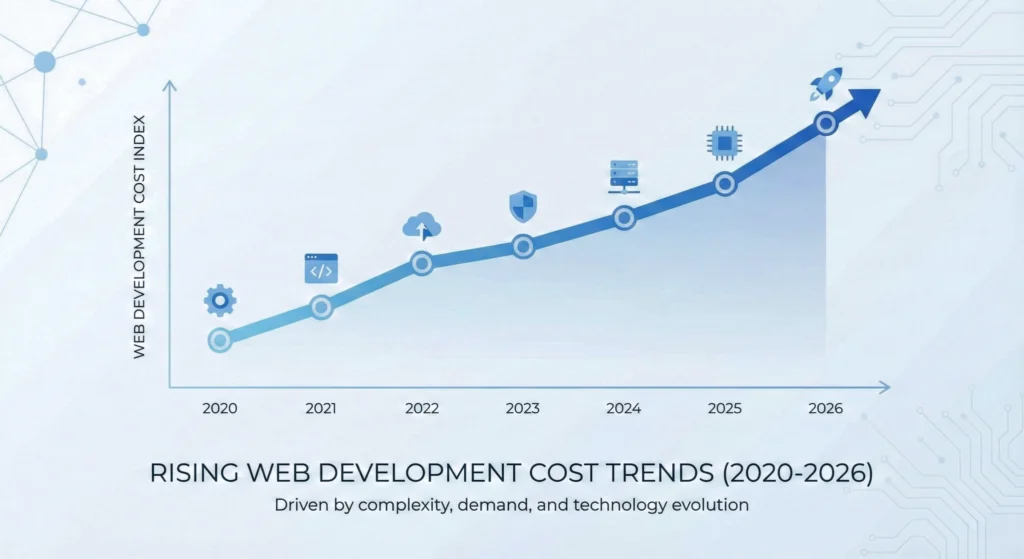
The cost of building a modern website in 2026 depends heavily on what kind of system you're actually building. Here's the market landscape based on verified project data:
| Website Type | Typical Project Budget | What It Covers |
|---|---|---|
| Template / Brochure Site | $1,000 – $5,000 | Pre-built theme, basic CMS, minimal customization |
| Custom SMB Site | $5,000 – $30,000 | Custom design, light integrations, CMS work |
| Mid-Market / Multi-Page | $20,000 – $100,000 | Design systems, integrations, SEO foundation |
| Enterprise / High-Traffic | $100,000 – $500,000+ | Multi-site, complex integrations, QA, migration strategy |
| Web Application (SaaS) | $18,000+ | User roles, data logic, authentication, API layer |
**The average project budget is $46,000**, with the median sitting between $20,000 and $25,000. Only about 10% of projects exceed $100,000 .
What drives the range:
Page count and feature complexity push projects toward the top of every range. Bookings, e-commerce, and third-party integrations each represent a system that must be configured and tested . Custom integrations with outside tools add $100 to $2,000+ each. E-commerce features add $2,000 to $20,000+ .
Who writes the content matters more than most people expect. Writing it yourself is free and slow. Done-for-you copy and photography are often quoted separately and are a common reason a quote comes in higher than expected .
The ongoing cost trap: Most quotes leave out maintenance. For a small business site, expect $600 to $6,000 a year in total ongoing costs hosting, domain renewal, SSL, software updates, security, backups, and content edits . For a web app, budget 15% to 25% of the build cost annually .
AI-generated content has hidden costs. While AI tools can write copy and generate images quickly, the output often requires heavy editing to sound human, on-brand, and accurate. There are also legal questions around AI-generated images and copyright if they're based on protected styles or artists' work .
Breakdown by Builder Type (2020-2026)
Who builds your website has a direct impact on both cost and outcome. The talent landscape has shifted dramatically:
| Builder Type | Hourly Rate | Typical Project Cost | Best For |
|---|---|---|---|
| DIY / AI Builder | $0 – $50/month | $100 – $3,000 | Portfolio sites, landing pages, MVPs |
| Freelancer | $15 – $80/hour | $1,500 – $10,000 | Custom branding without agency overhead |
| Boutique Agency | $50 – $150/hour | $6,000 – $50,000 | Strategy, process, multi-page builds |
| Full-Service Agency | $100 – $500/hour | $20,000 – $500,000+ | Complex ecosystems, integrations, enterprise |
| India-Based Agency | $15 – $50/hour | $3,000 – $50,000+ | Cost-effective delivery, global clients |
The AI builder tier (free to ~$50/month) now covers what used to require a freelancer. A local service business that needs to be findable and credible, a portfolio, a landing page for something still being validated these can be built in days with AI tools .
The freelancer tier ($1,500 to $10,000) is where custom design starts paying for itself. A freelancer gets you custom branding without agency overhead. A boutique agency from around $6,000 adds strategy and process, which matters more as the site gets more complicated .
The agency tier ($6,000 to $35,000+) is for revenue-critical builds. If the site is the storefront, if downtime costs money by the hour, or if the app is the product itself, the cost of getting it wrong is larger than the cost of building it properly .
The India advantage remains structural. Indian web development agencies charge $15 to $50 per hour, compared to $50 to $500 in Western markets . For complex builds, the savings are substantial. But quality variance is enormous. The critical question before hiring: "Show me a live site you shipped in the last 90 days not a portfolio, a running production system with real users."
Why Prices Changed in 2026
Three forces have reshaped website economics.
First, AI builders commoditized the bottom of the market. If your business model is installing a generic theme and swapping the logo, you're in trouble. AI has eaten the bottom of the market clients who want a $50 website use an automated builder now . Framer's AI plans start at $30 a month with adequate brochure sites. The freelancers who struggle are those trying to compete on speed and volume alone, because AI wins that race every time .
Second, the premium gap widened. The global web design services market still holds over $41.8 billion with 3.1% projected growth, because premium clients want custom strategy, not templates. VWO data shows custom-designed sites convert 33% higher than generic ones . A multi-million dollar business won't risk its revenue on a one-click prompt.
Third, Core Web Vitals became non-negotiable ranking factors. Google's 2026 thresholds are clear: LCP under 2.5 seconds, INP under 200 milliseconds, CLS under 0.1 . Measuring INP synthetically is limited because it measures responsiveness based on real human interactions. AI-generated code, unedited, can add 15-20% to page weight and often fails to generate proper ARIA labels or semantic HTML .
The result: the web is splitting into two markets commodity sites built by AI for businesses that just need a presence, and custom systems built by humans for businesses where the website is the product.
Pro Tips to Save Money in 2026
1. Pick the right build path for your actual needs. A local service business that needs to be findable and credible should stay in the DIY and AI builder tier. Paying $8,000 for a site that supports a business but does not drive it is a poor trade . A revenue-critical site or web app should go to an agency, because downtime costs money by the hour .
2. Count the weeks, not just the money. A site built with an AI builder can be live in a few days. An agency project commonly runs 8 to 16 weeks, and a custom web app 3 to 6 months . If the site brings in customers, every month of delay is revenue you didn't earn. A cheaper build that starts working in March may beat a better one that starts in July.
3. Model ongoing costs from day one. For a small business site, expect $600 to $6,000 a year. For a web app, 15% to 25% of build cost annually . Website maintenance costs are the line most quotes leave out, and they're why a build that looked affordable becomes a problem in year two.
4. Fix the AI-search and SEO basics. Validate meta descriptions, canonical tags, Open Graph, hreflang, and JSON-LD. The biggest opportunity is Product schema for ecommerce . A well-designed site that isn't optimized for search or populated with quality content will struggle to generate traffic regardless of how it looks .
5. Use AI for the boring parts, not the strategy. AI tools can generate layouts, write listing descriptions, and suggest category structures. But AI doesn't know why one client's directory needs trust signals above the fold, while another needs pricing transparency front and center. That context is the work .
6. Audit third-party tools ruthlessly. The average mid-market Shopify Plus merchant runs 35 to 60 apps. Each app adds licensing costs, performance risk, and integration complexity . Point-to-point integrations inflate costs by 20% to 35% over the lifecycle. Rationalize the ecosystem during migration, not after launch.
Questions to Ask Before Hiring
Before you commit budget to any web development partner, ask these questions.
1. "Show me a live site you shipped in the last 90 days not a portfolio, a running production system." Portfolios show cherry-picked work. Live sites expose real performance, real UX, and real maintenance.
2. "How will you measure Core Web Vitals, and what are your targets?" Google's 2026 thresholds are LCP under 2.5s, INP under 200ms, CLS under 0.1 . If they can't quote these numbers, they're not building for search.
3. "What's your approach to AI agents and machine-readable interfaces?" WebMCP is coming. Ask whether your site will expose structured tools for AI agents, or remain a visual interface that agents have to scrape .
4. "Who owns the code when the engagement ends?" A dev shop that builds and leaves is not a partner. Ask for the repository, the deployment pipeline, and the documentation.
5. "What's the monthly maintenance cost, and what does it cover?" Most quotes leave this out. Ask for a breakdown: hosting, security, backups, updates, content edits. If they can't provide it, you'll find out the hard way .
Why Delhi is a Great Hub for Modern Web Development
Delhi-NCR has become a serious destination for web development work, and the reason isn't just cost.
The region hosts a dense cluster of ecommerce, fintech, and enterprise companies—the exact clients who need modern, performant, agent-ready websites. DesignRush's 2026 rankings of top web development companies in India show Delhi-based agencies delivering complex builds at $15 to $50 per hour, compared to $50 to $500 in Western markets .
The talent density keeps improving. With a steady pipeline of frontend engineers, full-stack developers, and UX specialists, Delhi offers a combination of cost and capability that's hard to match. And the time zone advantage matters: a Delhi-based team can sync with Middle East morning, European afternoon, and US East Coast evening.
For businesses that need custom design, complex integrations, and ongoing maintenance, Delhi's agencies offer a middle path between the low-cost freelancer tier and the premium Western agency tier. The question isn't whether they can build it. The question is whether they can build it and maintain it because the modern website is never finished.
What We Offer
At Innovative AI Solutions, we build websites that perform, adapt, and survive the agentic web transition.
Our approach:
-
Performance First. Core Web Vitals are not an afterthought. LCP, INP, and CLS targets are baked into every build from day one.
-
Agent-Ready Architecture. We design for the WebMCP era—structured tools, machine-readable interfaces, and APIs that AI agents can call directly.
-
Constraint-Driven Design. No architectural dogma. Server-side rendering for public pages, client-side interactivity for authenticated dashboards, and the right balance for every workload .
-
Ongoing Maintenance. Monitoring, security updates, content edits, and performance tuning. Your site doesn't rot because someone forgot it existed.
-
SEO and GEO Foundation. Schema markup, metadata validation, and structured data that search engines and AI agents can read.
Our principle is simple: small steps, fast iteration, data speaks.
Frequently Asked Questions
Q: What is the agentic web?
The agentic web is a shift from websites designed for human eyes to websites designed for both humans and AI agents. Google's WebMCP standard lets websites expose JavaScript functions and HTML forms as structured tools that AI agents can call directly . Instead of an agent clicking through a form, it calls a machine-friendly function. This changes what websites need to expose and how they're architected.
Q: Will AI replace web designers?
76% of U.S. web designers cite AI as the biggest threat to their business . But the threat is concentrated at the bottom of the market template sites, simple landing pages, commodity work. Premium clients still want custom strategy, and custom-designed sites convert 33% higher than generic ones . The designers who thrive use AI as an assisting tool, not a substitute.
Q: How much does a website cost in 2026?
Template sites: $1,000 to $5,000. Custom SMB sites: $5,000 to $30,000. Mid-market multi-page builds: $20,000 to $100,000. Enterprise or high-traffic: $100,000 to $500,000+ . Web applications start around $18,000 .
Q: What are Core Web Vitals and why do they matter?
Core Web Vitals are Google's page experience metrics: LCP (Largest Contentful Paint) measures loading, INP (Interaction to Next Paint) measures responsiveness, and CLS (Cumulative Layout Shift) measures visual stability. Google's 2026 targets: LCP under 2.5s, INP under 200ms, CLS under 0.1 . They're ranking factors.
Q: Should I use AI to build my website?
For a simple site that needs to be findable and credible, yes. AI builders are fast and cheap. For a revenue-critical site or web app, no. AI-generated code can add 15-20% to page weight, often fails accessibility standards, and doesn't understand your business context . Use AI for prototyping and the boring parts. Hire humans for strategy and production code.
Frequently Asked Questions (Extended)
Q: How long does it take to build a modern website?
AI builder: days. Freelancer or boutique agency: 2 to 8 weeks. Full agency project: 8 to 16 weeks. Custom web app: 3 to 6 months . Count the weeks, not just the money if the site brings in customers, delay is lost revenue.
Q: What's the biggest mistake companies make with website budgets?
Leaving out ongoing costs. Most quotes cover the build and ignore maintenance, hosting, security, and content edits. For a small business site, plan for $600 to $6,000 a year. For a web app, 15% to 25% of build cost annually .
Q: What's the first step I should take tomorrow?
Audit your Core Web Vitals. Run your site through PageSpeed Insights or a similar tool. Check LCP, INP, and CLS against Google's 2026 thresholds . If you're failing, fix that first. Performance is the foundation everything else builds on. Not a strategy document about the agentic web.
Contact Us:
Phone: +91 7464 099 059 / +91 9689967356
Email: info@innovativeais.com
Address: 9th Floor, Pearls Best Heights-I, Head Office: 904, Netaji Subhash Place, Delhi, 110034