The Big Question
Let me start with a question that every business leader must answer in 2026.
"We are using AI tools across our organization. We have chatbots, copilots, and predictive models. Does that make us AI-first? If not, what is the difference?"
The honest answer:
Using AI tools does not make you AI-first. Being AI-first means redesigning your entire operating model around intelligence.
Here is the truth:
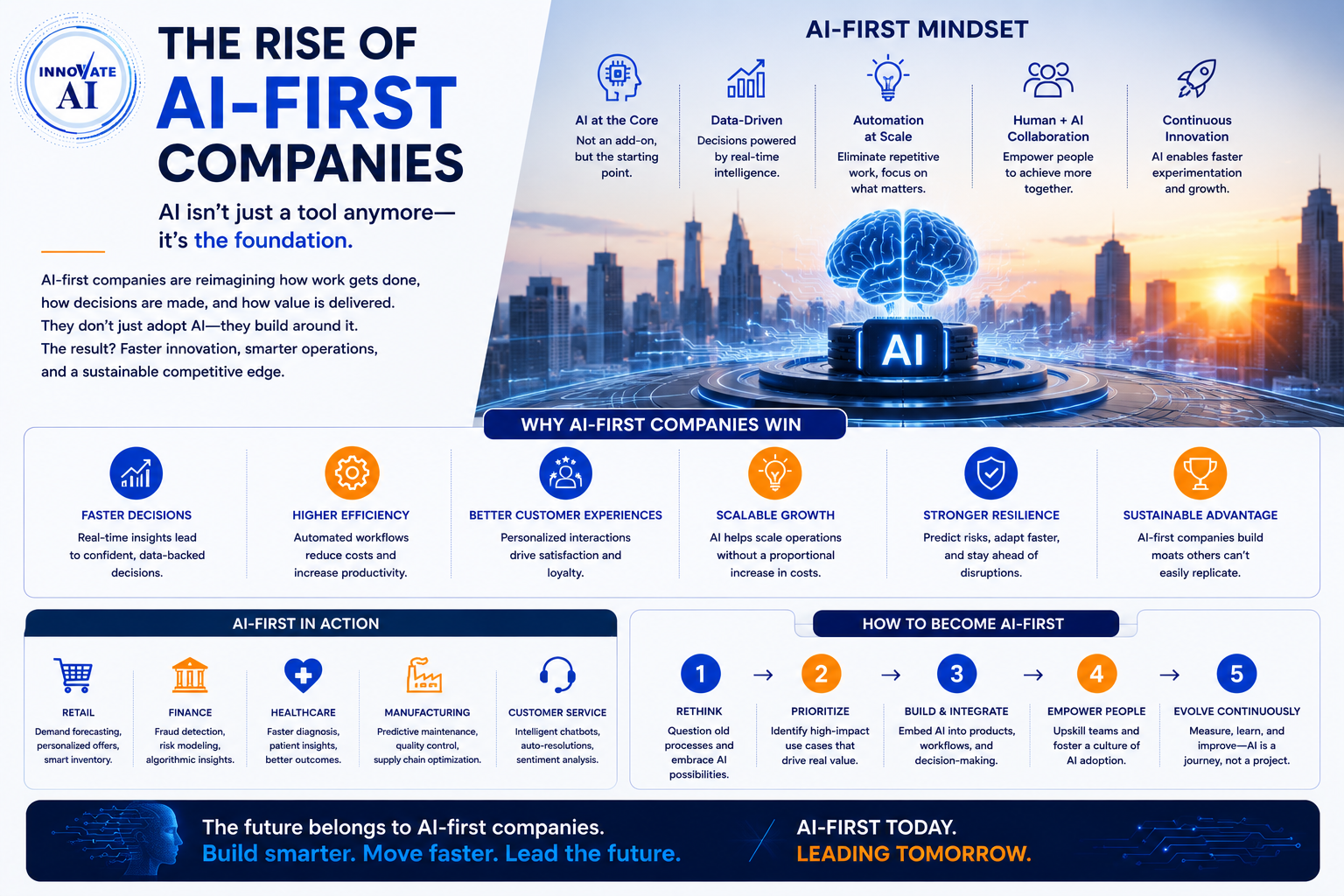
An AI-first company is not defined by the tools it buys. It is defined by how intelligence flows through the organization. AI-first companies do not add AI to existing processes—they redesign processes around AI capabilities .
The distinction is critical: AI-enabled organizations layer intelligence on top of legacy workflows. AI-first organizations rebuild workflows so that intelligence is the engine, not the accessory.
Step 3: What "AI-First" Actually Means
The Core Concept
An AI-first enterprise is one where artificial intelligence is embedded into the core operating model, not applied as an additional layer . It is designed—or redesigned—around AI-native business models as the primary mechanism for creating, delivering, and scaling value .
The Key Distinction
| AI-Enabled Organization | AI-First Organization |
|---|---|
| Adds AI to existing workflows | Redesigns workflows around AI |
| Uses AI as a tool | Treats AI as a collaborator |
| Incremental efficiency gains | Structural transformation |
| AI in isolated functions | AI across the entire enterprise |
| Periodic updates | Continuous learning and adaptation |
| Technology as an add-on | Technology as the foundation |
What the Data Shows
Despite more than $250 billion invested globally in AI in 2025, only 25% of companies say AI is having a transformative impact . Many organizations are still layering AI onto existing processes rather than redesigning how they operate around intelligence.
However, high performers behave differently. 34% of companies are scaling at least one industry-specific AI solution, and these companies are three times more likely to achieve enterprise-level returns . The difference is not just in technology investment—it is in operating model design.
Step 4: The Companies Leading the Shift
NVIDIA: AI-First Before It Was a Buzzword
NVIDIA was AI-first long before "AI-first" became a business buzzword. In 2014, CEO Jensen Huang articulated a vision that positioned deep learning and AI at the center of the company's future. Over the following decade, NVIDIA expanded far beyond graphics hardware to build an integrated AI computing platform spanning GPUs, CUDA, software frameworks, networking, systems, and a global developer ecosystem .
Today, most leading foundation models are trained and deployed on NVIDIA infrastructure. By repeatedly reinventing itself around the conviction that AI would become a foundational computing paradigm, NVIDIA positioned itself at the center of the modern AI ecosystem and became one of the most valuable companies in history .
Klarna: The AI-First Pivot and Pivot Back
Klarna is probably the most cited AI-first transformation case in fintech, and one of the most instructive for the right reasons. CEO Sebastian Siemiatkowski moved aggressively to embed AI across the organization. The productivity results are hard to argue with: 96% of employees now use AI tools daily, and revenue per employee has climbed by 152% since Q1 2023, approaching nearly $1 million per employee—a figure almost unheard of at Klarna's scale .
But Klarna's story is most valuable for what came next. After leaning heavily on an AI chatbot for customer support, one Siemiatkowski had publicly described as doing the work of 700 human agents, quality began to slip. Customer satisfaction fell, and by mid-2025, Siemiatkowski acknowledged that the approach had "gone too far." The company reversed course and began rebuilding its human customer service capacity, moving to a hybrid model where AI handles high-volume routine queries and human agents manage escalations and complex cases .
The outcome is arguably stronger than the original model: AI agent response times improved 82%, repeat issues dropped 25%, and cost per transaction fell 40%, all while customers regained access to human support when they need it most .
Duolingo: AI as Amplifier, Not Substitute
Duolingo declared itself AI-first in April 2025. CEO Luis von Ahn shared an all-hands memo outlining the company's ambition to use AI to scale content creation in ways that weren't humanly possible before. The strategy quickly delivered results: Duolingo launched 148 new AI-assisted courses and expanded features like personalized learning paths and conversational practice at a speed and scale that a human-only team couldn't have matched .
However, the announcement sparked public backlash over concerns about contractor displacement. Von Ahn later acknowledged the misstep directly, clarifying: "I do not see AI as replacing what our employees do—we are, in fact, continuing to hire at the same speed as before." In a subsequent interview, von Ahn affirmed AI makes his employees "four or five times" as productive, without a single layoff among full-time staff .
Primetrace: India's AI-First Consumer Startup
Primetrace, India's leading AI-first consumer startup, has scaled to a ₹550 crore Annual Revenue Run Rate with ₹200 crore EBITDA run rate as of February 2026, marking a rare profitability milestone in India's consumer app ecosystem. The company has delivered 50x revenue growth over three years, building its growth on real user needs, deep engagement, and strong retention .
Primetrace operates a "house of apps" model, identifying large consumer opportunities to build AI-native products around everyday use cases. Its product portfolio includes Kutumb (a community platform used by 2 lakh communities), Crafto AI (an AI-powered content creation app used by 200 million users), Tarot AI, Polo, and Sundar AI—each the most downloaded in its respective category, with cumulative downloads exceeding 350 million .
The company is powered by a proprietary AI infrastructure built specifically for the Indian market, using custom model training and proprietary datasets rather than relying on standard third-party solutions. Primetrace has built an intelligence layer that deeply understands the needs and preferences of Bharat users .
AI-First Service Firms
At the World Economic Forum Annual Meeting in Davos, Constellation Research named an elite set of organizations to its 2026 AI-First Service Firms list. These firms are "building at the speed of thought and operating with a massive span of control through decision automation." As Constellation Research's founder R "Ray" Wang noted: "AI-first consulting firms are proving that small, highly effective teams, augmented by digital labor, can outperform legacy behemoths in speed, efficiency, and revenue productivity" .
Step 5: The Five Building Blocks of an AI-First Operating Model
Based on research from the World Economic Forum and Kearney, five fundamental building blocks define how leading AI-first organizations design for structural transformation .
1. Intelligence Engine
The starting point is to identify the business's unique learning loops: repeated decisions, feedback, user signals, or operational data that can make an AI system better each time it runs .
AI-first organizations build self-reinforcing, data-driven flywheels that learn from every interaction, grow smarter with use, and connect performance back to business outcomes. They operate across three dimensions: speed through rapid hypothesis generation, scale through platform operationalization, and scope through the recomposition of proven capabilities into new ones. The result is a structural advantage that compounds: every cycle improves the next .
Example: Osmo shows this pattern with its olfactory-intelligence platform, trained on more than 3 billion molecules and 5 million fragrance classifications, enabling one platform to support many formulations rather than building per-product models .
2. Adaptive AI Technology Stack
For an intelligence engine to work, it cannot sit alongside the business as just another tool. It must connect into the systems where work already happens, while allowing the organization to adapt as models, vendors, and applications change .
AI-first organizations do this four ways:
-
Turn every interaction into a training signal, capturing overrides, feedback, and edge cases
-
Own the control layers, keeping orchestration and routing inside the enterprise so vendors can change without rebuilding workflows
-
Build model-agnostic portfolios, routing tasks by cost, accuracy, and risk
-
Make context dynamic, pulling live data rather than relying on static prompts
3. Operations Redesign
Eighty-four percent of companies have not redesigned jobs around AI capabilities, while AI high performers are nearly three times as likely as others to fundamentally redesign workflows .
AI-first organizations treat intelligence like capital: identifying the outcomes that matter most, then working backwards into the workflows where AI can create the greatest operating leverage. Workflows are digitized and connected to the intelligence engine end to end, codifying rules, matching models to tasks, building observability, and defining where human judgment is required. When this works, operations stop being static processes and become learning systems .
"Everyone is chasing the efficiency of AI; the bigger unlock is effectiveness." — Sarah Franklin, CEO of Lattice
4. Human-AI Teaming
The productivity upside is becoming clear: in a controlled field experiment, humans in human-AI teams achieved 73% greater productivity per worker .
AI-first organizations are responding by hiring and developing new talent profiles: design engineers, forward-deployment engineers, evaluation specialists, and AI safety engineers. The most effective AI-first teams are small, flat, and cross-functional—often fewer than 10 people and organized around one product, workflow, or customer problem .
"AI lets us redefine work around human skills rather than tasks. Once the routine work is handled, what's left and what we now build careers and measure success around is curiosity, judgment and the human skills machines don't have." — Sarah Franklin, CEO of Lattice
5. New Value Creation
As intelligence moves from internal operations into products, services, and customer experiences, every AI-first organization has to decide how it will create and capture value in the market. Intelligence can show up as a feature, the product itself, a workflow platform, invisible infrastructure, or a new interface entirely .
That choice matters because it shapes what customers pay for, where value accrues, and how feedback flows back into the intelligence engine. The market signal is clear: newly funded AI companies grew 70% between 2024 and 2025, but AI novelty alone is not enough .
Example: Contextere's voice-first factory-floor troubleshooting system replaced a 47-minute information-gathering process with near-instant context assembly, cutting troubleshooting time by up to 80%. The value was that intelligence was packaged into the way frontline workers already operate .
Step 6: The Frontier Firm Advantage
AI-first companies—often called "frontier firms"—are not defined by what they buy. They are defined by how intelligence flows through their organization .
Common Traits Across AI-First Companies
| Trait | Description |
|---|---|
| AI at the core | Not an add-on, but foundational |
| Data-driven culture | Decisions powered by data |
| Automation-first mindset | Reduce manual processes |
| Scalable systems | Growth without proportional cost increase |
| Continuous optimization | Systems improve over time |
Why They Scale Faster
Faster Decision-Making: Instead of waiting weeks for performance reports, AI systems adjust strategies in real time. Traditional companies rely on static reports and manual analysis, while AI-first companies use real-time data pipelines, predictive analytics, and automated decision systems .
Automation at Scale: Most businesses automate small tasks. AI-first companies automate entire workflows, decision chains, and cross-functional operations—including customer support (AI agents), data processing pipelines, and sales and marketing optimization .
Continuous Learning: AI systems improve over time through machine learning, feedback loops, and data accumulation. Unlike static processes, AI-driven systems get smarter with usage, adapt to new patterns, and improve accuracy automatically—creating a compounding advantage over competitors .
Step 7: The Indian Context
India's Consumer AI Opportunity
Primetrace's success reflects a broader trend in India. As Abhishek Kejriwal, Founder and CEO of Primetrace, noted: "India's consumer AI opportunity is massive and largely uncaptured. Over the next decade, AI will transform every digital touchpoint for a billion Bharat users—how they learn, earn, communicate, and make decisions" .
The "Bharat-First" AI Approach
Primetrace's strategy illustrates what AI-first looks like in the Indian market: building from the ground up for Indian users using proprietary datasets and custom model training rather than relying on standard third-party solutions. This creates an intelligence layer that deeply understands the needs and preferences of Bharat users .
Step 8: Implementation Roadmap
Phase 1: Assess and Design (Months 1-3)
| Action | Output |
|---|---|
| Identify your business's unique learning loops | Intelligence engine design |
| Map workflows and decision points | Operations redesign plan |
| Define where AI can create operating leverage | Prioritized use cases |
| Establish data foundation and governance | Data readiness baseline |
Phase 2: Build and Pilot (Months 4-6)
| Action | Output |
|---|---|
| Build adaptive technology stack | Modular infrastructure |
| Redesign one workflow around human-AI collaboration | Working prototype |
| Deploy intelligence engine for a bounded use case | Pilot results |
| Measure productivity and quality gains | Early ROI data |
Phase 3: Scale and Transform (Months 7-12)
| Action | Output |
|---|---|
| Expand to additional workflows | Scaled deployment |
| Develop new talent profiles | AI-literate workforce |
| Redesign business model around AI-native value creation | New value proposition |
| Establish continuous improvement cycles | Ongoing optimization |
Step 9: Frequently Asked Questions
Q1: What is the difference between AI-first and AI-native?
AI-first companies incorporate AI as a core capability that enhances products, services, and operations. AI-native organizations go further by structuring the entire business model and value proposition around AI .
Q2: Is being AI-first just about using more AI tools?
No. Being AI-first is about redesigning how work gets done, decisions are made, and value is created around intelligence. Using AI tools is a starting point, not the destination .
Q3: Do AI-first companies replace humans with AI?
No. The most effective AI-first companies treat AI as an amplifier, not a substitute. Klarna's course correction and Duolingo's clarification both show that human judgment, empathy, and relationship-building remain essential .
Q4: What is the biggest barrier to becoming AI-first?
Structural redesign. Most organizations attempt to layer AI onto existing processes rather than redesigning how they operate around intelligence. This is the reason only 25% of companies say AI is having a transformative impact .
Q5: How can Innovative AI Solutions help?
We help organizations design and implement AI-first operating models—from intelligence engine development and workflow redesign to human-AI collaboration frameworks and new value creation. Based in Delhi, serving clients across India.
Step 10: Final Tagline
"An AI-first company is not defined by the tools it buys. It is defined by how intelligence flows through the organization. The organizations that treat intelligence as infrastructure rather than a feature will compound an advantage that competitors cannot replicate. Those that redesign operations around human-AI collaboration will unlock capabilities that AI-enabled organizations cannot match."
Short version:
The rise of AI-first companies—how the next generation of enterprises is being built around intelligence. AI-first operating models, real-world examples (NVIDIA, Klarna, Duolingo, Primetrace), and implementation roadmap.
Hashtags:
#AIFirst #AIFirstEnterprise #AIStrategy #DigitalTransformation #AIOperatingModel #InnovativeAISolutions
Contact Us
Phone: +91 7464 099 059 / +91 96899 67356
Email: info@innovativeais.com
Address: Netaji Subhash Place, Pitampura, Delhi – 110034
Website: https://innovativeais.com
About the Author
Abhishek Kumar
Founder & CEO, Innovative AI Solutions
5+ years building AI systems for enterprises. Based in Delhi, serving clients across India.
Related services: to apply this in your business, explore our AI development services and RAG development.