The Big Question
What makes software "AI-native" instead of just "AI-powered"?
The distinction matters more than most vendors admit.
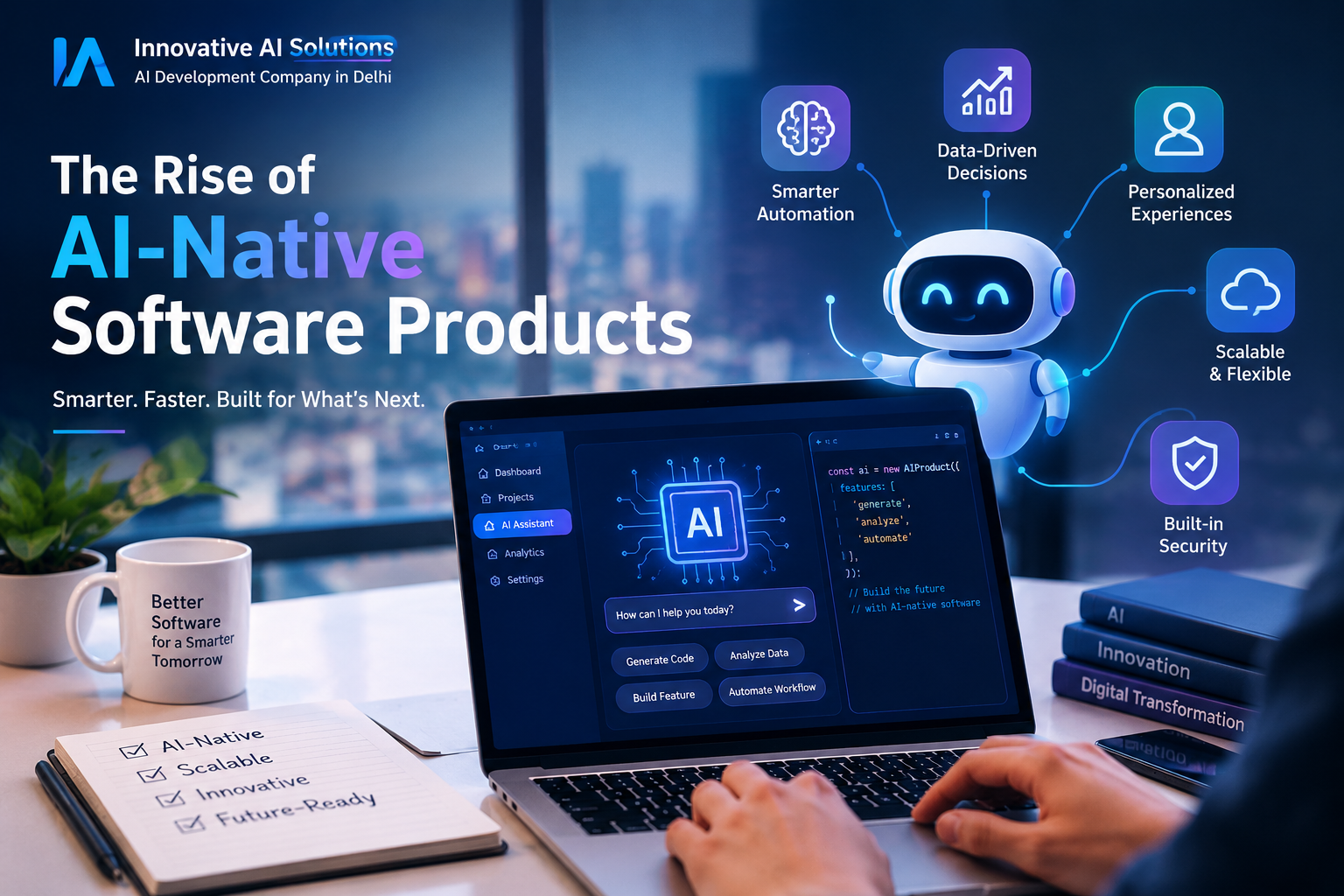
AI-powered software is traditional software with AI features added. An ERP with a copilot. A CRM with a chatbot. The architecture is the same. The data model is the same. The AI sits on top, calling APIs and generating text. It's useful, but it's incremental.
AI-native software is built with AI as the foundation. Agents aren't features they're the primary interface. Data isn't just stored servicesit's the substrate for reasoning. The architecture assumes that AI will make decisions, take actions, and coordinate work. Human oversight is designed in, but the system doesn't wait for instructions.
The difference shows up in outcomes. A copilot helps a salesperson draft an email. An AI-native sales agent qualifies leads, researches prospects, personalizes outreach, handles replies, and books meetings autonomously, within guardrails.
The market is responding. According to Gartner, agentic AI is set to disrupt enterprise software revenue models, with up to $234 billion of enterprise application spending exposed to agentic arbitrage between now and 2030 . Agentic systems deliver outcomes directly, bypassing traditional user experience-heavy applications and making the software invisible. This breaks the link between user growth and revenue growth for many enterprise software vendors .
This isn't a feature shift. It's an architectural one.
What Makes Software AI-Native
AI-native software has five defining characteristics.
Agents as the primary interface. In traditional software, users navigate screens and click buttons. In AI-native software, users express intent and agents execute. The interface becomes conversational, but more importantly, it becomes delegational. You tell the system what outcome you want, and it figures out how to achieve it.
Data as the substrate for reasoning. AI native software doesn't just store data. It uses data to reason. Every interaction, every transaction, every exception becomes training signal. The system gets smarter because it's used not because someone updated a rule.
Orchestration as the core capability. Multiple agents coordinate to complete workflows. A research agent gathers data. An analysis agent processes it. An action agent executes. A governance agent enforces policy. The orchestration layer is the product.
Governance built in, not bolted on. AI-native software assumes agents will make mistakes. It builds audit trails, escalation paths, confirmation gates, and rollback mechanisms from day one. Trust is an architectural requirement, not a compliance checkbox.
Outcomes as the unit of value. Traditional software is priced per seat. AI-native software is priced per outcome per resolved ticket, per qualified lead, per processed invoice. The vendor succeeds when the customer succeeds.
As one analysis puts it, AI-native means your product is built so that AI systems outside your company can reliably read, query, and act on it . AI enhanced makes you faster. AI-native makes you discoverable and interoperable.
The Architecture Shift
The technology stack for AI-native products is fundamentally different from traditional SaaS.
The old stack: Application → Database → API. Users interact with the application. The application reads and writes to the database. APIs connect to other systems.
The new stack: Intent layer → Orchestration layer → Agent layer → Tool layer → Data layer. Users express intent. The orchestration layer routes to agents. Agents use tools APIs, databases, external services to execute. The data layer provides context and memory.
ServiceNow's April 2026 announcement illustrates this shift at scale. The company moved its entire product portfolio to AI-native, declaring an end to the "sidecar AI era" where intelligence is bolted onto disconnected systems . Every ServiceNow product now includes AI, data connectivity, workflow execution, security, and governance built in not as a separate purchase .
At the heart of this transformation is the Context Engine, a system designed to provide real-time enterprise context for every AI-driven decision. Built on ServiceNow's data fabric and knowledge graph architecture, it connects relationships, policies, historical decisions, and operational signals, allowing AI agents to not just respond but also understand, decide, and act within business constraints .
The orchestration layer is where the competitive battle is being fought. As Metis Strategy describes it, organizations are building an enterprise orchestration layer that coordinates agents, systems, and humans while applying validation, policy, and auditability across workflows. Core platforms ERP, CRM, HCM still exist. But their native interfaces become less central to daily work. The orchestration layer handles coordination.
SAP's Autonomous Enterprise vision captures the same shift. Announced at SAPPHIRE 2026, the concept introduces AI-native applications with an agent-based engagement layer that operates across applications, workflows, and data domains. These agents reason over business intent, traverse processes, and execute actions using governed enterprise data .
The results in production are measurable. SAP reports 83% reduction in invoice cycle time, greater than 99% billing accuracy, and 98% reduction in time to reconcile ICT postings from autonomous system implementations .
The Pricing Revolution
AI-native software is forcing a fundamental rethink of how software is priced.
Seat-based pricing breaks down. If agents do the work, how many "seats" do you need? If one agent handles the workload of ten humans, does the customer pay for ten seats or one? The model doesn't fit.
Consumption pricing is volatile. Per-token or per-action pricing aligns cost with usage. But it creates unpredictable bills. A runaway agent can rack up costs quickly.
Outcome-based pricing is emerging. Gartner predicts that by 2030, $234 billion of enterprise application spending will be exposed to agentic arbitrage where AI agents complete tasks across multiple systems, reducing the need for users to interact with traditional software interfaces . This breaks the link between user growth and revenue growth.
The shift from selling access to selling work is fundamental. According to Kyle Poyar's 2026 Growth Unhinged monetization survey of more than 230 SaaS and AI companies, hybrid pricing has emerged as the leading model, rising from 25% to 37% adoption in just twelve months . Investors increasingly favor usage-based, outcome-based, and hybrid pricing structures over traditional seat-based approaches.
The reason is simple. Per-seat pricing was designed for a world in which humans were the primary unit of productivity. AI agents break that assumption. As intelligent systems perform more work, customer value can increase even as the number of users declines. In this environment, pricing must evolve to reflect output, usage, and outcomes rather than access alone .
Viking Growth's analysis frames it as a progression: pricing moves from users, to activity, to outputs, and finally to outcomes such as tasks completed or time saved. The closer pricing gets to measurable business results, the stronger the alignment with customer value and the greater the revenue potential often increasing from capturing less than 10% of value to 10x or more .
The strategic implication is significant. AI-native startups are not merely changing price cards; they are redefining the unit of value itself. The traditional SaaS question was: "How many users need access?" The AI-native question is: "What work is being completed, what value is being created, and how much risk is the vendor willing to assume?"
What Changes for Builders
If you're building software in 2026, the assumptions are different.
Assume agents will make mistakes. Build fallback mechanisms, escalation paths, and human in the loop workflows from day one. Gartner warns that overestimated reliability is a leading cause of agentic AI failure. Removing human oversight causes context loss, goal drift, and compounding mistakes.
Assume data will be messy. Most enterprises have incomplete, inconsistent data. AI-native products must handle this reality cleaning, enriching, and reconciling data as part of the workflow.
Assume governance will be required. Every agent action should be logged. Permissions should be enforced. Audit trails should be immutable. ServiceNow's AI Control Tower and App Engine Management Center govern every custom app and AI agent, ensuring they inherit the same identity framework .
Assume models will change. The best model today won't be the best model tomorrow. Build for model portability. Don't hard-code dependencies. Zoho's Zia Chat is model-agnostic, letting organizations choose their preferred AI models, and extensible to external systems through MCP integrations .
Assume competition will be intense. The barrier to building AI-native software is lower than building traditional software. Frameworks have matured. APIs are commoditized. The differentiator is domain depth and execution quality.
What Changes for Buyers
If you're buying software in 2026, the evaluation criteria are different.
Ask about orchestration, not features. How does the system coordinate multiple agents? What happens when an agent fails? How is context preserved across workflows?
Ask about governance, not just capabilities. How are actions logged? How are permissions enforced? How do humans stay in control?
Ask about pricing, not just cost. Is it seat-based, consumption-based, or outcome-based? What happens if usage spikes? What's the cost ceiling?
Ask about data, not just integration. How does the system handle messy data? How does it learn from usage? Who owns the data and the models?
Ask about exit, not just onboarding. Can you export your data? Can you switch models? Can you take your orchestration logic elsewhere? Vendor lock-in is a strategic risk.
Frequently Asked Questions
Q1: What is AI-native software?
AI-native software is built with AI as the foundation, not as an add-on feature. Agents are the primary interface, data is the substrate for reasoning, orchestration is the core capability, and outcomes are the unit of value. It's fundamentally different from traditional software with AI features bolted on .
Q2: How is AI-native different from AI-powered?
AI-powered software is traditional software with AI features added. The architecture, data model, and pricing remain the same. AI-native software assumes AI will make decisions, take actions, and coordinate work. The architecture is built for autonomy, not just assistance .
Q3: What is the orchestration layer?
The orchestration layer coordinates agents, systems, and humans while applying validation, policy, and auditability. It routes tasks to the right agent, manages context, handles failures, and enforces governance. It's becoming the primary control point for automation.
Q4: Why is pricing changing for AI-native software?
Seat-based pricing breaks down when agents do the work. Gartner predicts $234 billion of enterprise application spending will be exposed to agentic arbitrage by 2030 . The shift is from selling access to selling work. Hybrid pricing grew from 25% to 37% adoption in just twelve months .
Q5: What are the biggest risks in AI-native software?
Overestimated reliability (removing human oversight too early), weak data foundations (garbage in, garbage out), agent sprawl (too many unmanaged agents), and unmanaged token costs (runaway API consumption). Governance and observability are essential safeguards.
Q6: How do I evaluate AI-native software?
Ask about orchestration (how agents coordinate), governance (how actions are logged and controlled), pricing (what model and what ceiling), data (how messy data is handled), and exit (can you take your data and logic elsewhere).
Q7: What is Gartner's prediction for AI-native applications?
By 2030, 40% of enterprise application portfolios will include custom applications built with AI-native platforms up from just 2% in 2025. Gartner predicts the SaaS market will undergo a "metamorphosis" rather than an apocalypse .
Q8: What is ServiceNow's Context Engine?
A system designed to provide real-time enterprise context for every AI driven decision. Built on ServiceNow's data fabric and knowledge graph architecture, it connects relationships, policies, historical decisions, and operational signals, allowing AI agents to understand, decide, and act within business constraints .
Q9: What's the role of governance in AI-native software?
Governance is the foundation that allows scale. Every agent action should be logged. Permissions should be enforced. Audit trails should be immutable. Trust is an architectural requirement, not a compliance checkbox. ServiceNow's AI Control Tower governs every custom app and AI agent .
Q10: How do I start building AI-native software?
Start with one workflow where agents can deliver measurable value. Build the orchestration and governance layers first. Prove value. Then expand. Domain-specific agents deliver the highest ROI.
Frequently Asked Questions (Continued)
Q11: Will AI-native software replace SaaS?
Not entirely. SaaS becomes infrastructure a baseline capability. Gartner describes this as a "metamorphosis" rather than an apocalypse: SaaS will not be destroyed; it will emerge in a different form . The value migrates to the intelligence layer: domain knowledge, workflow logic, and proprietary data.
Q12: What is the difference between AI-native and agentic?
AI-native describes the architecture built with AI as the foundation. Agentic describes the capability systems that plan, execute, and adapt. AI-native software is typically agentic, but agentic capabilities can be added to traditional software.
Q13: How do I prevent vendor lock-in with AI-native software?
Own your data. Own your orchestration logic. Use open standards. Ensure APIs are documented and portable. Ask about exit plans before you sign. Zoho's Zia Chat is model-agnostic and extensible through MCP integrations, respecting existing enterprise permissions .
Q14: What's the biggest mistake buyers make?
Evaluating AI-native software like traditional software. Asking about features instead of orchestration. Asking about capabilities instead of governance. Asking about cost instead of pricing model. The evaluation criteria are different.
Q15: Why should I choose Innovative AI Solutions?
Because we build AI-native solutions, not AI-bolted on tools. Because we focus on orchestration, governance, and measurable outcomes. Because your code is always yours
Contact Us
Phone:
+91 7464 099 059
+91 9689967356
Email:
info@innovativeais.com
Address:
9th Floor, Pearls Best Heights-I,
Head Office: 904, Netaji Subhash Place,
Delhi – 110034