The Big Question
What happens when your AI service reports 99.9% uptime, zero errors, and sub-second latency yet users are quietly losing trust because the answers it produces are subtly wrong? When a model that performed perfectly in evaluation begins hallucinating in production because the data distribution shifted? When you cannot answer the question every auditor, regulator, and executive will eventually ask: Why did the system produce this output?
This is the gap AI observability exists to close. Traditional monitoring was built for deterministic systems. AI systems are probabilistic they infer rather than execute, and they can be confidently, silently wrong while every infrastructure metric stays green.
What Is AI Observability?
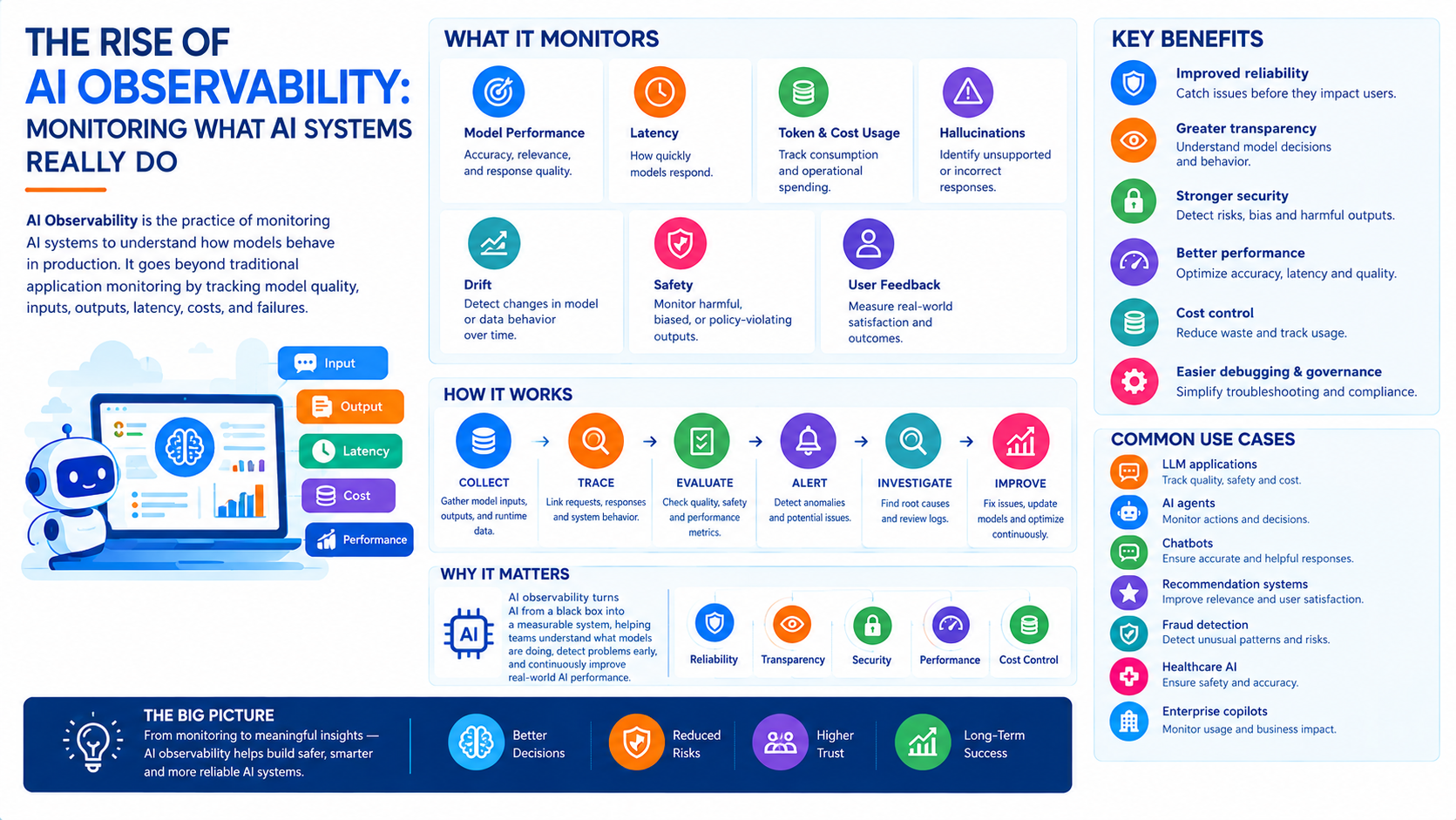
AI observability is the practice of instrumenting AI systems so that their internal behavior inputs, reasoning, tool calls, retrieval results, outputs, and outcomes can be understood, monitored, and improved in production.
It extends conventional observability (metrics, logs, traces) with dimensions that only exist for AI:
-
Semantic quality: Is the answer grounded, relevant, and coherent?
-
Reasoning paths: What steps, tools, and retrievals led to this output?
-
Model behavior: Has confidence calibration, refusal rate, or output distribution shifted?
-
Cost and latency by request type: Which queries are expensive, and why?
The core principle is simple: you cannot operate what you cannot observe, and for AI, uptime is the least interesting thing to observe.
Why Traditional Monitoring Falls Short
Traditional monitoring checks whether services are up or down. It does not tell you whether your AI system is reasoning correctly.
The silent failure problem: An LLM can degrade without any error being thrown. Latency stays normal. Throughput stays normal. Error rates stay at zero. But answer quality quietly falls because an upstream data source changed, because a retrieval index went stale, or because a new model version subtly altered tone and accuracy.
Uptime is not quality: A system that returns a confidently wrong answer in 200 milliseconds is, from a business perspective, failing while every infrastructure dashboard reports success.
Hallucinations don't throw exceptions: In traditional software, bugs surface as errors. In AI, the most damaging failures surface as fluent, plausible, incorrect text.
This is why AI observability must monitor behavior, not just availability.
The Pillars of AI Observability
A production-grade AI observability practice tracks several categories of signals simultaneously.
| Category | What It Tracks |
|---|---|
| Data and Logic Drift | Input distribution changes, output pattern shifts, stale retrieval sources |
| Model Confidence | Confidence score trends, confidence inversion (high confidence when wrong) |
| Semantic Quality | Answer relevance, groundedness, reasoning step accuracy, tool-call correctness |
| Operational Health | Token usage, time to first token, tokens per second, routing latency |
| Ethical and Regulatory | Bias detection, compliance flags, policy violations, PII leakage |
Each category answers a different question. Operational health tells you if the system is running. Semantic quality tells you if it is working.
The Three Layers of AI Observability
Layer 1: Infrastructure Observability
The foundation. Compute, memory, network, GPU utilization, queue depth, and API rate limits. This layer is largely inherited from existing observability tooling.
Layer 2: Model and Pipeline Observability
This layer tracks the AI-specific mechanics: prompt versions, model versions, token consumption, latency distributions, retry rates, and cache hit ratios. It answers: What exactly is running, and at what cost?
Layer 3: Behavioral and Semantic Observability
The layer most organizations are missing. It evaluates the meaning of outputs: Is this answer grounded in the retrieved context? Does this recommendation contradict policy? Has the refusal rate changed? Is the system producing more verbose but less accurate responses than last month?
Without this layer, you have no way to detect the most consequential AI failures.
Traces for AI: Beyond Request Logging
Modern AI observability borrows the concept of distributed tracing and adapts it to reasoning workflows.
An AI trace might capture:
-
The incoming request and its classification
-
The prompt template and version used
-
Retrieved documents and their relevance scores
-
Each tool call and its result
-
Each reasoning step in a multi-step agent
-
The final output and its evaluation scores
-
The user's subsequent action (accepted, edited, rejected)
This trace becomes the artifact that lets teams debug failures, audit decisions, and improve prompts and retrieval systems with evidence rather than intuition.
The key principle: Track failures in relation to each other. A stalled queue, a slow model response, and a dropped retrieval may each look minor individually together, they indicate a developing failure.
Evaluation as a Continuous Practice
Observability and evaluation are two halves of the same discipline. Observability collects the data; evaluation interprets it.
Offline evaluation: Run standardized test sets before every deployment regression suites for accuracy, safety, and refusal behavior.
Online evaluation: Score a sample of live production traffic continuously using automated evaluators (including LLM-as-a-judge approaches) to catch drift that test suites cannot anticipate.
Human review: Route a small, stratified sample of outputs to human reviewers to calibrate automated evaluators and catch categories of failure no rubric anticipated.
This three-part loop offline, online, human is what transforms observability from a dashboard into a control system.
Behavioral Monitoring in Practice
Behavioral monitoring does not rely on individual alerts. AI failures usually manifest as patterns across multiple signals. The approach is to track:
-
Baselines: Establish normal behavior for your specific use case across the pillars above.
-
Delayed metrics: Beyond time-series monitoring, use delayed, quality-oriented metrics (accepted output ratio, edit distance, downstream success).
-
Correlations: Link upstream errors to downstream latency and quality degradation.
-
Confidence inversion: Flag cases where the system is most confident and most wrong.
With baselines in place, silent degradation becomes visible before users report problems or worse, before they quietly stop using the system.
The Governance Connection
Observability is the technical foundation for AI governance. Every regulatory framework from the EU AI Act to internal risk policies requires the ability to explain and audit AI behavior.
Observability provides:
-
Traceability: What data, model version, and reasoning produced this output?
-
Auditability: Immutable logs of decisions and overrides.
-
Accountability: Named owners for each system component and a clear escalation path.
Without observability, governance becomes documentation. With it, governance becomes enforceable.
Implementation Roadmap
Phase 1: Foundation (Weeks 1-4)
-
Instrument existing pipelines with structured logging and tracing.
-
Define baselines across infrastructure, cost, and semantic quality.
-
Select evaluation criteria relevant to your use case groundedness, relevance, safety, tone.
Phase 2: Build Behavioral Observability (Weeks 5-8)
-
Deploy automated evaluators on a sample of production traffic.
-
Implement confidence and drift tracking across model versions and data sources.
-
Build dashboards that correlate cost, latency, and quality not just infrastructure health.
Phase 3: Operationalize and Govern (Weeks 9-12+)
-
Integrate observability into CI/CD so evaluations gate deployments.
-
Establish a human review loop to calibrate automated scoring.
-
Connect observability to governance with traceable, auditable decision records.
Frequently Asked Questions
Q1: What is AI observability?
AI observability is the practice of instrumenting AI systems so their behavior inputs, reasoning, retrieval, outputs, and outcomes—can be understood, monitored, and improved in production. It extends traditional observability with semantic and behavioral dimensions.
Q2: How is it different from traditional monitoring?
Traditional monitoring tracks availability and performance. AI observability additionally tracks semantic quality, reasoning correctness, and behavioral drift because AI systems can be silently and confidently wrong while all infrastructure metrics remain green.
Q3: What should I monitor first?
Start with operational health and cost (token usage, latency, routing), then layer in semantic quality evaluation on a sample of production traffic. Baselines come before alerts.
Q4: Can AI observability help with compliance?
Yes. Observability provides the traceability and auditability that governance frameworks require what data, model version, and reasoning produced each output, and who is accountable.
Q5: How can Innovative AI Solutions help?
We help organizations design, build, and operationalize AI observability from instrumentation and evaluation design to behavioral monitoring and governance integration. Based in Delhi, serving clients across India.
Why Delhi is a Great Hub for AI Observability Innovation
Delhi is emerging as a hub for enterprise AI adoption, backed by a thriving IT services ecosystem. As Indian enterprises move AI from pilots into production, observability becomes essential for maintaining trust, controlling cost, and meeting regulatory expectations making the region a natural center for building these capabilities.
What We Offer at Innovative AI Solutions
-
Observability Strategy: We help you define what to monitor and how to measure AI quality.
-
Instrumentation and Tracing: We implement structured logging, tracing, and evaluation pipelines.
-
Behavioral Monitoring: We establish baselines and drift detection for production AI.
-
Evaluation Design: We build offline, online, and human review loops.
-
Governance Integration: We connect observability to audit, risk, and compliance workflows.
Final Thought
The shift is clear: from monitoring whether AI systems are running to monitoring whether they are working. As AI becomes embedded in consequential decisions, observability is no longer optional it is the mechanism by which trust is earned, maintained, and proven. The organizations that invest in AI observability now will be the ones that can deploy AI with confidence.
Contact Us:
Phone: +91 7464 099 059 / +91 9689967356
Email: info@innovativeais.com
Address: Netaji Subhash Place, Pitampura, Delhi – 110034
Website: https://innovativeais.com
About the Author
Abhishek Kumar
Founder & CEO, Innovative AI Solutions
5+ years building AI, cloud, and enterprise systems. Based in Delhi, serving clients across India.